Britain sited 2 nuclear power plants on eroding shingle beach
Miss Sian Farrell | October 2, 2016 I have been following the various stories related to nuclear power and its problems ever since the Chernobyl event in 1986. I thought I knew about pretty much all of them. But then I found out that Britain has the largest shingle beach in Europe. It’s over 8 square miles in size and because of the fast moving tides and river currents, around 90,000 cubic meters of shingle are washed from its western shore to its eastern shore each year. Its lighthouse is regularly moved because of this problem.
This is the same shingle beach (western side) on which our government chose to site, not one, but TWO nuclear power plants. Contractors move 30,000 tons of shingle (less than a third of what is lost), back in front of Dungeness each year because of this erosion.
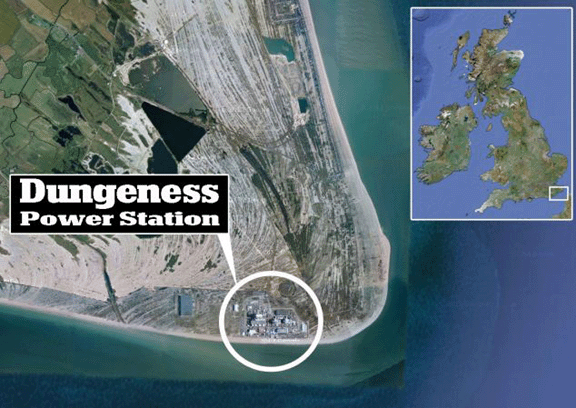
This Is for me, a shocking and disturbing revelation!
Nuclear power station has been leaking radioactive waste ‘for months’, says Environment Agency “……The Evironment Agency confirmed that levels of tritium were normal elsewhere in Dungeness B’s surroundings and added that the power station is allowed to discharge tritium in the environment under permit……. http://www.dailymail.co.uk/news/article-2311217/Nuclear-power-station-leaking-radioactive-waste-months-says-Environment-Agency.html#ixzz4M0Kjsu6A
China’s growing nuclear waste problem
waste levels are growing rapidly. The government-backed China Nuclear Energy Association said that by the end of 2020, the nation’s nuclear plants will have to get rid of more than 1,000 tonnes of spent fuel each year……
The Tianwan facility as well as the Daya Bay nuclear plant complex in the southern city of Shenzhen have nearly run out of room for on-site waste storage, said Mr Chai Guohan, chief engineer at the Ministry of Environmental Protection’s Nuclear and Radiation Safety Centre.
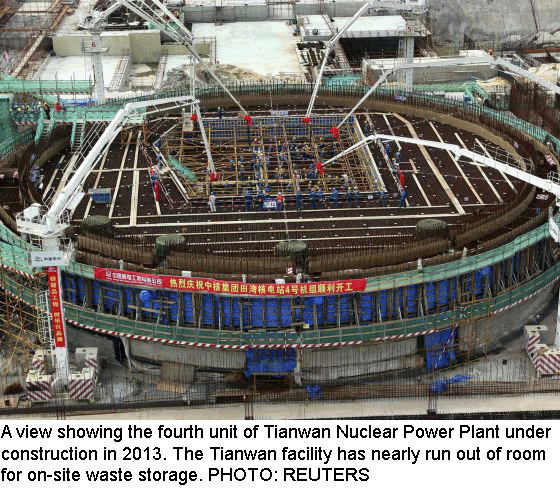
 Spent-fuel issues cloud China’s nuclear expansion Questions raised over country’s ability to handle radioactive waste as storage space runs out, Today, BEIJING , 2 Oct 16— A Chinese nuclear power plant construction programme has been on a fast track ever since the government’s four-year moratorium on building such facilities was lifted this year.
Now, five years after Japan’s 2011 Fukushima disaster led to the moratorium, China is fully engaged in an expansion that is scheduled to add 24 new reactor units to the nation’s existing 32.
But nuclear plant construction projects have stirred controversy in China, particularly due to questions surrounding incomplete plans for handling a dangerous by-product of nuclear energy — radioactive waste.
In August, hundreds of people took to the streets to protest a government plan to build a nuclear waste recycling facility in the Jiangsu province city of Lianyungang. The protest prompted the local authorities to suspend work on a feasibility study that would have moved the project forward.
Indeed, public scepticism about nuclear power in China has persisted ever since an earthquake-induced tsunami destroyed the Fukushima plant.
Some analysts have linked that scepticism to a lack of transparency among government agencies that oversee nuclear power plants and the energy companies that build them.
In the wake of the Lianyungang protests, for example, neither the central nor local government authorities have said when work on the feasibility study might resume, nor whether officials might consider building the plant elsewhere.
The proposed Lianyungang recycling plant would be built by state-owned China National Nuclear Corporation and French energy company Areva under an agreement they signed in 2013…….
China plans to open a permanent storage facility for high-level radioactive waste, perhaps in the remote west, by 2020. Waste reprocessing and recycling, which have the potential for squeezing energy out of spent fuel, are also part of the equation.
Radioactive waste generated by reactors at existing nuclear plants across the country is currently being stored at each plant site.
Moreover, medium and low-level wastes are currently stored at sites in Gansu province and Guangdong province. Plans call for opening five additional facilities for this kind of waste by 2020……
Medium and low-level waste can be safely stored at near-ground-level storage facilities, according to Mr Zhao Chengkun, a former director of the National Nuclear Safety Administration.
But waste levels are growing rapidly. The government-backed China Nuclear Energy Association said that by the end of 2020, the nation’s nuclear plants will have to get rid of more than 1,000 tonnes of spent fuel each year……
The controversial plan for a Lianyungang recycling centre was drafted due to rising demand for a new place to put waste from the Tianwan nuclear complex near the city. The complex includes two operating reactors and two that are now under construction.
The Tianwan facility as well as the Daya Bay nuclear plant complex in the southern city of Shenzhen have nearly run out of room for on-site waste storage, said Mr Chai Guohan, chief engineer at the Ministry of Environmental Protection’s Nuclear and Radiation Safety Centre.
The proposed Lianyungang facility, with a capacity for treating 800 tonnes of spent fuel every year, was originally slated to be up and running before 2030.
China has for years been looking at reprocessing spent fuel using a system commonly used in other countries called “plutonium uranium redox extraction” (Purex). The Lianyungang plant would use this system.
Dr Ma Yuefeng, a researcher from the China Institute for Radiation Protection, said that although Purex can reduce the amount of nuclear waste on hand, public health can be threatened by chemical pollutants that are by-products of the process……..http://www.todayonline.com/chinaindia/china/spent-fuel-issues-cloud-chinas-nuclear-expansion
Wildfire danger to stranded radioactive wastes
 Feds Leave Radioactive Waste Stranded In Wildfire Danger
Zone http://www.mintpressnews.com/feds-leave-radioactive-waste-stranded-wildfire-danger-zone/191781/ DOE announces it will not meet deadline for removal of radioactive containers held above-ground at northern New Mexico nuclear weapons lab, By The Department of Energy admitted Friday it will not meet a deadline to remove dangerous radioactive waste, currently stranded above-ground in unsafe conditions at a New Mexico nuclear weapons laboratory, before wildfire season hits.
At least 3,706 cubic meters of radioactive waste are being stored at the Los Alamos National Laboratory complex after the Waste Isolation Pilot Plant, an underground nuclear waste dump in southeastern New Mexico, was shut down indefinitely in February due to an airborne radiation leak.
Officials in New Mexico have warned that the waste at Los Alamos could be within the reach of wildfires and must be transferred elsewhere by the end of June. According to the Associated Press, “The agreement for removal of the waste by June 30 was reached after a massive wildfire lapped at the edge of lab property three years ago, raising concerns about the thousands of barrels of waste that were being stored outside.”
“The waste at Los Alamos is trapped with no place to go,” Arnie Gundersen, chief engineer and nuclear safety advocate at Fairewinds Associates, told Common Dreams.
The Los Alamos radioactive materials are “transuranic waste” that is described by the DOE as “clothing, tools, rags, debris, soil and other items contaminated with radioactive material generated during decades of nuclear research and weapons development.”
Concerns have been raised about the safety of these barrels after it was posited that changes in methods of packaging at Los Alamos, from use of inorganic to organic cat litter to absorb moisture, may be responsible for a chemical reaction with nitrate salts and set off the “heat event” behind the WIPP leak. Officials are still trying to determine the cause of the accident and are investigating the potential danger of the more than 500 nuclear waste containers originating from Los Alamos that were packed with organic cat litter.
The DOE had been sending some Los Alamos radioactive waste to a Texas facility for temporary storage until WIPP is functional. Upon discovering that Los Alamos shipments may be dangerous, the DOE halted all shipments, citing public safety.
But Gundersen warns that these barrels of waste could pose a threat in Texas and Los Alamos, where they are being stored above-ground. “It is worse in the summer, because it is hotter in the summer, and the reactions become less stable,” he said.
In a statement (pdf) released Friday, the New Mexico Environment Department said it is “disappointed, but not surprised” that the DOE will not meet its deadline to remove the waste.
Meanwhile, it is still not clear when WIPP will reopen. The facility, which was never supposed to leak, is the bedrock of the U.S. government’s current approach to dispose of military-generated plutonium-contaminated transuranic waste from decades of nuclear bomb production and testing.
Critics have warned that WIPP’s failure raises serious questions about the overall federal strategy for disposing of nuclear waste.
The scandalous human toll of mining for lithium from cobalt – investigative journalism
 We who advocate renewable energy systems, and new technologies need to be aware of the dangers of the mining and processing of rare metals such as lithium. The history of this industry is scandalous. AFP: China pays price for world’s rare earths addiction. But today, the exploitation of lithium miners continues.
 THE COBALT PIPELINE Tracing the path from deadly hand-dug mines in Congo to consumers’ phones
  and laptops WP, by Todd C. Frankel September 30, 2016
The sun was rising over one of the richest mineral deposits on Earth, in one of the poorest countries, as Sidiki Mayamba got ready for work.
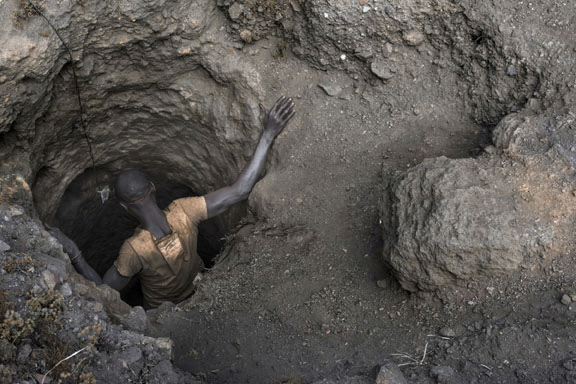
Mayamba is a cobalt miner. ….
This remote landscape in southern Africa lies at the heart of the world’s mad scramble for cheap cobalt, a mineral essential to the rechargeable lithium-ion batteries that power smartphones, laptops and electric vehicles made by companies such as Apple, Samsung and major automakers.
But Mayamba, 35, knew nothing about his role in this sprawling global supply chain. He grabbed his metal shovel and broken-headed hammer from a corner of the room he shares with his wife and child. He pulled on a dust-stained jacket. A proud man, he likes to wear a button-down shirt even to mine. And he planned to mine by hand all day and through the night. He would nap in the underground tunnels. No industrial tools. Not even a hard hat. The risk of a cave-in is constant……
The world’s soaring demand for cobalt is at times met by workers, including children, who labor in harsh and dangerous conditions. An estimated 100,000 cobalt miners in Congo use hand tools to dig hundreds of feet underground with little oversight and few safety measures, according to workers, government officials and evidence found by The Washington Post during visits to remote mines. Deaths and injuries are common. And the mining activity exposes local communities to levels of toxic metals that appear to be linked to ailments that include breathing problems and birth defects, health officials say.
The Post traced this cobalt pipeline and, for the first time, showed how cobalt mined in these harsh conditions ends up in popular consumer products. It moves from small-scale Congolese mines to a single Chinese company — Congo DongFang International Mining, part of one of the world’s biggest cobalt producers, Zhejiang Huayou Cobalt — that for years has supplied some of the world’s largest battery makers. They, in turn, have produced the batteries found inside products such as Apple’s iPhones — a finding that calls into question corporate assertions that they are capable of monitoring their supply chains for human rights abuses or child labor.
Apple, in response to questions from The Post, acknowledged that this cobalt has made its way into its batteries…….
Few companies regularly track where their cobalt comes from. Following the path from mine to finished product is difficult but possible, The Post discovered. Armed guards block access to many of Congo’s mines. The cobalt then passes through several companies and travels thousands of miles.
Yet 60 percent of the world’s cobalt originates in Congo — a chaotic country rife with corruption and a long history of foreign exploitation of its natural resources…..
In the past year, a Dutch advocacy group called the Center for Research on Multinational Corporations, known as SOMO, and Amnesty International have put out reports alleging improprieties including forced relocations of villages and water pollution. Amnesty’s report, which accused Congo DongFang of buying materials mined by children, prompted a fresh wave of companies to promise that their cobalt connections were being vetted.
But the problems remained starkly evident when Post journalists visited mining operations in Congo this summer. https://www.washingtonpost.com/graphics/business/batteries/congo-cobalt-mining-for-lithium-ion-battery/
European Union to ratify Paris climate agreement

 EU ministers are expected to ratify the agreement, along with India and Cananda, next week meaning enough countries will have signed up for the deal to come into legal force, Guardian, Arthur Neslen, 1 Oct 16, EU ministers have agreed to ratify the landmark Paris climate agreement at an extraordinary summit in Brussels on Friday, all but guaranteeing that it will pass a legal threshold to take effect next week and sparing the bloc’s blushes in the process.
The European Parliament is expected to rubber stamp the decision in Strasbourg next Tuesday, allowing the EU to sign off on it as soon as the following day.
The EU’s president, Jean-Claude Juncker said: “Today, the EU’s member states decided to make history together and bring closer the entry into force of the first ever universally binding climate change agreement. We must and we can hand over to future generations a world that is more stable, a healthier planet, fairer societies and more prosperous economies.
“This is not a dream. This is a reality and it is within our reach. Today we are closer to it.”
The Paris pact to limit global warming to “well below 2C” will enter into force 30 days after 55 countries, accounting for 55% of the planet’s emissions hand their ratification papers to the offices of Ban Ki-Moon in New York.
India is expected to ratify the deal over the weekend, with Canada next week also likely to join the 61 countries that have so far signed up. The EU’s added weight should then tip the treaty into effect……..
One spectre haunting the summit though was the prospect of a victory for the climate-sceptic Republican candidate, Donald Trump, in US elections later this year.
EU sources say that the bloc would aim to stick to its climate commitments if that happened. One told the Guardian: “It can’t be indefinite but our initial reaction would be to try to lead others in anticipation that this was a temporary aberration in US politics and that common sense would prevail, whether in four years time or sooner.”
Europe’s own intentions have been clouded for some by resistance from coal-dependant Poland to any review of the EU’s existing climate pledge in 2018. In the Paris deal, this is seen as an opportunity to scale up ambitions towards a 1.5C target.
The EU has not proposed any new climate actions in line with a 1.5C goal, but new legislation on renewables and energy efficiency is expected later this year, to help meet Europe’s existing climate pledges……..
everal EU countries have formaly signed off on the Paris deal to date, including France, Germany, Hungary, Slovakia, Portugal and Austria.
Theresa May has promised to ratify the agreement by the end of this year. https://www.theguardian.com/environment/2016/sep/30/eu-gives-green-light-to-activate-paris-climate-deal
In northern France thousands protest against nuclear power

 Thousands protest against nuclear power in northern France http://en.rfi.fr/environment/20161001-thousands-protest-against-nuclear-power-northern-france Several thousand people demonstrated against the construction of nuclear reactors near the northern French town of Flamanville on Saturday. British opponents of the planned reactor at Hinkley Point joined European opponents of nuclear power.
The protesters gathered at Siouville-Hague, between a nuclear waste treatement centre at La Hague and the site of a third nuclear reactor at Flamanville, which is currently under construction.
The first protest against the plan took place 10 years ago at Cherbourg on the Channel coast.
French power company EDF, which is also building the Hinkley Point reactor, says it should be ready to operate in the third quarter of 2018, six years late.
Its cost has trebled to 10.5 billion euros after a number of problems.
French Green MP and possible presidential candidate Cécile Duflot joined the demonstration, as did a number of British anti-nuclear activists.
Opponents claim that nuclear power is dangerous and expensive. The sector employs about 10,000 people in Normandy.
Tribulations of the nuclear industry, as serious safety flaws found in EDF’s nuclear reactors
As for For Hinkley Point C, it now appears inevitable that the Flamanville reactor will not be completed by its target date of the end of 2020, indeed it may very well never be completed at all. Under the terms of agreement for the plant’s construction accepted by the European Commission, this would render the UK government unable to extend promised credit guarantees to HPC’s financial backers.

for EDF, Areva, their shareholders and the entire French nuclear industry, the end really could be nigh.
 France’s Nuclear Power Stations ‘At Risk of Catastrophic
Failure’ http://www.globalresearch.ca/frances-nuclear-power-stations-at-risk-of- catastrophic-failure/5548593 Sizewell B and 27 Other EDF Nuclear Plants By Oliver Tickell Global Research, October 01, 2016 The Ecologist 29 September 2016 A new review of the safety of France’s nuclear power stations has found that at least 18 of EDF’s units are are ”operating at risk of major accident due to carbon anomalies.”
U.N. atomic agency chief says Iran sticking to nuclear deal
Reuters 2 Oct 16 Iran has kept to a nuclear deal it agreed with six world powers last year limiting its stockpiles of substances that could be used to make atomic weapons, the head of the International Atomic Energy Agency (IAEA) told French daily Le Monde.
Confirming the findings of a confidential report by the U.N. agency seen by Reuters last month, IAEA Director-General Yukiya Amano said Tehran had observed the deal which was opposed by hardliners inside Iran and by skeptics in the West.
“The deal is being implemented since January without any particular problem,” he told Le Monde in an interview published on Saturday……. http://www.reuters.com/article/us-iran-nuclear-idUSKCN1213DX
Britain’s competition to promote Small Modular Nuclear Reactors- Roll Royce keenly participating
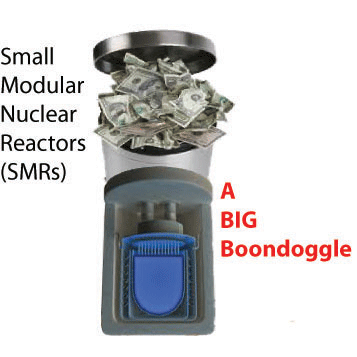 Rolls-Royce ramps up efforts to build mini-nuclear power plants, CITY.A.M. Jessica Morris , 2 Oct 16 Rolls-Royce has ramped up its efforts to build a fleet of small nuclear power stations as the next stage of a government competition draws closer. City A.M. understands that 30 employees from its Trident submarine work are now checking work on Rolls’ blueprint for the Small Modular Reactors (SMRS).
The Sunday Times first reported the news.……
The government launched a competition to identify the best value SMR design for the UK last year.
Ministers believe SMRs could increase and UK’s energy security and eventually become a leading export. However, the technology faces hurdles such as safety and security, financing as well as design approval.
There are 33 companies currently competing and a winner could be announced in the coming months.
The department for Business, Energy and Industrial Strategy has said it will publish a roadmap “for one or more possible pathways for SMRs” in the Autumn. http://www.cityam.com/250521/rolls-royce-ramps-up-efforts-build-mini-nuclear-power
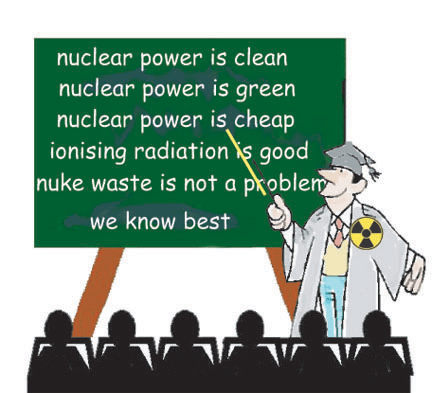
Big nuclear promotion to Asian schookids,by International Atomic Energy Agency
 Dr Paterson highlighted the importance of changing the conversation around nuclear issues through both outreach and education to address the knowledge gap and a lack of understanding that exists in society……
“People’s awareness has to be raised about the benefits of nuclear technology for health, the environment and important research,” said Dr Paterson.
Inspiring tomorrow’s scientists: The IAEA presents a new nuclear science and technology educational resource package for secondary schools,International Atomic Energy Agency 30 September 2016 “…… a new educational resource package developed by the IAEA in partnership with education and communication experts from around the world aims to answer. The Compendium of Resources and Activities on Nuclear Science and technology for Secondary School Teachers and Students, presented this week at a side event entitled ‘Introducing Nuclear Science and Technology in Secondary Schools’ on the margins of the 60th IAEA General Conference, aims to make nuclear science more interesting and attractive to students, and to encourage young people to enter the fields of nuclear science and technology……. we need to ensure that the nuclear knowledge is passed on to the next generations. This project is an opportunity for the youth, for developing countries, for women! ” said Ms Najat Mokhtar, Director of the IAEA’s Division for Asia and the Pacific in her opening statement to the side event……
engaging their interest while still in high school is key to ensuring a cohort of students and graduates interested in pursuing careers as scientists, and ready to take on the challenge of developing nuclear knowledge and capacity in their countries……
“In the Philippines, 46 Science Department Heads and around 200 teachers were trained by IAEA experts. ……..Over 900 high school teachers and 10,000 high-school students benefitted from the pilot project. Many of the teachers who received training from IAEA experts in turn trained other teachers back in their countries. …….
Dr Adrian Paterson, Chief Executive Officer at the Australian Nuclear Science and Technology Organisation (ANSTO) and Dr Takeshi Iimoto, Associate Professor at the University of Tokyo, who had both provided expert advice to the preparation of the Compendium, shared their experience and talked about some of the ideas that they had contributed. Dr Paterson highlighted the importance of changing the conversation around nuclear issues through both outreach and education to address the knowledge gap and a lack of understanding that exists in society……
“People’s awareness has to be raised about the benefits of nuclear technology for health, the environment and important research,” said Dr Paterson.
Background
The pilot Compendium initiative was successfully completed under a regional technical cooperation project RAS0065 supported by the Department of Nuclear Sciences and Applications and the Department of Technical Cooperation. A follow-up regional project for Asia and the Pacific is being prepared for 2018–2020 to expand and sustain nuclear science and technology information, education and communication among secondary school students and teachers in the region. https://www.iaea.org/technicalcooperation/Home/Highlights-Archive/Archive-2016/0930016-GC-comp.html
Russia spreading its influence, seeking lithium deal with Chile
 Russian nuclear firm Rosatom eyes Chilean lithium | SANTIAGO 2 Oct 16 Russian state nuclear power plant giant Rosatom sent lobbyists to meet with the Chilean government and discuss “collaboration in possible lithium projects,” a government website revealed at the weekend.
Four representatives of the company met with Mining Deputy Minister Igancio Moreno in September, according to information published on the government’s lobbying transparent website.
Rosatom has signed billions of dollars worth of overseas contracts and is seen as a tool for Russia to wield political influence abroad.
This year, it signed a contract to build a nuclear research center in Chile’s neighbor Bolivia. It also has interests in several other Latin American countries.
Chile itself has no nuclear power plants and is not expected to build any, as it is one of the world’s most seismically active countries and is regularly shaken by strong earthquakes.
But Chile does have one of the world’s most plentiful supplies of lithium, a mineral used in rechargeable batteries and electronics that has seen rocketing interest and a sharp price rise in recent months on hopes of an electric vehicle boom.
Lithium also has applications for the nuclear industry. As a consequence, the Chilean government considers lithium a “strategic mineral,” leasing out rights and limiting its production.
Most lithium extraction projects involve partnership with the government and state copper miner Codelco [COBRE.UL] is expected to decide on a partner to develop its own lithium assets in the first quarter of next year.
The need to support a community when a nuclear power station closes
Regional and national conversations about nuclear power center on electricity supply and cost, environmental goals and radiological safety. But we focus on how closure looks from the host community’s standpoint. There are substantial financial and social losses that pose major, long-term risks to local and regional economies.
The foreseeable losses from plant closures are substantial enough to merit major planning efforts. Economic impact studies forecast the nature and scale of losses, but it’s not clear what to do next to prepare, beyond bracing for the worst and slashing budgets.
Unfortunately, no targeted programs or funding exist to support nuclear host communities doing this kind of planning. The accelerating pace of nuclear power plant closures has exposed a problem that will affect quality of life for hundreds of towns, many in rural or economically depressed areas. There are no model practices or policies, and no federal entity that assumes responsibility beyond radiological safety, environmental cleanup and monitoring of spent fuel.
A decade ago, community leaders in Southern Vermont asked what might happen to the regional economy if their plant shut down. They conducted a study to understand the problem, and produced the first-ever Comprehensive Economic Development Strategyincorporating nuclear plant closure impacts into economic planning. They had realized it was up to the region to take action because no help would be offered. By the time Vermont Yankee announced closure, work was already underway to replace Vermont Yankee losses with new jobs and businesses.
Today, the community around the Diablo Canyon Power Plant is at the start of a long journey. As home to many of the earliest plant closures, New England offers a network of people with experience, many of whom are also working to improve federal policies that will frame your future experience. This includes engaging with two current initiatives; NRC rulemaking on decommissioning and the Department of Energy consent-based approach to the spent fuel siting process.
Hundreds of billions of dollars will be spent to decommission the nuclear power plants that supply one-fifth of our nation’s energy. Additional billions are going into spent fuel handling and related litigation.
Currently, the best-case closure scenario is simply restoring nuclear sites to a natural state, erasing the past with no attempt to generate new economic activity.
We can do more. Only a few decades ago, America lacked a coherent approach to polluted sites. Now brownfield programs commonly transform polluted sites into new assets that attract investment.
Military base closures have been devastating, but over time Base Realignment and Closurepractices are evolving to help create new economic activity and redevelopment.
The local, county, regional and state agencies responsible for each community need enough funding and authority to implement timely and sufficient mitigation of all risks — to economic, environmental and human health. Decommissioning creates unfunded mandates precisely at the point when revenues are dropping. Ultimately, we need a national solution that makes the long-term economic health of host communities a policy goal. We need a federal agency that assumes responsibility for achieving that goal.
We urge California’s policymakers to join a growing body of state and federal legislators and regulators who believe we can do better when it comes to caring for the communities providing our nation’s energy.
John Mullin is professor emeritus of regional planning at the University of Massachusetts Amherst and former dean of the graduate school. He is co-founder of the Institute for Nuclear Host Communities and teaches a course on nuclear plant closures in the UMass Honors College.
Laura Sibilia is economic development director at the Brattleboro Development Credit Corp. in Vermont and a member of Vermont’s House of Representatives. She worked on development of a Comprehensive Economic Development Strategy to address impacts of Vermont Yankee’s closure.
Jennifer Stromsten is program director for the Institute for Nuclear Host Communities. She has 20 years of nonprofit development experience, and a master’s degree in regional planning, focused on sustainable land use and economic development. http://www.sanluisobispo.com/opinion/letters-to-the-editor/article105472331.html
Japan and India to make nuclear marketing deal in November
 Japan, India to sign nuclear cooperation deal in November – report http://www.firstpost.com/fwire/japan-india-to-sign-nuclear-cooperation-deal-in-november-report-reuters-3030874.html First Post 2 Oct 16 Reuters TOKYO Japan and India are likely to sign a civil nuclear cooperation pact during a visit to Japan by Indian Prime Minister Narendra Modi in mid-November, the Mainichi newspaper reported on Saturday.The governments of Asia’s second- and third-largest economies are leaning toward holding a summit meeting between Modi and his Japanese counterpart Shinzo Abe, the report said, citing unidentified diplomatic sources from both nations.The two leaders last December reached a basic agreement for cooperation in the peaceful use of nuclear energy, but they stopped short of signing the agreement, citing outstanding technical and legal differences.Japan, the only country to have suffered a nuclear attack, has been demanding additional non-proliferation guarantees from India, which has a nuclear weapons programme, before exporting nuclear reactors.
India and Japan have been negotiating the nuclear energy deal since Japan’s ally, the United States, opened the way for nuclear commerce with India, which has shunned the global Non-Proliferation Treaty (NPT).
The two countries have reached a basic agreement during the working level negotiations that Japan would halt cooperation immediately if India conducted a nuclear test, the report added.A final deal with Japan would benefit U.S. firms. India has already given land for nuclear plants to GE-Hitachi – which is an alliance between the U.S. and Japanese firms – and to Toshiba’s Westinghouse Electric Company.
(Reporting by Osamu Tsukimori; Editing by Christian Schmollinger)
#ExxonKnew lawsuit could open floodgates for more cases

 New type of #ExxonKnew lawsuit could open floodgates for more cases, Mashable, Andrew Freedman, 2 Oct 16, Exxon’s climate change-related legal problems are growing by the day.
The suit, filed by the Conservation Law Foundation (CLF), is significant because it is the first to allege that a private company is violating the Clean Water Act and hazardous waste laws by failing to adequately prepare for climate change impacts such as sea level rise and stormwater runoff from increased instances of heavy rainfall events.
According to the suit — filed with the U.S. District Court for the District of Massachusetts — the Exxon facility in Everett, Massachusetts, just to the northwest of Boston, has a stormwater drainage system that is easily overrun during extreme precipitation events, which are becoming more frequent due to climate change.
The suit contends that climate change-fed heavy rainfall is flooding the facility, which emits harmful contaminants into a tributary of the Mystic River in violation of the facility’s permit.
The reporting revealed that instead of incorporating the risks into its planning and being transparent about them, the company chose to fund climate denial groups and withhold its research from shareholders.
The reporting has sparked a public campaign against Exxon, known together with the reporting by the hashtag #ExxonKnew………
The lawsuit could pave the way for many more similar legal actions, and not just against Exxon, but other oil and gas companies too.
“America’s coastlines are dotted with oil and chemical tanks and other facilities that are at risk from rising seas.” http://mashable.com/2016/09/29/exxon-knew-lawsuit-massachusetts/#rjmvgqrODuq7
1 This Month

of the week – Shut Down Drone Warfare!


Tell the Ukrainian Government to Drop Prosecution of Peace Activist Yurii Sheliazhenko

Petition to revoke the licensing of the Near Surface Nuclear Disposal Facility (NSDF) at Chalk River. https://www.ourcommons.ca/petitions/en/Petition/Details?Petition=e-7247
To see nuclear-related stories in greater depth and intensity – go to https://nuclearinformation.wordpress.com
-
Archives
- April 2026 (103)
- March 2026 (251)
- February 2026 (268)
- January 2026 (308)
- December 2025 (358)
- November 2025 (359)
- October 2025 (376)
- September 2025 (257)
- August 2025 (319)
- July 2025 (230)
- June 2025 (348)
- May 2025 (261)
-
Categories
- 1
- 1 NUCLEAR ISSUES
- business and costs
- climate change
- culture and arts
- ENERGY
- environment
- health
- history
- indigenous issues
- Legal
- marketing of nuclear
- media
- opposition to nuclear
- PERSONAL STORIES
- politics
- politics international
- Religion and ethics
- safety
- secrets,lies and civil liberties
- spinbuster
- technology
- Uranium
- wastes
- weapons and war
- Women
- 2 WORLD
- ACTION
- AFRICA
- Atrocities
- AUSTRALIA
- Christina's notes
- Christina's themes
- culture and arts
- Events
- Fuk 2022
- Fuk 2023
- Fukushima 2017
- Fukushima 2018
- fukushima 2019
- Fukushima 2020
- Fukushima 2021
- general
- global warming
- Humour (God we need it)
- Nuclear
- RARE EARTHS
- Reference
- resources – print
- Resources -audiovicual
- Weekly Newsletter
- World
- World Nuclear
- YouTube
-
RSS
Entries RSS
Comments RSS
 nuclear-news