 Critics Question Plans For Nuclear Waste Storage At San Onofre Nuclear expert says it’s a “witches brew of radioactivity” 7 San Deiego By JW August , 30 Sept 16 The threat of a nuclear meltdown is no longer a concern at the San Onofre Nuclear Generating Station because it’s shut down.
A shuttered nuclear plant does present another potential threat to public safety, according to an editorial in the April 2016 edition of Scientific American Magazine. The article warns of a greater danger, and says “more threatening than a meltdown, it’s the steady accumulation of radioactive waste.”

The San Onofre Nuclear Generating Station was permanently retired by its owners, Southern California Edison, SCE, and SDG&E in 2013. The plant’s operations left 3.6 million pounds of radioactive waste behind.
If all goes as planned that radioactive waste is headed to bluffs just north of the dead reactors above San Onofre State Beach. It will sit near Interstate 5 in Southern California between two major metropolitan areas, San Diego and Los Angeles, where 17 million people call home.
Fifty canisters of radioactive leftovers, from fuel burned before the plant closed, are already in storage on the plant’s property. It accounts for about 30 percent of the radioactive waste on site. In the spring of 2017, the remaining radioactive waste will begin to be moved out of the pools of cooling water where it is currently stored and into 100 stainless steel dry casks which will also be encased in a cement pad.
Daniel Hirsch, the Director of the Program on Environmental and Nuclear Policy at UC Santa Cruz, said it is imperative the fuel rods be moved out of the pools and into dry casks as soon as possible.
“It is the most dangerous stuff on earth; a witches brew of radioactive material,” he said.
A fuel rod is a long zirconium metal tube containing pellets of fissionable material, which provide fuel for nuclear reactors.
“Those pools are so densely packed, that if you lose the coolant you could have a fire in them,” Hirsch said.
According to a report from Robert Alvarez, a former policy advisor to the U.S. Department of Energy, a pool fire would release more radioactivity than a reactor meltdown. Hirsch, a long-time critic of the industry told NBC 7 Investigates the clock is ticking, something the plant’s owners agree with.
The location of the waste storage is something the plant’s owners and nuclear waste critics do not agree with.
“They’re going to be stored on the beach in the worst possible location you can imagine,” Charles Langley, who opposes the storage plans at San Onofre, said. Langley tracks all things related to San Onofre and the nuclear waste storage plans for Public Watchdogs, a San Diego based non-profit website.
The proposed storage site is northwest of the plant’s units one and two; the two reactor domes that can be seen from the freeway.
Currently, the San Onofre Nuclear Generating Station is the largest privately-owned coastal nuclear storage site in the country. When compared to government owned sites, it’s the second largest in the country, behind the Hanford Site in Washington where the first plutonium reactor was built and the bomb dropped on Nagasaki, Japan was created.
Langley said the location selected is all about money. “It’s the cheapest alternative,” he said. “It’s what’s best for the stockholders. It’s not what’s best for the people of Orange and San Diego County.”
SCE does not agree. Neither does the Nuclear Regulatory Commission, NRC, and the California Coastal Commission, which both approved the Pacific coastline location.
It’s not a case of no risk, the utilities argue, but low risk.
In January, due to El Nino weather conditions, there was considerable erosion of the beaches and bluffs around the San Onofre plant, the same area where the canisters will be stored.
Nina Babiarz, a transportation consultant and former journalist, said the location for the nuclear waste storage is a poor one. “It’s on an earthquake fault in a tsunami zone,” she said. NBC 7 Investigates reviewed weather reports and found rising sea levels at and around the nuclear waste storage location could continue.
A Pacific Institute report on sea level rise, with contributions by the Scripps Institution of Oceanography, found “flooding and erosion” risks will increase. According to the report, “in areas where the coast erodes easily, sea level rise will likely accelerate shoreline recession” and “may expose previously protected areas to flooding.” The United States Geological Service found the same dynamics: extreme bluff, cliff and beach erosion, accelerating over time.
The City of Del Mar, located 33 miles from San Onofre and with a similar coastline, did its own risk assessment of projected impact from sea level rise, storm surges and coastal flooding. In its assessment it describes the potential for extensive flooding and cliff collapses. …………http://www.nbcsandiego.com/news/local/Critics-Question-Plans-For-Nuclear-Waste-Storage-At-San-Onofre-395305981.html
October 1, 2016
Posted by Christina Macpherson |
decommission reactor, USA, wastes |
Leave a comment
Hinkley Point C developers face £7.2bn cleanup bill at end of nuclear plant’s life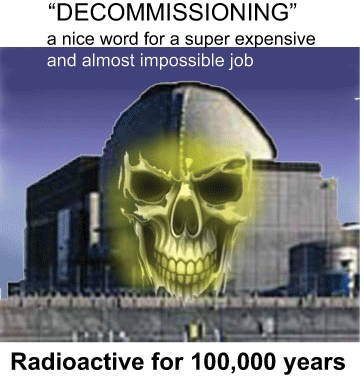
French and Chinese developers will be the first nuclear operators in the UK that will have to pay to decommission the site, Guardian, Adam Vaughan, 30 Sept 16 , The French and Chinese companies that are to build the £18bn Hinkley Point C nuclear power station will have to pay up to £7.2bn to dismantle and clean it up.
Documents published yesterday reveal for the first time how much the developers, EDF and China General Nuclear Power Group (CGN), will have to pay to decommission the plant, beginning in 2083.
The new reactors in Somerset will be unique in British nuclear history, as they are the first for which the operator will have to pay to make good the site afterwards.
“Waste transfer contracts signed today mean that, for the first time in the UK, the full costs of decommissioning and waste management associated with the new power station are set aside during generation and are included in the price of the electricity,” EDF said in a statement.
Decommissioning costs ate up around half the budget for the now-disbanded department of energy and climate change, after the liabilities for cleaning up old nuclear plants were effectively nationalised in 2004 and 2005 when two companies faced financial problems.
The Hinkley Point C decommissioning costs are estimated at £5.9bn to £7.2bn, with the dismantling of the plant expected to begin in 2083. The government, EDF and CGN anticipate the winding up of the new reactors will continue well into the 22nd century. The plant is expected to be fully decommissioned “from 2138” when the final spent fuel is disposed of.
Experts said the cost estimate was likely to be on the low side. “The reality in terms of decommissioning is that it always costs more than people say,” said Dr Paul Dorfman, of the Energy Institute at University College London.
He claimed that the precedent of the government taking ownership of the liabilities of British Nuclear Fuels Limited and British Energy more than a decade ago showed that the government would be forced to shoulder the costs if Hinkley’s developers had a shortfall.
The body charged with dismantling 17 of Britain’s old nuclear power plants puts the cost of cleanup at £117bn over 100 years in its latest annual report, more than twice the cost estimated a decade ago. A large proportion of the cost is due to the complexity of Sellafield……..https://www.theguardian.com/environment/2016/sep/30/hinkley-point-c-developers-face-72bn-cleanup-bill-at-end-of-nuclear-plants-life?CMP=twt_a-environment_b-gdneco&utm_content=buffer99004&utm_medium=social&utm_source=twitter.com&utm_campaign=buffer
October 1, 2016
Posted by Christina Macpherson |
decommission reactor, UK, wastes |
Leave a comment
Most people alive today set to witness dangerous global warming in their lifetime, scientists warn
Average temperature could rise to two degrees Celsius above the norm by 2050 or ‘even sooner’, Independent, UK, Ian Johnston Environment Correspondent 30 September 2016 The world could hit two degrees Celsius of warming – the point at which many scientists believe climate change will become dangerous – as early as 2050, a group of leading experts has warned.

In a report called The Truth About Climate Change, they said many people seemed to think of global warming as “abstract, distant and even controversial”.
But the planet is now heating up “much faster” than anticipated, said Professor Sir Robert Watson, a former chair of the Intergovernmental Panel on Climate Change and one of the authors of the report.
If their analysis is correct, it means the majority of people alive today will experience what it is like to live on a dangerously overheated planet. At the Paris Climate Summit last year, world leaders agreed to try to limit global warming to as close to 1.5C above pre-industrial levels as possible – amid concerns the 2C target may not be safe enough.
But in the same year the level of warming reached 1C after an astonishing 0.15C rise in just three years.
Droughts, floods, wildfires and storms are all set to increase as the world warms, threatening crops and causing the extinction of species. The new report warned the 1.5C target had “almost certainly already been missed”.
Even if all the pledges to cut emissions made by countries at Paris are fulfilled, the average temperature is set to reach that level in the early 2030s and then 2C by 2050, they said. Professor Watson, a chemist who has worked for Nasa, the World Bank, the US president and now at the renowned Tyndall Centre for Climate Change Research in Norwich, said: “Climate change is happening now and much faster than anticipated.
“While the Paris Agreement on Climate Change is an important step in the right direction, what is needed is a doubling or tripling of efforts. “Without additional efforts by all major emitters, the 2C target could be reached even sooner.”
The report said an extra 0.4 to 0.5C of warming was expected to take place because of greenhouse gases that have already been emitted due to the slow response of the ocean and atmosphere.
The report said that full implementation of the pledges made at Paris would require wealthy countries to give a total of $100bn a year – as promised at the summit – to poor countries to help them transition to a zero-carbon economy.
“About 80 per cent of the pledges are subject to the condition that financial and technological support is available from developed countries,” Professor Watson said.
“These conditions may not be met, which means that these pledges may not be realized.”……….http://www.independent.co.uk/environment/global-warming-truth-about-climate-change-dangerous-2c-a7337871.html?utm_source=Daily+Carbon+Briefing&utm_campaign=be1cc22710-cb_daily&utm_medium=email&utm_term=0_876aab4fd7-be1cc22710-303473869
October 1, 2016
Posted by Christina Macpherson |
2 WORLD, climate change |
Leave a comment
 South Africa: Nuke RFP Delayed in Order to Give Eskom Greater Say and Avoid Parliamentary Scrutiny http://allafrica.com/stories/201609300697.html By Gordon Mackay, 30 Sep 16 At a cabinet briefing today, Minister in the Presidency, Jeff Radebe, confirmed that it was highly unlikely that the nuclear RFP would be issued tomorrow as announced by the Minister of Energy, Tina Joemat-Pettersson, three weeks ago in Parliament.
Minister Radebe also suggested that the delay in issuing the RFP is largely due to a decision by cabinet to strip the Department of Energy of its role as government’s designated procurement agent in favour of Eskom.
This must be seen for what it is – a blatant attempt by the Zuma administration to:
- side-line parliamentary oversight of the nuclear new build programme;
- block public debate on the need for additional nuclear capacity;
- create a veil of secrecy around the procurement process which would now be subject to internal Eskom processes and procedures;
- give President Jacob Zuma greater control of the nuclear procurement process.

Designating Eskom as the procuring agent of the state will fundamentally limit the role and capacity of Parliament to oversee the nuclear deal and, in doing so, increase the potential of corruption surrounding the trillion rand deal.
The DA rejects any attempt to designate Eskom, headed by CEO and Zupta buddy, Brian Molefe, as the procuring agent for nuclear. Eskom has proven with Medupi and Kusile that it is unfit to manage mega-projects. It has also proven that its governance procedures are lax and the Supreme Court of Appeal has found its Board Tender Committee to be corrupt.
The DA is further concerned that the nuclear new build programme will further be subject to undue influence by the President, who is the Chair of the SOE Co-ordinating Committee.
We will use every mechanism available to us to ensure that this deal – which we do not need and cannot afford – is not pushed through without proper parliamentary oversight and scrutiny.
October 1, 2016
Posted by Christina Macpherson |
politics, South Africa |
Leave a comment
What happens if India and Pakistan both fire nuclear warheads at each other? http://www.thenewsminute.com/article/what-happens-if-india-and-pakistan-both-fire-nuclear-warheads-each-other-50604
If India and Pakistan detonated 100 nuclear warheads, over 21 million people will die immediately, and half the world’s ozone layer would be destroyed, September 29, 2016 – By Abheet Singh Sethi, 30 Sept 16
If India and Pakistan fought a war detonating 100 nuclear warheads (around half of their combined arsenal), each equivalent to a 15-kiloton Hiroshima bomb, more than 21 million people will be directly killed, about half the world’s protective ozone layer would be destroyed, and a “nuclear winter” would cripple monsoons and agriculture worldwide.

As the Indian Army considers armed options, and a Bharatiya Janata Party (BJP) MP urges a nuclear attack, even as the Pakistan Defence Minister threatens to “annihilate” India in return, the following projections, made by researchers from three US universities in 2007, are a reminder of the costs of nuclear war.
According to the study by researchers from Rutgers University, University of Colorado-Boulder and University of California, Los Angeles, about 21 million people – half the death toll of World War II – would perish within the first week from blast effects, burns and acute radiation in India and Pakistan.
This death toll would be 2,221 times the number of civilians and security forces killed by terrorists in India over nine years to 2015, according to an IndiaSpend analysis of South Asia Terrorism Portal data.
Another two billion people worldwide would face risks of severe starvation due to the climatic effects of the nuclear-weapon use in the subcontinent, according to a 2013 assessment by the International Physicians for the Prevention of Nuclear War, a global federation of physicians. Continue reading →
October 1, 2016
Posted by Christina Macpherson |
climate change, India, Pakistan, weapons and war |
Leave a comment
 Signs of a great rift over Zuma’s nuclear programme, Rand Daily Mail, RAY HARTLEY 30 SEPTEMBER 2016 In another indication of President Jacob Zuma’s dimishing influence, his headlong rush to build a ‘fleet’ of nuclear reactors has been halted. And there are signs that it is going to be cut down to size, if it goes ahead at all.
October 1, 2016
Posted by Christina Macpherson |
politics, South Africa |
Leave a comment
Pakistan threatens to DESTROY India with nuclear bomb as atomic enemies edge to the brink of war https://www.thesun.co.uk/news/1883306/pakistan-threatens-to-destroy-india-with-nuclear-bomb-as-atomic-enemies-edge-to-the-brink-of-war/ Tensions have risen dramatically between the nuclear-armed neighbours BY SARA KAMOUNI 30th September 2016,
PAKISTAN’S Defence Minister has threatened to “destroy” India – after India said on Thursday it had carried out “surgical strikes” on suspected militants preparing to infiltrate from Pakistan-ruled Kashmir.
The strikes, which were a response to shots fired across the de facto border through the disputed Himalayan territory, could lead to a military escalation between the two nuclear-armed neighbours – risking a ceasefire agreed in 2003.
Tensions have been heightened since an attack on an Indian military base in Kashmir earlier this month, which left 18 soldiers dead.
Both countries claim Kashmir in full, but rule separate parts – and have fought three wars over Kashmir since gaining independence from Britain in 1947
Responding to India’s latest strikes, Defence Minister Khawaja Asif said: “We will destroy India if it dares to impose war on us.
“Pakistan army is fully prepared to answer any misadventure of India.
“We have not made atomic device to display in a showcase.
“If a such a situation arises we will use it and eliminate India.”
Meanwhile, US Defence Secretary Ashton Carter said: “Pakistan nuclear weapons are entangled in a history of tension, and while they are not a threat to the United States directly, we work with Pakistan to ensure stability.”
China, a traditional Pakistani ally, has also called for dialogue between the two nations.
October 1, 2016
Posted by Christina Macpherson |
Pakistan, weapons and war |
Leave a comment
 Hillary Clinton Is More ‘Dovish’ Than Obama on Nukes, Hacked Audio Suggests, NY Mag, By Eric Levitz ” ……………his (Obama’s) administration is pursuing a $1 trillion nuclear “modernization” program, which many experts think will only heighten the risk of atomic war.
The president’s plan involves breaking up America’s existing nuclear stockpile into smaller, more reliable weapons, including cruise missiles with nuclear tips. This allows Obama to maintain his pledge to create no “new nuclear weapons,” while developing a sleek, modern arsenal that will, somehow, further deter enemy nations from attacking the United States.
There are a few problems with this plan. For one thing, building more precise nuclear cruise missiles only makes their use “more thinkable,” in the words of former vice-chairman of the Joint Chiefs of Staff James E. Cartwright. What’s more, the move threatens to kick off a new round of nuclear proliferation, as Stephen Kinzer, a scholar of international relations at Brown University,
recently observed:…….
Finally, there’s the program’s exorbitant cost. At a time when deficit politics are constraining our government’s ability to invest in basic social services and infrastructure improvements, do we really need to spend $1 trillion on renovating weapons we don’t ever want to use?
Hillary Clinton, for one, thinks not.
Earlier this week, the Washington Free Beacon published an audio recording of a fundraiser Clinton held back in February, which was gleaned from the hack of a campaign staffer — reportedly, as part of the same hack that exposed DNC emails.
In that audio, Andrew C. Weber, a former Defense Department official, asks Clinton if she would cancel the nuclear-cruise-missile project, were she elected president.
“I certainly would be inclined to do that,” she replied. “The last thing we need are sophisticated cruise missiles that are nuclear-armed.”
Clinton went on to suggest that such weapons would likely encourage a nuclear arms race, and praised former Defense secretary William J. Perry for his public opposition to the modernization program.
“This is going to be a big issue,” Clinton added. “It’s not just the nuclear-tipped cruise missile. There’s a lot of other money we’re taking about to go into refurbishing and modernization … Do we have to do any of it? If we have to do some of it, how much do we have to do? That’s going to be a tough question, so I will look to people like you and Bill Perry to help me answer that question.”
Elsewhere in the recording, Clinton took a more “hawkish” stance on cybersecurity, suggesting the United States must deter attacks from China and Russia through retaliatory measures. ……http://nymag.com/daily/intelligencer/2016/09/clinton-to-the-left-of-obama-on-nukes-hacked-audio-suggests.html
October 1, 2016
Posted by Christina Macpherson |
USA elections 2016 |
Leave a comment
 Hillary Clinton ‘Inclined To’ Cancel Nuclear Cruise Missile, Aviation Week Sep 30, 2016 by Lara Seligman in Ares As the Pentagon moves ahead with a trillion-dollar modernization of its nuclear arsenal, Democratic presidential nominee Hillary Clinton seems to be breaking with the Obama administration’s posture, signaling she might cancel a planned replacement of the legacy nuclear-tipped cruise missile.
Reports emerged this week that Clinton broke her silence on the administration’s planned modernization of strategic submarines, bombers and siloed intercontinental ballistic missiles (ICBM ), expressing doubts during a February fundraiser about whether the U.S. should go forward with the overhaul.
“The last thing we need are sophisticated cruise missiles that are nuclear armed,” Clinton said, according to reports of an audio recording of the fundraiser that appeared on the website of The Washington Free Beacon.
During the event, Clinton was asked about the modernization effort and whether she, as president, would cancel the replacement for the legacy Air-Launched Cruise Missile (ALCM), dubbed the Long-Range Standoff (LRSO) weapon.
“I certainly would be inclined to do that,” she answered. “The last thing we need are sophisticated cruise missiles that are nuclear-armed.”
LRSO may be the most vulnerable piece of the Pentagon’s nuclear arsenal. In her opposition to the new cruise missile, which will arm Northrop Grumman’s B-2s and next-generation B-21 bombers, Clinton joins a chorus of dissenters from Sens. Elizabeth Warren of Massachusetts and Bernie Sanders of Vermont to former defense secretary William Perry. Warren and Sanders, along with several other senators, called on Obama in July to cancel LRSO, saying it “would provide an unnecessary capability that could increase the risk of nuclear war.”………http://aviationweek.com/blog/hillary-clinton-inclined-cancel-nuclear-cruise-missile
October 1, 2016
Posted by Christina Macpherson |
USA elections 2016 |
Leave a comment
This has drawn attention to South Africa’s status as a global model for renewable energy, and raises new question about why the country is pursuing nuclear when renewables look so promising.
South Africa has the fastest growing green economy in the world, according to credit rating agency Moody’s.
“South Africa was the continent’s largest renewables market in 2015 in terms of asset finance for utility-scale projects and it saw the highest year-on-year growth globally,” said Christopher Bredholt, a Moody’s vice president, in a Sept. 16 report. Asset finance is usually used by businesses to lease equipment without having to buy it outright, according to Finance & Leasing Association.
South Africa had the highest growth globally for asset finance in 2015 at 300 percent, representing $4.5 billion, according to Moody’s.
Continue reading →
October 1, 2016
Posted by Christina Macpherson |
politics, renewable, South Africa |
Leave a comment
 South Africa: Nuclear Plan On Ice As Eskom May Take Ownership AllAfrica.com 30 Sept 16 Early indications are that Eskom may ultimately be responsible for the management and implementation of South Africa’s nuclear plan and not the Department of Energy as had originally been planned.
At the same time the much anticipated request for proposal for the nuclear plan won’t be issued on Friday as mooted by Energy Minister Tina Joemat-Pettersson earlier this month.
Jeff Radebe, Minister in the Presidency responsible for Planning and Monitoring, reiterated at a cabinet briefing on Thursday that more consultations need to take place before a request for proposal (RFP) can be issued on 30 September 2016.
Joemat-Pettersson issued a statement a few hours after Radebe’s briefing, confirming this………..
At the time of the previous cabinet meeting on the issue of nuclear in December 2015, nuclear was going to be led by Energy,” Radebe said during question time on Thursday.
“But recently there are references made to Eskom. That’s why I’m talking about issues of consultation. Those types of consultations must unfold before the RFP is issued. The instituting authority must be clearly defined.”
State-owned nuclear firm Necsa could also play a bigger role in the process. “Necsa has had discussions with government officials and Eskom – and there are clear indications that Necsa will play a major role as the primary nuclear centre of the country,” Necsa chair Kelvin Kemm told Fin24 on Thursday.
Asked during question time if he meant that Eskom instead of the DoE would be driving South Africa’s nuclear build programme, Radebe responded, saying when cabinet previously deliberated on the nuclear process in December 2015, the decision was that the Department of Energy would be driving the process. “If there is a change it will have to come back to cabinet for deliberation,” he said.
Radebe also repeated that the RFP would not be issued on Friday, despite previous assertions by Joemat-
Pettersson that the RFP was due for Friday. “There was no contradiction,” Radebe said with reference to Pandor’s statement on Tuesday.
“My understanding is that what minister Pandor was saying, due to the processes of consultation [and the fact that] processes had not completed, the RFP will only be issued after all those issues of consultation have been concluded and being brought back to cabinet. So I do not envisage that tomorrow on the 30 of September the RFP will be issued by the Department of Energy,” Radebe said.Source: Fin24 http://allafrica.com/stories/201609300935.html
October 1, 2016
Posted by Christina Macpherson |
politics, South Africa |
Leave a comment
 It’s time to cut America’s nuclear arsenal http://thebulletin.org/it%E2%80%99s-time-cut-america%E2%80%99s-nuclear-arsenal9942 Daryl G. KimballKingston Reif, 30 Sep 16, As he enters his final months in office, President Obama is still evaluating options to reduce the role and number of nuclear weapons in US strategy. His final decisions are expected before the end of October.
In a recent article in the Bulletin, we argued that the president should declare that the United States would not be the first to use nuclear weapons. In addition, he should direct a reduction in the size of the US nuclear arsenal. Not only could America make significant cuts to its nuclear forces without harming its security, but doing so would get the president closer to a major unmet goal while simultaneously freeing up federal money that could be much better used on other military priorities.
The United States could cut the size of its strategic nuclear forces on the basis of its own defense requirements alone. In 2013, a Pentagon reviewdetermined that America’s deployed strategic nuclear force is one-third larger than necessary to deter a nuclear attack. The president could direct the Pentagon to reduce the number of deployed strategic warheads from roughly 1,500 today to 1,000 within five years. He could also—and should—order the retirement and dismantling of a significant portion of our non-deployed “hedge” arsenal, estimated to be about 2,600 warheads. A thousand deployed warheads would still provide more than enough nuclear firepower to deter any current or potential nuclear adversary. Just one of our nuclear-armed submarines could devastate an entire country and kill millions. And if an enemy isn’t deterred by 1,000 deployed nuclear weapons, what logic presumes 1,500 would make a difference?
By cutting America’s excessive nuclear firepower, the president would also advance one of his key nuclear policy objectives. In his 2010 “Nuclear Posture Review Report,” Obama pledged that his administration would reduce the number, role, and salience of nuclear weapons in US defense strategy. He also called for maintaining and modernizing America’s remaining nuclear forces on a smaller triad of delivery systems.
Things have not gone as planned. In fact, not only has the reduction process stalled but the cost of sustaining our nuclear forces has skyrocketed.
The president’s posture review set the stage for the 2010 New Strategic Arms Reduction Treaty (New START), which established modestly lower limits for US and Russian deployed strategic arsenals (1,550 deployed strategic warheads each) and mandated a far-reaching verification regime. A follow-on study conducted by the US government in 2013 determined that future deterrence requirements could be met with one-third fewer deployed strategic nuclear forces.
Yet Obama did not immediately reduce the size of America’s nuclear force, despite the follow-on study’s conclusion that deterrence could be achieved by even a unilateral reduction. Instead, in a June 2013 speech in Berlin, he invited Russia to negotiate a further one-third reduction of each country’s strategic nuclear arms.
Russian leaders have rebuffed the offer for more than three years now, saying that they want to address other issues as well, such as the nuclear forces of other nations, America’s increasingly accurate conventional weapons, and missile defenses deployed in Europe, which Moscow believes could undercut its own nuclear retaliatory potential and disrupt strategic stability between itself and its old Cold War adversary.
As a result, US and Russian forces still far exceed deterrence requirements and many weapons deployed by both sides remain in “launch-under-attack” mode—ready to be fired within minutes of an order to do so. If used even in a “limited” way, the result would be a global humanitarian catastrophe.
Leading from ahead. Obama should not give Russian President Putin a veto over cuts of unnecessary and expensive US strategic nuclear weapons. Nor should he give Putin an easy excuse to maintain a similarly bloated arsenal of deployed strategic warheads aimed at the United States.
Now is the time to announce that the United States will reduce its strategic nuclear force to 1,000 (or fewer) strategic deployed warheads, invite Russia to do the same, and propose that the two sides agree to resume formal talks to regulate all types of strategic offensive and defensive weapons systems (nuclear and nonnuclear) that could affect strategic stability. Such a strategy could prompt Russia to rethink its expensive nuclear weapons modernization projects and possibly build-down its strategic nuclear arsenal.
In addition, more-rapid reductions of US and Russian nuclear forces, which comprise 95 percent of global stockpiles, would increase pressure on China and other nuclear-armed states to join the nuclear disarmament enterprise, an objective that leaders in Russia and the United States say they support.
Even if Russia is reluctant to immediately join the United States in reducing to 1,000 warheads, an American reduction would put Russia on the defensive and force Moscow to explain to a critical international community why it needs to maintain a larger deployed nuclear arsenal than the United States.
Such a move would not be unprecedented. Twenty-five years ago this week, George H.W. Bush announced a bold “Presidential Nuclear Initiative” as the Soviet Union began to break apart. It would unilaterally eliminate the US arsenal of land-based tactical nuclear weapons, withdraw tactical nukes from ships and submarines, and terminate certain nuclear weapons programs, including the development of the mobile Peacekeeper intercontinental ballistic missile.
A decade later, George W. Bush decided to unilaterally slash the size of the total US nuclear warhead stockpile (including those already deployed) in order to align American nuclear posture with changing national security needs. The cuts to the deployed force were later codified in a short bilateral treaty with Moscow known as the Strategic Offensive Reductions Treaty. But as Secretary of Defense Donald Rumsfeldtold the Senate Armed Services Committee in 2002: “We would have made these cuts regardless of what Russia did with its arsenal.”
Indeed, reductions to the US nuclear arsenal—which since the end of the Cold War has declined from about 22,000 warheads to roughly 4,600 as of September 30, 2015—have largely been the result of independent presidential discretion. While there isrough parity in the total size of each country’s total nuclear stockpile, the United States currently possesses hundreds more strategic nuclear delivery systems and warheads than does Russia, while Moscow maintains hundreds more non-strategic (or tactical) nuclear warheads than Washington.
Value for money. It is certainly true that Russia’s recent actions in Ukraine and irresponsible saber-rattling pose a challenge to European security. But every dollar Washington spends to maintain a bloated nuclear arsenal is a dollar that can’t be spent on military capabilities more relevant to countering Russia and assuring allies. It is not in the American interest to engage in a tit-for-tat race with the Russians to rebuild an excessively large nuclear force, especially if it comes at the expense of needed conventional improvements, such as programs to maintain America’s military technological edge.
By scaling back its nuclear force to 1,000 deployed strategic warheads and making associated reductions to the hedge stockpile, the United States could remove a big obstacle to trimming tens of billions of dollars from the Defense Department’s costly and excessive plan for new strategic submarines, missiles, and bombers over the next decade, which is premised on maintaining New START force levels in perpetuity.
The Pentagon estimates that the cost to replace nuclear delivery systems and their associated supporting infrastructure alone could cost half-a-trillion dollars over the next 20 years, a spending level that both the White House and Defense Department warn may not be sustainable and could force difficult trade-offs with other programs. This amounts to a multi-decade nuclear spending binge that promises to perpetuate excessive force levels and Cold War–era fighting capabilities for generations to come.
A more realistic, affordable, and sustainable course could include:
- reshaping or canceling the plan to spend at least $85 billion or more on roughly 650 new land-based missiles to support a deployed force of 400 missiles;
- halting the plan for roughly 1,000 new air-launched, nuclear-capable cruise missiles at a cost of some $20 billion to $25 billion;
- trimming back the plan for 12 new nuclear-armed ballistic missile submarines, which are estimated to cost $140 billion to develop.
Obama has it within his power to trim excess nuclear weapons and avoid spending tens of billions of defense dollars on redundant and unnecessary nuclear weapons systems. By doing so, he would open the way for further reductions in the role and size of not only America’s nuclear forces but Russia’s as well—and help build a future that’s a little more safe and secure.
October 1, 2016
Posted by Christina Macpherson |
USA, weapons and war |
Leave a comment
Pakistan is running full speed to develop tactical nukes in their continuing hostility with India’
U.S. Democratic presidential nominee Hillary Clinton has expressed concern over the possibility of Pakistan’s nuclear weapons falling into the hands of jihadists, which she said was “a threatening scenario,” according to a media report.
“Pakistan is running full speed to develop tactical nukes in their continuing hostility with India,” the former Secretary of State told a close door fundraiser in Virginia in February, The New York Times reported, citing 50-minute audio audio hacked from the Democratic Party’s computers.
“But we live in fear that they’re going to have a coup, that jihadists are going to take over the government, they’re going to get access to nuclear weapons, and you’ll have suicide nuclear bombers. So, this could not be a more threatening scenario,” the daily quoted Ms. Clinton as saying in the audio that appeared on The Washington Free Beacon website.
During the fund raiser, responding to a question on modernisation of nuclear weapons, the daily said, Ms. Clinton went beyond the question to warn of an emerging nuclear arms race, naming Russia and China as well as Pakistan and India.
“This is one of the most dangerous developments imaginable.”
October 1, 2016
Posted by Christina Macpherson |
USA elections 2016 |
Leave a comment
Nuclear threat not acceptable, US tells Pakistan, http://www.thehindu.com/news/international/nuclear-threat-not-acceptable-us-tells-pakistan/article9170042.ece VARGHESE K. GEORGE, 1 Oct 16 The United States has conveyed to Pakistan that nuclear threats are not acceptable, a senior State Department official who did not want to be named, said. The message was conveyed to Pakistan after its defence minister said twice in the span of a week that his country could use tactical nuclear weapons against India.
“We made that clear to them. Repeatedly,” the official said when asked whether the U.S has conveyed to Pakistan that no nuclear capable country is expected to threaten anyone with the use of nukes. “We haven’t kept the devices that we have just as showpieces. But if our safety is threatened, we will annihilate them (India),” the defence minister of Pakistan had said.
“It is very concerning, it is a serious thing,” the U.S official said, adding that the U.S has been urging both countries to “pull back and deescalate.” “At the same time we have made it very clear that what happened in the Indian arm base (Uri) is an act of cross border terrorism,” the official added.
The U.S is concerned about the safety of Pakistani nuclear weapons otherwise also, the official said. “The safety of these weapons is always a concern for us. So we are always monitoring it, regardless of what they said on this particular occasion,” he said.
October 1, 2016
Posted by Christina Macpherson |
Pakistan, politics international, USA, weapons and war |
Leave a comment
Nuclear War: Pakistan, China, Russia Vs India, America Nuclear Warheads USA Morning News 1 Oct 16 “……… Nuclear Warhead Assessment
So if it comes down to an all-out nuclear war between the US-India on one side and China-Russia-Pakistan on the other, here is an assessment of which side is likely to have an upper hand in the war:
- It has been estimated that China, India, and Pakistan all possess ballistic missile, cruise missile, and sea-based nuclear weapons.
- Even though China, Russia, and the U.S. possess nuclear weaponry, according to the NPT, they have been banned from building and maintaining such weapons in perpetuity.
- China has 260 approximate warheads, Russia has roughly 7300 and Pakistan has 120.
- The USA is lagging slightly behind Russia with 7100 warheads and India currently has 110.
Hence, with Russia currently ahead than all the rest in the nuclear race, both India and Pakistan are looking to Russia to build an alliance with. http://www.morningnewsusa.com/nuclear-war-pakistan-china-russia-vs-india-america-nuclear-warheads-23109179.html
October 1, 2016
Posted by Christina Macpherson |
India, Pakistan, politics international, Russia, weapons and war |
Leave a comment











 nuclear-news