International day for the total elimination of nuclear weapons -September 26
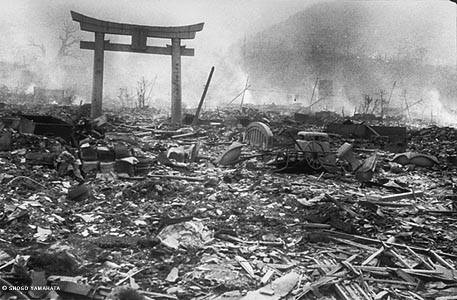 [HERALD INTERVIEW] Nagasaki atom bomb survivor urges denuclearization of world Korea Herald, 24 Sept 16 TOKYO — More than 70 years later, Terumi Tanaka can still relive the havoc wrought on his hometown Nagasaki, which was flattened by a plutonium bomb unleashed from a United States Army Air Forces plane.
At around 11 a.m. on Aug. 9, 1945, Tanaka was at his home some 3.2 kilometers away from the hypocenter of the atomic blast, when he heard a “loud bang” and immediately fell unconscious.
“Everything was instantly blown away in a storm,” the 84-year-old Japanese man told The Korea Herald in Tokyo last week. “I survived because I was lying down on the floor. However, five out of my six relatives died, some instantaneously from the raging inferno, some slowly from putrefying burns.”
Ahead of the international day for the total elimination of nuclear weapons on Sept. 26, designated by the United Nations in 2014, the secretary-general of the Japan Confederation of Atomic and Hydrogen Bomb Sufferers’ Organization, also known as Nihon Hidankyo, warned of the indelible consequences of pursuing nuclear arms and energy.
The bombshell dropped on Nagasaki, dubbed “Fat Man,” killed 74,000 people, roughly half the number that had perished from Hiroshima three days earlier. There are currently over 174,000 survivors — called “hibakusha” in Japanese — of the apocalyptic events in Japan and several thousands more worldwide.
Along with civic organizations such as Japan NGO Network for Nuclear Weapons Abolition and Peace Boat, Nihon Hidankyo has shepherded anti-nuclear calls around the world since it was established in 1956. It has participated in international conferences, street rallies and speaking tours, urging the total abolition of nuclear weapons, state compensation for their injuries, enhancement of government policies and relief measures, and solidarity with nuclear victims around the globe.
“Japan practically became a colony of the US since the war ended,” Tanaka said. “The US government forbade discussion or research of the bombing for seven years after 1945, and the Japanese government followed suit for an additional three years, thereby doing nothing for 10 years.”
As part of the San Francisco Peace Treaty in 1951, Tokyo renounced its right to claim damages from the nuclear bombardments from Washington. The hibakushas were deprived of their health, disadvantaged in employment and discriminated against by society, according to Nihon Hidankyo.
“Life was very tough before 1956, when our government started legislating laws and providing health care to the victims,” Tanaka recalled. “Before that, the sick and dying had to pay for medical expenses out of their own pockets, and many poor people died from malnutrition.”
Tanaka, who lived with a mother and three siblings, had to scrape by working odd jobs and saving pennies for the family as well as schooling. He called it an “unspeakable hardship.”
“We couldn’t eat for days on end. Everyone was poor, and even with little money there was practically nothing we could buy,” he said. “In spite of all our misery, we hoped that things would get better. We survived by shoving whatever was edible into our mouths.”
While Hiroshima has since become a universal symbol of mass destruction, Nagasaki on Japan’s southwestern island of Kyushu has largely been relegated to the larger city’s shadow. Nagasaki was bombed after Hiroshima, though it was less devastating due to the mountains and valleys of the city.
According to analysts, some 50,000 Koreans are thought to have lived in Hiroshima and 20,000 in Nagasaki during the attack, out of which roughly 30,000 and 10,000 are estimated to have died.
Most of Nagasaki’s Korean victims, who came from Hapcheon County in South Gyeongsang Province, were forcibly conscripted for backbreaking labor in wartime factories. The survivors returned home after the war to establish an organization similar to Nihon Hidankyo, with which the Japanese side maintains close contact. …… http://www.koreaherald.com/view.php?ud=20160925000225
Clinton and Trump both dance to the nuclear lobby’s tune
Energy issues divide presidential candidates, Dayton Daily News, 25 Sept 16 “…….Nuclear

 Neither candidate has focused much on nuclear energy during the campaign.
Although Clinton mentions “advanced reactors” in her clean energy plans, the Nuclear Energy Institute took aim at the proposals, saying they fall short of “recognizing that the current and future workhorse of carbon reduction in the nation’s power generation is nuclear power.”
On her campaign website, Clinton does say those who want to “rapidly shut down our nation’s nuclear power fleet put ideology ahead of science,” making it harder and more costly to build a clean energy future.
Trump has vowed to pursue “all forms of energy.” In his North Dakota speech he said that would include nuclear, wind and solar energy – “but not to the exclusion of other energy.
“The government should not pick winners and losers,” he said. “Instead, it should remove obstacles to exploration.”…..http://www.daytondailynews.com/news/news/national-govt-politics/energy-issues-divide-presidential-candidates/nsfFg/
Jill Stein’s political views on nuclear energy
 Why is the American political system so impossible? This candidate makes sense, not Trump and Clinton
 Jill Stein’s political views on nuclear energy http://www.jill2016.com/platform
- End destructive energy extraction and associated infrastructure: fracking, tar sands, offshore drilling, oil trains, mountaintop removal, natural gas pipelines, and uranium mines.
- Halt any investment in fossil fuel infrastructure, including natural gas, and phase out all fossil fuel power plants.
- Phase out nuclear power and end nuclear subsidies.
- End all subsidies for fossil fuels and impose a greenhouse gas fee / tax to charge polluters for the damage they have created.
South Africa’s Eskom wildly underestimates the cost of planned nuclear build
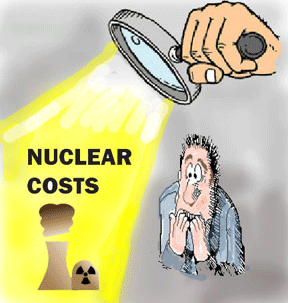
 ‘Eskom’s nuclear build cost and running projections are overheated’ – Analyst SUNDAY TIMES BUSINESS BY ASHA SPECKMAN, 2016-09-25 The price at which Eskom is projecting it will deliver nuclear energy as part of the proposed nuclear build has been rubbished by energy analysts who say South Africa could end up paying much more.
The power utility is targeting R1 per kilowatt-hour for nuclear energy – and this week Eskom’s head of generation, Matshela Koko, said the state-owned company expected to be able to fund the nuclear build programme from its own cash resources.
But energy analysts have scoffed at this, saying cost studies and examples from other projects show the bill to be massive. At the rate proposed, the project would not be viable.
Frank Spencer, an independent analyst, said: “If it comes in at R2/kWh or even R1.50/kWh, it would make absolutely no sense to pursue from a commercial perspective.”
The government and private sector’s expectations of the costs are miles apart.
Eskom spokesman Khulu Phasiwe said projections that the power utility had done put the cost of additional nuclear power at R500-billion. But Spencer estimated the cost would be about R1-trillion……..
He said decommissioning costs associated with dismantling nuclear power stations in future were often omitted from modelling, which eventually inflated the cost of the project.
“I think the expectations are based on what we’re seeing in the UK – [but] the cost of energy let alone the cost of the build programme, and finally what the levellised cost of energy works out to once all of those costs are taken into account, will be significantly higher than that.”…….
Eberhard said: “Nuclear vendors promise low prices but inevitably there are significant cost and time overruns. If these prices are not fixed in a contract then consumers end up with very expensive electricity.”
He cited the Hinkley C facility, where a 35-year contract for the equivalent of R1.65/kWh has been signed, as an example of a contract secured at a low rate……..
Last week, Moody’s placed Eskom’s credit rating on review for downgrade, saying that future tariffs may be affected due to the ongoing growth of independent power producers and a regulator that is hostile to Eskom’s tariff increase requests.
The agency also noted that institutional investors were beginning to display risk aversion to funding state-owned companies…….speckmana@sundaytimes.co.za http://www.timeslive.co.za/sundaytimes/businesstimes/2016/09/25/Eskoms-nuclear-build-cost-and-running-projections-are-overheated—Analyst
Hillary Clinton, evasive, contradictory on nuclear power, changed policy 9 times
 Hillary Just Flip-Flopped On Nuclear Power For The 9th Time http://dailycaller.com/2016/09/24/hillary-just-flip-flopped-on-nuclear-power-for-the-9th-time/ ANDREW FOLLETT Democratic nominee Hillary Clinton told Scientific American the U.S. needed to explore using more nuclear power, marking the ninth time the former secretary of state has flip-flopped on nuclear energy.
Clinton’s position changed from totally ignoring nuclear power in her 2016 platform to a tepid embrace of the technology.
Clinton’s newfound position on nuclear power puts her at odds with the anti-nuclear environmental movement, including The Sierra Club, the Natural Resources Defense Council, 350.org, and the Union of Concerned Scientists. Environmentalists have backed Clinton because of green energy and climate policies.
The nuclear industry, on the other hand, was happy about Clinton’s embrace of nuclear power.
“We absolutely appreciate that from the Hillary camp,” Baker Elmore, director of federal programs at the Nuclear Energy Institute, told The Daily Caller News Foundation. “When she was Senator, she had a very controversial plant at Indian Point in her state of New York. She was never really overly critical of it which was a big plus. We really appreciate the new statement.”
Clinton previously opposed nuclear power in her Senate campaigns, but supported it once she actually got into office. She changed positions on nuclear energy eight times, according to an analysis of her public statements and policy positions by The Daily Caller News Foundation.
Clinton’s campaign did not return requests for comment to TheDCNF in time for publication.
e flip-flops began when Clinton was running for the Democratic nomination in 2008, however, she started off from a pro-nuclear power position, saying, “I think nuclear power has to be part of our energy solution,” in February 2007. “We get about 20% of our energy from nuclear power in our country,” Clinton continued. “Other countries like France get much much more, so we have to look at it because it doesn’t put greenhouse gas emissions into the air.”
Clinton transitioned from this initial pro-nuclear stance during the early race to a neutral stance later on, as her primary race with then-candidate Sen. Barack Obama tightened.
“I’m agnostic about nuclear power,” Clinton said in July 2007 during a YouTube Democratic primary debate. “Until we figure out what we’re going to do with the waste and the cost, it’s very hard to see nuclear as a part of our future. But that’s where American technology comes in. Let’s figure out what we’re going to do about the waste and cost if we think nuclear should be a part of the solution.”
As her 2008 race with Obama got closer, Hillary migrated to an even more vehemently anti-nuclear position, explicitly excluding the industry from her platform.”I don’t include nuclear power in my energy policy, which I think is an appropriate approach given the problems we have with it,” Clinton told SentinelSource.com during an interview in late 2007.
After Clinton lost the Iowa caucus, she said that, “I have a comprehensive energy plan that does not rely on nuclear power,” in a January 2008 debate in Las Vegas.
When she lost the race for the Democratic nomination in 2008, Clinton’s views regarding nuclear power shifted radically. She began representing American nuclear companies to other countries as Obama’s secretary of state. Clinton used her position to support American nuclear companies in bids to construct and operate reactors in other countries, and helped American nuclear companies get contracts in countries like Japan, the Czech Republic and India.
“I think that nuclear power will remain a component of the energy supply globally, currently the United States, last time I looked, got 20 percent of our energy from nuclear plants,” Clinton said in October of 2012.
When Clinton again ran for the Democratic nomination in 2016, she rarely directly discussed nuclear energy, though one of her campaign fact sheet claims she favors “advanced nuclear,” which requires, “expand[ing] successful innovation initiatives, like ARPA-e, and cut those that fail to deliver results.”
By the time Clinton pulled ahead of Vermont Sen. Bernie Sanders in March, her policy director told a local Idaho news source that, “nuclear energy has an important role to play in our clean-energy future.”
After locking down the Democratic nomination, Clinton shifted back to opposing nuclear power.
Clinton’s platform for 2016 calls for having the nation run “entirely on clean energy by midcentury,” with a goal of “getting 50 percent of our electricity from clean energy sources within a decade.” The platform never defines clean energy, but other sections clearly indicate that it excludes nuclear, even though a single nuclear reactor can prevent 3.1 million tons of carbon-dioxide (CO2) emissions annually. The phrases “nuclear energy” or “nuclear power” never appear in Clinton’s platform.
Send tips to andrew@dailycallernewsfoundation.org. http://dailycaller.com/2016/09/24/hillary-just-flip-flopped-on-nuclear-power-for-the-9th-time/#ixzz4LIxitxDa
Hillary Clinton did not cut Russia’s nuclear arms, as claimed in ads
CNN fact-check: No, Hillary Clinton did not cut Russia’s nuclear arms http://hotair.com/archives/2016/09/24/cnn-fact-checks-claim-hillary-clinton-cut-russias-nuclear-arms/ BY JOHN SEXTON Yesterday, Jake Tapper fact-checked a claim about Russian nuclear arms made in two different Hillary Clinton campaign ads this year. One of the ads, which was aired thousands of times in Colorado and Virginia back in April, claims Hillary secured “a massive reduction in nuclear weapons.” FactCheck.org looked at that claim at the time and concluded, “the record doesn’t show that Clinton was responsible for ‘securing a massive reduction in nuclear weapons.’”
A new Clinton ad, which is airing in seven states this month, echoed the previous claim saying Hillary “got the treaty cutting Russia’s nuclear arms.”
But as Jake Tapper points out nearly all of this is false. It’s true that there is a treaty called New START which sets limits on the number of strategic nuclear weapons Russia can deploy. However that treaty doesn’t say anything about short range nukes or the number of total nuclear weapons Russia can have. It doesn’t require a single nuclear weapon be destroyed.
Even more striking, Tapper notes that Russia was already under the agreed limit when the treaty was signed in 2011. Russia has since increased the number of strategic nuclear arms by nearly 200, from 1,537 to 1,735. “Not only did it not cut the number of nuclear weapons,” Tapper says, “there’s actually been an increase.” Here’s a chart [on original] created by FactCheck.org back in April showing the number of strategic nuclear arms held by the U.S. and Russia. Note that the number of warheads held by Russia is up:
Tapper and FactCheck.org both grant that the treaty has value but the claims Clinton is making about the treaty reducing the number of Russian arms is false. Here’s the full fact-check: (youtube)
Contradictory and confusing statements by climate science deniers
 How climate science deniers can accept so many ‘impossible things’ all at once 23 September 2016 by Guest Author,
http://www.skepticalscience.com/how-deniers-accept-so-many-impossible-things-at-once.html Sometimes, climate science deniers will tell you that we can’t predict global temperatures in the future. Sometimes, they’ll say we’re heading for an ice age.
Occasionally, contrarians will say that no single weather event can prove human-caused global warming. But then they’ll point to somewhere that’s cold, claiming this disprovesclimate change.
Often, deniers will tell you that temperature records show that global warming stopped at some point around 1998. But also they’ll insist that those same temperature records can’t be relied on because Nasa and the Bureau of Meteorology are all communist corruption monkeys. Or something.
Black is also white. Round is also flat. Wrong is also right?
A new research paper published in the journal Synthese has looked at several of these contradictory arguments that get thrown around the blogosphere, the Australian Senate and the opinion pages of the (mostly) conservative media.
The paper comes with the fun and enticing title: “The Alice in Wonderland mechanics of the rejection of (climate) science: simulating coherence by conspiracism.”
Why Alice? Because, as the White Queen admitted: “Why, sometimes I’ve believed as many as six impossible things before breakfast.”
The three authors, including Dr John Cook, of the University of Queensland, look at both rhetorical and scientific arguments put by deniers.
One example is the popular theme that casts “sceptics” as “dissenting heroes” who bravely oppose “political persecution and fraud”. You know, like modern-day Galileos.
But the authors write that deniers will also try and convince the public that there is no consensus among scientists about the causes of climate change (there is and it’s us). They write:
Either there is a pervasive scientific consensus in which case contrarians are indeed dissenters, or there is no consensus in which case contrarian opinions should have broad support within the scientific community and no fearless opposition to an establishment is necessary.
The authors unleash similar jujitsu-style logic on other contradictory arguments and give examples of where the same individuals have apparently argued against themselves.
One of the authors’ examples of incoherent logic comes from the Australian geologist and mining industry figure Prof Ian Plimer and his 2009 book, Heaven and Earth – a book favourably cited by the likes of the former prime minister Tony Abbott and Cardinal George Pell.
On page 278, Plimer writes that “temperature and CO2 are not connected” but, on page 411, writes that “CO2 keeps our planet warm”.
According to the authors, their examples of “incoherence” only hold together in the minds of the deniers if you apply types of glue known as “conspiracist ideation” and “identity-protective cognition”.
So what’s that all about?
Conspiracist ideation, or conspiratorial thinking, is the tendency to entertain suggestions: for example that Nasa and the Bureau of Meteorology are conspiring to deliberately manipulate temperature data just to make global warming seem worse than it really is, rather than to correct for known issues.
An example of “identity-protective cognition” in this case, the authors explain, is where people who advocate for small governments and “free markets” face a dilemma.
Accepting the scientific consensus would likely see increased levels of regulation, which challenges their identity as free-market advocates. So instead, the authors argue, the only options open are to either deny the consensus or try and discredit it.
Because cutting GHG emissions requires interventions – such as regulation or increased taxation – that interfere with laissez-faire free-market economics, people whose identity and worldview centres around free markets are particularly challenged by the findings from climate science.
Lead author Prof Stephan Lewandowsky, an expert in cognitive psychology at the University of Bristol, has written several research papers finding links between the rejection of science, “conspiracist ideation” and the belief in free market economic principles.
One argument that deniers may try with this Synthese paper is that climate scientists also contradict each other and have offered several explanations for the supposed global warming “pause” or “slowdown” (this was never really a thing).
Lewandowsky told me:
Click here to read the rest from Graham Readfearn in the Guardian
Hillary Clinton and Donald Trump: policies on climate change
Where Hillary Clinton and Donald Trump stand on climate change, Business Insider, REBECCA HARRINGTON SEP 26, 2016 “……..The candidates’ positions on environmental issues are very different.
While Hillary Clinton lists “Protecting animals and wildlife” and “Climate change” as two major topics on her campaign website, Trump doesn’t include anything about the environment.
We’ve rounded up their statements publicly and on their websites to find out how the two stack up on environmental issues.
On her campaign site, Clinton calls climate change an “urgent threat” to “our economy, our national security, and our children’s health and futures.” She wants to uphold the Paris Agreement that sets targets to reverse the worst effects of global warming, which nearly 200 countries agreed to last December.
“When it comes to climate change, the science is crystal clear,” Clinton said on ScienceDebate. “That’s why as President, I will work both domestically and internationally to ensure that we build on recent progress and continue to slash greenhouse gas pollution over the coming years as the science clearly tells us we must.”
Clinton has proposed investing in clean energy and more efficient vehicles, cutting energy waste by implementing more robust efficiency and pollution standards, and cutting subsidies on oil and gas as ways of dealing with climate change.
Trump doesn’t accept the overwhelming scientific evidence that climate change is real and wants to dismantle the Paris Agreement.
In response to a question about his views on climate change on ScienceDebate, Trump implied that the US shouldn’t waste “financial resources” on climate change and should instead use them to ensure the world has clean water, eliminate diseases like malaria, increase food production, or develop alternative energy sources.
“There is still much that needs to be investigated in the field of ‘climate change,’” he said. “We must decide on how best to proceed so that we can make lives better, safer and more prosperous.”……..http://www.businessinsider.com.au/clinton-trump-environment-policies-plans-climate-change-platforms-2016-9?platform=hootsuite?r=US&IR=T
In last 10 years wind energy growth 23 percent, solar 50 percent – World Energy Council
 Wind and solar power enjoy a decade of massive growth: World Energy Council http://www.cnbc.com/2016/09/20/wind-and-solar-power-enjoy-a-decade-of-massive-growth-world-energy-council.html Anmar Frangoul CNBC.com, 20 Sep 2016 Renewable sources of power including hydroelectric and solar represent around 30 percent of the world’s total capacity and 23 percent of total global electricity production, according to a new report from the World Energy Council (WEC).
The report also said that $286 billion was invested in 154 gigawatts of “new renewables capacity” in 2015, with China’s spending on renewable sources representing 36 percent of global investments.
“The success of both the development of intermittent renewables and their efficient integration in electricity systems fundamentally depends on the right market design and regulatory framework and solid regional planning to avoid bottlenecks,” Christoph Frei, secretary general of the WEC, said in a statement.
The report comes in the wake of last year’s historic COP21 agreement in Paris. There, global leaders agreed to make sure global warming stayed below 2 degrees Celsius and to also pursue efforts to limit the temperature rise to 1.5 degrees Celsius.
“We are beyond the tipping point of grand energy transition,” Frei added. “Implementing technically and economically sound, stable policies supported by clear carbon price signals will enable this transition and take us a step closer to meeting the climate aspirations agreed at COP21.”
The report, Variable Renewables Integration in Electricity Systems 2016 – How to get it right, was launched on September 20 and published by the WEC in partnership with CESI S.p.A.
The WEC said that it drew upon 32 country case studies, representing roughly 90 percent of global installed solar and wind capacity.
South Africa’s nuclear programme will be a disaster.
The nuclear killer lurking in our midst, Pambazuka News Gerard Boyce Sep 22, 2016
South Africa’s nuclear programme will be a disaster. Besides the fallouts being witnessed in the jostling for gains by greedy politicians, the project is likely to gobble up huge amounts of public funds that will be difficult to account for as the government will cite national security concerns of nuclear power, thereby curtailing citizens’ right to accountability.
Nuclear power kills. If ever one had any doubts about the truthfulness of this statement, the past few months in South African politics have surely dispelled them. During this time, the government’s nuclear plans effectively killed the political career of former Finance Minister Nhlanhla Nene whilst indications are that the career of current Finance Minister Pravin Gordhan will soon suffer the same fate. It has slain any semblance of unity in the upper echelons of the ruling African National Congress. It is rumoured that the public spats in which members of various ruling party factions are engaged and that have come to hog national headlines each week are a result of ongoing palace intrigue that is caused by their jostling for position which will enable them to secure the maximum benefits from the potential bonanza that awaits when tenders for the construction of nuclear plants are awarded.
The open hostility exhibited by erstwhile comrades has exposed as a sham the image of a strong and united party and revealed a picture of an organisation riven by factionalism and bitter internal disputes. It is widely predicted that, if this deal is pushed through (as current indications are that it will), the country’s credit rating will be downgraded to junk status. A downgrade will likely plunge the economy into a coma and cause it to be put on life support………
it can become relatively easy for governments to be drawn into continuing to invest in their nuclear programmes even if they see little or no justification for doing so. One has only to observe the decades long (and seemingly never-ending) construction periods of many nuclear plants internationally for evidence thereof. Needless to say, this set of circumstances provides the ideal conditions in which graft and patronage networks are able to thrive and is likely to increase both the opportunity and propensity for certain individuals to engage in corrupt practices.
Secondly, given the destructive purposes to which nuclear technology can be put, a raft of laws and regulations have to be passed in order to prevent this technology falling into the wrong hands. Since each reactor is potentially a national calamity, policymakers justify these regulations as being necessary to protect the welfare and safety of citizens. These laws also serve to provide convenient cover behind which the less than savoury aspects of these deals can be hidden.

To shore up this cover, the global nuclear industry seems to have a built-in failsafe against closer public scrutiny and unwanted attention in that, once established, stakeholders in the industry can always appeal to the nebulous concept of the ‘national interest’ in an attempt to conceal their actions from the public. By elevating every investigation of their operations to a potential national security concern, they are able to shield their operations from investigation and thus to avoid criticism. Arguably, this has the effect of lowering the degree to which this industry feels accountable to the public since being open to investigation and subject to criticism (and thence learning) forms the basis of public accountability…….. Dr Gerard Boyce is a Senior Lecturer in the School of Built Environment and Development Studies at the University of KwaZulu-Natal. He writes in his personal capacity. http://www.pambazuka.org/human-security/nuclear-killer-lurking-our-midst?utm_campaign=shareaholic&utm_medium=twitter&utm_source=socialnetwork
Russia’s nuclear marketing: sell nukes, then sell the clean-up, too!
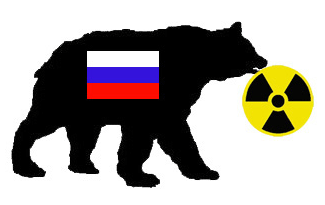 Making nuclear power plants safe after they shut down RBTH, September 24, 2016 ANDREI RETINGER, The problems of dealing with spent nuclear fuel, radioactive waste and the decommissioning of nuclear facilities (experts call it “back end”) did not immediately become apparent to the countries developing their nuclear industries. But now the world market for back end services is booming and its value is estimated to total about $347 billion until 2030.
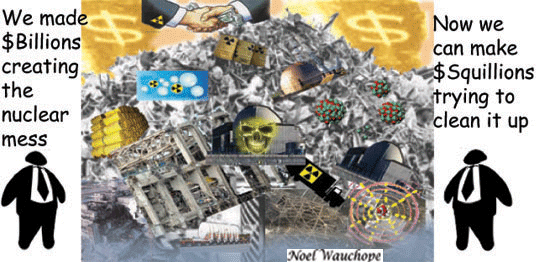
A number of nuclear facilities in the UK are scheduled for decommissioning, and all the 17 nuclear power plants that are still operating in Germany are due to close down by 2020. Japan must rehabilitate the areas after the accident at Fukushima, and the United States and Russia need to solve the problems of radioactive waste storage and reprocessing. Not all countries have the ability to solve these problems, but Russian technologies and facilities can come to their aid…..
in 2008, Russia was faced with a catastrophic situation because of the accumulation of radioactive waste and spent fuel remaining from the time of the creation of nuclear weapons and the Cold War. Storage sites were almost full and had not been provided with reliable insulation, creating a threat to people and the environment.
In this situation, Russia had no choice but to tackle the problem urgently. In 2007, it adopted a state program on nuclear and radiation safety, which was developed by the Rosatom State Atomic Energy Corporation. Then it approved a law on radioactive waste management, taking into account the latest standards and requirements………https://rbth.com/science_and_tech/2016/09/24/making-nuclear-power-plants-safe-after-they-shut-down_632711
Israel with 200 nuclear weapons a bigger threat than Iran

 Which is the Real Threat? Iranian Nuclear Program Versus Israel’s 200 Nukes.Sputnik News, 23 Sept 16 As Israel continues to oppose the Iranian nuclear deal, leaked emails written by former US Secretary of State Colin Powell suggest that Tel Aviv does have a sizeable cache of functioning nuclear weapons at its disposal.
These revelations cast a new light on Israel’s vehement opposition to the nuclear deal reached between the P5+1 group and Iran in July 2015. Furthermore, Sabbah Zanganeh, Iranian political analyst and Middle Eastern affairs expert, told Sputnik Persian that the existence of the Israeli nuclear arsenal is one of the chief factors contributing to the tensions in the region. “This is all part of the US double standards policy. The Americans are well-aware of the fact that the Iranian nuclear program always was and still is peaceful in nature and poses no threat to any nation or country. The US also knows that Iran opposes nuclear weapons, and not just for moral or humanitarian reasons, but first and foremost due to its religious beliefs. Iran rejects weapons of mass destruction of any kind,” Zanganeh said. On the other hand, he argued, Israel, which enjoys absolute US support, constantly threatens other countries in the region, provoking military conflicts and instigating wars against Egypt, Syria, Lebanon, Jordan and Palestine……..https://sputniknews.com/middleeast/20160921/1045551459/tehran-israel-nuclear-weapons.html
Amazing growth in wind and solar power in USA, and even more to come
 Wind and solar get cheaper and better, Energy Transition, 14 Sep 2016 by Ben Paulos Wind and solar power have reached a tipping point in the US, as their prices become competitive with conventional electricity sources. Ben Paulos looks at the leaps and bounds in solar and wind, and what this means for the US energy transition.
In the cornfields of Iowa, thousands of wind turbines are spinning, supplying over 30 percent of the state’s power—the highest percentage of any US state. On especially windy days in the spring, there may be enough wind power to run the whole state.
The state’s largest utility, MidAmerican Energy—partly owned by billionaire investor Warren Buffett—aims to provide 100 per cent renewable energy. And with their plan to add another 2000 MW recently approved, they’ll be getting 85 percent of their power from renewables, mostly wind.
While that number is impressive, even more impressive is the fact that MidAmerican won’t have to raise rates to do it. Thanks to the steady decline in prices and improvement in performance, wind energy is now the cheapest source of new electricity in some parts of the US.
Solar prices, too, are falling rapidly. California is the national leader by far, in both distributed and utility-scale systems. The state is now home to 14,000 MW of solar, including over 4000 MW installed on over 400,000 rooftops. Utilities are signing contracts for solar power for as low as 3 cents per kWh.
Reports released in August by the Lawrence Berkeley Lab, as well as other industry data, are showing that wind and solar prices and performance have reached a tipping point, putting renewable energy squarely in the mainstream.
Wind
What has changed? What is driving the growth of wind and solar power? While the price of wind turbines is certainly important to the cost of wind energy, the biggest price reductions in recent years have come from improved performance……..
Solar
Solar power has its own cost drivers, but it is similar to wind in one respect: the cost of the solar panels themselves is no longer the most important aspect.
Because panel prices have fallen so low—only 80 cents per watt—they now make up only one-fifth of the total cost of a residential rooftop system. Some of the costs are in the other hardware, like racks and electronics. But especially expensive are the “soft costs”—all of the other things needed to get those panels on your roof, like marketing, acquiring customers, and getting permits………
Utility-scale solar plants are increasingly using tracking systems that follow the sun across the sky, thus increasing output. Power contracts signed for new systems in 2015 were at or below $ 50 per MWh, with some as low as about $ 30 per MWh.
Overall, the US has 29.3 GW of solar installed, according to GTM Research. Utility-scale solar has been the fastest growing segment for the past few years, accounting for over half of the 7.5 GW installed in 2015.
California continues to dominate the market, with about half of all solar as of the end of 2015. But that share has been falling as other states grow.
Some US neighborhoods are seeing very high levels of saturation. In San Diego County, one in eight single family homes has solar, with some zip codes boasting double that rate. Hawaii, with very high electricity prices and excellent sunshine, has more solar power per capita than any state. In 2014, 6 percent of the state’s power came from the sun, and 17 percent of homes sported solar panels.
While this growth has been impressive, all signs point to even greater growth in coming years. At the end of 2015, there were at least 56.8 GW of utility-scale solar plants waiting to be interconnected across the nation, enough to triple current levels. And wind is expected to see at least 8 GW of growth per year: in the Midwest alone, there are 29 GW of wind projects waiting to be connected. We can expect to see even better, cheaper wind and solar soon.
Bentham Paulos is an energy consultant and writer based in California. http://energytransition.de/2016/09/wind-and-solar-get-cheaper-and-better/
Ambitious solar power plan for 12,000 homes in Saskatchewan
 SaskPower says solar plan to power up to 12,000 homes by 2021
Crown says between 10,000-12,000 Sask. homes will run on solar power within 5 years CBC News 22, 2016 SaskPower says between 10,000-12,000 homes in Saskatchewan will be run on solar power by 2021, from a project aiming to deliver 60 megawatts. Some of that electricity should be reaching the grid by 2018.
The government’s target is to have 50 per cent of its power delivered by renewable sources by 2030.
- Saskatchewan aims to get half its power from renewable energy by 2030
- SaskPower to use wind, solar, geothermal to hit 50% renewable mark by 2030
“So if we think about it, 2000 megawatts would be about fifty per cent of our mix today,” said Guy Bruce, SaskPower’s Vice President of Planning, Environment and Sustainable development. “So it’s a relatively small percentage, but it’s a move in the right direction.”
Three types of solar power providers
The 60-megawatt plan is divided into three types of providers. Twenty megawatts are expected to be provided by community projects, and another 20 from a competitive bidding process with vendors due to begin in September. SaskPower says it’s currently in negotiations with the First Nations Power Authority to provide two more 10-megawatt solar projects. ………http://www.cbc.ca/news/canada/saskatchewan/saskpower-solar-plan-2021-1.3774119
Cheap, Portable Solar Panel could transform the solar power industry
 This Cheap, Portable Solar Panel Will Be the iPad of Renewables by Good News Network – Sep 24, 2016 A California-based startup unveiled a product this week that aims to disrupt solar power production, much like the iPhone changed communications.
SunCulture Solar Inc. is calling its wire-free SolPad, which resembles a large iPad, the “world’s first integrated solar energy solution.”
It combines batteries, software, inverters and solar panels into one device. Typically, a solar system involves installation of separate parts, increasing costs. SolPad can be used off grid or tied to the grid, and uses batteries that the company says are safer than traditional lithium-ion ones.
”If the grid goes down, SolPad can keep delivering electricity,” the company said in a video unveiling the device in California this week.
“We’ve transformed solar — much like the smartphone revolutionized the personal computer sector, combining numerous components into a single device that’s significantly less expensive, more powerful and easier to use than conventional systems,” said CEO Christopher Estes.
The company plans to bring the product to market in the second half of next year……..http://www.goodnewsnetwork.org/cheap-portable-solar-device-will-ipad-renewables/
1 This Month

of the week – Shut Down Drone Warfare!


Tell the Ukrainian Government to Drop Prosecution of Peace Activist Yurii Sheliazhenko

Petition to revoke the licensing of the Near Surface Nuclear Disposal Facility (NSDF) at Chalk River. https://www.ourcommons.ca/petitions/en/Petition/Details?Petition=e-7247
To see nuclear-related stories in greater depth and intensity – go to https://nuclearinformation.wordpress.com
-
Archives
- April 2026 (103)
- March 2026 (251)
- February 2026 (268)
- January 2026 (308)
- December 2025 (358)
- November 2025 (359)
- October 2025 (376)
- September 2025 (257)
- August 2025 (319)
- July 2025 (230)
- June 2025 (348)
- May 2025 (261)
-
Categories
- 1
- 1 NUCLEAR ISSUES
- business and costs
- climate change
- culture and arts
- ENERGY
- environment
- health
- history
- indigenous issues
- Legal
- marketing of nuclear
- media
- opposition to nuclear
- PERSONAL STORIES
- politics
- politics international
- Religion and ethics
- safety
- secrets,lies and civil liberties
- spinbuster
- technology
- Uranium
- wastes
- weapons and war
- Women
- 2 WORLD
- ACTION
- AFRICA
- Atrocities
- AUSTRALIA
- Christina's notes
- Christina's themes
- culture and arts
- Events
- Fuk 2022
- Fuk 2023
- Fukushima 2017
- Fukushima 2018
- fukushima 2019
- Fukushima 2020
- Fukushima 2021
- general
- global warming
- Humour (God we need it)
- Nuclear
- RARE EARTHS
- Reference
- resources – print
- Resources -audiovicual
- Weekly Newsletter
- World
- World Nuclear
- YouTube
-
RSS
Entries RSS
Comments RSS
 nuclear-news