North Korea is urged by East Asia Summit to abandon nuclear program
East Asia Summit urges NK to abandon nuclear program , Korea Times
|
US-China Cooperation on N. Korean Nuclear Threat is undermined by national rivalries
US-China Tensions Undermine Cooperation on N. Korean Nuclear Threat SEOUL — VOA NEWS 8 SEP 16 Washington and Beijing’s longstanding agreement on the need to persuade North Korea to give up its nuclear ambitions is, analysts say, splintering over rising tensions in the region and diverging national interests.
American and South Korean officials, as well as analysts from China and Russia, addressed the increasingly complex security situation on the Korean peninsula at the Seoul Defense Dialogue on Thursday, organized by the South Korean Ministry of Defense.
Stay the course
Kim Hong-kyun, the South Korean Special Representative for Korean Peace and Security Affairs, called for continued international support to pressure the Kim Jong Un government to curb its defiant and continued development of nuclear weapons and ballistic missiles……..
The latest round of United Nations sanctions caused economic pain, especially, Kim said, in trade, shipping and finance. However, since the new restrictions were imposed in March, North Korea has conducted 20 tests of short and medium range missiles, including submarine-based launches, advancing its capability to reach the U.S. mainland with a nuclear strike.
Both Kim and U.S. Undersecretary of Defense David Shear noted that diplomatic outreach is at a standstill as both Seoul and Washington demand that Pyongyang first take significant action to dismantle its nuclear program before any talks can occur.
“Unfortunately, today there have been no credible signs that North Korea is ready to move down this path,” Shear said.
China For sanctions to be effective, China’s support remains crucial as it is North Korea’s economic lifeline. Nearly 90 percent of all North Korean trade flows through China.
Shi Yinhong, a professor of international relations at Renmin University in China, said officials in Beijing have doubts that sanctions alone will force Pyongyang to change……..http://www.voanews.com/a/us-china-tensions-north-korea-nuclear-threat/3498672.html
Political deception aimed at sabotaging the nuclear agreement with Iran – phony news
 Media Trumpet Another Phony “Secret Nuclear Deal” Story , 08 September 2016 By Gareth Porter, Truthout | News Analysis Two major media outlets — Reuters and The Washington Post — pushed another Iran “secret side deal” story last week, ignoring obvious facts that revealed it as clever political deception aimed at sabotaging the nuclear agreement with Iran.
Stories in both of those outlets suggested that a leading think tank had revealed a secret deal that allowed Iran to exceed various qualitative and quantitative limits placed on it under the nuclear agreement reached last year — the main current theme of political opponents of the agreement. The stories were based on claims in a report co-authored by David Albright, the head of the Institute for Science and International Security, who has long been treated by corporate media as the leading “independent” expert on Iran’s nuclear program.
In fact, as Truthout revealed in 2014, Albright had abandoned any independence he had maintained on Iran as early as 2008 and had aligned his position on nuclear negotiations with Iran with those of the Bush administration and Israel…….
Albright’s attack on the Obama administration and the Joint Commission was only the latest installment in the current campaign by pro-Israeli media and political opponents of the JCPOA to claim existence of “secret side deals” between the Obama administration and Iran. Just six weeks ago, the Associated Press correspondent in Vienna, George Jahn, published a story that falsely portrayed Iran’s report to the International Atomic Energy Agency [IAEA] on its plan for implementation of the agreement as such a “secret side deal.” The agreement reached between Iran and the IAEA on the issue of alleged past Iranian nuclear work, which included arrangements for taking environmental samples at Iran’s Parchin military facility, was also treated by JCPOA opponents as a “secret side deal.” http://www.truth-out.org/news/item/37527-media-trumpet-another-phony-secret-nuclear-deal-story
Decrepit old nuclear facilities a safety worry in America

 Photos show nuclear facilities in dangerous disrepair By Nicole Gaouette and Barbara Starr, CNNWashington (CNN) Story highlights
- Nuclear officials describe critical utility, safety and support systems that are failing
- Many facilities date from World War II and intended to operate for as little as one decade
US nuclear security facilities are dangerously decrepit and putting national security goals at risk, according to nuclear officials who are asking Congress to back the administration’s push to modernize the system.
Indian companies see Hybrid Solar and Wind Systems as the renewable energy future
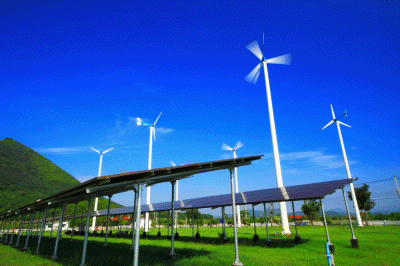
Hybrid Solar and Wind Systems Attract Turbine Makers in India http://www.bloomberg.com/news/articles/2016-09-05/hybrid-solar-and-wind-systems-attract-turbine-makers-in-india Anindya Upadhyay September 6, 2016
-
Gamesa planning 50-megawatt wind-solar hybrid project
-
Combined power generation can boost a project’s reliabilityWind turbine makers in India are looking at building more renewable energy projects that would combine solar and wind in a bid to provide a reliable and cost-effective power supply.Gamesa Corp. Tecnologica SA, the largest wind-turbine maker in India by market share, is preparing to announce its first wind-solar project within the next two months. Suzlon Energy Ltd., India’s largest domestic manufacturer of wind turbines, says it expects to focus on hybrids starting next year.“We feel that hybrid projects will make 50 to 60 percent of our sales over the next three years,” Ramesh Kymal, the chief executive officer of Gamesa’s India operations, said in an interview in New Delhi. “In a couple of months an announcement of a hybrid project from Gamesa can be expected.”The major advantage of a solar-wind hybrid is a boost to the reliability of the system as power generation from the two different sources supplement each other. Combining the two technologies and sharing a grid connection can also increase capacity, developers say. Hybrids hold an additional appeal in India where land acquisition remains a challenge.
India aims to install 10 gigawatts of hybrid capacity by 2022, according to a draft policyreleased earlier this year by the Ministry of New and Renewable Energy.
- Interest in hybrids is spreading. In 2014, Toshiba Corp. and Mitsui & Co. announced the completion of a solar and wind project in Japan’s Aichi prefecture. That project, developed in cooperation with six other companies including Toray Industries Inc., consists of 50 megawatts of solar capacity and 6 megawatts of wind. Canberra-based Windlab Systems Pty Ltd. and Japan’s Eurus Energy Holdings Cop. are building a large-scale hybrid solar-wind plant in the state of Queensland.“A common grid infrastructure for wind and solar installations will bring stability in the grid and will help avoid curtailment and seasonality of energy production,” Tulsi Tanti, founder and chairman of Pune, India-based Suzlon Energy, said in an interview, adding that wind and solar are complementary.
Suzlon will focus more intensely on wind and solar hybrid projects beginning next year, with a target to win market share of more than 40 percent in the next five years, Tanti said. In the case of Gamesa, the Zamudio, Spain-based turbine manufacturer has already identified some projects owned by existing customers that could benefit by adding solar, Kymal said.
- Other developers have also shown interest. Inox Wind Ltd.’s wind sites in the Indian states of Rajasthan, Gujarat and Madhya Pradesh are all ideal for hybrid projects, said Devansh Jain, a director at Inox, adding that he’s waiting for the ministry’s policy to be finalized before moving forward.“Wind-solar hybrid projects will boost growth but will not be a fundamental game changer,” Jain said in a phone interview, saying the government’s auctions of wind projects will likely be the biggest driver of growth in the sector.
India Goals
The interest in hybrid projects comes as India pushes aggressively to develop its clean energy capacity. Under a effort led by Prime Minister Narendra Modi, India is aiming by 2022 to install 100 gigawatts of solar capacity and 60 gigawatts of wind power.
India installed a record 3.5 gigawatts of wind in the fiscal year ended March 31, according to the Indian Wind Turbine Manufacturers Association.
“Hybrid projects offer advantages in sharing of resources for construction and maintenance of a project, as well as power transmission,” according to Shantanu Jaiswal, a Bloomberg New Energy Finance analyst in New Delhi.
Dangers of Sellafield nuclear site – a concern for nearby Isle of Man
 Isle of Man government ‘concerned’ about Sellafield safety, BBC News, 8 September 2016 Isle Of Man / Ellan Vannin The Manx government is “concerned” about the safety of the Sellafield nuclear site, a spokesman said.
On Monday, the BBC’s Panorama programme uncovered several safety concerns, from staffing levels to waste storage.
The Mannin Branch of the Celtic League has called on the Manx government to campaign for a full, independent inspection of the plant in Cumbria…….
The Isle of Man is located about 34 miles (55km) from the nuclear fuel reprocessing plant.
Due to its potential impact on the Manx fishing industry, the Manx government began monitoring radioactivity levels in the Irish Sea in 1989.
A government spokesman said: “Seafood fished in Manx waters can contain traces of radio-nuclides associated with effluent discharges from Sellafield to the Irish Sea, therefore these are monitored regularly to confirm that they remain well below maximum safe limits.”
The BBC investigation was prompted by a whistle-blower – a former senior manager who was worried by conditions at the plant…….http://www.bbc.com/news/world-europe-isle-of-man-37307763
India and Canada hoping to market nuclear technology together?
 India, Canada discuss civil-nuclear cooperation The two leaders discussed a wide range of issues of mutual interest, including civil-nuclear cooperation between the two countries, an official release issued said today. Indian Express By: PTI | New Delhi September 8, 2016 India and Canada have discussed a wide range of issues of mutual interest, including the civil-nuclear cooperation between the two countries. The discussion was held during a meeting between Union Minister Jitendra Singh and visiting Canada Minister for Natural Resources, James Gordon Carr, here on Wednesday.
The two leaders discussed a wide range of issues of mutual interest, including civil-nuclear cooperation between the two countries, an official release issued said today. As a country with large energy requirements, India looks forward to promoting nuclear energy production at a significant scale and the two nations can jointly work to achieve this, said Singh, Minister of State in Prime Minister’s Office.
He referred to a common technological base of Pressurised Heavy Water Reactor (PHWR) in which India and Canada are global leaders and it is an area offering opportunity of potential bilateral cooperation between the two countries……….
Singh referred to the visit of Prime Minister Narendra Modi to Canada in April 2015 during which a long term uranium procurement contract was signed by Department of Atomic Energy, Government of India with the Canadian Uranium producer CAMECO…….http://indianexpress.com/article/india/india-news-india/india-canada-discuss-civil-nuclear-cooperation-3020552/
International Atomic Energy Agency (IAEA) concerned about nuclear safety in China
CHINA STILL NEEDS ‘FURTHER WORK’ TO IMPROVE NUCLEAR SAFETY, IAEA SAYS http://www.brecorder.com/top-news/front-top/317444-china-still-needs-%E2%80%98further-work%E2%80%99-to-improve-nuclear-safety-iaea-says.html 08 September 2016 SHANGHAI: China has boosted safety regulation at its growing fleet of nuclear reactors but needs “further work” in areas such as waste management and handling ageing plants, the International Atomic Energy Agency (IAEA) said on Thursday.
New Study: ‘Blow Torch’-Like Ocean Warming Advances Killer Seas, Shifts El Nino, Heats Hydrates

“Tampering can be dangerous. Nature can be vengeful. We should have a great deal of respect for the planet on which we live.” — Carl-Gustaf Rossby
But as the new study points out, 90% of the extra heat that our greenhouse gases trap is actually absorbed by the oceans. That means that the upper few meters of the sea have been steadily warming more than a tenth of a degree celsius per decade, a figure that’s accelerating. When you think of the volume of water that represents, and then try to imagine the energy necessary to raise its temperature, you get an idea of the blowtorch that our civilization has become. — Bill McKibben
The scale of ocean warming is truly staggering with the numbers so large that it is difficult for most people to comprehend. — Explaining Ocean Warming
*****
If there’s one simple fact about past Earth…
View original post 1,585 more words
September 8 Energy News

Opinion:
¶ “Beauty and power: how Norway is making green energy look good” • On the edge of a forest in northern Norway, an unusual hydroelectric plant is generating a buzz. Øvre Forsland is a big departure from the hulking power stations. It looks more like an elegant, custom‑built home from TV show Grand Designs. [The Guardian]
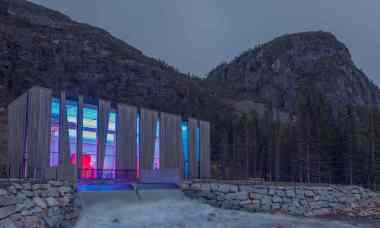 Øvre Forsland hydroelectric station.
Photograph: Pedro Alvarez for the Observer.
¶ “Dear Theresa: Let it go! Six powerful reasons to dump Hinkley C” • Theresa May ducked out of a signing ceremony to review the Hinkley C nuclear project. Soon she will have to make a decision. In this open letter Scientists for Global Responsibility set out six compelling reasons for her to let the monstrous white elephant go. [The Ecologist]
Science and Technology:
¶ Torrential rains unleashed on south Louisiana in August were made almost twice as…
View original post 787 more words
September 7 Energy News
Science and Technology:
¶ Shipping routes across the Arctic are going to open up significantly this century even with a best-case reduction in CO2 emissions, a new study suggests. University of Reading, UK, researchers have investigated how the decline in sea-ice, driven by warmer temperatures, will make the region more accessible. [BBC]
 Sea-ice is in decline but scientists expect a lot of annual variability. SPL
World:
¶ The G20 meeting in China may have been notable for the decision by both China and the US to ratify the Paris climate treaty. But the G20 nations are still taking little action on ending fossil fuel subsidies, despite agreeing to the move in 2009 to end what has been described as the “dumbest policy” in the world. [CleanTechnica]
¶ The London Metropolitan Police is now trialling the use of a range-extended BMW i3 as a patrol car, exploring the…
View original post 615 more words
What’s Swimming in the Open Water Near the North Pole These Days?
Globally, it’s been a record-hot year. But nowhere has seen so much anomalous warmth during 2016 as the Arctic. As melt season draws to a close, some dramatic effects are now becoming visible in the NASA satellite shots. Large regions near the North Pole are losing their white covering of sea ice and showing the telltale blue-black of open water:
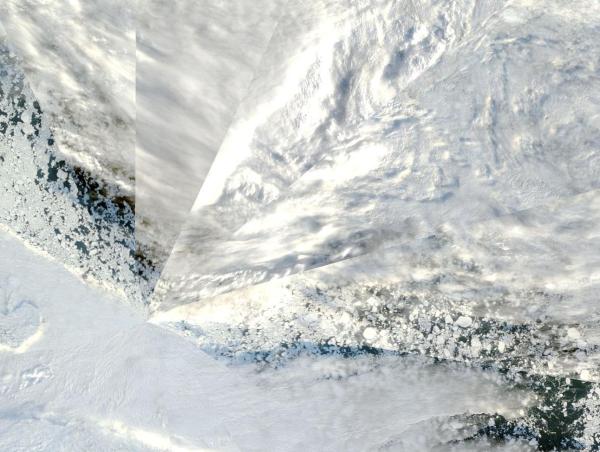
(Large areas of open water are visible near the North Pole in this LANCE MODIS satellite shot.)
The above image, provided by NASA, shows the Northern Hemisphere polar region on September 5, 2016. To get some sense of the size of this region of low-concentration sea ice, the bottom edge of this capture represents approximately 300 miles. For a point of reference, the North Pole can be seen where the lines of the satellite image frames converge in the lower left-hand side of the capture.
All throughout this satellite shot…
View original post 349 more words
The world had better pay attention NOW – to soaring ocean temperatures
Soaring ocean temperature is ‘greatest hidden challenge of our generation’
IUCN report warns that ‘truly staggering’ rate of warming is changing the behaviour of marine species, reducing fishing zones and spreading disease, Guardian, Oliver Milman. 6 Sept 16, The soaring temperature of the oceans is the “greatest hidden challenge of our generation” that is altering the make-up of marine species, shrinking fishing areas and starting to spread disease to humans, according to the most comprehensive analysis yet of ocean warming.

The oceans have already sucked up an enormous amount of heat due to escalating greenhouse gas emissions, affecting marine species from microbes to whales, according to an International Union for Conservation of Nature (IUCN) reportinvolving the work of 80 scientists from a dozen countries.
The profound changes underway in the oceans are starting to impact people, the report states. “Due to a domino effect, key human sectors are at threat, especially fisheries, aquaculture, coastal risk management, health and coastal tourism.”…..
The scale of warming in the ocean, which covers around 70% of the planet, is “truly staggering”, the report states. The upper few metres of ocean have warmed by around 0.13C a decade since the start of the 20th century, with a 1-4C increase in global ocean warming by the end of this century.
The ocean has absorbed more than 90% of the extra heat created by human activity. If the same amount of heat that has been buried in the upper 2km of the ocean had gone into the atmosphere, the surface of the Earth would have warmed by a devastating 36C, rather than 1C, over the past century.
At some point, the report says, warming waters could unlock billions of tonnes of frozen methane, a powerful greenhouse gas, from the seabed and cook the surface of the planet. This could occur even if emissions are drastically cut, due to the lag time between emitting greenhouse gases and their visible consequences.
Warming is already causing fish, seabirds, sea turtles, jellyfish and other species to change their behaviour and habitat, it says. Species are fleeing to the cooler poles, away from the equator, at a rate that is up to five times faster than the shifts seen by species on land.
Even in the north Atlantic, fish will move northwards by nearly 30km per decade until 2050 in search of suitable temperatures, with shifts already documented for pilchard, anchovy, mackerel and herring.
The warming is having its greatest impact upon the building blocks of life in the seas, such as phytoplankton, zooplankton and krill. Changes in abundance and reproduction are, in turn, feeding their way up the food chain, with some fish pushed out of their preferred range and others diminished by invasive arrivals.
With more than 550 types of marine fishes and invertebrates already considered threatened, ocean warming will exacerbate the declines of some species, the report also found…….
Ocean acidification, where rising carbon dioxide absorption increases the acidity of the water, is making it harder for animals such as crabs, shrimps and clams to form their calcium carbonate shells.
The IUCN report recommends expanding protected areas of the ocean and, above all, reduce the amount of heat-trapping gases pumped into the atmosphere.
“The only way to preserve the rich diversity of marine life, and to safeguard the protection and resources the ocean provides us with, is to cut greenhouse gas emissions rapidly and substantially,” said Inger Andersen, director general of the IUCN.https://www.theguardian.com/environment/2016/sep/05/soaring-ocean-temperature-is-greatest-hidden-challenge-of-our-generation
Britain’s national disgrace: nuclear reprocessing at Sellafield
The National Audit Office (NAO) stated these tanks pose “significant risks to people and the
environment”. One official review published in The Lancet concluded that, at worst, an explosive release from the tanks could kill two million Britons and require the evacuation of an area reaching from Glasgow to Liverpool. These dangerous tanks have also been the subject of repeated complaints from Ireland and Norway who fear their countries could be contaminated if explosions or fires were to occur.
In short, the practice of reprocessing at Sellafield has been and remains a monumental national disgrace.
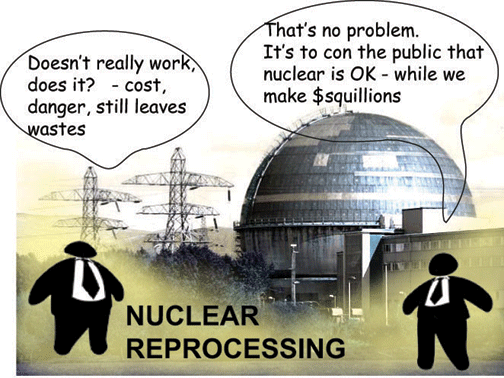
Especially serious are the ~20 large holding tanks at Sellafield containing thousands of litres of extremely radiotoxic fission products. Discussing these tanks, the previous management consortium Nuclear Management Partners stated in 2012:
“there is a mass of very hazardous [nuclear] waste onsite in storage conditions that are extraordinarily vulnerable, and in facilities that are well past their designated life.”
most of all, we should recognize that nuclear policies, in both weapons and energy, have poorly served the nation.
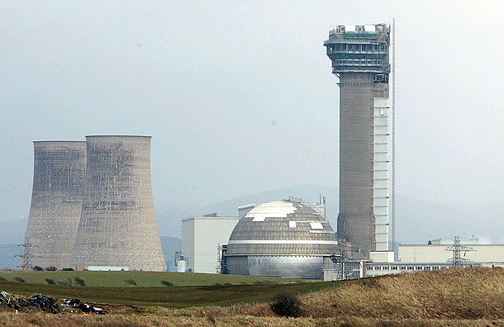 Sellafield exposed: the nonsense of nuclear fuel reprocessing http://www.theecologist.org/reviews/2988095/sellafield_exposed_the_nonsense_of_nuclear_fuel_reprocessing.html Ian Fairlie 6th September 2016 Last night’s BBC Panorama programme did a good job at lifting the lid on Britain’s ongoing nuclear disaster that is Sellafield, writes Ian Fairlie. But it failed to expose the full scandal of the UK’s ‘reprocessing’ of spent fuel into 50 tonnes of plutonium, enough to build 20,000 nuclear bombs – while leaving £100s of billions of maintenance and cleanup costs to future generations.
Many readers will have seen the interesting Panorama programme on the poor safety record at Sellafield broadcast on BBC1 last night.
The BBC press release stated this was a “special investigation into the shocking state of Britain’s most hazardous nuclear plant” – and it certainly was.
The most important of several whistleblower revelations was that the previous US managers had been shocked at the state of the plant when they took over its running in 2008.
Although the programme producers are to be congratulated for tackling the subject, it was only 30 minutes long and tells only a fragment of the whole sorry story.
This article tries to give more background information, and importantly, more analysis and explanation. The full story would require several books, and provide exceedingly painful reading.
What is reprocessing for? Continue reading
More frequent, more powerful Super Typhoons, with climate change
 Is not the push for nuclear reactors in East Asia (almost always located on coast) a dangerous trend, in view of increasing typhoons?
Super typhoons becoming more powerful and more frequent, new study finds, SMH, Peter Hannam 6 Sept 16 The most destructive categories of tropical storms to strike the heavily populated regions of east Asia are becoming more intense and increasing as much as four-fold in frequency because of climate change, according to new research by US-based scientists.

Since the late 1970s, typhoons making land in a region stretching from Vietnam and the Philippines to Korea and Japan have become 12 per cent to 15 per cent more intense.
Those hitting south-east Asia with a category 4 or 5 strength have more than doubled in number, with the increase even more for China and Taiwan and regions north, the paper published in Nature Geoscience on Tuesday found.
The increase in sea-surface temperature is key to providing extra energy to tropical storms, with the outcome for the megacities of the region looking grimmer……..
“The intensification is strongest for typhoons that tend to make landfall because of the stronger warming of the coastal waters near east and south-east Asia,” said Wei Mei, a researcher in the department of marine sciences at the University of South Carolina and co-author of the paper.
Additional warming is expected to intensify the storms, particularly in some of east Asia’s main economic centres, Dr Mei said: “The typhoons striking mainland China, Taiwan, Japan, and Korea will intensify further because of the faster warming of waters of 20 degrees north.”…….
The north-west Pacific basin has both the largest data set of super typhoon-strength storms and the clearest trend towards intensification as the planet warms, Steve Turton, an adjunct professor at the Central Queensland University, said.
This year has also been an active one for the region………http://www.smh.com.au/environment/climate-change/super-typhoons-becoming-more-powerful-and-more-frequent-new-study-finds-20160905-gr8rch.html
1 This Month
Chernobyl: The Lost Tapes – A good documentary on Chernobyl on SBS available On Demand for the next 3 weeks– https://www.sbs.com.au/ondemand/tv-program/chernobyl-the-lost-tapes/2352741955560

of the week–London Campaign for Nuclear Disarmament

Tell the Ukrainian Government to Drop Prosecution of Peace Activist Yurii Sheliazhenko
To see nuclear-related stories in greater depth and intensity – go to https://nuclearinformation.wordpress.com
-
Archives
- April 2026 (152)
- March 2026 (251)
- February 2026 (268)
- January 2026 (308)
- December 2025 (358)
- November 2025 (359)
- October 2025 (376)
- September 2025 (257)
- August 2025 (319)
- July 2025 (230)
- June 2025 (348)
- May 2025 (261)
-
Categories
- 1
- 1 NUCLEAR ISSUES
- business and costs
- climate change
- culture and arts
- ENERGY
- environment
- health
- history
- indigenous issues
- Legal
- marketing of nuclear
- media
- opposition to nuclear
- PERSONAL STORIES
- politics
- politics international
- Religion and ethics
- safety
- secrets,lies and civil liberties
- spinbuster
- technology
- Uranium
- wastes
- weapons and war
- Women
- 2 WORLD
- ACTION
- AFRICA
- Atrocities
- AUSTRALIA
- Christina's notes
- Christina's themes
- culture and arts
- Events
- Fuk 2022
- Fuk 2023
- Fukushima 2017
- Fukushima 2018
- fukushima 2019
- Fukushima 2020
- Fukushima 2021
- general
- global warming
- Humour (God we need it)
- Nuclear
- RARE EARTHS
- Reference
- resources – print
- Resources -audiovicual
- Weekly Newsletter
- World
- World Nuclear
- YouTube
-
RSS
Entries RSS
Comments RSS
 nuclear-news