The miserable and ongoing history of EDF’s unfinished nuclear reactors in Flamanville and Olkiluoto
The £18bn Hinkley gamble: Nuclear deal will cost every UK family an extra £1,000 as May signs off on the plans to protect Britain’s national security
- Prime Minister approved plans after restricting influence of Chinese state
- Britain will guarantee EDF £92.50 per megawatt hour, up on current market price of £38.91
- Tory MP Zac Goldsmith said the plant would generate ‘most expensive energy in the history of energy generation’
By JASON GROVES DEPUTY POLITICAL EDITOR FOR THE DAILY MAIL, 16 Sept 16 “……..Construction at the site near Cherbourg began in 2007, with a scheduled completion date of 2012. But within a year, cracks were found in the concrete base and a quarter of the welds in the reactor’s secondary steel lining were found to be defective.
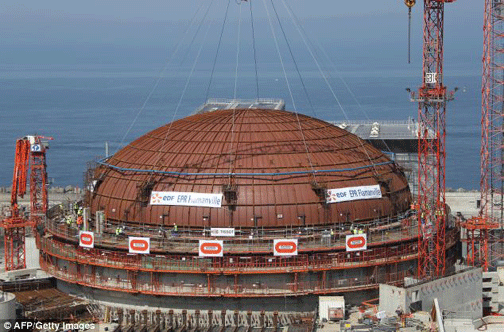
Inspections also revealed holes in concrete pillars and faults in buildings where nuclear fuel is to be stored.
A report by France’s nuclear safety authority in 2011 recorded 13 incidents of sub-standard safety measures. In 2013, a welder fell to his death. Then last year defects were discovered in safety valves in the cooling system.
Chillingly, this was similar to a problem that led to the Three Mile Island nuclear plant accident in Pennsylvania in 1979, which before Chernobyl was the world’s worst nuclear accident, and resulted in $1billion (£750million) of clean-up costs.
It was also in 2015 that Flamanville suffered a potentially killer-blow.
Tests on the steel used to construct the base and lid of the nuclear reactor vessel showed that too much carbon had been used, leading to weaknesses in the structure.
Professor Steve Thomas, of the University of Greenwich, said that if this led to the reactor failing, there would be no warning. ‘It will fail catastrophically and allow its radioactive contents into the environment,’ he said.
For their part, EDF and its project partner – the majority French state-owned company Areva, which makes nuclear reactors – have been forced to make more tests on the steel.
At the time the faults were found, the Financial Times said: ‘The scale of the risks to EDF if those tests identify a serious problem is hard to exaggerate.’
Whatever the findings of these new tests, Flamanville’s opening date – which has already been put back six years – is still nowhere in sight.
Professor Thomas warns that if it has to be rebuilt, the process could take up to five years, adding: ‘That might be prohibitively expensive and the whole plant could be abandoned.’
All this assumes that government-owned EDF doesn’t go bust in the meantime – which is a possibility.
In March, the company’s finance director Thomas Piquemal resigned, saying that taking on Hinkley as a project risked driving the firm to bankruptcy. Problems were compounded by the fact that Areva has had to be bailed out by the French government, with an injection of £3.4billion of public money in April. Inevitably, the European Commission has launched an investigation into this rescue package to check it did not ‘unduly distort competition’.
For some time, Areva – which is 87 per cent owned by the state – had been struggling with a downturn in the nuclear industry and has suffered big financial losses on its projects.
Once the pride of France, the reactor designer saw its credit rating downgraded last year, and in February it reported a €2billion (£1.7billion) net loss for 2015.
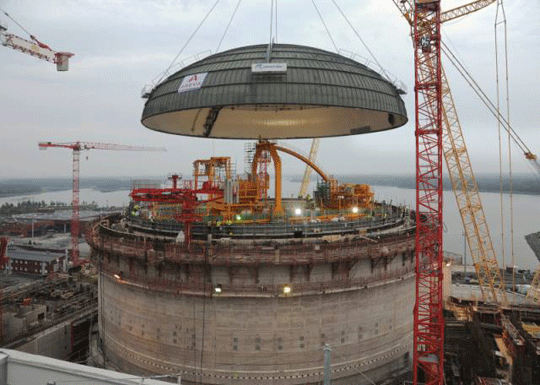
The project been subject to lawsuits, technology failure, construction errors and a bitter row between participant companies that has been described as ‘one of the biggest conflicts in the history of the construction sector’.
Work began on the EPR in 2005 and was scheduled to be completed in 2009. But from early on, problems emerged.
The concrete base on which the plant was to be built proved to be faulty, and had to be taken up and relaid. Then there was a problem with the electronic control systems.
Because it is absolutely vital that engineers can manage the temperature inside the reactor, a new nuclear plant must have two parallel control systems in case one fails.
The problem at Olkiluoto was that the two systems were too similar – meaning that if something caused the first one to shut down, there was a big risk that the second one would also close down.
The issue took five years to resolve – with the result that the power station is not expected to open until 2018 at the earliest.
Not surprisingly, the Finnish government has cancelled an option to buy a second reactor.http://www.dailymail.co.uk/news/article-3791895/The-18bn-Hinkley-gamble-nuclear-deal-cost-UK-family-extra-1-000-signs-plans-protect-Britain-s-national-security.html
Chaotic planning in South Africa: nuclear power not necessary
 Nuclear power call is based on outdated plans, warns Yelland, BD Live South Africa
BY CHARLOTTE MATHEWS, 16 SEPTEMBER 2016, SA DID not need to commission huge new inflexible nuclear power capacity because the government’s chaotic planning meant there was a big chance the country would have a surplus of electricity in the next few years, Chris Yelland, the MD of EE Publishers, said on Thursday.
“SA does not have an energy crisis, it has a management crisis,” he said.
Yelland was speaking at the launch of Powermode’s monitoring portal, shortly after Energy Minister Tina Joemat-Pettersson said a request for proposals for 9,600MW of nuclear power would be issued on September 30.
Yelland said government figures released in Parliament this week showed electricity demand since 2011 had trended significantly lower than in the low-growth scenario in the outdated 2010 Integrated Resource Plan, and its 2013 update. Flagging demand reflected slow global growth in recent years and an economy moving towards lower energy intensity.
“Government cannot forecast correctly for five years, let alone 50. If SA moves to nuclear newbuild, it is committing to one vendor for 9,600MW, based on 2010 estimates, which are clearly wrong.”………..
Members of the Energy Intensive Users Group, SA’s biggest power consumers, were installing more solar power to reduce their reliance on Eskom.
As Eskom’s market share was shrinking, its unit costs were rising, requiring ever-higher tariffs, which in turn forced more customers to become self-sufficient. Yelland said Eskom’s next application to recover costs was likely to be for a R22bn clawback, double what it was allowed in 2016.
In the past decade, Eskom’s tariffs have risen fourfold in nominal terms and were now increasing at double its historical average, adjusted for inflation.
Yelland said SA had to move away from centralised planning to a market-driven model for power-generation and create more distributed generation rather than generating most of its power on the Highveld. It needed a greater mix of different sources, not a large amount of new nuclear power. All this would provide the flexibility to meet changing demand patterns.http://www.bdlive.co.za/business/energy/2016/09/16/nuclear-power-call-is-based-on-outdated-plans-warns-yelland
Subsidies to France’s EDF, problems with France’s reactor build – UK MPs and analysts not happy about Hinkley nuclear decision
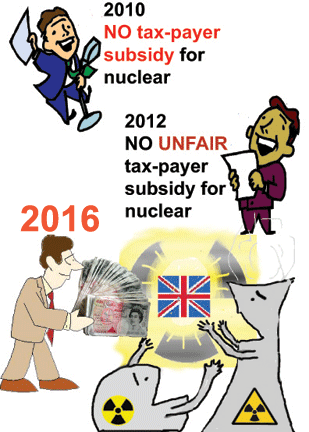 MPs and analysts issue fresh nuclear warnings over Hinkley Point project, Business Matters, 16 Sept 16 Fresh warnings have been triggered over the cost, security, and deliverability of Britain’s first new nuclear reactors for decades following yesterday’s green light for the £18bn build at Hinkley Point in Somerset. Hinkley Point C will be built by France’s EDF with £6bn of
Chinese investment. It is effectively subsidised by the UK taxpayer under the terms of the guaranteed “strike price” that will be paid by consumers for the electricity generated, reports City AM.
This price is more than twice the current wholesale price of electricity, prompting the Energy Intensive Users Group to describe the subsidy as “astonishingly generous”.
Conservative MP Zac Goldsmith said the deal would produce “the most expensive energy in the history of energy generation”.
The Chinese state-backed firm that is investing in Hinkley, CGN, intends to take a majority stake in another reactor at Bradwell, in Essex. However, this has fuelled security concerns over Chinese involvement in UK strategic infrastructure.
“China has said it has ambitions to proceed with [Bradwell] but having China or a Chinese company running a nuclear reactor like that is always going to be difficult for national security concerns, so I’m not sure how you can bridge that gap,” said Alan Mendoza, executive director at The Henry Jackson Society……..There are also doubts over whether the reactors can be built in the allotted timeframe, and as to whether they can bridge the UK’s looming energy supply gap.
The new reactors are due for completion in 2023 but Whitman Howard utilities analyst Angelos Anastasiou believes a timescale of 2025 to 2030 is more realistic.
“Approval of Hinkley C is necessary but not sufficient to avoid a future supply crunch,” said Jeremy Nicholson, director of the Energy Intensive Users Group…….
the cost to billpayers will be substantial. It will be necessary to maintain a focus on cost for future plants,” Institute of Directors (IoD) chair Lady Barbara Judge said. She also said that despite the costs of the Hinkley project, the move signals a clear geo-political strategy being pursued in Whitehall.She added: “Approving Hinkley shows that the government believes China is an important and strategic market for Britain.”……….http://www.bmmagazine.co.uk/newswire/mps-analysts-issue-fresh-nuclear-warnings-hinkley-point-project/
West not keeping its commitment for Iran trade, in nuclear deal
West failing to deliver nuclear deal promises, says Iran vice-president
Ali Akbar Salehi attacks lack of progress on banking transactions and trade eight months after landmark agreement, Guardian, Saeed Kamali Dehghan, 17 Sept 16, Iran has fully complied with its commitments under last year’s landmark nuclear agreement, but eight months after the official removal of sanctions, the west is failing to deliver on its promises, the country’s vice president has told the Guardian.
Ali Akbar Salehi, the head of the country’s Atomic Energy Organisation, said that if the agreement was to remain intact, both sides had to meet their commitments.
The US-educated scientist, who also served as a former foreign minister of Iran, was the second most senior Iranian negotiator in nearly two years of talks between Tehran and world’s six leading powers that led to the final nuclear accord, known as the joint comprehensive plan of action (JCPOA), in Vienna in July 2015. The deal was implemented in January, and triggered the removal of sanctions.
“As has been stated by the International Atomic Energy Agency (IAEA), Iran has remained committed to its commitments,” Salehi said. “While the other side – it’s very clear now to public opinion and it’s not a secret – has not really delivered on the promises; that the sanctions would be removed and that banking transactions would go back to normal, that trade would speed up and economic relations would be enhanced. These have not been materialised to the extent that we expected.”……..
Although nuclear-related sanctions were lifted in January, big European banks remain reluctant to do business with Iran. European banks are concerned about existing US sanctions relating to terrorism as well as uncertainty in the US before the election of a new president…….
The banking issue has prevented Iran from capitalising on the interest shown by western businesses in returning to the country, or finalising lucrative deals with the west, such as the purchase of planes from Airbus and Boeing. Iran’s central bank chief told the Guardian in May that Tehran was still locked out of global financial system……..
The fate of the nuclear agreement will affect the next presidential elections in Iran, which are scheduled for spring next year. President Hassan Rouhani is seeking re-election and opponents, including former president Mahmoud Ahmadinejad, have indicated their willingness to challenge him. Rouhani would have to show Iranians tangible relief from sanctions if he is to maintain their support.
Relations between Tehran and London have significantly improved since the nuclear agreement, with both sides appointing new ambassadors in their respective capitals this month after nearly a five-year hiatus. https://www.theguardian.com/world/2016/sep/16/west-failing-deliver-nuclear-deal-promises-iran-vice-president-ali-akbar-salehi
South African govt says no nuclear deals made, but now there is one!
Zuma pals clinch first nuclear deal, Mail and Guardian, Jessica Bezuidenhout 16 Sep 2016 Shantan Reddy, the son of President Jacob Zuma’s friend Vivian Reddy, has clinched what appears to be a landmark deal for the country’s controversial multibillion-rand nuclear programme.
Details of the R171-million contract for “the procurement of the nuclear build programme management system” emerged after an innocuous-looking entry appeared on the department of energy’s website.
Listed under the category “awarded bids”, it is scant on detail, simply naming the winning bidder of BAC-10/2016 as Central Lake Trading 149, a company trading as Empire Technology.
The little-known company’s sole director is Shantan Reddy, the son of flamboyant power and property mogul Vivian Reddy, a longtime friend of the president.
Although there is no suggestion of wrongdoing on the part of Reddy or his company, the awarding of this contract has set off alarm bells with industry experts and politicians because the government continues to maintain that it has not entered into any nuclear deal.
The contract awarded to Reddy’s company, if indeed linked to the “nuclear build”, as stated by the energy department, suggests that work may have already begun behind the scenes.
“Considering that the minister of energy is on record stating no deal has been signed and the deputy president [has said] that South Africa will not commence on nuclear if it can’t afford it, the issuance of a contract is highly irregular,” said Gordon Mackay, the Democratic Alliance’s spokesperson on energy.
The Mail & Guardian briefly spoke to Shantan Reddy about the energy department deal. He asked for questions to be sent on SMS but did not respond by deadline….. (subscribers only) http://mg.co.za/article/2016-09-16-00-zuma-pals-clinch-first-nuclear-deal
Australia’s secret shame – the Maralinga nuclear bomb tests
This March, documents obtained exclusively by news.com.au revealed that hundreds of children and grandchildren of veterans exposed to radiation were born with shocking illnesses including tumours, Down syndrome, cleft palates, cerebral palsy, autism, missing bones and heart disease.
Other veterans posted to the Maralinga nuclear test site blamed the British Nuclear Test for an unusually high number of stillbirths and miscarriages among the group.
“The rest of the Aboriginal people in this country need to know the story as well,” “This one’s been kept very quiet.”
Nuclear will be on show at the National Aboriginal Cultural Institute in Adelaide, South Australia from 17 September to 12 November.
 The secret destruction of Australia’s Hiroshima, http://www.news.com.au/lifestyle/real-life/news-life/the-secret-destruction-of-australias-hiroshima/news-story/9eabf722dbe2f87e03a297c2a348a8e1 news.com.au, SEPTEMBER 17, 2016 WHEN nuclear explosions tore through Australia’s vast, arid centre, some people living there didn’t even know it was coming.
It devastated the country for miles around, annihilating every bird, tree and animal in its path.
Even today, the effects of our very own Hiroshima are still felt by the families it ripped apart, and those suffering horrific health problems as a result.
The British military detonated seven nuclear bombs in remote Maralinga, around 800km north-west of Adelaide, plus two at Emu Fields and three off the coast near Karratha, Western Australia.
They also staged hundreds of minor trials investigating the impact of non-nuclear explosions on atomic weapons, involving tanks, gun, mannequins in uniforms and even tethered goats. In many ways, these smaller tests were equally dangerous, spraying plutonium in all directions.
Yet most Australians know very little about the blasts that shattered communities, and the dramatic story now buried under layers of dust.
Archie Barton was just a child when the nuclear testing took place between 1956 and 1963, stretching across a huge now uninhabitable 120km of land where he and thousands of others lived.
“He was taken away from his mother,” his stepson Steve Harrison tells news.com.au. “He was part of the Stolen Generations. He grew up in homes around Australia, and led a very rough life.
“Before my mum, he was a full-blown alcoholic. He wanted to go back to his birthplace.
“He came into my life at a very young age. I was 14. I knew him as a strong, proud Aboriginal black man. He ended up getting an OBE.”
‘CHEAP AND NASTY SOLUTION’
Mr Barton’s family was not the only one scattered by the bombs. Many walked for days or even weeks to find new homes, deliberately going barefoot so their relatives could follow behind. British soldiers repeatedly turned them back south when they tried to head north.
Unsurprisingly, many never found each other.
“They were dispersed pretty much to the four points of the compass,” said Paul Brown, creative director of new showcase Nuclear, featuring Mr Harrison’s artwork. “It represented a massive dislocation from the watering holes and places that were important to Aboriginal people.
“If Aboriginal people weren’t caught up in the blast, it was by sheer luck, not design.
“People were very close at the time of the blast, they even had to take people into the decontamination area to scrub them down.”
Decades later, 57-year-old Mr Harrison’s village still isn’t a safe place for humans to live, despite numerous attempts to decontaminate the area, in 1967, 1985 and the late 1990s.
Ian Anderson’s 1993 New Scientist article “Britain’s dirty deeds at Maralinga” exposed negotiations between the UK and Australia to dispose of toxic plutonium that had been lightly covered with soil instead of being buried in concrete bunkers.
And as recently as 2007, nuclear engineer Alan Parkinson claimed the latest $100 million clean-up was a “cheap and nasty solution”.
IT RUINED QUITE A LOT OF LIVES’
The Anandu people fled to Oak Valley, Yalata, Renmark and almost anywhere between Kalgoorlie in WA and Adelaide.
Torn from family members and their homes, indigenous communities saw the consequences travel down the generations. Alcoholism is one of the biggest problems, along with drugs, crime, homelessness and lack of acceptance from new towns where these displaced people live on the fringes.
The Royal Commission found evidence of terrible disabilities caused by likely radiation impacts on both veterans and Aboriginal communities.
This March, documents obtained exclusively by news.com.au revealed that hundreds of children and grandchildren of veterans exposed to radiation were born with shocking illnesses including tumours, Down syndrome, cleft palates, cerebral palsy, autism, missing bones and heart disease.
Other veterans posted to the Maralinga nuclear test site blamed the British Nuclear Test for an unusually high number of stillbirths and miscarriages among the group.
A 2008 Department of Veterans’ Affairs study reported that the doses to Australians were small, with a spokesman tellingnews.com.au that studies into the descendants of Hiroshima and Nagasaki nuclear bombs survivors showed they “do not have an increased frequency of chromosome abnormalities or major birth defects.”
Yet a 1999 study for the British Nuclear Test Veterans Association found that 30 per cent of involved veterans had died from cancer, mainly in their 50s.
Troops flew through mushroom clouds from explosions without protection and marched to ground zero immediately after bomb detonation. Airborne drifts of radioactive material resulted in “radioactive rain” being dropped on Brisbane and Queensland country areas.
“When they created this problem, they didn’t picture it at the end,” says Mr Harrison. “People are fighting for their existence.
“We can go back, but cannot go back and live there. It’s ruined quite a lot of lives.
“I see people who’ve been taken away coming back trying to reconnect with family. Most now live in Yalata on the Nullabor Plains.
“It was so sad, so hard. You need to grow up with family from a young age. Now they’re telling people they’ve got to leave communities in the Northern Territory, they’re closing down a lot of these communities.”
THIS ONE’S BEEN KEPT QUIET’
The Maralinga bombs were set off in a way that officially satisfied safe firing requirements. The detonations were even celebrated as a “great success” in The Advertiser.
But Mr Brown says there is evidence the military was “deliberately misleading the public about the likely impact.”
Britain’s Parliament last year issued a statement of recognition and set up a benevolent fund for veterans who took part in the nuclear tests.
Mr Brown hopes his exhibition, 60 years on from the blasts, will show that these are not simply stories about victims. “Often people have gone on the front foot,” he said. “In Japan, the Hibakusha are world leaders in the peace movement. They’ve taken it upon themselves to campaign for disarmament and world peace.”
Mr Harrison, who has visited Hiroshima and Nagasaki survivors in Japan and presented them with a sculpture, says his main concern is making sure Australians know what happened in their own country.
“The rest of the Aboriginal people in this country need to know the story as well,” he added.
“This one’s been kept very quiet.”
Nuclear will be on show at the National Aboriginal Cultural Institute in Adelaide, South Australia from 17 September to 12 November.
Russia has not changed its nuclear weapons doctrine -Non-Proliferation Treaty (NPT) conference
Russian Nuclear Doctrine Unchanged Despite Escalation Claims, Sputnik News, 16 Sept 16 – Official Russia has stressed to its four Non-Proliferation Treaty (NPT) nuclear state partners that claims of it lowering its threshold for nuclear weapon use and increasing its military doctrine’s reliance on nuclear weapons are untrue, a senior official from the Russian Foreign Ministry told Sputnik…….
The five countries, known as the P5 group, include Russia, the United States, the United Kingdom, France and China. The international NPT treaty took effect in 1970 and has been ratified by 191 governments………
“Therefore, the possibility of any preventive offensive actions with the use of the nuclear weapons threat is not implied,” he added. The comments come as a rebuke to several claims previously made by NATO officials with regard to Russia allegedly modernizing its nuclear forces……..
“We noted that the US nuclear doctrine is practically oversized, envisioning use of nuclear weapons for protection of vital interest, which could include almost all purposes,” Leontyev said. These interests can be anything defined as such by the United States, including the global economy and international laws, he emphasized…….
Russia did not receive any official initiatives from the United States on renewing the treaty, but will consider them should Washington offer them, Leontyev said. “There were no official initiatives. We shall consider them if we receive them,” he said………https://sputniknews.com/russia/20160917/1045395099/russian-nuclear-doctrine-unchanged.htm
America giving up on the Mixed Oxide Nuclear Fuel (MOX) boondoggle
“The first question I asked was why if she mistakenly skipped over MOX. This is the largest federal construction project in the nation right now,” Jameson said. “The answer was no. She [National Nuclear Administration Principal Deputy Administrator Madelyn Creedon ]said they left it out on purpose, that they’re trying to get rid of it so they weren’t going to talk about it.”
to box up the project and move to another method of plutonium disposal known as dilute and dispose.
The NNSA has said the alternative is cheaper, citing life-cycle costs of MOX in the $50 billion to $60 billion range.
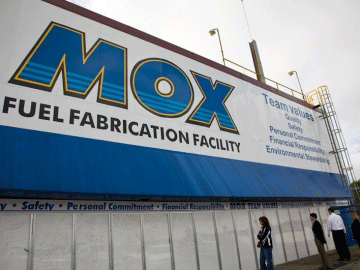 Aiken official: Savannah River Site’s MOX purposefully left out of NNSA discussion http://www.aikenstandard.com/article/20160914/AIK0101/160919745 Thomas Gardiner Email @TGardiner_AS The speaker from the National Nuclear Security Administration at the Energy Communities Alliance meeting in Arlington, Virginia, this week intentionally snubbed the Mixed Oxide Fuel Fabrication Facility, or MOX, under construction at the Savannah River Site, one Aiken official said.
Due to its relation to the Site, Aiken has delegate members that make up the ECA, an organization of local governments adjacent to or affected by Department of Energy activities that meet to discuss issues, establish policy positions and promote community interests.
On Tuesday, Greater Aiken Chamber of Commerce President and CEO David Jameson and Aiken County Councilman Chuck Smith were both in attendance, where National Nuclear Administration Principal Deputy Administrator Madelyn Creedon addressed NNSA projects nationwide.
But Jameson said even with Smith, who is the current ECA chairman, seated just down the table from her, Creedon deliberately passed over the MOX project.
“The first question I asked was why if she mistakenly skipped over MOX. This is the largest federal construction project in the nation right now,” Jameson said. “The answer was no. She said they left it out on purpose, that they’re trying to get rid of it so they weren’t going to talk about it.”
Nearly $5 billion has been poured into the monolithic building thus far, setting the stage for ripe political debate.
Legislators that include U.S. Sens. Tim Scott, R-S.C., and Lindsey Graham, R-S.C., along with U.S. Rep. Joe Wilson, R-S.C., have battled the NNSA and the Obama administration, who have driven for months to box up the project and move to another method of plutonium disposal known as dilute and dispose.
The NNSA has said the alternative is cheaper, citing life-cycle costs of MOX in the $50 billion to $60 billion range.
U.S. Secretary of Energy Ernest Moniz mirrored Creedon’s presentation this week with his own comments at the Carnegie Endowment for International Peace.
Moniz said, “We are in no man’s land, where we spend enough money to not get anywhere. There is no way that Congress is going to commit to spending a billion dollars a year for half a century to dispose of 34 metric tons of plutonium.”
MOX is part of a plutonium disposal agreement with Russia inked in 2000. In the interest of non-proliferation, the two nations bilaterally agreed to destroy or disposition plutonium that would never again be usable in nuclear weapons.
According to Congressional testimony by Under Secretary for Nuclear Security and NNSA Administrator Retired Lt. Gen. Frank G. Klotz, USAF in May, the Obama administration wants to move away from MOX to the dilute and dispose method, which doesn’t change the physical properties or chemical makeup of the plutonium, without getting approval of the Russians
Reports in Russian media said President Vladimir Putin sees the move to dilute and dispose as being outside of the agreement.
Moniz responded to Russian complications at the Carnegie Endowment.
“We do have a few other issues to deal with Russia at this time, and it’s maybe not the most (favorable) time for that question, as President Putin has pointed out,” he said.
Meanwhile, Congress is currently funding MOX at about $350 million a year, which, according to the NNSA, is enough to keep the construction going, even if it is at a trickle. Funding for 2017 is not yet official but is included in all versions of the National Defense Authorization Act bill for the year. That bill is in inter-chamber conference, and legislators are hopeful it will be brought to the floor next week.
Nearly $5 billion has been poured into the monolithic building thus far, setting the stage for ripe political debate.
Legislators that include U.S. Sens. Tim Scott, R-S.C., and Lindsey Graham, R-S.C., along with U.S. Rep. Joe Wilson, R-S.C., have battled the NNSA and the Obama administration, who have driven for months to box up the project and move to another method of plutonium disposal known as dilute and dispose.
Life-cycle costs, however, are estimates from the time ground is broken until the mission is completed and the building’s purpose has been fulfilled entirely. Those costs can change drastically over time, especially considering what Jameson called the “slow-build” approach.
“I like to look at it this way,” Jameson said. “My wife and I were married 39 years ago. I know about how much our bills are, like mortgage payments, electricity, car payments and so on. Our wedding cost about $4,000 then, but would you ever say that the life-cycle cost of our wedding was $1.2 million?”
U.S. Secretary of Energy Ernest Moniz mirrored Creedon’s presentation this week with his own comments at the Carnegie Endowment for International Peace.
Moniz said, “We are in no man’s land, where we spend enough money to not get anywhere. There is no way that Congress is going to commit to spending a billion dollars a year for half a century to dispose of 34 metric tons of plutonium.”
MOX is part of a plutonium disposal agreement with Russia inked in 2000. In the interest of non-proliferation, the two nations bilaterally agreed to destroy or disposition plutonium that would never again be usable in nuclear weapons.
According to Congressional testimony by Under Secretary for Nuclear Security and NNSA Administrator Retired Lt. Gen. Frank G. Klotz, USAF in May, the Obama administration wants to move away from MOX to the dilute and dispose method, which doesn’t change the physical properties or chemical makeup of the plutonium, without getting approval of the Russians.
Reports in Russian media said President Vladimir Putin sees the move to dilute and dispose as being outside of the agreement.
Moniz responded to Russian complications at the Carnegie Endowment.
“We do have a few other issues to deal with Russia at this time, and it’s maybe not the most (favorable) time for that question, as President Putin has pointed out,” he said.
Meanwhile, Congress is currently funding MOX at about $350 million a year, which, according to the NNSA, is enough to keep the construction going, even if it is at a trickle. Funding for 2017 is not yet official but is included in all versions of the National Defense Authorization Act bill for the year. That bill is in inter-chamber conference, and legislators are hopeful it will be brought to the floor next week.
Thomas Gardiner covers energy, science and health topics for the Aiken Standard.
General Electric a big winner from UK’s Hinkley nuclear decision
GE wins $1.9 billion order from UK’s Hinkley Point nuclear plant, CNBC 16 Sept 16
General Electric said it will receive $1.9 billion for a contract to supply steam turbines, generators and other equipment to the Hinkley Point C project, the United Kingdom’s first new nuclear power plant in decades…….GE is also bidding on nuclear competitions in Finland, South Africa, Saudi Arabia, Egypt, India and China……
Britain follows up quixotic Brexit decision with quixotic Hinkley nuclear decision
Britain Does A Brexit On Nuclear Power Seeking Alpha Sep. 16, 2016 Keith Williams
Summary
Hinkley Point C nuclear project approved by UK Government: backs nuclear over renewable energy. Is this, like Brexit, a lonely position?
$23.7 billion construction cost financed by French ((EDF)) ($15.8 billion) and Chinese Government CGN ($7.9 billion); this cost excludes financing costs.
Completion 2025+, agreed power price 92.50 pounds/MWh in 2012 prices (double wholesale rate now) for 35 years regardless of wholesale price of power (consumers will make up difference).
Further nuclear projects planned in the UK by the EDF/CGN consortium.
GE an early beneficiary.
As everyone is getting used to Britain’s Quixotic decision to exit the EU, the British have done it again by deciding to go ahead with the massive Hinkley Point C nuclear reactor program, despite the fact that this locks Britain into expensive power for the next 35 years.
The Hinkley Point C story…….
The project is not without risk. Only four nuclear plants using the technology planned for Hinkley Point C are under construction. The two European plants under construction have had massive cost blowouts and neither is yet operational (see below).
The cost structure and completion date for Hinkley Point C has already grown considerably since the project was first announced. The guaranteed cost of power is twice what was first envisaged and completion has slipped by 8 years…. (registered readers only) http://seekingalpha.com/article/4006707-britain-brexit-nuclear-power
China planning to be dominant player in UK’s nuclear power industry
China plans central role in UK nuclear industry after Hinkley Point approval China General Nuclear aims to submit designs for Bradwell power station in Essex within weeks of Somerset approval, sources say, Guardian,
Graham Ruddick,16 Sept 16, China is set for a central role in Britain’s nuclear industry after the government gave the go-ahead for a new power station at Hinkley Point.
The Chinese company involved in the £18bn project plans to submit a design for a nuclear power station in Essex within weeks. China General Nuclear agreed to take a 33% stake in Hinkley Point C in Somerset, alongside the French energy group EDF, in return for leading the project at Bradwell, Essex…….
Secret nuclear management contract given to donor to South Africa’s President Zuma
‘Predatory elite’ eye nuclear deal http://mg.co.za/article/2016-09-16-00-editorial-predatory-elite-eye-nuclear-deal The looming nuclear deal that seems to be President Jacob Zuma’s biggest pet project (and will be South Africa’s biggest financial and construction deal ever, if it happens) has been questioned by many commentators, including MPs and civil society groups. The deal, which already has links with Russia’s notoriously oligarchic government, worries anyone who can see in it the largest opportunity yet for the looting of state resources by the group currently devoting all their means to that end.
The nation was told, in the National Assembly, that all the necessary checks would be put in place and that the legal and other hurdles would be diligently cleared before the deal went ahead. The intimation was that any serious obstacles to the deal would come to light and could possibly scupper it entirely – a prospect many would welcome.
But the nation was also told, by a different minister in the other House of Parliament, that it was full steam ahead on the project – with the intimation that no objections would be allowed to stand in its way.
The first utterance came from Deputy President Cyril Ramaphosa, who seems to have been given the job of placating the objectors and the intelligentsia, or anyone concerned about the ongoing plans of what unionist Zwelinzima Vavi long ago called “the predatory elite”.
The second utterance came from Zuma’s extremely loyal energy minster, Tina Joemat-Pettersson, so it was to be expected that she would show every sign of wanting to do his bidding as soon as possible.
It has emerged that a contract worth R171-million for a “programme management system” to help get the nuclear deal off the ground has been awarded, in practical secrecy, to a company called Empire Technology. This is wholly owned by Shantan Reddy, the son of controversial businessperson Vivian Reddy, who has given Zuma considerable financial support over the years, including a contribution to the building of the president’s family complex in Nkandla.
That so little is known about the company, and that the deal appears to have gone through so quickly, is cause for concern.
Is the nuclear deal going ahead or not? Will South Africa be taking adequate precautions to ensure that it doesn’t overly indebt the nation? Was the evidence collated and presented to Zuma’s Cabinet? There are no clear answers to any of these questions.
Without a rational and sensible evaluation of the logic of the deal, and an accounting of the costs and benefits to South Africa if it goes ahead, it can’t be seen as much more than another way for the predatory elite to milk money from the state.
South Africa: Jacob Zuma’s disastrous nuclear deal
Zupta’s nuclear deal: either we end it or it ends us, Politics Web, 16 Sept 16, Jacob Zuma’s nuclear deal will be disastrous for South Africa. It will literally bankrupt us, diverting billions of rands from poverty reduction projects, while producing a nuclear white elephant in two decades’ time. But it will make a lot of money for Zuma, the Guptas and ANC cronies in the short-term and they will be long gone by the time we feel the real pain.
In Parliament last week, Energy Minister Tina Joemat-Pettersson confirmed that government is going ahead with the nuclear procurement process and Public Enterprises Minister Lynne Brown confirmed that information on the process will not be made public. In other words: “We’re going to tie you into far more debt that you can ever repay, but this is none of your business.”
This morning, a DA-assisted Mail and Guardian investigation has revealed the first concrete signs of corruption associated with the nuclear deal. A R171 million contract for the “Nuclear New Build Programme Management System” has been issued, potentially irregularly, to the son of Vivian Reddy, a close friend and ally of President Jacob Zuma.
South Africans should be deeply concerned about the government’s nuclear project. Let’s be clear. It is in no way motivated by a genuine desire to secure South Africa’s energy future in the most cost effective and sustainable way. Rather, this huge project is going ahead because Zuma, the Guptas and other ANC elites stand to make millions in bribes and tenders.
Like the Arms Deal, Nkandla and the President’s new jet, there is no intention to use state resources judiciously in order to derive the maximum public benefit. And like these ill-conceived projects, the nuclear deal will have the ultimate effect of stealing from all of us, but particularly the poor, in order to enrich a small group of connected ANC cadres……….
In forging ahead with this ill-conceived plan, our hapless government is locking SA into an over-priced, outdated technology within Eskom’s monopoly, while blocking the development of renewables which are dynamic, increasingly cost-effective and more job-creating. It is no coincidence that Eskom is refusing to sign any new contracts with independent power producers…………http://www.politicsweb.co.za/opinion/zuptas-nuclear-deal-either-we-end-it-or-it-ends-us
Hinkley nuclear plant vulnerable to becoming a “stranded asset”
A Nuclear Lesson For Big Oil (And Vice Versa), Bloombeg Gadfly, 16 Sept 16 By Liam Denning It is a reasonable bet that the $24 billion Hinkley Point C nuclear power project in the U.K., due online in 2025, will neither be ready by 2025 nor cost just $24 billion. Indeed, it’s so reasonable that, as fellow Gadfly Chris Bryant lays out here, the stock market appears to be making that very same bet.
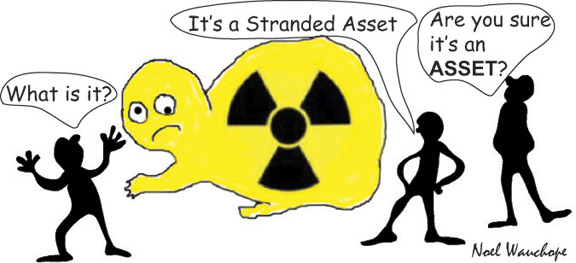
Leave aside the also reasonable conspiracy theories about London buttering up Paris and Beijing by approving the project and focus on the ostensible reason for doing it: maintaining security of energy supply……….
The oil and gas industry’s experience reveals one more insidious risk facing the nuclear project.
There’s a reason EDF demanded the U.K. government guarantee an electricity price for Hinkley Point’s output atdouble the current wholesale price. Financing a $24 billion project that won’t produce a cent of revenue for a decade is really tough — especially in an industry carrying as muchhistorical baggage on busted budgets and timescales as nuclear power does. Subsidies and guarantees help bridge the risk gap………
mega-projects can prove vulnerable not despite their scale but because of it. They might extract savings on, say, procurement, but their inherent complexity makes it hard to apply lessons from previous examples to gain efficiency. ……..
And once a company is several years into building a new power plant or LNG terminal, the compulsion to complete it is enormous, due to the already huge sunk costs (and need to save face), even if budgets and schedules have been blown through or — as was the case with fracking — another technology has disrupted the market……..
With energy technology in such flux right now, ranging from renewable power to batteries to energy efficiency, is there a high risk that a giant plant a decade or more away from completion becomes stranded? You bet…..……
In Hinkley Point’s case, of course, any future U.K. government wouldn’t dare try to wriggle out of those high, guaranteed power prices for fear of enraging the French. Because that’s never happened. https://www.bloomberg.com/gadfly/articles/2016-09-16/hinkley-point-nuclear-power-project-s-lesson-for-big-oil
1 This Month
Chernobyl: The Lost Tapes – A good documentary on Chernobyl on SBS available On Demand for the next 3 weeks– https://www.sbs.com.au/ondemand/tv-program/chernobyl-the-lost-tapes/2352741955560

of the week–London Campaign for Nuclear Disarmament

Tell the Ukrainian Government to Drop Prosecution of Peace Activist Yurii Sheliazhenko
To see nuclear-related stories in greater depth and intensity – go to https://nuclearinformation.wordpress.com
-
Archives
- April 2026 (139)
- March 2026 (251)
- February 2026 (268)
- January 2026 (308)
- December 2025 (358)
- November 2025 (359)
- October 2025 (376)
- September 2025 (257)
- August 2025 (319)
- July 2025 (230)
- June 2025 (348)
- May 2025 (261)
-
Categories
- 1
- 1 NUCLEAR ISSUES
- business and costs
- climate change
- culture and arts
- ENERGY
- environment
- health
- history
- indigenous issues
- Legal
- marketing of nuclear
- media
- opposition to nuclear
- PERSONAL STORIES
- politics
- politics international
- Religion and ethics
- safety
- secrets,lies and civil liberties
- spinbuster
- technology
- Uranium
- wastes
- weapons and war
- Women
- 2 WORLD
- ACTION
- AFRICA
- Atrocities
- AUSTRALIA
- Christina's notes
- Christina's themes
- culture and arts
- Events
- Fuk 2022
- Fuk 2023
- Fukushima 2017
- Fukushima 2018
- fukushima 2019
- Fukushima 2020
- Fukushima 2021
- general
- global warming
- Humour (God we need it)
- Nuclear
- RARE EARTHS
- Reference
- resources – print
- Resources -audiovicual
- Weekly Newsletter
- World
- World Nuclear
- YouTube
-
RSS
Entries RSS
Comments RSS
 nuclear-news