 Why a Donald Trump Victory Could Make Climate Catastrophe Inevitable, Michael Klare on the forces moving us toward an uninhabitable planet. Mother Jones, MICHAEL KLARE, SEP. 17, 2016 “……., the fate of the planet rests on the questionable willingness of each of those countries to abide by that obligation, however sour or bellicose its relations with other signatories may be. As it happens, that part of the agreement has already been buffeted by geopolitical headwinds and is likely to face increasing turbulence in the years to come.
That geopolitics will play a decisive role in determining the success or failure of the Paris Agreement has become self-evident in the short time since its promulgation. While some progress has been made toward its formal adoption—the agreement will enter into force only after no fewer than 55 countries, accounting for at least 55 percent of global greenhouse gas emissions, have ratified it—it has also encountered unexpected political hurdles, signaling trouble to come…….
Great Britain’s astonishing Brexit vote has complicated the task of ensuring the European Union’s approval of the agreement, as European solidarity on the climate issue—a major factor in the success of the Paris negotiations—can no longer be assured. “There is a risk that this could kick EU ratification of the Paris Agreement into the long grass,” suggests Jonathan Grant, director of sustainability at PricewaterhouseCoopers.
The Brexit campaign itself was spearheaded by politicians who were also major critics of climate science and strong opponents of efforts to promote a transition from carbon-based fuels to green sources of energy. For example, the chair of the Vote Leave campaign, former Chancellor of the Exchequer Nigel Lawson, is also chairman of the Global Warming Policy Foundation, a think tank devoted to sabotaging government efforts to speed the transition to green energy. Many other top Leave campaigners, including former Conservative ministers John Redwood and Owen Paterson, were also vigorous climate deniers.
In explaining the strong link between these two camps, analysts at the Economistnoted that both oppose British submission to international laws and norms: “Brexiteers dislike EU regulations and know that any effective action to tackle climate change will require some kind of global cooperation: carbon taxes or binding targets on emissions. The latter would be the EU writ large and Britain would have even less say in any global agreement, involving some 200 nations, than in an EU regime involving 28.”……..
In his first major speech on energy, delivered in May, Trump—who has called global warming a Chinese hoax—pledged to “cancel the Paris climate agreement” and scrap the various measures announced by President Obama to ensure US compliance with its provisions. Echoing the views of his Brexit counterparts, hecomplained that “this agreement gives foreign bureaucrats control over how much energy we use on our land, in our country. No way.” He also vowed to revive construction of the Keystone XL pipeline (which would bring carbon-heavy Canadian tar sands oil to refineries on the Gulf Coast), to reverse any climate-friendly Obama administration acts, and to promote the coal industry. “Regulations that shut down hundreds of coal-fired power plants and block the construction of new ones—how stupid is that?” he said, mockingly……..
nationalistic exceptionalism could become something of the norm if Donald Trump wins in November, or other nations join those already eager to put the needs of a fossil-fuel-based domestic growth agenda ahead of global climate commitments. With that in mind, consider the assessment of future energy trends that the Norwegian energy giant Statoil recently produced. In it is a chilling scenario focused on just this sort of dystopian future………
Indeed, the future pace of climate change will be determined as much by geopolitical factors as technological developments in the energy sector. While it is evident that immense progress is being made in bringing down the price of wind and solar power in particular—far more so than all but a few analysts anticipated until recently—the political will to turn such developments into meaningful global change and so bring carbon emissions to heel before the planet is unalterably transformed may, as the Statoil authors suggest, be dematerializing before our eyes. If so, make no mistake about it: We will be condemning Earth’s future inhabitants, our own children and grandchildren, to unmitigated disaster…….
To avoid an Eaarth (as both Bill McKibben and the Statoil authors imagine it) and preserve the welcoming planet in which humanity grew and thrived, climate activists will have to devote at least as much of their energy and attention to the international political arena as to the technology sector. At this point, electing green-minded leaders, stopping climate deniers (or ignorers) from capturing high office, and opposing fossil-fueled ultranationalism is the only realistic path to a habitable planet.
Michael T. Klare is a professor of peace and world security studies at Hampshire College and the author, most recently, of The Race for What’s Left. http://www.motherjones.com/environment/2016/09/donald-trump-brexit-paris-accord-climate-change
September 19, 2016
Posted by Christina Macpherson |
2 WORLD, climate change, USA elections 2016 |
Leave a comment
 Deadly Radioactive Dust and Dying Children: US-NATO Use of Depleted Uranium (DU) Ammunition http://www.globalresearch.ca/deadly-radioactive-dust-and-dying-children-us-nato-use-of-depleted-uranium-du-ammunition/5545973
Award-Winning Filmmaker Shunned for Exposing the Truth The fate of Frieder Wagner is a peculiar example of what happens when you stand up to the establishment’s injustice. A notable director who won the prestigious German Grimme Award, responsible for numerous documentaries for the ARD and ZDF channels, he quickly became a pariah after making a movie called Deadly Dust (Todesstaub) about the use of depleted uranium (DU) shells by NATO forces in the Middle East and in the former Yugoslavia.
In an exclusive interview with Sputnik, Wagner explained that Deadly Dust is based on an earlier documentary called The Doctor, the Depleted Uranium, and the Dying Children (Der Arzt und die verstrahlten Kinder von Basra) that he filmed for WDR. In April 2004 the movie was screened during the anniversary of the Chernobyl nuclear disaster. But even though that autumn it received the ÖkoMedia award, it was never screened again. And no matter what ideas he came up with, the TV channels that he previously worked with stopped sending him new orders for some reason.
“I contacted a head of the WDR editorial office whom I’d worked with before and asked him what happened. He paused for a second and then told me “The WDR editorial office considers you a ‘difficult’ person. And most importantly, the topics you suggest are especially hard. Right now I’ve got nothing more to tell you”,” Wagner explained.
He added that about a year ago he met with Siegesmund von Ilsemann, an editor at Spiegel magazine who wrote a comprehensive report about the ‘deadly dust’ and its effects, and who revealed to the astonished director that the use of depleted uranium by the military literally became a taboo subject in Germany.
“He told me that the issue of DU munitions use and its consequences became taboo in Germany. And no TV channel or newspaper would allow even him – a person who worked on this subject for a long time – to publish anything related to it,” Wagner added.
DU shells are made of byproducts of uranium enrichment. Their superior armor-piercing capabilities make them a potent anti-tank weapon, especially considering that when an armored vehicle gets hit by such a shell, the impact and subsequent release of heat energy causes it to ignite, incinerating the target’s interior. But it’s the ‘deadly dust’ produced by a DU shell detonation that is probably the most insidious aspect of this type of ordnance.
“At such a high temperature the substance – depleted uranium – burns down to nano-particles, each of them a hundred times smaller than a red blood cell. And due to their extremely small size, these particles ‘travel’ through a human body, infiltrating brain, lungs, kidneys, placenta, bloodstream and even sperm and egg cells which causes severe developmental diseases in newborns,” Wagner said.
According to him, US forces actively used DU munitions in Kosovo, Somalia, Libya and during both Iraqi campaigns, not to mention that they keep using them in Afghanistan up to this day.
“I’ve travelled to Iraq and Kosovo myself. We collected soil, water and tissue samples. All tissue samples contained depleted uranium particles, and even worse, they contained the so called uranium-236 which can only be produced artificially,” he said.
He also pointed out that the families of 16 out of 109 Italian soldiers who died of cancer sued the Italian government. During the trials, which the plaintiffs won, it was established that the fatal disease in all cases was caused by the use of DU munitions in Iraq and Kosovo.
And yet, much to Wagner’s surprise, no global wave of outrage spearheaded by the UN, Amnesty International and similar organizations took place over these developments.
“It should’ve happened a long time ago. In 2001 in Germany and in many other European nations the press wrote a lot about the first deaths among the Spanish and Portuguese soldiers in Kosovo. The then-Defense Minister of Germany Rudolf Scharping nearly lost his position. But then NATO and the UN decreed that this topic must be removed from the media – and they succeeded,” Wagner surmised.
September 19, 2016
Posted by Christina Macpherson |
children, media, secrets,lies and civil liberties |
Leave a comment
while Hinkley could finally become a reality, the debate about nuclear power stations is far from over.
 Hinkley must not be taken as a precedent for other nuclear stations https://www.theguardian.com/business/2016/sep/18/hinkley-point-not-precedent-other-nuclear-bradwell-sizewell-cgn, 18 Sept 16
Political reality made it hard for Theresa May to deny the French and Chinese their project. But other new plants still can, and should, be opposed. Despite the majority of the British public being opposed to a new nuclear power station at Hinkley Point C, according to various surveys, Theresa May has approved the £18bn project.
The arguments against it are well understood – cost, safety and national security. On the first point, George Osborne, the former chancellor, was on the radio supporting the project last week, claiming that the costs would be borne by French group EDF and its Chinese partner CGN.
That is disingenuous at best, misleading at worst. EDF and CGN expect to make a profit from their investment and the National Audit Office has said the project could cost taxpayers almost £30bn in subsidies to these companies.
Other factors May had to consider when making a final call about whether to go ahead with Hinkley included the diplomatic repercussions of scrapping a project that was significant to France and China. The shadow of Brexit also hung over the decision: this is not a time to be damaging relationships with two key trading partnerships.
EDF and CGN’s reputations were on the line. EDF has lost its finance director and is at war with its trade unions because of the project. China – a country not renowned for taking disappointment well – has said the opportunity to invest in UK nuclear will allow it to advertise its technological expertise to the world.
As a result, May faced a decision akin to not inviting your boss to your wedding. It is your day, you are more than entitled to make that decision and you probably shouldn’t have invited them in the first place: but snubbing them is not going to be positive for your career prospects.
The government was not overwhelmed by alternatives either. Yes, Rolls-Royce could build smaller nuclear reactors around the country and yes, other forms of renewable energy could help. But Hinkley is scheduled to start producing electricity by 2025 and deliver 7% of the UK’s energy needs. Could the other options really deliver that much electricity in the same time frame?
One of the criticisms of Hinkley is that it is an answer to an old question, with energy requirements and technology evolving all the time. Well, yes: that is partly because the project was first dreamt up 10 years ago – and to block construction now would eradicate a decade of work.
Taking all this into account, it looks like May and her government have played the percentages. They may not have been excited about the idea of Hinkley, but the cons of scrapping it at this stage probably outweigh the pros.
However, Britain’s energy strategy beyond Hinkley is another matter. It was surprising that alongside the government’s announcement that the nuclear power plant would go ahead there were suggestions emanating from Whitehall and Beijing that similar projects in Bradwell, Essex, and Sizewell, Suffolk, were also on track.
The Bradwell B project is particularly noteworthy because CGN will design the reactor and own two-thirds of it. The Chinese company plans to submit its design for Bradwell within weeks.
May and her government must seriously think about whether they want more nuclear power stations popping up around the country. While the decision on whether to proceed with Hinkley became wrapped up with diplomatic issues, Bradwell and Sizewell must only be approved if the government genuinely believes they are the best solution to Britain’s energy issues. Most experts would say they are not.
Stopping Bradwell and Sizewell would not be straightforward: one of the main reasons that CGN supported Hinkley Point was so it could develop its own power station at Bradwell. However, it is possible that the Office for Nuclear Regulation and the government could, for example, reject CGN’s design for the reactor. Or the Chinese could be offered the opportunity to invest in another high-technology project on attractive terms, such as High Speed 2.
So, while Hinkley could finally become a reality, the debate about nuclear power stations is far from over.
September 19, 2016
Posted by Christina Macpherson |
general |
Leave a comment
Plans to truck nuclear waste on the interstate sounding alarms, Tribune Democrat, By John Finnerty, jfinnerty@cnhi.com 19 Sep 16 HARRISBURG – Government plans to truck nuclear waste along the interstate in western Pennsylvania and five other states is akin to allowing a series of potential “mobile Chernobyls on steroids,” said Kevin Kamps, radioactive waste watchdog for the group Beyond Nuclear.

Environmentalists are sounding alarms about the possible consequences, especially if a truck crashes, catches fire and causes the waste to escape its container.
Kamps likened the possibility to the 1986 disaster in the Ukraine that killed 30 people, injured hundreds more and contaminated huge swaths of land.
Beyond Nuclear and five other groups are suing the Department of Energy, hoping to halt the shipments until the government can study their impact.
In 2013, the department said a study isn’t needed because earlier reports have already been done. But those studies focused on solid waste – not liquid – and environmentalists say this would be the first time liquid nuclear waste has been moved in North America.
“Transporting even solid, high-level radioactive waste – such as irradiated nuclear fuel from commercial atomic reactors – is already, itself, very high risk,” Kamps said………
environmental groups say the Energy Department doesn’t need to move the waste in the first place.
In at least one similar situation, nuclear waste in Indonesia was diluted so that it no longer contained weapons-grade uranium, said Mary Olson, director of the southeast office of the Nuclear Information and Resource Service, another group involved in the lawsuit.
That waste was solidified and placed in storage, rather than moved back to the United States, she said.“The same plan could be applied to the Chalk River waste,” she said.
An Energy Department public affairs office didn’t respond to a request for comment……
The Nuclear Energy Institute estimates that Pennsylvania’s nuclear power plants have 7,100 metric tons of used fuel in storage. Only Illinois has more used nuclear waste warehoused at its power plants.
“The barriers to moving waste from U.S. reactor sites are many, but when that waste moves, it will take tens of thousands of containers on trucks and rail cars to do it,” Olson said.
Some estimates suggest 50,000 truckloads will be needed to haul all of the waste now stored at power plants. “So, the 150 trucks from Canada are significant. Any time this material is moved, it is significant,” Olson said. “But the Chalk River shipments are still like Little League compared to moving the 40 years of waste accumulated at reactor sites.
“When those gates open,” she said, “it will be a flood.”
September 19, 2016
Posted by Christina Macpherson |
safety, USA |
Leave a comment
 How TPP threatens our progress on climate change http://www.sfchronicle.com/opinion/openforum/article/How-TPP-threatens-our-progress-on-climate-change-9223661.php By Van Jones September 14, 2016
In the past month, wildfires forced tens of thousands of people across California to evacuate their homes. Over the same period, historic floods in Louisiana destroyed or damaged more than 60,000 homes, uprooting families and ruining lives.
Whether fire or water, we know that human-induced climate change is making natural disasters more frequent and more intense.
So why are some in Washington pushing hard for a policy that would make climate change considerably worse?
This fall, Congress is likely to vote on the Trans-Pacific Partnership — an agreement among 12 nations along the Pacific Rim. While billed as a “free trade” deal, most of the TPP is actually about creating new rights for multinational corporations, including the big polluters most responsible for the climate emergency.
Under the TPP, the biggest global firms — including many responsible for offshore drilling and fracking — would be able to sue American taxpayers over laws and regulations that are meant to protect public health and the environment. Rather than suing in regular courts, these corporations would, through the TPP, be able to sue before unaccountable arbitration panels — each panel made up of three corporate lawyers — who could award unlimited cash compensation. Similar rules in other trade deals have already made possible nearly 700 such lawsuits — including efforts to challenge the U.S. rejection of the Keystone XL pipeline and a moratorium on fracking in Quebec.
What does this mean for California?
TPP would allow multinational corporations that own gas-fired power plants from Alameda County to San Diego County to threaten state restrictions on carbon emissions — including some of the new world-leading standards recently passed in Sacramento. The deal would also vastly increase the number of fracking firms and offshore drilling companies that could challenge our protections.
But it’s not about just dirtier air and water or more susceptibility to climate risks. It’s also about jobs.
Because TPP would threaten a successful California rebate program for green technologies that are made in-state, the deal could result in the elimination of good-paying green jobs in fields like solar and wind manufacturing and energy efficiency. Green jobs employ all kinds of people — truck drivers, welders, secretaries, scientists — all across the state. These jobs can pull people out of poverty while protecting the planet.
Given that California has lost an estimated 413,000 manufacturing jobs since America entered NAFTA and the World Trade Organization, we can’t afford to pass a new trade deal and again undermine people’s livelihoods.
But there’s good news. Labor, environmental and social justice leaders now oppose the TPP, as do both major presidential nominees, House Democratic Leader Nancy Pelosi, and Senate Democratic Leader Harry Reid.
Still, some in Washington are scheming to pass the TPP during Congress’s “lame duck” session after the election. While most members of California’s Congressional delegation firmly oppose the deal, some remain on the fence.
As the consequences of climate change get clearer, the case against the TPP gets stronger.
Van Jones is president and founder of the Dream Corps, and is a regular CNN contributor.
Weigh in
You can reach Congress directly by calling (888) 701-6507 and let your representative know that you oppose TPP.
September 19, 2016
Posted by Christina Macpherson |
2 WORLD, climate change, USA |
Leave a comment
 Obama to decide on cuts to US nuclear arsenal in October Limited politically feasible options on table for president to cement a disarmer legacy, most far-reaching of which is a one-third cut to deployed strategic arsenal, Guardian, Julian Borger, 17 Sep 16, Barack Obama is expected to make a final decision next month on possible cuts to the US nuclear arsenal, in an attempt to consolidate his legacy as a disarmer before leaving office.
Options on the table include reducing the number of deployed strategic warheads, slimming down the reserve stockpile, cutting military stores of fissile material available for making new warheads, and putting off some modernisation plans, including the a controversial air force programme for developing an air-launched cruise missile.
The president is due to consult his principal national security officials in October on which, if any, of the options are still feasible in the time left before he leaves office.
Some more radical options, like changing the US nuclear posture to rule out first use of nuclear arms in a conflict and taking some of the nation’s intercontinental ballistic missiles off hair-trigger alert, have faced such strong opposition from allies abroad and the Pentagon that they are no longer being seriously considered………https://www.theguardian.com/world/2016/sep/17/obama-nuclear-arsenal-disarmament-russia-congress
September 19, 2016
Posted by Christina Macpherson |
politics, weapons and war |
Leave a comment
 There’s no safe way to move nuclear waste’: Scottish Politicians slam nuke flight that needed armed cop convoy http://www.dailyrecord.co.uk/news/scottish-news/gun-cop-8859315, 18 SEP 2016 BY JIM LAWSON Green MP John Finnie and Caithness MP Paul Monaghan among those to voice concerns about flying nuclear waste to the US. THE first flight believed to be carrying British nuclear waste to America took off from Wick Airport amid tight security yesterday.
Scots politicians and anti-nuclear campaigners have slammed the deal, brokered by David Cameron and Barack Obama, to move the waste.
 The airport was closed from early morning as armed police patrolled the perimeter.
Twenty miles away in Thurso, more armed officers escorted a lorry from the 
Dounreay nuclear plant through the town. It was carrying two heavily reinforced containers.
At 11.40am, a police convoy brought the containers on to the runway.
A US Air Force transport plane landed 10 minutes later and loading began almost immediately. The plane took off two-and-a-half hours later.
The plan to transport highly enriched uranium from Dounreay to the US emerged late last year.
Dounreay bosses won’t confirm or deny the scheme, but Cameron revealed after talks with Obama earlier this year that uranium from the plant would be moved to South Carolina.
Other types of uranium will be sent to Europe in exchange and used to make medical isotopes. But Dr Richard Dixon, director of Friends of the Earth, said: “There is no truly safe way to move this waste.”
 Caithness MP Paul Monaghan said the deal was “morally reprehensible” and Green MP John Finnie said people would be stunned that nuclear waste was being transported by plane.
Nuclear expert John Large said: “The risk in transport by air is the fuel being engulfed in fire, the packages breaking down and the fuel igniting.”
The runways at Wick have been extended at a cost of £18million to take the US planes, and Highland Council have published an order allowing local roads to be closed for five hours at a time until March 2018.
 Police refused to comment on yesterday’s operation for security reasons.The first flight believed to
be carrying British nuclear waste to America took off from Wick Airport amid tight security yesterday.
Scots politicians and anti-nuclear campaigners have slammed the deal, brokered by David Cameron and Barack Obama, to move the waste.
The airport was closed from early morning as armed police patrolled the perimeter.
Twenty miles away in Thurso, more armed officers escorted a lorry from the Dounreay nuclear plant through the town. It was carrying two heavily reinforced containers.
At 11.40am, a police convoy brought the containers on to the runway.
A US Air Force transport plane landed 10 minutes later and loading began almost immediately. The plane took off two-and-a-half hours later.
The plan to transport highly enriched uranium from Dounreay to the US emerged late last year.
 Dounreay bosses won’t confirm or deny the scheme, but Cameron revealed after talks with Obama earlier this year that uranium from the plant would be moved to South Carolina.
Other types of uranium will be sent to Europe in exchange and used to make medical isotopes. But Dr Richard Dixon, director of Friends of the Earth, said: “There is no truly safe way to move this waste.”
The runways at Wick have been extended at a cost of £18million to take the US planes, and Highland Council have published an order allowing local roads to be closed for five hours at a time until March 2018.
Police refused to comment on yesterday’s operation for security reasons.
September 19, 2016
Posted by Christina Macpherson |
politics, safety, UK |
Leave a comment
 DA DEMANDS ANSWERS OVER NUCLEAR CONTRACT http://ewn.co.za/2016/09/17/DA-demands-answers-over-nuclear-contract The party has called on the Energy Ministry to answer questions about an apparent nuclear contract. Gia Nicolaides | a day ago
JOHANNESBURG – The Democratic Alliance (DA) says the Energy Ministry needs to answer questions about an apparent nuclear contract that has left South Africans in the “dark”.
The Mail & Guardian is reporting that Shantan Reddy, the son of President Jacob Zuma’s friend Vivian Reddy, clinched a contract worth R171 million for the procurement of a nuclear build programme management system.
It’s been listed on the Energy Department‘s website under the “awarded bids” section, despite Deputy President Cyril Ramaphosa recently saying that a final decision to proceed with a nuclear build programme will only be made once there’s been a request for proposals.
The DA’s energy spokesperson Gordan Mackay says, “Since the president made the announcement in 2014 about the nuclear build programme, not a single document has surfaced in Parliament. We have submitted questions again three weeks ago, which she has declined on the basis that the information was sensitive.”
Empire Technology appears to have clinched the multi-million rand contract. (Edited by Shimoney Regter)
September 19, 2016
Posted by Christina Macpherson |
politics, secrets,lies and civil liberties, South Africa |
Leave a comment
 Why Uranium Investments Will Remain Radioactive No commodity faces the unique pressure that uranium and nuclear fuel do and there is little prospect of a near-term recovery WSJ By SPENCER JAKAB Sept. 18, 2016
There is too much of nearly every commodity in the world today. Then there is uranium.
The outlook for the element that powers nuclear reactors may be worse than for any other, and there is almost no prospect for improvement soon. Unlike other commodities, low prices won’t stimulate demand.
There are several reasons for the weakness, some obvious, others surprising. The result has been the price of triuranium octoxide, which surged 1,400% in the five years through June 2007 to $136 a pound, is now about $25. And the price of fuel processing has dropped by nearly two-thirds since 2010.
The obvious reasons are the shutdown of nuclear power plants after the 2011 nuclear accident at Fukushima, Japan. Plants also shut down in Germany, Sweden, and elsewhere, while Belgium and Taiwan may be next. Even China, the leading growth market for nukes, enacted a delay in plant approvals. Meanwhile, the fracking revolution made some planned and existing U.S. plants uneconomical……..
The end of a U.S.-Russia deal to convert old Soviet warheads in 2013 took the equivalent of 20 million tons of triuranium octoxide ore, or 10% of annual supply off the market. That should have been good news for prices. But in anticipation of the end of the deal, processors that turn their ore into fuel built arrays of expensive centrifuges.
Once built, these centrifuges must be run constantly. This has encouraged processors to engage in “underfeeding”—using less ore but enriching it more intensely to create extra fuel. It is the equivalent of mining about 15 million pounds a year of extra ore saysJonathan Hinze, executive vice president at Ux Consulting. U.S. stockpiles of all types of ore and fuel combined have risen by a third in four years, according to the U.S. Energy Information Administration.
Miners are partially cushioned by fixed long-term contracts with many customers. Canadian miner Cameco reported a cash cost of mining of over $27 a pound in the first half of 2016 but expects to realize an average price above $40 this year. Its capacity isn’t all needed, but shutting down uranium mines is expensive and difficult to reverse…….
Cameco, which has seen its share price drop by 84% since its 2007 peak, is one of the few pieces of the supply chain reacting to the dismal outlook. The miner shut down its Rabbit Lake mine, the longest-operating uranium mine in North America, this summer.
But such painful cuts alone won’t bring the market into balance for what feels to investors like a lifetime—or at least a half-life.http://www.wsj.com/articles/why-uranium-investments-will-remain-radioactive-1474225882
September 19, 2016
Posted by Christina Macpherson |
2 WORLD, business and costs, Uranium |
Leave a comment
 As world protests, North Korea sees nuclear power status within reach BY JOHN POWER on SEPTEMBER 18, 2016 in ASIA TIMES NEWS
Denying North Korea nuclear status may be “as foolish an act as trying to eclipse the sun with a palm.” Since its first nuclear test in 2006, Pyongyang has detonated progressively more powerful devices, in 2009, 2013 and twice this year and also made major strides in developing its delivery systems. The more the U.S. isolates North Korea, the more are the chances of Pyongyang rising to a fully fledged nuclear power.Following North Korea’s fifth and most powerful nuclear test last week, U.S. President Barack Obama reiterated a stance that has undergirded American and much international policy for decades: Pyongyang would never be accepted as a member of the nuclear arms club.
Promising new sanctions against the already isolated country in response to its “unlawful and dangerous actions,” Obama was unequivocal that “the United States does not, and never will, accept North Korea as a nuclear state.”
It’s a vow, however, that appears increasingly hollow in light of Pyongyang’s impressive advancement of its nuclear ambitions, forcefully demonstrated by last Friday’s detonation, the second this year and fourth on Obama’s watch……..
Since its first nuclear test in 2006, Pyongyang has detonated progressively more powerful devices, in 2009, 2013 and twice this year, with its most recent weapon thought to have been more powerful than the bomb dropped on Hiroshima. At the same time, it has made major strides in developing its delivery systems. Last month, it successfully launched a ballistic missile from a submarine.
Experts such as Siegfried Hecker now consider plausible the once fanciful idea that North Korea could soon be capable of striking the U.S. mainland with a nuclear warhead, possibly within a decade……..http://atimes.com/2016/09/as-world-protests-north-korea-sees-nuclear-power-status-within-reach/
September 19, 2016
Posted by Christina Macpherson |
North Korea, weapons and war |
Leave a comment
 Anti-nuclear pensioner holds up transportation of nuclear warheads – again! The National, SEPTEMBER 16TH, 2016 ANDREW LEARMONTH THE FULL MIGHT OF BRITAIN’S NUCLEAR ARSENAL HAS BEEN BROUGHT TO ITS KNEES – AGAIN – BY 77-YEAR-OLD PROTESTER BRIAN QUAIL.
Anti-nukes campaigner Quail and his colleague Alasdair Ibbotson managed to hold up four gigantic trucks thought be carrying nuclear warheads, by simply flagging them down and then crawling underneath.
In one of the pictures, a stumped cop can be seen scratching his head, as colleagues try to coax Quail out from under the armoured car. The trucks had left the Atomic Weapons Establishment Burghfield near Reading on Wednesday before slowly making their way up to Scotland…….
The retired teacher is no stranger to protests, and has a successful track record when it comes to stopping convoys carrying warheads.
In March this year he held up at least four 100 kiloton nuclear warheads being taken through Scotland by using nothing more than a Pelican crossing…..Veronika Tudhope of Scottish CND said there was widespread opposition to weapons being transported through Scotland: “It’s time the people of Scotland’s views were respected.”http://www.thenational.scot/news/anti-nuclear-pensioner-holds-up-transportation-of-nuclear-warheads-again.22439
September 19, 2016
Posted by Christina Macpherson |
general |
Leave a comment
http://enformable.com/2016/09/inhofe-capito-question-nrcs-preparedness-for-reactor-completion-at-vogtle-and-v-c-summer/?utm_source=feedburner&utm_medium=email&utm_campaign=Feed%3A+Enformable+%28Enformable%29 Inhofe and Capito expressed concern in the letter that the NRC may not be adequately prepared to handle the more than 850 inspections, tests and analyses that will be required for Southern Co.’s Vogtle 3 and 4 and SCANA Corp’s V.C. Summer 2 and 3 reactors.
September 19, 2016
Posted by Christina Macpherson |
general |
Leave a comment
UK new nuclear plans face major challenges, warns EDF chief Emily Gosden, energy editor , Telegraph 17 SEPTEMBER 2016
Britain’s ambitions for a new era of nuclear power face a series of major challenges, the UK boss of the French energy giant behind Hinkley Point C has warned.
Vincent de Rivaz, chief executive of EDF Energy, this week secured Government approval for his £18bn project to build Britain’s first new nuclear plant in a generation at the Somerset site.
Ministers want Hinkley to be the first of a wave of new reactors, including EDF’s plans to lead on a second new plant at Sizewell in Suffolk and to support China’s CGN, its junior partner in Hinkley, to build its own reactor at Bradwell in Essex.
However, in an interview with The Telegraph, Mr de Rivaz said EDF faced a challenge to make Sizewell “significantly cheaper” than Hinkley, which has been criticised for its high cost.
He also said he did not yet know how EDF, which struggled to afford Hinkley, would fund the Suffolk plant. “We are not in a position to say anything about the way we are going to finance Sizewell,” he said. “We have a lot to do to deliver a lower cost and we have a lot to do to find a way to finance it. We are not yet there. What is down the road is not going to be easy. To build these two plants will not be easy.”
He also said China’s planned plant at Bradwell faced “many hurdles” to get the go-ahead and would “not be delivered before the next decade”, though he was “confident” it would eventually succeed. However, he insisted new security safeguards announced by the Government last week did not present an obstacle and the Chinese were happy with the rules…….
Peter Atherton, the analyst who has called the Hinkley deal “one of the worst ever signed”, said: “You have to recognise it’s a fabulous achievement by EDF and Vincent in particular to get it to this point.… They should make [de Rivaz] French ambassador, because he’s capable of getting the UK Government to do inexplicable things.” http://www.telegraph.co.uk/business/2016/09/17/uk-new-nuclear-plans-face-major-challenges-warns-edf-chief/
September 19, 2016
Posted by Christina Macpherson |
general |
Leave a comment

 Energy department to co-operate with Treasury on nuclear deal, BUSINESS NEWS / 18 September 2016, Pretoria – The energy department will fully co-operate with National Treasury regarding the nuclear new build programme, Energy Minister Tina Joemat-Pettersson insisted on Saturday……………….
–Democratic Alliance spokesperson Gordon Mackay said earlier the first beneficiary of the proposed nuclear deal appeared to be none other than Shantan Reddy, the son of President Jacob Zuma’s close friend and ally, Vivian Reddy, with his company having been awarded a R171-million contract for the “nuclear new build programme management system”.
The awarding of the contract to Reddy’s company was highly irregular considering that both Joemat-Pettersson and Deputy President Cyril Ramaphosa had been at pains to assure South Africans that no deal had been concluded.
“If there is in fact no nuclear deal yet, why the need to procure a R171-million system to manage it?” Mackay asked.
Alarmingly, the contract with Reddy was awarded on the back of an as yet unidentified tender in the Free State and not publically advertised on the department’s website, as was standard practice. That notwithstanding, the deal with Reddy was personally signed off by the department’s director general.
“This raises serious questions surrounding the tender process that was followed, not least of which is what knowledge the minister had of the deal with Reddy.”
The DA would submit parliamentary questions to Joemat-Pettersson to ascertain, among other things, the reasons for the deviation from the department’s standard procurement process and the basis on which Reddy’s company, an entity with no experience in the nuclear field, was awarded the contract.
Also, whether the minister had any involvement in, or knowledge of the contract and why a contract for the management of the new build programme had been awarded if, by the minster’s account, no deal had been concluded.
“The move is premature at best and once again suggests that protestations by government are a smokescreen to hide the fact that the nuclear new build is a done deal. Moreover, the development ads to the growing body of evidence suggesting that the primary motivation being Zuma’s pursuit of the ill-advised and unaffordable nuclear deal is to enrich his cronies and fund his patronage network.
“The DA has long maintained that the nuclear deal has potential for corruption the likes of which South Africa has never seen. One thing is increasingly clear – the only really beneficiary of the nuclear deal will be Zuma Inc at the expense of an already highly indebted and fragile South African economy,” Mackay said.
African News Agency (ANA) http://www.iol.co.za/business/news/energy-department-to-co-operate-with-treasury-on-nuclear-deal-2069549
September 19, 2016
Posted by Christina Macpherson |
politics, secrets,lies and civil liberties, South Africa |
Leave a comment
 geoharvey
Opinion:
¶ “Trump’s climate science denial clashes with reality of rising seas in Florida” • In Miami, Donald Trump said he believed scientists have tricked Americans into accepting that global warming is caused by the burning of fossil fuels. Meanwhile, the city is spending $500 million in a program to protect itself from the rising ocean. [Los Angeles Times]
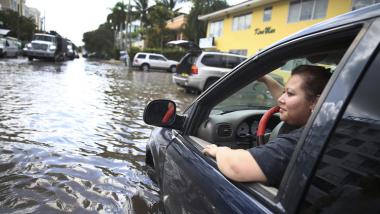 Sandy Garcia sits in her vehicle on a flooded
street in Fort Lauderdale. (Joe Raedle / Getty Images)
World:
¶ The president of Costa Rica inaugurated the Reventazon Hydroelectric Plant in the country’s Caribbean region, the second-biggest infrastructure work in Central America after the Panama Canal and the largest of its kind in the region. The dam has a capacity of 305.5 MW, enough to power 525,000 homes. [Latin American Herald Tribune]
¶ A University of Waterloo study says bringing solar and wind energy to Canada’s remote…
View original post 576 more words
September 18, 2016
Posted by Christina Macpherson |
Uncategorized |
Leave a comment







 nuclear-news