Factor climate into national security policy – executive direction by President Obama
For the first time, Obama requires U.S. government to factor climate into national security policy,WP By Juliet Eilperin September 21 President Obama signed a presidential memorandum Wednesday establishing that climate-change impacts must be factored into the development of all national security-related doctrine, policies and plans.
The move signals Obama’s determination to exercise his executive authority during his final months in office to elevate the issue of climate in federal decision-making, even though it remains unclear whether his successor will embrace this approach.
Under the directive, 20 federal agencies and offices that work on climate science, intelligence and national security must “collaborate to ensure the best information on climate impacts is available to strengthen our national security” through the new Federal Climate and National Security Working Group. That group must release a climate change and national security action plan in 90 days. All the relevant agencies must then identify steps to implement it.
Speaking to reporters on a conference call, White House officials said this would spur a more specific and focused strategy when it comes to both identifying how different regions of the world would be affected by climate change and how to respond……..https://www.washingtonpost.com/news/energy-environment/wp/2016/09/21/for-the-first-time-obama-requires-u-s-government-to-factor-climate-into-national-security-policy/?utm_term=.a5aae6b8a2bf
Global atmospheric temperature rise already predicted to be above 1.5 °C
 The oil and gas we have already tapped will take us past 1.5 °C https://www.newscientist.com/article/2106758-the-oil-and-gas-we-have-already-tapped-will-take-us-past-1-5c/ By Fred Pearce
When you’re in a hole, stop digging. If the world is to have any chance to halt warming below 2 °C, as agreed at the UN’s climate summit in Paris, we cannot develop any more oil wells, coal mines or gas fields.
In fact, we need to go further and start phasing out existing projects, according to the first study of the likely carbon emissions from current fossil fuel extraction.
As more world leaders this week ratify the Paris Agreement at the UN General Assembly in New York, the study finds that “potential carbon emissions from developed reserves – where the wells are already drilled, the pits dug, and the pipelines, processing facilities, railways and export terminals constructed – will take us just beyond the Paris Agreement’s two degrees Celsius warming limit”
Developed reserves of oil and gas alone, even if coal were phased out immediately, would threaten the agreement’s preferred lower target of 1.5 °C, says the study from Oil Change International, a US think tank that opposes fossil fuels.
But the report’s author, Greg Muttitt, used industry data to calculate that developed reserves of coal, oil and gas will deliver emissions of 941 billion tonnes.
“There is no room in the atmosphere. No new fossil fuel infrastructure should be built,” says Muttitt. “This means no fracking for gas in the UK or any other new country, and a fairly rapid winding down of existing fracking in the US. All energy development needs to be focused on clean energy from now on.”
Energy analysts say that investment in new fossil fuel resources is already waning in the wake of the Paris Agreement.
Anthony Hobley of the Carbon Tracker Initiative, a think tank set up by former investment analysts, said Muttitt’s hopes of an end to investment in new coal mines could be imminent. Coal burning has been in decline since 2013. As a result, the industry was stuck with assets worth $200 billion that had “no prospect of paying back their investment cost if the world is serious about the two-degree ceiling”.
Last year, Goldman Sachs said it believed that, led by China, the world reached “peak coal” production in 2013.
France: Public consultation on the draft decree on protection against the dangers of ionizing radiation
Sean Arclight Hervé Courtois CRIIRAD calls to mobilize against the adoption of very high reference levels
to manage nuclear accidents and their consequences.
The French authorities are preparing to establish the zones management criteria contaminated following a nuclear accident (or after an attack affecting a nuclear installation). What level of radiation exposure, and thus risk, will be taken in reference to decide whether or not to hire a particular action to protect the population? Very concretely: to what level of risk you will be condemned to live in contaminated areas? At what level of risk can you expect to be compensated and rehoused in a healthy environment?
The French authorities have retained the levels of effective dose as high as possible: 100 mSv for the accident phase and 20 mSv / year for accidental post phase (while for the public, the maximum dose limit is typically 1 mSv / year and that this value is already at a high level of risk). More limitations are high, lower are the expenses related to the protection and compensation for damage. This choice is unfortunately consistent with the capping of compensation for victims of a major nuclear accident. Nuclear power is exempted from the application of the polluter pays principle: they are the victims who bear the health and economic consequences of the disaster.
This decision does not just happen. It is the fruit of 20 years of efforts of the nuclear lobby, and specifically the French nuclear lobby via the Trojan horse, the FNEC (1). The key idea is to convince people that can be done entirely live in contaminated areas. Just a bit of training and equipment to control their environment, food. These experts have just “forgot” the central problem of the deteriorating health status of people, especially children.
If you are shocked by the image of the Japanese children wear around their necks a dosimeter as a pendant, if it is not the future you want for your children, act!
1. Study Centre on the Protection of the evaluation in the field Nuclear: an association with 4 members (EDF, AREVA, CEA and IRSN) and has widely infiltrated the national and international decision-making and including the ICRP (Jacques Lochard, Director of the FNEC, is now vice chairman of the main committee)
The Ministry of Environment, Energy and Marine has launched a consultation on the draft decree on the Directive 2013/59. Remember that France must transpose the Directive into French law by January 2018. This consultation is an opportunity to denounce the proposals which we find unacceptable and show already our requirements. We later learned of this consultation will end on 30 September.
Take part in the public consultation
and say NO to the obligation to live in contaminated areas!
> Learn more
> How to participate in the public consultation?
The Directive covers many topics which will be discussed further. Other actions will be implemented in the coming weeks. We already rely on your help to relay! https://www.facebook.com/groups/1021186047913052/
The unsolved problem of high level nuclear wastes
How Nuclear Power Causes Global Warming, The Progressive, September 21, 2016 Harvey Wasserman“……As for the high-level waste, this remains one of humankind’s most persistent and dangerous problems. Atomic apologists have claimed that the intensely radioactive spent fuel rods can somehow be usable for additional power generation. But after a half-century of efforts, with billions of dollars spent, all attempts to do that have utterly failed. There are zero successful reactors capable of producing more reactor fuel than they use, or able to derive more energy from the tens of thousands of tons of spent fuel rods they create.
Some reactors, like Fukushima, use “mixed-oxide” fuels that have proven to be extremely dirty and expensive. It’s possible some of this “MOX” fuel containing plutonium, actually fissioned at Fukushima Unit Three, raising terrifying questions about the dangers of its use. The mushroom cloud that appears on video as Fukushima Unit Three exploded stands as an epic warning against further use of these impossible-to-manage fuels.
The MOX facility under construction near Aiken, South Carolina, is now projected to require another ten years to build with another ten possible after that to phase into production. U.S. Secretary of Energy Ernest Moniz said on September 13, 2016, at the Carnegie Endowment for International Peace that the mismanaged project was “impossible” to carry out and that it could cost $30 billion to $50 billion. Even the current pro-nuclear Congress won’t fully fund the project and the Department of Energy DOE continues to recommend abandoning it…….
Atomic apologists argue that the disposal of high-level reactor wastes should be a relatively simple problem, lacking only the political will to proceed. The industry touts New Mexico’sWaste Isolation Pilot Project, or WIPP, which has long been the poster child for military attempts to deal with high-level trash from the nuclear weapons program. Accepting its first shipment of waste in 1999, WIPP was touted as the ultimate high-tech, spare-no-expense model that proved radioactive waste disposal “can be done.”
But a series of disastrous events in February, 2014, led WIPP to stop accepting wastes—the sole function for which it was designed. Most significant was the explosion of a single barrel of highly radioactive waste materials (it was mistakenly packed with organic rather than clay-based kitty litter). About a dozen WIPP workers were exposed to potentially harmful radiation. The entire facility remains closed. In a phone interview, facility management told me it may again accept some wastes before the end of this year. But at least part of the cavernous underground labyrinth may never be reopened. The Los Angeles Times estimatedthe cost of this single accident at $2 billion…….Harvey Wasserman wrote SOLARTOPIA! OUR GREEN-POWERED EARTH. He editsnukefree.org. You can find his GREEN POWER & WELLNESS SHOW at www.prn.fm
Nuclear power is NOT emissions-free
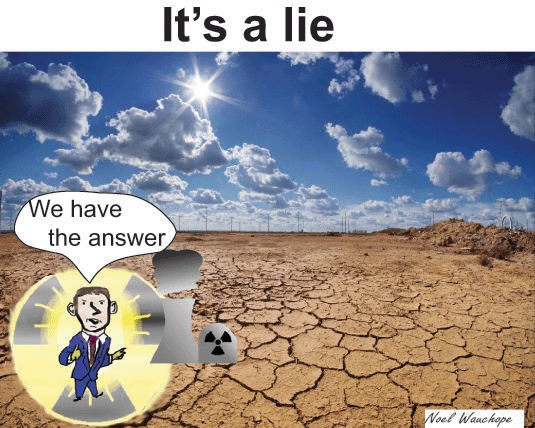 My Turn: Nuclear power isn’t emissions-free http://www.concordmonitor.com/Nuclear-power-is-a-stew-of-radioactive-poison-4919032 By ROB BLAKENEY For the Monitor, September 23, 2016 I am dismayed at the Monitor for giving readers a second bite of the same radioactive nuclear apple from Vermont Yankee’s Howard Shaffer (Monitor Forum, Aug. 31).
This is Shaffer’s second atomic power promotion to appear in the Monitor this year (MonitorOpinion, June 13), again hyping the industry’s discredited tale that nuclear energy is “emissions-free.”
I am grateful I was able to show (Monitor Forum, June 23) why that claim is blatantly false, when nuclear power’s carbon footprint properly includes emissions from atomic fuel extraction and manufacturing. But now the Monitor has brought back the same industry representative to fly in the face of undisputed facts and disseminate the same misinformation.
In my opinion, that is as bad as Matt Lauer letting Donald Trump get away with his often-repeated lie about having opposed the Iraq War. Better to remember the old adage: “Fool me once, shame on you; fool me twice, shame on me.”
I repeat: only reactor operation is carbon-free; all the many other stages in the nuclear fuel chain – uranium mining, uranium milling, fuel fabrication, fuel enrichment, reactor construction, reactor decommissioning and waste management – use massive amounts of fossil fuel and emit massive amounts of carbon. As does transportation from each stage of the fuel cycle to the next, via ship, truck or rail. This information has been quantified by independent researchers with ties to no industry.
Among further facts independent researchers have exposed: nuclear carbon emissions are increasing with the industry’s growing reliance on low-grade uranium ore as high-grade supplies are exhausted; and, emissions from the construction and decommissioning of nuclear power plants are so significant that each plant must operate for two or three years just to offset its energy inputs. (By comparison, a wind power plant offsets its sunk energy costs in only three to seven months of operation.)
Growing up in the 1950s – the dawn of the atomic era – I felt the appeal of nuclear power hype – that it would be the “peaceful atom” and “too cheap to meter.” Once those claims were categorically exposed as noxious hype, the world’s most dangerous industry seized on the climate change crisis to contrive a fig leaf to try to counter the inescapable reality – atomic power is poison power. Hopefully people will not get fooled again by nuclear energy’s shiny new “emissions-free” hype.
Canada’s SNC Lavalin marketing nuclear reactors to China
 SNC-Lavalin to build Candu nuclear reactor for China, BERTRAND MAROTTE, MONTREAL — The Globe and Mail, Sep. 22, 2016 SNC-Lavalin Group Inc. is closing in on its goal of becoming a major player in China’s thriving nuclear-energy industry with an agreement for the development in that country of the next generation of Candu reactors.
The Montreal-based global engineering giant said on Thursday it has an agreement in principle for a joint venture with state-owned atomic-power and weapons company China National Nuclear Corp. and manufacturing conglomerate Shanghai Electric Group Co. Ltd. to design, market and build the Advanced Fuel Candu Reactor (AFCR).
SNC signed an initial memorandum of understanding with CNNC to pursue power generation, mining and nuclear-related environmental projects around the world more than two years ago.
SNC bought the Candu unit from Ottawa for $15-million in 2011. But Candu has had a poor track record of selling its technology abroad and questions have also been raised over its cost-effectiveness.
China, however, appears to have endorsed the concept of building reactors that run on recycled uranium…….
The proposed joint venture follows the signing of a framework agreement in 2014 and is subject to government and regulatory approvals, SNC said. http://www.theglobeandmail.com/report-on-business/industry-news/energy-and-resources/snc-lavalin-strikes-deal-to-build-nuclear-reactors-in-china/article32000350/
Wind energy getting popular with USA Republicans
Why Republicans support wind energy Tom Kiernan, Roberta Combs, Michele Combs, Desmoines Register September 20, 2016 Did you know that American wind turbines can now produce as much electricity as 17 typical nuclear power plants or 65 coal plants? That’s how much wind power has grown across the U.S.
A cleaner energy economy built by growing wind energy benefits both our economy and our health.
Wind energy greatly reduces a variety of health-harming air pollutants, including smog-causing sulfur dioxide and nitrogen oxides. Cutting these helps reduce asthma rates and other respiratory illnesses, creating $7.3 billion in avoided health costs last year alone.
Conventional wisdom says Democrats are typically consistent supporters of clean energy, while Republicans aren’t. That notion actually doesn’t match up with reality.
Sen. Chuck Grassley has shown visionary leadership in creating and advocating for the Production Tax Credit, a fundamental part of why we have a modern U.S. wind industry today. This performance-based tax incentive is a big reason why Iowa already generates nearly a third of its electricity using wind, with the 40 percent milestone looming in the near-future. It’s also why wind power’s technology has advanced enough to drop costs by two-thirds over just six years, saving American consumers billions of dollars.
It’s also not widely known that wind power supports well-paying jobs and invests in 75 percent of all Republican districts in the U.S.
Republican-represented districts host 86 percent of the total wind farm fleet in America. That means the majority of wind’s economic benefits — including jobs, billions of dollars in private investment, and added tax revenue for improving local infrastructure — go to rural communities with a strong presence of typically Republican voters……..http://www.desmoinesregister.com/story/opinion/columnists/iowa-view/2016/09/20/why-republicans-support-wind-energy/90743862/
USA could lend $billions to India – anything to sell nuclear reactors!
 India Could Get Billions from the U.S. To Build a Nuclear Reactor, Fortune, by Reuters SEPTEMBER 22, 2016 If a lending freeze doesn’t get in the way.
India is negotiating with U.S. Export-Import Bank for an $8-9 billion loan to finance six Westinghouse Electric nuclear reactors, two sources familiar with the talks said, although a lending freeze at the trade agency threatens progress.
The mega-project, the result of warming U.S.-India ties in recent years, could open up billions of dollars of further investment in India’s nuclear power sector, ……..
The Westinghouse deal, however, is contingent on financing and Ex-Im cannot approve loans of more than $10 million, owing to a row in the U.S. Congress over board appointments stemming from a campaign by conservatives to close the government lender……..
“Financing of the reactors is the critical piece; everything is down to this,” said one source involved in protracted negotiations to build the reactors in the south-eastern Indian state of Andhra Pradesh.
The source, requesting anonymity because of the sensitivity of the talks, said Indian negotiators and Ex-Im officials were trying to set the terms of the financial package in the hope that the freeze on the bank, affecting potential sales of several major U.S. companies, would lift soon.
Westinghouse is owned by Japan’s Toshiba Corp but is based in the United States……..
In addition to U.S. Ex-Im, India is also seeking funding from Japan and South Korea for the reactors to be built in Kovvada, two sources familiar with the talks said……..
While negotiators are unlikely to nail down a contract under Obama, who steps down in January, their challenge will be to come up with concessional financing terms that will make Westinghouse’s AP1000 reactors affordable.
Westinghouse did not respond to a request for comment, while a U.S. Ex-Im Bank spokeswoman declined to comment. An NPCIL official said the firm had nothing to say at this stage…….
ndia is also in talks with Russia to build four more reactors on top of the two already completed in Kudankulam in southern Tamil Nadu state, as well as with France’s EDF for the construction of six reactors of 1650 MW each in western India, which would be the world’s biggest nuclear power complex.
But talks with Westinghouse are more advanced than those with the French, with the two sides aiming to sign an early works agreement next month, sources familiar with their progress said.
A delegation from the U.S.-based firm visited New Delhi earlier this month to finalize the pact that would include the timeline and up-front costs such as land acquisition and site preparation, said a source familiar with the matter. http://fortune.com/2016/09/22/india-nuclear-power/
Recurring problems cited at Westinghouse nuclear plant
The State, BY SAMMY FRETWELL sfretwell@thestate.com COLUMBIA, SC
The report, compiled by plant operator Westinghouse, says the company wasn’t always tough-minded enough about safety and it didn’t ensure employees knew enough about nuclear safety while operating some of the factory’s equipment.
Westinghouse’s report cited “long standing deficiencies’’ that led to a buildup of uranium in excess of federal nuclear safety standards in part of the Bluff Road plant……….
Buildups of atomic material are of concern because they can lead to nuclear accidents, although that did not occur in this case. Nuclear safety advocates say Westinghouse needs to redouble its efforts to make sure other, more serious problems don’t arise……..http://www.thestate.com/news/local/article103589917.html
Global warming will accelerate as oceans reach limits of remediation

If humanity stopped all production of greenhouse gases today, Earth would experience several decades more of additional global warming. That is not simply because the carbon dioxide, methane and other greenhouse gases thrown into the atmosphere by human activity won’t disappear in a day, but because the oceans can’t continue to act as shock absorbers.
Earth has tipped into a heat imbalance since 1970, and this excess heating has thus far been greatly ameliorated because the world’s oceans have absorbed 93 percent of the enhanced heating since the 1970s. This accumulated heat is not permanently stored, but can be released back into the atmosphere, potentially providing significant feedback that would accelerate global warming.
The latest in a series of scientific reports detailing the disastrous course of global warming, “Explaining Ocean Warming: Causes, Effects and Consequences,” concludes that the mean global ocean temperature will increase by as much as…
View original post 1,144 more words
September 22 Energy News

Science and Technology:
¶ A study suggests that microgrids, rarely used in today’s power sector, will come to be the “fundamental building block” of the 21st-century grid. The report was released by the National Electrical Manufacturing Association, which represents electrical, medical imaging, and radiation therapy manufacturers. [Midwest Energy News]
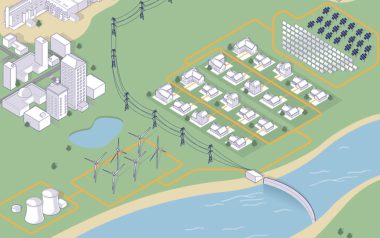 Sandia microgrid graphic (Please click on the image to enlarge it.)
¶ A study published in the Journal of Political Economy examines the true costs associated with the variability inherent in solar energy, and finds that it is nowhere near as costly or impactful as some people have been led to believe. In fact, the authors state, “the cost impact of unpredictability is relatively small.” [CleanTechnica]
¶ DONG Energy and SmartWind Technologies have installed an advanced radar system to collect 3D data on the wind flow at the 210-MW Westermost Rough offshore wind farm, which lies off…
View original post 754 more words
Uranium Hexaflouride: Cheshire’s Hidden Menace STOCKPILED

This Could Not Happen in Leafy Cheshire? Think again!
Our colleagues at CLOSE CAPENHURST have dared to ask the questions:
“How Much Depleted Hex Is At Capenhust ? ? ?
How Much Hex ?
Uranium Hexafluoride is highly toxic, radioactive, corrosive to most metals, and reacts violently with water.
One of the questions we have been asking since the Close Capenhurst Campaign was established is just how much Depleted Uranium Hexafluoride is stored at the URENCO Capenhurst site.
The best answer we have received is ‘ A vast Quantity’,which is also the only way we have been able to describe it.
We just don’t know.
Although one recent article stated that it is some 60,000 tonnes.
This is exactly what we want to know.
1. How many containers of Depleted Uranium Hexafluoride are stored at the Capenhurst site ?
2. What is the total mass of Depleted Uranium Hexafluoride which…
View original post 357 more words
September 21 Energy News
Opinion:
¶ “Are virtual power plants the next evolution of American infrastructure?” • 2016 could be a pivotal year. In June, New York’s Con Edison, together with solar storage providers SunPower and Sunverge, announced a new pilot program for New York City homes that would transform their rooftops into a virtual power plant. [PennEnergy]
 Solar trackers in shallow water
¶ “Democratic and Republican Platforms Present Contrasting Energy Planks” • At their respective national conventions in late July, the Democratic and Republican Parties established the policy platforms on which their respective federal, state and local candidates will base their election campaigns. Those platforms are very different. [JD Supra]
Science and Technology:
¶ A 30-meter catamaran, powered by solar, wind and self-generated hydrogen, will be launched next February to sail around the world as a clean energy laboratory. The Energy Observer aims to circumnavigate the globe using only…
View original post 740 more words
Risk of another Chernobyl or Fukushima type accident plausible, experts say
 Risk of another Chernobyl or Fukushima type accident plausible, experts say, Pressenza, 20.09.2016 – Silvia Swinden This is the title of a report on Science News that should make us think twice about the construction of Hinckley point C, apart from issues of cost and nuclear waste.
“A team of risk experts who have carried out the biggest-ever analysis of nuclear accidents warn that the next disaster on the scale of Chernobyl or Fukushima may happen much sooner than the public realizes.” says the report, and continues:
“Researchers at the University of Sussex, in England, and ETH Zurich, in Switzerland, have analysed more than 200 nuclear accidents, and — estimating and controlling for effects of industry responses to previous disasters — provide a grim assessment of the risk of nuclear power.
“Their worrying conclusion is that, while nuclear accidents have substantially decreased in frequency, this has been accomplished by the suppression of moderate-to-large events. They estimate that Fukushima- and Chernobyl-scale disasters are still more likely than not once or twice per century, and that accidents on the scale of the 1979 meltdown at Three Mile Island in the USA (a damage cost of about 10 Billion USD) are more likely than not to occur every 10-20 years.
“As Dr Spencer Wheatley, the lead author, explains: “We have found that the risk level for nuclear power is extremely high……….
“The research team for this new study gathered their data from reports, academic papers, press releases, public documents and newspaper articles. The result is a dataset that is unprecedented — being twice the size of the next largest independent analysis. Further, the authors emphasize that the dataset is an important resource that needs to be continually developed and shared with the public.”
At a time when renewable sources of energy are becoming more efficient and cheaper, it is irresponsible to commit the future of several generations to a project that can only be justified as a convenient business for a minority of wealthy voters and perhaps the consequence of the UK’s increasing isolation in view of Brexit, that will make it progressively less able to resist the forces of international capital.
In view of its risks it is time to include Nuclear Energy (at least in its present design) as a form of violence and violation of human rights of a population that is never truly consulted on these issues. http://linkis.com/www.pressenza.com/20/fvUSg
Russia warns: if Hinkley nuclear project fails it will discredit the entire global nuclear industry
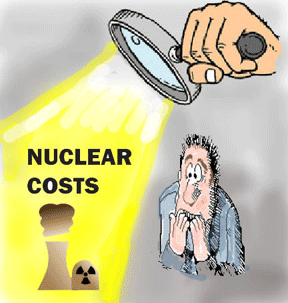
 Russia issues Hinkley nuclear warning, climate news,network September 19, 2016, by Terry Macalister State-owned Russian nuclear corporation says the industry’s credibility is at risk if building the new UK power plant is delayed or runs over budget.
LONDON, 19 September, 2016 – A major nuclear developer has warned the French energy giant EDF that it must deliver the Hinkley Point project in the UK on time and on budget or risk damaging the credibility of the wider industry.
In an exclusive interview with Climate News Network, Kirill Komarov, first deputy chief executive of Russian state-owned corporation Rosatom, expressed fears that problems at other EDF schemes − such as Flamanville in France andOlkiluoto in Finland − could be repeated.
Rosatom believes the decision by the UK prime minister, Theresa May, to give the go-ahead to the first new nuclear reactors in Britain for over 20 years was a major step forward, but knows that the eyes of the world will now be on a good performance at the Hinkley power plant in southwest England.
Komarov said: “It’s a good signal that the government confirmed its commitment to nuclear. At the same time, record-high cost and the risks of possible delays and cost overruns might undermine the reputation of the sector.”
The Russian group, which is constructing nuclear reactors in China, India and the Middle East, believes its own prices are up to 30% lower than EDF’s…………
Rosatom believes the UK should be wary of the potential delays attached to the new European Pressurised Reactor (EPR) designs that are being trialled at Olkiluoto, Flamanville and soon at Hinkley.
The company also reckons that the 1600 megawatt capacities of EPRs may be too large for the needs of the modern world. It believes its own VVER-designed 1000-1200 MW reactors are more suitable, especially in developed countries where power demand is unlikely to grow too much, because of energy efficiency and demand reduction policies.
Rosatom is clearly keen to sell its reactors in the UK, which has relatively tight regulations and is seen by EDF and others as a good shop window for the world http://climatenewsnetwork.net/russia-issues-hinkley-nuclear-warning/
1 This Month
Chernobyl: The Lost Tapes – A good documentary on Chernobyl on SBS available On Demand for the next 3 weeks– https://www.sbs.com.au/ondemand/tv-program/chernobyl-the-lost-tapes/2352741955560

of the week–London Campaign for Nuclear Disarmament

Tell the Ukrainian Government to Drop Prosecution of Peace Activist Yurii Sheliazhenko
To see nuclear-related stories in greater depth and intensity – go to https://nuclearinformation.wordpress.com
-
Archives
- April 2026 (139)
- March 2026 (251)
- February 2026 (268)
- January 2026 (308)
- December 2025 (358)
- November 2025 (359)
- October 2025 (376)
- September 2025 (257)
- August 2025 (319)
- July 2025 (230)
- June 2025 (348)
- May 2025 (261)
-
Categories
- 1
- 1 NUCLEAR ISSUES
- business and costs
- climate change
- culture and arts
- ENERGY
- environment
- health
- history
- indigenous issues
- Legal
- marketing of nuclear
- media
- opposition to nuclear
- PERSONAL STORIES
- politics
- politics international
- Religion and ethics
- safety
- secrets,lies and civil liberties
- spinbuster
- technology
- Uranium
- wastes
- weapons and war
- Women
- 2 WORLD
- ACTION
- AFRICA
- Atrocities
- AUSTRALIA
- Christina's notes
- Christina's themes
- culture and arts
- Events
- Fuk 2022
- Fuk 2023
- Fukushima 2017
- Fukushima 2018
- fukushima 2019
- Fukushima 2020
- Fukushima 2021
- general
- global warming
- Humour (God we need it)
- Nuclear
- RARE EARTHS
- Reference
- resources – print
- Resources -audiovicual
- Weekly Newsletter
- World
- World Nuclear
- YouTube
-
RSS
Entries RSS
Comments RSS
 nuclear-news