Global warming will accelerate as oceans reach limits of remediation

If humanity stopped all production of greenhouse gases today, Earth would experience several decades more of additional global warming. That is not simply because the carbon dioxide, methane and other greenhouse gases thrown into the atmosphere by human activity won’t disappear in a day, but because the oceans can’t continue to act as shock absorbers.
Earth has tipped into a heat imbalance since 1970, and this excess heating has thus far been greatly ameliorated because the world’s oceans have absorbed 93 percent of the enhanced heating since the 1970s. This accumulated heat is not permanently stored, but can be released back into the atmosphere, potentially providing significant feedback that would accelerate global warming.
The latest in a series of scientific reports detailing the disastrous course of global warming, “Explaining Ocean Warming: Causes, Effects and Consequences,” concludes that the mean global ocean temperature will increase by as much as…
View original post 1,144 more words
September 22 Energy News

Science and Technology:
¶ A study suggests that microgrids, rarely used in today’s power sector, will come to be the “fundamental building block” of the 21st-century grid. The report was released by the National Electrical Manufacturing Association, which represents electrical, medical imaging, and radiation therapy manufacturers. [Midwest Energy News]
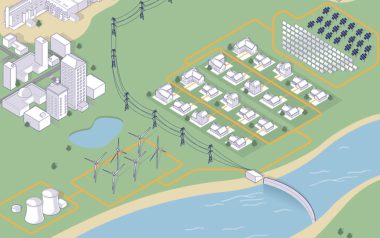 Sandia microgrid graphic (Please click on the image to enlarge it.)
¶ A study published in the Journal of Political Economy examines the true costs associated with the variability inherent in solar energy, and finds that it is nowhere near as costly or impactful as some people have been led to believe. In fact, the authors state, “the cost impact of unpredictability is relatively small.” [CleanTechnica]
¶ DONG Energy and SmartWind Technologies have installed an advanced radar system to collect 3D data on the wind flow at the 210-MW Westermost Rough offshore wind farm, which lies off…
View original post 754 more words
Uranium Hexaflouride: Cheshire’s Hidden Menace STOCKPILED

This Could Not Happen in Leafy Cheshire? Think again!
Our colleagues at CLOSE CAPENHURST have dared to ask the questions:
“How Much Depleted Hex Is At Capenhust ? ? ?
How Much Hex ?
Uranium Hexafluoride is highly toxic, radioactive, corrosive to most metals, and reacts violently with water.
One of the questions we have been asking since the Close Capenhurst Campaign was established is just how much Depleted Uranium Hexafluoride is stored at the URENCO Capenhurst site.
The best answer we have received is ‘ A vast Quantity’,which is also the only way we have been able to describe it.
We just don’t know.
Although one recent article stated that it is some 60,000 tonnes.
This is exactly what we want to know.
1. How many containers of Depleted Uranium Hexafluoride are stored at the Capenhurst site ?
2. What is the total mass of Depleted Uranium Hexafluoride which…
View original post 357 more words
September 21 Energy News
Opinion:
¶ “Are virtual power plants the next evolution of American infrastructure?” • 2016 could be a pivotal year. In June, New York’s Con Edison, together with solar storage providers SunPower and Sunverge, announced a new pilot program for New York City homes that would transform their rooftops into a virtual power plant. [PennEnergy]
 Solar trackers in shallow water
¶ “Democratic and Republican Platforms Present Contrasting Energy Planks” • At their respective national conventions in late July, the Democratic and Republican Parties established the policy platforms on which their respective federal, state and local candidates will base their election campaigns. Those platforms are very different. [JD Supra]
Science and Technology:
¶ A 30-meter catamaran, powered by solar, wind and self-generated hydrogen, will be launched next February to sail around the world as a clean energy laboratory. The Energy Observer aims to circumnavigate the globe using only…
View original post 740 more words
Risk of another Chernobyl or Fukushima type accident plausible, experts say
 Risk of another Chernobyl or Fukushima type accident plausible, experts say, Pressenza, 20.09.2016 – Silvia Swinden This is the title of a report on Science News that should make us think twice about the construction of Hinckley point C, apart from issues of cost and nuclear waste.
“A team of risk experts who have carried out the biggest-ever analysis of nuclear accidents warn that the next disaster on the scale of Chernobyl or Fukushima may happen much sooner than the public realizes.” says the report, and continues:
“Researchers at the University of Sussex, in England, and ETH Zurich, in Switzerland, have analysed more than 200 nuclear accidents, and — estimating and controlling for effects of industry responses to previous disasters — provide a grim assessment of the risk of nuclear power.
“Their worrying conclusion is that, while nuclear accidents have substantially decreased in frequency, this has been accomplished by the suppression of moderate-to-large events. They estimate that Fukushima- and Chernobyl-scale disasters are still more likely than not once or twice per century, and that accidents on the scale of the 1979 meltdown at Three Mile Island in the USA (a damage cost of about 10 Billion USD) are more likely than not to occur every 10-20 years.
“As Dr Spencer Wheatley, the lead author, explains: “We have found that the risk level for nuclear power is extremely high……….
“The research team for this new study gathered their data from reports, academic papers, press releases, public documents and newspaper articles. The result is a dataset that is unprecedented — being twice the size of the next largest independent analysis. Further, the authors emphasize that the dataset is an important resource that needs to be continually developed and shared with the public.”
At a time when renewable sources of energy are becoming more efficient and cheaper, it is irresponsible to commit the future of several generations to a project that can only be justified as a convenient business for a minority of wealthy voters and perhaps the consequence of the UK’s increasing isolation in view of Brexit, that will make it progressively less able to resist the forces of international capital.
In view of its risks it is time to include Nuclear Energy (at least in its present design) as a form of violence and violation of human rights of a population that is never truly consulted on these issues. http://linkis.com/www.pressenza.com/20/fvUSg
Russia warns: if Hinkley nuclear project fails it will discredit the entire global nuclear industry
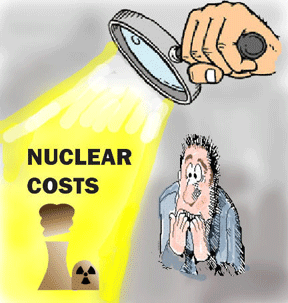
 Russia issues Hinkley nuclear warning, climate news,network September 19, 2016, by Terry Macalister State-owned Russian nuclear corporation says the industry’s credibility is at risk if building the new UK power plant is delayed or runs over budget.
LONDON, 19 September, 2016 – A major nuclear developer has warned the French energy giant EDF that it must deliver the Hinkley Point project in the UK on time and on budget or risk damaging the credibility of the wider industry.
In an exclusive interview with Climate News Network, Kirill Komarov, first deputy chief executive of Russian state-owned corporation Rosatom, expressed fears that problems at other EDF schemes − such as Flamanville in France andOlkiluoto in Finland − could be repeated.
Rosatom believes the decision by the UK prime minister, Theresa May, to give the go-ahead to the first new nuclear reactors in Britain for over 20 years was a major step forward, but knows that the eyes of the world will now be on a good performance at the Hinkley power plant in southwest England.
Komarov said: “It’s a good signal that the government confirmed its commitment to nuclear. At the same time, record-high cost and the risks of possible delays and cost overruns might undermine the reputation of the sector.”
The Russian group, which is constructing nuclear reactors in China, India and the Middle East, believes its own prices are up to 30% lower than EDF’s…………
Rosatom believes the UK should be wary of the potential delays attached to the new European Pressurised Reactor (EPR) designs that are being trialled at Olkiluoto, Flamanville and soon at Hinkley.
The company also reckons that the 1600 megawatt capacities of EPRs may be too large for the needs of the modern world. It believes its own VVER-designed 1000-1200 MW reactors are more suitable, especially in developed countries where power demand is unlikely to grow too much, because of energy efficiency and demand reduction policies.
Rosatom is clearly keen to sell its reactors in the UK, which has relatively tight regulations and is seen by EDF and others as a good shop window for the world http://climatenewsnetwork.net/russia-issues-hinkley-nuclear-warning/
180 mishaps in UK nuclear waste transport vehicles

 UK nuclear weapons convoys ‘have had 180 mishaps in 16 years’ Vehicles carrying nuclear weapons have had collisions, breakdowns and brake failures, disarmament campaign says, Guardian, Rob Evans, 21 Sept 16, Military convoys carrying nuclear weapons through Britain’s cities and towns have experienced 180 mishaps and incidents, including collisions, breakdowns and brake failures during the last 16 years, according to a report produced by a disarmament campaign.
The incidents catalogued in the report – based on official logs released under theFreedom of Information Act – include fuel leaks, overheated engines, clutch problems, and other mechanical faults in the convoys.
At other times, according to the report, the convoys went the wrong way, were diverted, and lost communications with commanders. The rate at which the incidents have occurred has risen in recent years, with 43 in the last three years.
In its report published on Wednesday, the International Campaign to Abolish Nuclear Weapons (Ican) warns that a serious accident involving the convoys could spread radioactivity over cities, contaminating communities and increasing cancer risks.
The convoys pass through cities and towns between Scotland and southern England. However, an opinion poll commissioned by Ican shows that nearly two-thirds of British adults did not know that the military transports nuclear warheads on British roads, prompting the campaigners to argue that members of the public have not given their consent to the dangers they pose.
Materials for nuclear weapons are driven through or flown over 122 local councils in the UK, including densely-populated areas such as Bristol, Birmingham, Cardiff, Edinburgh, Glasgow, Leeds, Liverpool, Sheffield, Manchester and Newcastle, according to Ministry of Defence data…….
The Ican report describes how nuclear warheads are carried in dark green, 44-tonne trucks between a bomb factory at Burghfield near Reading in Berkshire and a naval depot at Coulport on Loch Long near Glasgow, where they are loaded onto submarines.
The 900-mile round trips, usually spread over one or two days, are completed between two and six times a year, with the most recent onereported to have been completed this week.
According to Ican, the convoys – comprising up to 20 vehicles including police cars and a fire engine – use a variety of routes. One from Burghfield, where the warheads are assembled and maintained, goes along the M40, round Birmingham and past Preston on the M6, and then the M74 to Glasgow……..
Matt Hawkins, spokesman for Ican, said the report “painted a grim picture of the great risks posed by nuclear convoys”, adding that nuclear weapons “only add danger to our lives, exposing us all to the risk of radiation leaks or an attack by terrorists on one of these convoys”.
In 2003, following pressure from the Guardian, the MoD was forced to publish a list of accidents involving nuclear weapons between 1960 and 1991 after decades of secrecy. It showed that the weapons had been dropped, struck by other weapons and carried on a truck that slid down a hill and toppled over. https://www.theguardian.com/uk-news/2016/sep/21/uk-nuclear-weapons-convoys-have-had-180-mishaps-in-16-years
Nuclear dangers: the 15 costliest nuclear disasters
 The 15 costliest nuclear disasters and the nuclear risks of the future,Treehugger, Christine Lepisto (@greenanswer) September 20, 2016 The names Chernobyl and Fukushima connote nuclear disaster. But do you remember Three Mile Island? Have you ever heard of Beloyarsk, Jaslovske, or Pickering? These names appear among the 15 most expensive nuclear disasters.
- Chernobyl, Ukraine (1986): $259 billion
- Fukushima, Japan (2011): $166 billion
- Tsuruga, Japan (1995): $15.5 billion
- Three Mile Island, Pennsylvania, USA (1979): $11 billion
- Beloyarsk, USSR (1977): $3.5 billion
- Sellafield, UK (1969): $2.5 billion
- Athens, Alabama, USA (1985): $2.1 billion
- Jaslovske Bohunice, Czechoslovakia (1977): $2 billion
- Sellafield, UK (1968): $1.9 billion
- Sellafield, UK (1971): $1.3 billion
- Plymouth, Massachusetts, USA (1986): $1.2 billion
- Chapelcross, UK (1967): $1.1 billion
- Chernobyl, Ukraine (1982): $1.1 billion
- Pickering, Canada (1983): $1 billion
- Sellafield, UK (1973): $1 billion
A new study of 216 nuclear energy accidents and incidents crunches twice as much data as the previously best review, predicting that
“The next nuclear accident may be much sooner or more severe than the public realizes.”
The study points to two significant issues in the current assessment of nuclear safety. First, the International Atomic Energy Agency (IAEA) serves the dual masters of overseeing the industry and promoting nuclear energy. Second, the primary tool used to assess the risk of nuclear incidents suffers from blind spots.
The conflict of interest in the first issue is clear. The second issue may not be transparent to the layperson until they understand more fully how industry conducts the probabilistic safety assessments (PSAs) which are the source of the standard predictions of the risk of nuclear accidents. …….http://www.treehugger.com/energy-disasters/15-costliest-nuclear-disasters-and-nuclear-risks-future.html
UK Liberal Democrats oppose Hinkley nuclear plan – ‘very poor value for money’
 Lib Dems vote to oppose Hinkley nuclear plant in emergency conference motion, Left Foot Forward,
Adam Barnett 19 September, 2016 Project is ‘very poor value for money’ and we should use renewable energy instead, say members Liberal Democrats voted to oppose a new nuclear power station at Hinkley Point C today in an emergency policy motion at party conference.
The party agreed this morning that the new £18 billion plant in Somerset was ‘very poor value for money’ for consumers and proposed renewable energy instead.
The motion also noted that similar nuclear plants in France and Finland are both ‘years behind schedule and significantly over budget’.
It concludes:
‘Conference believes that construction of a new nuclear station at Hinkley Point is both entirely dependent on public subsidy and represents very poor value for money for UK consumers, and that therefore it should be opposed.
Conference calls for a UK energy strategy resting on investments in energy efficiency, renewable energy, storage and interconnection with European grids, thereby providing energy security, an end to fuel poverty and the reduction of greenhouse gas emissions at the same time as creating jobs, exports and prosperity.’……..https://leftfootforward.org/2016/09/lib-dems-vote-to-oppose-hinkley-nuclear-plant-in-emergency-conference-motion/
Further nuclear power development in China will need local public consent
 China nuclear developers must seek public consent: draft rules, http://www.reuters.com/article/us-china-nuclear-safety-idUSKCN11Q18K (Reporting by David Stanway; editing by Jason Neely), 20 Sept 16 China’s nuclear developers must seek the consent of local stakeholders before going ahead with new projects, according to draft rules published by the country’s cabinet on Monday.
Developers will need to assess the impact a nuclear project will have on social stability and solicit public opinion through hearings or announcements, the Legislative Affairs Office of the State Council said.
China is in the middle of a rapid nuclear reactor building program and aims to have 58 gigawatts (GW) of capacity in full commercial operation by the end of 2020, up from 30.7 GW at the end of July.
But despite a strong safety record at existing plants, the government has struggled to convince the public about the safety of nuclear power.
Protests in the eastern coastal city of Lianyungang last month led to the cancellation of a proposed $15 billion nuclear waste processing plant.
“Japan’s Fukushima accident once again created doubt about the safety of nuclear power among the public, and also caused feelings of fear and opposition to occur from time to time,” the Legislative Affairs Office said in a statement.
It said the new draft rules would improve information disclosure and allow the public to participate more actively in the construction and supervision of nuclear projects.
The Legislative Affairs Office has made the draft guidelines available to the public and will accept suggestions until Oct. 19, it said in a notice posted on its website (www.chinalaw.gov.cn).
A team of experts from the International Atomic Energy Agency said this month that China’s “unparalleled” nuclear expansion would pose challenges for its regulators, and more work needed to be done in areas such as waste management and the handling of ageing reactors.
US taxpayers up for huge costs for accident at Waste Isolation Pilot Project (WIPP)
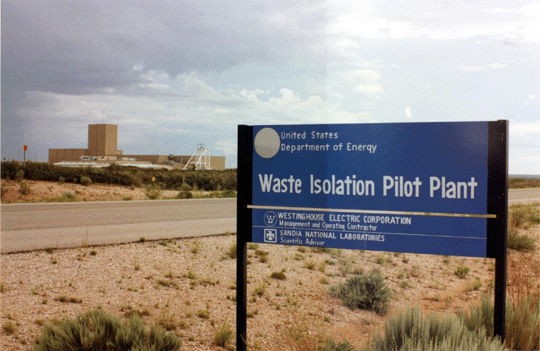 WIPP nuclear waste accident will cost US taxpayers $2 billion. Ecologist, Dr Jim Green 20th September 2016 The clean-up after the February 2014 explosion at the world’s only deep underground repository for nuclear waste in New Mexico, USA, is massively over budget, writes Jim Green – and full operations won’t resume until at least 2021. The fundamental cause of the problems: high level radioactive waste, poor regulation, rigid deadlines and corporate profit make a dangerous mix.
An analysis by theLos Angeles Timesfinds that costs associated with the February 2014 explosion at the Waste Isolation Pilot Plant (WIPP) could total US$2 billion.
The direct cost of the clean-up is now estimated at US$640 million, based on a contract modification made in July with contractor Nuclear Waste Partnership.
The cost-plus contract leaves open the possibility of even higher costs as the clean-up continues and, as the LA Times notes, it does not include the complete replacement of the contaminated ventilation system (which failed after the 2014 explosion) or any future costs of operating the repository longer than originally planned.
The lengthy closure following the explosion could result in waste disposal operations extending for an additional seven years, at an additional cost of US$200 million per year or US$1.4 billion (€1.25b) in total. Thus direct (clean-up) costs and indirect costs could exceed US$2 billion.
And further costs are being incurred storing waste at other nuclear sites pending the re-opening of WIPP. Federal officials hope to resume limited operations at WIPP by the end of this year, but full operations cannot resume until a new ventilation system is completed in about 2021……….
GAO identifies a host of problems
An August 2016 report by the Government Accountability Office (GAO) found that the federal Department of Energy (DOE) did not meet its initial cost and schedule estimates for restarting nuclear waste disposal operations at WIPP, resulting in a cost increase of about US$64 million (€57m) and a delay of nine months.
Worse still, mismanagement of the clean-up has involved poor safety practices. Last year, the DOE’s Independent Office of Enterprise Assessments released a report that found that WIPP clean-up operations were being rushed to meet the scheduled reopening date and that this pressure was contributing to poor safety practices.
The report states: “The EA analysis considered operational events and reviews conducted during May 2014 through May 2015 and identified a significant negative trend in performance of work. During this period, strong and unrealistic schedule pressures on the workforce contributed to poor safety performance and incidents during that time are indicators of the potential for a future serious safety incident.”
The report points to “serious issues in conduct of operations, job hazard analysis, and safety basis.” Specific problems identified in the report include:……….
the National Nuclear Safety Administration (NNSA) – a semi-autonomous agency within the DOE – is itself a big part of the problem of systemic mismanagement of nuclear sites. A June 2015 Government Accountability Office report strongly criticised NNSA oversight of contractors who manage the nation’s nuclear weapons facilities.
The report points to a litany of ongoing failures to properly oversee private contractors at eight nuclear sites, including those managing LANL. The report found that the NNSA lacked enough qualified staff members to oversee contractors, and it lacked guidelines for evaluating its contractors.
Greg Mello from the Los Alamos Study Group was blunt in his criticism of the NNSA: “An agency that is more than 90 percent privatized, with barely enough federal employees to sign the checks and answer the phones, is never going to be able to properly oversee billion-dollar nuclear facilities of vast complexity and danger.” http://www.theecologist.org/News/news_analysis/2988145/wipp_nuclear_waste_accident_will_cost_us_taxpayers_us2_billion.html
Finland ready to grasp a nuclear marketing opportunity in South Australia

 Finland’s Onkalo nuclear waste disposal facility want to export the technology to South Australia, The Advertiser Daniel Wills, Helsinki, Finland, The Advertiser September 21, 2016 OPERATORS of the world’s most advanced nuclear disposal facility want to export the technology to South Australia and form an alliance to help the state develop its own commercial facility to take waste from around the world.
At a briefing with Premier Jay Weatherill at Finland’s Onkalo nuclear waste disposal facility, Posiva Solutions Oy managing director Mika Pohjonen said his company would be willing to licence intellectual property and engineering solutions to SA if it were to proceed with expanding the local nuclear industry.
Posiva is a joint venture owned by two of Finland’s biggest energy companies — Teollisuuden Voima Oyj and Fortum Power and Heat. It is set to become the first organisation in the world to bury a canister of spent nuclear fuel when they begin inserting them into the bedrock from 2020. Mr Pohjonen said SA could hope to move from site selection to burying canisters within about 15 years, less than half the time taken by Finland, because the Scandinavians had already undertaken the slow work of proving the technology………
The Onkalo disposal site is about 10 times smaller than that conceived by SA’s Nuclear Fuel Cycle Royal Commission.……
Mr Weatherill will by the end of the year declare a formal State Government position to Parliament on expansion of the industry………
“The next major step is a threshold question about whether we maintain our prohibition against a facility for spent fuel or whether we take a step to explore it further.”- Mr Weatherill said ….

European Court of Auditors see nuclear decommissioning funds shortfall
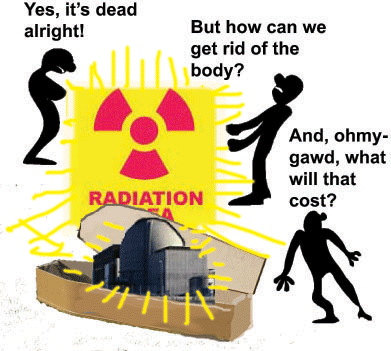 EU auditor sees nuclear decommissioning funds shortfall, Reuters, By Alissa de Carbonnel, 20 Sept 16, | BRUSSELS European Union plans for financing the decommissioning of nuclear plants in Bulgaria, Lithuania and Slovakia are inadequate and more resources need to be put aside, the European Court of Auditors said in a report.
The report criticizing costly delays and warning of technical hurdles ahead shines a spotlight on the challenges facing Germany and other nations within the bloc that are planning to retire their nuclear reactors.
The EU’s spending watchdog said the estimated cost of decommissioning the three Soviet-era plants closed more than a decade ago had risen 40 percent since 2010 to at least 5.7 billion euros ($6.4 billion) by 2015. That figure doubles if the cost of disposing spent fuel once and for all is included.
The EU auditors said while the bloc’s budget covered the vast majority of the costs of shutting down the reactors in the three member states, significant funding was still needed to take the plants offline completely.
They said the reactor buildings at Bulgaria’s Kozloduy, Lithuania’s Ignalina and Slovakia’s Bohunice had yet to be dismantled and no solution had been found for the disposal of spent nuclear fuel……..
The only repository for spent fuel being dug deep underground in Europe has been under construction in Finland for nearly 40 years and won’t be ready until after 2020…….
A working paper by the European Commission, seen by Reuters in February, showed the bloc was short of more than 118 billion euros needed to dismantle its nuclear plants. ($1 = 0.8945 euros)(Editing by David Clarke) http://www.reuters.com/article/us-eu-nuclearpower-idUSKCN11Q12A
South Africa’s Energy Minister is asked to release all nuclear-bid information

 Minister will have to release all nuclear-bid information’, IOL News, 21 September 2016, Craig Dodds Cape Town – The chairman of Parliament’s energy oversight committee is to write to Energy Minister Tina Joemat-Pettersson to request all documents related to nuclear procurement by October 11, after she refused to release them on the basis that they were “sensitive”.
This comes after a legal opinion sought by another parliamentary committee confirmed that it had the right in terms of the National Assembly rules to “summon any person to produce any document it requires in carrying out its functions”………
In a written reply to a request from Mackay earlier this month, Joemat-Pettersson refused to provide a number of key documents related to nuclear procurement.
Majola said the National Assembly rules provided a mechanism for the committee to deal with confidential documents, which gave the chairperson of the committee, and not the minister, the authority to determine what should be kept from public view, and how.
“We will have to ask for the documents. We will go through legal advice to see which of the documents can be dealt with by the committee differently, not which of the documents will not be seen by the committee,” Majola said.
He committed to write to Joemat-Pettersson immediately, requesting that the department furnish the committee with all the documents.http://www.iol.co.za/dailynews/news/minister-will-have-to-release-all-nuclear-bid-information-2070774
1 This Month

of the week – Shut Down Drone Warfare!


Tell the Ukrainian Government to Drop Prosecution of Peace Activist Yurii Sheliazhenko

Petition to revoke the licensing of the Near Surface Nuclear Disposal Facility (NSDF) at Chalk River. https://www.ourcommons.ca/petitions/en/Petition/Details?Petition=e-7247
To see nuclear-related stories in greater depth and intensity – go to https://nuclearinformation.wordpress.com
-
Archives
- April 2026 (68)
- March 2026 (251)
- February 2026 (268)
- January 2026 (308)
- December 2025 (358)
- November 2025 (359)
- October 2025 (376)
- September 2025 (257)
- August 2025 (319)
- July 2025 (230)
- June 2025 (348)
- May 2025 (261)
-
Categories
- 1
- 1 NUCLEAR ISSUES
- business and costs
- climate change
- culture and arts
- ENERGY
- environment
- health
- history
- indigenous issues
- Legal
- marketing of nuclear
- media
- opposition to nuclear
- PERSONAL STORIES
- politics
- politics international
- Religion and ethics
- safety
- secrets,lies and civil liberties
- spinbuster
- technology
- Uranium
- wastes
- weapons and war
- Women
- 2 WORLD
- ACTION
- AFRICA
- Atrocities
- AUSTRALIA
- Christina's notes
- Christina's themes
- culture and arts
- Events
- Fuk 2022
- Fuk 2023
- Fukushima 2017
- Fukushima 2018
- fukushima 2019
- Fukushima 2020
- Fukushima 2021
- general
- global warming
- Humour (God we need it)
- Nuclear
- RARE EARTHS
- Reference
- resources – print
- Resources -audiovicual
- Weekly Newsletter
- World
- World Nuclear
- YouTube
-
RSS
Entries RSS
Comments RSS
 nuclear-news