The miserable and ongoing history of EDF’s unfinished nuclear reactors in Flamanville and Olkiluoto
The £18bn Hinkley gamble: Nuclear deal will cost every UK family an extra £1,000 as May signs off on the plans to protect Britain’s national security
- Prime Minister approved plans after restricting influence of Chinese state
- Britain will guarantee EDF £92.50 per megawatt hour, up on current market price of £38.91
- Tory MP Zac Goldsmith said the plant would generate ‘most expensive energy in the history of energy generation’
By JASON GROVES DEPUTY POLITICAL EDITOR FOR THE DAILY MAIL, 16 Sept 16 “……..Construction at the site near Cherbourg began in 2007, with a scheduled completion date of 2012. But within a year, cracks were found in the concrete base and a quarter of the welds in the reactor’s secondary steel lining were found to be defective.
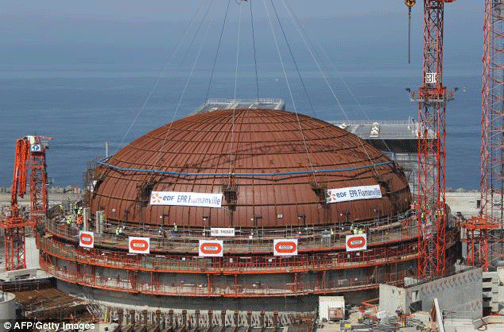
Inspections also revealed holes in concrete pillars and faults in buildings where nuclear fuel is to be stored.
A report by France’s nuclear safety authority in 2011 recorded 13 incidents of sub-standard safety measures. In 2013, a welder fell to his death. Then last year defects were discovered in safety valves in the cooling system.
Chillingly, this was similar to a problem that led to the Three Mile Island nuclear plant accident in Pennsylvania in 1979, which before Chernobyl was the world’s worst nuclear accident, and resulted in $1billion (£750million) of clean-up costs.
It was also in 2015 that Flamanville suffered a potentially killer-blow.
Tests on the steel used to construct the base and lid of the nuclear reactor vessel showed that too much carbon had been used, leading to weaknesses in the structure.
Professor Steve Thomas, of the University of Greenwich, said that if this led to the reactor failing, there would be no warning. ‘It will fail catastrophically and allow its radioactive contents into the environment,’ he said.
For their part, EDF and its project partner – the majority French state-owned company Areva, which makes nuclear reactors – have been forced to make more tests on the steel.
At the time the faults were found, the Financial Times said: ‘The scale of the risks to EDF if those tests identify a serious problem is hard to exaggerate.’
Whatever the findings of these new tests, Flamanville’s opening date – which has already been put back six years – is still nowhere in sight.
Professor Thomas warns that if it has to be rebuilt, the process could take up to five years, adding: ‘That might be prohibitively expensive and the whole plant could be abandoned.’
All this assumes that government-owned EDF doesn’t go bust in the meantime – which is a possibility.
In March, the company’s finance director Thomas Piquemal resigned, saying that taking on Hinkley as a project risked driving the firm to bankruptcy. Problems were compounded by the fact that Areva has had to be bailed out by the French government, with an injection of £3.4billion of public money in April. Inevitably, the European Commission has launched an investigation into this rescue package to check it did not ‘unduly distort competition’.
For some time, Areva – which is 87 per cent owned by the state – had been struggling with a downturn in the nuclear industry and has suffered big financial losses on its projects.
Once the pride of France, the reactor designer saw its credit rating downgraded last year, and in February it reported a €2billion (£1.7billion) net loss for 2015.
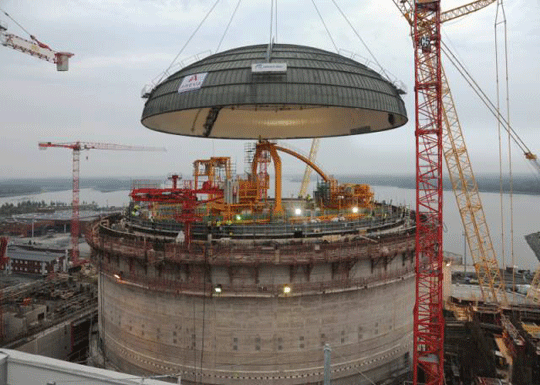
The project been subject to lawsuits, technology failure, construction errors and a bitter row between participant companies that has been described as ‘one of the biggest conflicts in the history of the construction sector’.
Work began on the EPR in 2005 and was scheduled to be completed in 2009. But from early on, problems emerged.
The concrete base on which the plant was to be built proved to be faulty, and had to be taken up and relaid. Then there was a problem with the electronic control systems.
Because it is absolutely vital that engineers can manage the temperature inside the reactor, a new nuclear plant must have two parallel control systems in case one fails.
The problem at Olkiluoto was that the two systems were too similar – meaning that if something caused the first one to shut down, there was a big risk that the second one would also close down.
The issue took five years to resolve – with the result that the power station is not expected to open until 2018 at the earliest.
Not surprisingly, the Finnish government has cancelled an option to buy a second reactor.http://www.dailymail.co.uk/news/article-3791895/The-18bn-Hinkley-gamble-nuclear-deal-cost-UK-family-extra-1-000-signs-plans-protect-Britain-s-national-security.html
No comments yet.
1 This Month

of the week – Shut Down Drone Warfare!


Tell the Ukrainian Government to Drop Prosecution of Peace Activist Yurii Sheliazhenko

Petition to revoke the licensing of the Near Surface Nuclear Disposal Facility (NSDF) at Chalk River. https://www.ourcommons.ca/petitions/en/Petition/Details?Petition=e-7247
To see nuclear-related stories in greater depth and intensity – go to https://nuclearinformation.wordpress.com
-
Archives
- April 2026 (79)
- March 2026 (251)
- February 2026 (268)
- January 2026 (308)
- December 2025 (358)
- November 2025 (359)
- October 2025 (376)
- September 2025 (257)
- August 2025 (319)
- July 2025 (230)
- June 2025 (348)
- May 2025 (261)
-
Categories
- 1
- 1 NUCLEAR ISSUES
- business and costs
- climate change
- culture and arts
- ENERGY
- environment
- health
- history
- indigenous issues
- Legal
- marketing of nuclear
- media
- opposition to nuclear
- PERSONAL STORIES
- politics
- politics international
- Religion and ethics
- safety
- secrets,lies and civil liberties
- spinbuster
- technology
- Uranium
- wastes
- weapons and war
- Women
- 2 WORLD
- ACTION
- AFRICA
- Atrocities
- AUSTRALIA
- Christina's notes
- Christina's themes
- culture and arts
- Events
- Fuk 2022
- Fuk 2023
- Fukushima 2017
- Fukushima 2018
- fukushima 2019
- Fukushima 2020
- Fukushima 2021
- general
- global warming
- Humour (God we need it)
- Nuclear
- RARE EARTHS
- Reference
- resources – print
- Resources -audiovicual
- Weekly Newsletter
- World
- World Nuclear
- YouTube
-
RSS
Entries RSS
Comments RSS
 nuclear-news
Leave a comment