Russia has not changed its nuclear weapons doctrine -Non-Proliferation Treaty (NPT) conference
Russian Nuclear Doctrine Unchanged Despite Escalation Claims, Sputnik News, 16 Sept 16 – Official Russia has stressed to its four Non-Proliferation Treaty (NPT) nuclear state partners that claims of it lowering its threshold for nuclear weapon use and increasing its military doctrine’s reliance on nuclear weapons are untrue, a senior official from the Russian Foreign Ministry told Sputnik…….
The five countries, known as the P5 group, include Russia, the United States, the United Kingdom, France and China. The international NPT treaty took effect in 1970 and has been ratified by 191 governments………
“Therefore, the possibility of any preventive offensive actions with the use of the nuclear weapons threat is not implied,” he added. The comments come as a rebuke to several claims previously made by NATO officials with regard to Russia allegedly modernizing its nuclear forces……..
“We noted that the US nuclear doctrine is practically oversized, envisioning use of nuclear weapons for protection of vital interest, which could include almost all purposes,” Leontyev said. These interests can be anything defined as such by the United States, including the global economy and international laws, he emphasized…….
Russia did not receive any official initiatives from the United States on renewing the treaty, but will consider them should Washington offer them, Leontyev said. “There were no official initiatives. We shall consider them if we receive them,” he said………https://sputniknews.com/russia/20160917/1045395099/russian-nuclear-doctrine-unchanged.htm
America giving up on the Mixed Oxide Nuclear Fuel (MOX) boondoggle
“The first question I asked was why if she mistakenly skipped over MOX. This is the largest federal construction project in the nation right now,” Jameson said. “The answer was no. She [National Nuclear Administration Principal Deputy Administrator Madelyn Creedon ]said they left it out on purpose, that they’re trying to get rid of it so they weren’t going to talk about it.”
to box up the project and move to another method of plutonium disposal known as dilute and dispose.
The NNSA has said the alternative is cheaper, citing life-cycle costs of MOX in the $50 billion to $60 billion range.
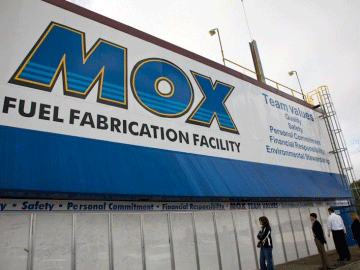 Aiken official: Savannah River Site’s MOX purposefully left out of NNSA discussion http://www.aikenstandard.com/article/20160914/AIK0101/160919745 Thomas Gardiner Email @TGardiner_AS The speaker from the National Nuclear Security Administration at the Energy Communities Alliance meeting in Arlington, Virginia, this week intentionally snubbed the Mixed Oxide Fuel Fabrication Facility, or MOX, under construction at the Savannah River Site, one Aiken official said.
Due to its relation to the Site, Aiken has delegate members that make up the ECA, an organization of local governments adjacent to or affected by Department of Energy activities that meet to discuss issues, establish policy positions and promote community interests.
On Tuesday, Greater Aiken Chamber of Commerce President and CEO David Jameson and Aiken County Councilman Chuck Smith were both in attendance, where National Nuclear Administration Principal Deputy Administrator Madelyn Creedon addressed NNSA projects nationwide.
But Jameson said even with Smith, who is the current ECA chairman, seated just down the table from her, Creedon deliberately passed over the MOX project.
“The first question I asked was why if she mistakenly skipped over MOX. This is the largest federal construction project in the nation right now,” Jameson said. “The answer was no. She said they left it out on purpose, that they’re trying to get rid of it so they weren’t going to talk about it.”
Nearly $5 billion has been poured into the monolithic building thus far, setting the stage for ripe political debate.
Legislators that include U.S. Sens. Tim Scott, R-S.C., and Lindsey Graham, R-S.C., along with U.S. Rep. Joe Wilson, R-S.C., have battled the NNSA and the Obama administration, who have driven for months to box up the project and move to another method of plutonium disposal known as dilute and dispose.
The NNSA has said the alternative is cheaper, citing life-cycle costs of MOX in the $50 billion to $60 billion range.
U.S. Secretary of Energy Ernest Moniz mirrored Creedon’s presentation this week with his own comments at the Carnegie Endowment for International Peace.
Moniz said, “We are in no man’s land, where we spend enough money to not get anywhere. There is no way that Congress is going to commit to spending a billion dollars a year for half a century to dispose of 34 metric tons of plutonium.”
MOX is part of a plutonium disposal agreement with Russia inked in 2000. In the interest of non-proliferation, the two nations bilaterally agreed to destroy or disposition plutonium that would never again be usable in nuclear weapons.
According to Congressional testimony by Under Secretary for Nuclear Security and NNSA Administrator Retired Lt. Gen. Frank G. Klotz, USAF in May, the Obama administration wants to move away from MOX to the dilute and dispose method, which doesn’t change the physical properties or chemical makeup of the plutonium, without getting approval of the Russians
Reports in Russian media said President Vladimir Putin sees the move to dilute and dispose as being outside of the agreement.
Moniz responded to Russian complications at the Carnegie Endowment.
“We do have a few other issues to deal with Russia at this time, and it’s maybe not the most (favorable) time for that question, as President Putin has pointed out,” he said.
Meanwhile, Congress is currently funding MOX at about $350 million a year, which, according to the NNSA, is enough to keep the construction going, even if it is at a trickle. Funding for 2017 is not yet official but is included in all versions of the National Defense Authorization Act bill for the year. That bill is in inter-chamber conference, and legislators are hopeful it will be brought to the floor next week.
Nearly $5 billion has been poured into the monolithic building thus far, setting the stage for ripe political debate.
Legislators that include U.S. Sens. Tim Scott, R-S.C., and Lindsey Graham, R-S.C., along with U.S. Rep. Joe Wilson, R-S.C., have battled the NNSA and the Obama administration, who have driven for months to box up the project and move to another method of plutonium disposal known as dilute and dispose.
Life-cycle costs, however, are estimates from the time ground is broken until the mission is completed and the building’s purpose has been fulfilled entirely. Those costs can change drastically over time, especially considering what Jameson called the “slow-build” approach.
“I like to look at it this way,” Jameson said. “My wife and I were married 39 years ago. I know about how much our bills are, like mortgage payments, electricity, car payments and so on. Our wedding cost about $4,000 then, but would you ever say that the life-cycle cost of our wedding was $1.2 million?”
U.S. Secretary of Energy Ernest Moniz mirrored Creedon’s presentation this week with his own comments at the Carnegie Endowment for International Peace.
Moniz said, “We are in no man’s land, where we spend enough money to not get anywhere. There is no way that Congress is going to commit to spending a billion dollars a year for half a century to dispose of 34 metric tons of plutonium.”
MOX is part of a plutonium disposal agreement with Russia inked in 2000. In the interest of non-proliferation, the two nations bilaterally agreed to destroy or disposition plutonium that would never again be usable in nuclear weapons.
According to Congressional testimony by Under Secretary for Nuclear Security and NNSA Administrator Retired Lt. Gen. Frank G. Klotz, USAF in May, the Obama administration wants to move away from MOX to the dilute and dispose method, which doesn’t change the physical properties or chemical makeup of the plutonium, without getting approval of the Russians.
Reports in Russian media said President Vladimir Putin sees the move to dilute and dispose as being outside of the agreement.
Moniz responded to Russian complications at the Carnegie Endowment.
“We do have a few other issues to deal with Russia at this time, and it’s maybe not the most (favorable) time for that question, as President Putin has pointed out,” he said.
Meanwhile, Congress is currently funding MOX at about $350 million a year, which, according to the NNSA, is enough to keep the construction going, even if it is at a trickle. Funding for 2017 is not yet official but is included in all versions of the National Defense Authorization Act bill for the year. That bill is in inter-chamber conference, and legislators are hopeful it will be brought to the floor next week.
Thomas Gardiner covers energy, science and health topics for the Aiken Standard.
General Electric a big winner from UK’s Hinkley nuclear decision
GE wins $1.9 billion order from UK’s Hinkley Point nuclear plant, CNBC 16 Sept 16
General Electric said it will receive $1.9 billion for a contract to supply steam turbines, generators and other equipment to the Hinkley Point C project, the United Kingdom’s first new nuclear power plant in decades…….GE is also bidding on nuclear competitions in Finland, South Africa, Saudi Arabia, Egypt, India and China……
Britain follows up quixotic Brexit decision with quixotic Hinkley nuclear decision
Britain Does A Brexit On Nuclear Power Seeking Alpha Sep. 16, 2016 Keith Williams
Summary
Hinkley Point C nuclear project approved by UK Government: backs nuclear over renewable energy. Is this, like Brexit, a lonely position?
$23.7 billion construction cost financed by French ((EDF)) ($15.8 billion) and Chinese Government CGN ($7.9 billion); this cost excludes financing costs.
Completion 2025+, agreed power price 92.50 pounds/MWh in 2012 prices (double wholesale rate now) for 35 years regardless of wholesale price of power (consumers will make up difference).
Further nuclear projects planned in the UK by the EDF/CGN consortium.
GE an early beneficiary.
As everyone is getting used to Britain’s Quixotic decision to exit the EU, the British have done it again by deciding to go ahead with the massive Hinkley Point C nuclear reactor program, despite the fact that this locks Britain into expensive power for the next 35 years.
The Hinkley Point C story…….
The project is not without risk. Only four nuclear plants using the technology planned for Hinkley Point C are under construction. The two European plants under construction have had massive cost blowouts and neither is yet operational (see below).
The cost structure and completion date for Hinkley Point C has already grown considerably since the project was first announced. The guaranteed cost of power is twice what was first envisaged and completion has slipped by 8 years…. (registered readers only) http://seekingalpha.com/article/4006707-britain-brexit-nuclear-power
China planning to be dominant player in UK’s nuclear power industry
China plans central role in UK nuclear industry after Hinkley Point approval China General Nuclear aims to submit designs for Bradwell power station in Essex within weeks of Somerset approval, sources say, Guardian,
Graham Ruddick,16 Sept 16, China is set for a central role in Britain’s nuclear industry after the government gave the go-ahead for a new power station at Hinkley Point.
The Chinese company involved in the £18bn project plans to submit a design for a nuclear power station in Essex within weeks. China General Nuclear agreed to take a 33% stake in Hinkley Point C in Somerset, alongside the French energy group EDF, in return for leading the project at Bradwell, Essex…….
Secret nuclear management contract given to donor to South Africa’s President Zuma
‘Predatory elite’ eye nuclear deal http://mg.co.za/article/2016-09-16-00-editorial-predatory-elite-eye-nuclear-deal The looming nuclear deal that seems to be President Jacob Zuma’s biggest pet project (and will be South Africa’s biggest financial and construction deal ever, if it happens) has been questioned by many commentators, including MPs and civil society groups. The deal, which already has links with Russia’s notoriously oligarchic government, worries anyone who can see in it the largest opportunity yet for the looting of state resources by the group currently devoting all their means to that end.
The nation was told, in the National Assembly, that all the necessary checks would be put in place and that the legal and other hurdles would be diligently cleared before the deal went ahead. The intimation was that any serious obstacles to the deal would come to light and could possibly scupper it entirely – a prospect many would welcome.
But the nation was also told, by a different minister in the other House of Parliament, that it was full steam ahead on the project – with the intimation that no objections would be allowed to stand in its way.
The first utterance came from Deputy President Cyril Ramaphosa, who seems to have been given the job of placating the objectors and the intelligentsia, or anyone concerned about the ongoing plans of what unionist Zwelinzima Vavi long ago called “the predatory elite”.
The second utterance came from Zuma’s extremely loyal energy minster, Tina Joemat-Pettersson, so it was to be expected that she would show every sign of wanting to do his bidding as soon as possible.
It has emerged that a contract worth R171-million for a “programme management system” to help get the nuclear deal off the ground has been awarded, in practical secrecy, to a company called Empire Technology. This is wholly owned by Shantan Reddy, the son of controversial businessperson Vivian Reddy, who has given Zuma considerable financial support over the years, including a contribution to the building of the president’s family complex in Nkandla.
That so little is known about the company, and that the deal appears to have gone through so quickly, is cause for concern.
Is the nuclear deal going ahead or not? Will South Africa be taking adequate precautions to ensure that it doesn’t overly indebt the nation? Was the evidence collated and presented to Zuma’s Cabinet? There are no clear answers to any of these questions.
Without a rational and sensible evaluation of the logic of the deal, and an accounting of the costs and benefits to South Africa if it goes ahead, it can’t be seen as much more than another way for the predatory elite to milk money from the state.
South Africa: Jacob Zuma’s disastrous nuclear deal
Zupta’s nuclear deal: either we end it or it ends us, Politics Web, 16 Sept 16, Jacob Zuma’s nuclear deal will be disastrous for South Africa. It will literally bankrupt us, diverting billions of rands from poverty reduction projects, while producing a nuclear white elephant in two decades’ time. But it will make a lot of money for Zuma, the Guptas and ANC cronies in the short-term and they will be long gone by the time we feel the real pain.
In Parliament last week, Energy Minister Tina Joemat-Pettersson confirmed that government is going ahead with the nuclear procurement process and Public Enterprises Minister Lynne Brown confirmed that information on the process will not be made public. In other words: “We’re going to tie you into far more debt that you can ever repay, but this is none of your business.”
This morning, a DA-assisted Mail and Guardian investigation has revealed the first concrete signs of corruption associated with the nuclear deal. A R171 million contract for the “Nuclear New Build Programme Management System” has been issued, potentially irregularly, to the son of Vivian Reddy, a close friend and ally of President Jacob Zuma.
South Africans should be deeply concerned about the government’s nuclear project. Let’s be clear. It is in no way motivated by a genuine desire to secure South Africa’s energy future in the most cost effective and sustainable way. Rather, this huge project is going ahead because Zuma, the Guptas and other ANC elites stand to make millions in bribes and tenders.
Like the Arms Deal, Nkandla and the President’s new jet, there is no intention to use state resources judiciously in order to derive the maximum public benefit. And like these ill-conceived projects, the nuclear deal will have the ultimate effect of stealing from all of us, but particularly the poor, in order to enrich a small group of connected ANC cadres……….
In forging ahead with this ill-conceived plan, our hapless government is locking SA into an over-priced, outdated technology within Eskom’s monopoly, while blocking the development of renewables which are dynamic, increasingly cost-effective and more job-creating. It is no coincidence that Eskom is refusing to sign any new contracts with independent power producers…………http://www.politicsweb.co.za/opinion/zuptas-nuclear-deal-either-we-end-it-or-it-ends-us
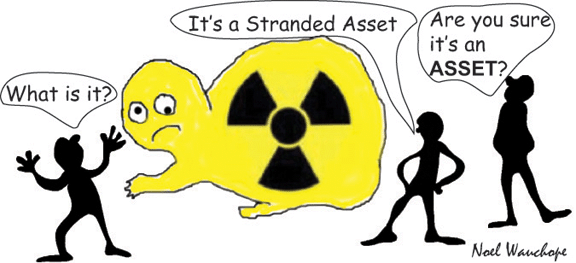
Hinkley nuclear plant vulnerable to becoming a “stranded asset”
A Nuclear Lesson For Big Oil (And Vice Versa), Bloombeg Gadfly, 16 Sept 16 By Liam Denning It is a reasonable bet that the $24 billion Hinkley Point C nuclear power project in the U.K., due online in 2025, will neither be ready by 2025 nor cost just $24 billion. Indeed, it’s so reasonable that, as fellow Gadfly Chris Bryant lays out here, the stock market appears to be making that very same bet.
Leave aside the also reasonable conspiracy theories about London buttering up Paris and Beijing by approving the project and focus on the ostensible reason for doing it: maintaining security of energy supply……….
The oil and gas industry’s experience reveals one more insidious risk facing the nuclear project.
There’s a reason EDF demanded the U.K. government guarantee an electricity price for Hinkley Point’s output atdouble the current wholesale price. Financing a $24 billion project that won’t produce a cent of revenue for a decade is really tough — especially in an industry carrying as muchhistorical baggage on busted budgets and timescales as nuclear power does. Subsidies and guarantees help bridge the risk gap………
mega-projects can prove vulnerable not despite their scale but because of it. They might extract savings on, say, procurement, but their inherent complexity makes it hard to apply lessons from previous examples to gain efficiency. ……..
And once a company is several years into building a new power plant or LNG terminal, the compulsion to complete it is enormous, due to the already huge sunk costs (and need to save face), even if budgets and schedules have been blown through or — as was the case with fracking — another technology has disrupted the market……..
With energy technology in such flux right now, ranging from renewable power to batteries to energy efficiency, is there a high risk that a giant plant a decade or more away from completion becomes stranded? You bet…..……
In Hinkley Point’s case, of course, any future U.K. government wouldn’t dare try to wriggle out of those high, guaranteed power prices for fear of enraging the French. Because that’s never happened. https://www.bloomberg.com/gadfly/articles/2016-09-16/hinkley-point-nuclear-power-project-s-lesson-for-big-oil
Huge workforce maintains Japan’s shuttered nuclear power stations
Nuclear plant can’t sell power but thousands still work there Japan’s utilities keep plants open, hoping to restart them, Straits Times, 16 Sept 16 TOKYO • More than 6,000 workers cycle through the world’s biggest nuclear plant every day to operate and maintain a facility that has not sold a kilowatt of electricity in more than four years.
The buzz at Tokyo Electric Power’s (Tepco’s) Kashiwazaki-Kariwa plant plays out daily across Japan, where utilities employ thousands of workers and spend billions of dollars awaiting the green light to restart commercial operations.
With only three of the country’s 42 operable reactors running, they are betting a national government committed to nuclear power will win over local officials and a wary public who do not believe enough has been done to guarantee safety after the worst meltdown since Chernobyl.
“Even though operating expenses of non-generating reactors remain high, utilities would prefer to keep them open while there is any chance they can restart,” said Mr James Taverner, a Tokyo-based analyst at IHS Markit.
“Utilities have already committed significant expenditure for plants to meet new safety standards, and decommissioning costs are considerable.”
The plant, the world’s biggest with generating capacity of about 8.2 gigawatts, has seven reactors at a facility spread across more than 400ha and located about 217km north-west of Tokyo in the prefecture of Niigata…….
o boost confidence in its facility’s safety, Tepco has spent 470 billion yen on flood barriers, a 15m seawall and a reservoir the size of 30 Olympic-sized swimming pools to supply water in the event a reactor pump fails.
KK’s restart is far from assured. The plant was forced to shut for 21 months following an earthquake in July 2007. Though some units eventually restarted, all were shuttered again after the March 2011 Fukushima accident for safety checks.
The restart of nuclear reactors is opposed by 53 per cent of Japanese and supported by just 30 per cent, according to a nationwide poll conducted earlier this year by the Mainichi newspaper.
Should KK clear the necessary regulatory, legal and political hurdles and resume operations, Tepco plans to maintain the facility’s workforce at current levels, a reflection of how many workers are needed even during a period called cold shutdown. http://www.straitstimes.com/asia/east-asia/nuclear-plant-cant-sell-power-but-thousands-still-work-there
Fears of radioactive leak from spent nuclear fuel facility in Norway
Ife need more time to investigate the reason for radioactivity , TU (Google translate from Norwegian) Norway nuke disaster rough draft from Norwegian. ØYVIND LIE 4. APRIL 2016 –
As TU has previously discussed, fearing Norwegian Radiation radioactive leak from the Institute for Energy Technology (Ife) its storage facility for spent nuclear fuel at Kjeller in Akershus.
According to a Swedish expert, hired by Ife, it should be “extensive corrosion” on the containers in the old stave well with fuel from the 1950s and 1960s, and “strong suspicion” that it is leaking into groundwater.
Need more time
NRPA therefore notified that they would impose Ife investigating why around spell well for radioactivity before April 15th.
That time, however, too short for Ife.
“In order to establish an appropriate program that can provide information about a possible contamination situation today, but also with the intent to monitor conditions in the future, it is necessary with good planning and necessary preparations,” writes Ife in an email to the NRPA.
This program involves including drilling of beans to take samples below the level where the fuel is stored and if necessary also around……. http://www.tu.no/artikler/ife-trenger-mer-tid-for-a-undersoke-grunnen-for-radioaktivitet/346002
1 This Month
To see nuclear-related stories in greater depth and intensity – go to https://nuclearinformation.wordpress.com/
12 February – Webinar The Big Push: New Nuclear Projects in Canada
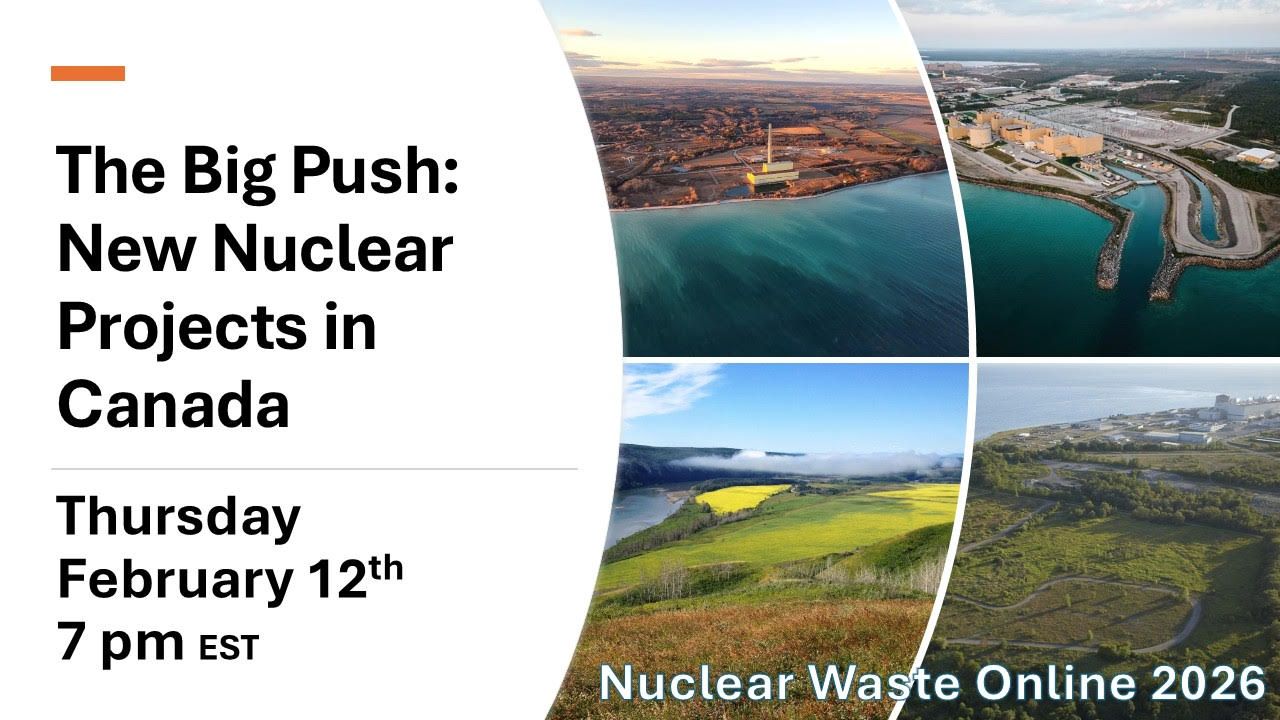
Thursday, February 12, 7 pm Eastern | 2nd of 4 sessions in the 2026 Nuclear Waste Online webinar series
Join a webinar on the push for new nuclear generation in Canada. Go to Northwatch.org to register or use the registration link https://us02web.zoom.us/webinar/register/WN_ZfWOf1GITqSRIZX8CB-A9w
-
Archives
- February 2026 (127)
- January 2026 (308)
- December 2025 (358)
- November 2025 (359)
- October 2025 (376)
- September 2025 (258)
- August 2025 (319)
- July 2025 (230)
- June 2025 (348)
- May 2025 (261)
- April 2025 (305)
- March 2025 (319)
-
Categories
- 1
- 1 NUCLEAR ISSUES
- business and costs
- climate change
- culture and arts
- ENERGY
- environment
- health
- history
- indigenous issues
- Legal
- marketing of nuclear
- media
- opposition to nuclear
- PERSONAL STORIES
- politics
- politics international
- Religion and ethics
- safety
- secrets,lies and civil liberties
- spinbuster
- technology
- Uranium
- wastes
- weapons and war
- Women
- 2 WORLD
- ACTION
- AFRICA
- Atrocities
- AUSTRALIA
- Christina's notes
- Christina's themes
- culture and arts
- Events
- Fuk 2022
- Fuk 2023
- Fukushima 2017
- Fukushima 2018
- fukushima 2019
- Fukushima 2020
- Fukushima 2021
- general
- global warming
- Humour (God we need it)
- Nuclear
- RARE EARTHS
- Reference
- resources – print
- Resources -audiovicual
- Weekly Newsletter
- World
- World Nuclear
- YouTube
-
RSS
Entries RSS
Comments RSS
 nuclear-news