Climate Change Think Tank sets out 10 serious mistakes in Hinkley nuclear decision
 HINKLEY GREEN LIGHT A MASSIVE STRATEGIC MISTAKE, SAYS CLIMATE CHANGE
 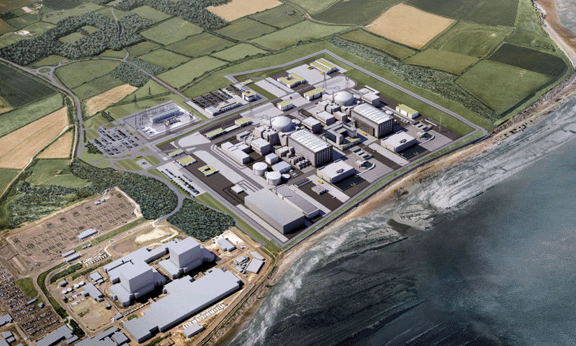 THINK TANK http://tomburke.co.uk/2016/09/15/hinkley-green-light-a-massive-strategic-mistake-says-climate-change-think-tank/ September 15, 2016 by tomburke Following reports today that the Government is about to give the green light to the Hinkley Point C nuclear power station, E3G, a leading climate change think tank said it would be a hugely expensive strategic mistake, using expensive 20th century technology that would soon be obsolete.
E3G Chairman, Tom Burke said: “It is a 20th Century solution to 21st Century problems. Bigger is no longer better. There are faster, cheaper, cleaner and smarter ways to deliver affordable, secure, low carbon electricity to Britain’s consumers.
Nothing about this deal is good for Britain’s hardworking families. They will pay the bill for decades but the jobs will go abroad. It is bad for consumers, bad for the climate and bad for the country.
The Prime Minister is missing a real opportunity to set Britain on course to a more productive and secure future. Instead she has committed us to an expensive and anachronistic energy policy that will leave Britain further behind in a rapidly changing world.”
- E3G sets out below ten reasons why this is a bad deal for British consumers and documents the range of cheaper, smarter, options for low carbon energy security that are better value for money.
HINKLEY POINT : The 10 Mistakes
The Investor Agreement that Greg Clark will sign with EDF is an irrevocable index-linked ‘take or pay’ contract to purchase 35 years’ worth of electricity from EDF at more than twice the current wholesale price. This will cost British consumers £37 billion in subsidy, four times that originally forecast[1]
- This deal binds future governments as well as the current Government. It will prevent Britain’s consumers buying cheaper electricity if it would displace that from EDF.
- It means Britain’s electricity consumers will pay more than £1 billion/year in subsidy to EDF for 35 years.
- The business case for this Agreement has never been subject to informed public scrutiny. The arguments for HPC and the rest of the nuclear programme have never been stress tested.
- The National Audit Office has already raised doubts that it represents value for money in the light of developments, including significant reductions in electricity demand forecasts, since it was first proposed[2].
- The National Infrastructure Commission has identified a package of other measures that could provide affordable, secure, low carbon electricity at lower cost.
- The National Grid has cut its forecast of the need for new centralised generation capacity in Britain by more than 50%, announcing its estimate of growth for decentralised generation was 50 times too low[3]
- EDF’s unions will argue in the French Courts that delaying a Hinkley decision until 2018 would allow for a design review to be completed that would reduce the subsidy needed from £92.50/MWh to £75/MWh[4].
- State Aids clearance for the UK subsidy is under challenge by the Austrian Government and others in the European Court. A further State Aids challenge is likely to the French Government’s re-financing of EDF. If either is successful the deal will fall.
- Hinkley will not produce electricity until 2030. There are cheaper, faster, cleaner and more reliable options available to deliver affordable, secure, low cost electricity to British consumers. These include:
- energy efficiency has reduced electricity demand by 25TWh ( 7% – the same as Hinkley will produce ) since 2010. A McKinsey report for the Government estimates that by 2030 demand could be reduced by a further 23% while reducing consumers bills;
- the National Infrastructure Commission reports that additional interconnectors could supply 2-3 Hinkleys by 2025;
- another National Infrastructure Commission report proposed investment in storage and smart grids that would provide the equivalent of 4 Hinkleys by 2030 and save £8 billion.
- Dong Energy, the world’s largest wind energy company, could replace all Hinkley’s electricity sooner and at lower cost. Offshore wind costs are continuing to fall.
- electricity from solar power is now also cheaper than Hinkley, having fallen by half in the last five years. From almost no solar panels in the UK, a third of a Hinkley has been added since 2010. Half of that was delivered in just 18 month.
- E3G is an independent global think tank, working to accelerate the transition to a low-carbon economy. E3G specializes in climate diplomacy, climate risk, energy policy and climate finance.
- In 2016, E3G was ranked the number one environmental think tank in the UK by the Go To Think Tank Index, second in Europe and sixth in the World.
No comments yet.
1 This Month

of the week – Shut Down Drone Warfare!


Tell the Ukrainian Government to Drop Prosecution of Peace Activist Yurii Sheliazhenko

Petition to revoke the licensing of the Near Surface Nuclear Disposal Facility (NSDF) at Chalk River. https://www.ourcommons.ca/petitions/en/Petition/Details?Petition=e-7247
To see nuclear-related stories in greater depth and intensity – go to https://nuclearinformation.wordpress.com
-
Archives
- April 2026 (7)
- March 2026 (251)
- February 2026 (268)
- January 2026 (308)
- December 2025 (358)
- November 2025 (359)
- October 2025 (376)
- September 2025 (257)
- August 2025 (319)
- July 2025 (230)
- June 2025 (348)
- May 2025 (261)
-
Categories
- 1
- 1 NUCLEAR ISSUES
- business and costs
- climate change
- culture and arts
- ENERGY
- environment
- health
- history
- indigenous issues
- Legal
- marketing of nuclear
- media
- opposition to nuclear
- PERSONAL STORIES
- politics
- politics international
- Religion and ethics
- safety
- secrets,lies and civil liberties
- spinbuster
- technology
- Uranium
- wastes
- weapons and war
- Women
- 2 WORLD
- ACTION
- AFRICA
- Atrocities
- AUSTRALIA
- Christina's notes
- Christina's themes
- culture and arts
- Events
- Fuk 2022
- Fuk 2023
- Fukushima 2017
- Fukushima 2018
- fukushima 2019
- Fukushima 2020
- Fukushima 2021
- general
- global warming
- Humour (God we need it)
- Nuclear
- RARE EARTHS
- Reference
- resources – print
- Resources -audiovicual
- Weekly Newsletter
- World
- World Nuclear
- YouTube
-
RSS
Entries RSS
Comments RSS
 nuclear-news
Leave a comment