Australia’s secret shame – the Maralinga nuclear bomb tests
This March, documents obtained exclusively by news.com.au revealed that hundreds of children and grandchildren of veterans exposed to radiation were born with shocking illnesses including tumours, Down syndrome, cleft palates, cerebral palsy, autism, missing bones and heart disease.
Other veterans posted to the Maralinga nuclear test site blamed the British Nuclear Test for an unusually high number of stillbirths and miscarriages among the group.
“The rest of the Aboriginal people in this country need to know the story as well,” “This one’s been kept very quiet.”
Nuclear will be on show at the National Aboriginal Cultural Institute in Adelaide, South Australia from 17 September to 12 November.
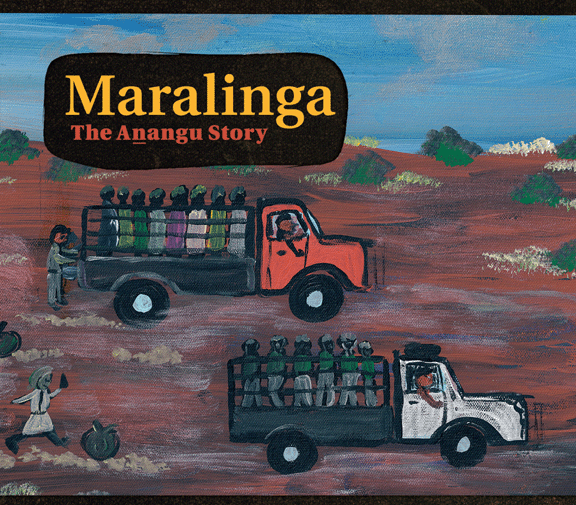 The secret destruction of Australia’s Hiroshima, http://www.news.com.au/lifestyle/real-life/news-life/the-secret-destruction-of-australias-hiroshima/news-story/9eabf722dbe2f87e03a297c2a348a8e1 news.com.au, SEPTEMBER 17, 2016 WHEN nuclear explosions tore through Australia’s vast, arid centre, some people living there didn’t even know it was coming.
It devastated the country for miles around, annihilating every bird, tree and animal in its path.
Even today, the effects of our very own Hiroshima are still felt by the families it ripped apart, and those suffering horrific health problems as a result.
The British military detonated seven nuclear bombs in remote Maralinga, around 800km north-west of Adelaide, plus two at Emu Fields and three off the coast near Karratha, Western Australia.
They also staged hundreds of minor trials investigating the impact of non-nuclear explosions on atomic weapons, involving tanks, gun, mannequins in uniforms and even tethered goats. In many ways, these smaller tests were equally dangerous, spraying plutonium in all directions.
Yet most Australians know very little about the blasts that shattered communities, and the dramatic story now buried under layers of dust.
Archie Barton was just a child when the nuclear testing took place between 1956 and 1963, stretching across a huge now uninhabitable 120km of land where he and thousands of others lived.
“He was taken away from his mother,” his stepson Steve Harrison tells news.com.au. “He was part of the Stolen Generations. He grew up in homes around Australia, and led a very rough life.
“Before my mum, he was a full-blown alcoholic. He wanted to go back to his birthplace.
“He came into my life at a very young age. I was 14. I knew him as a strong, proud Aboriginal black man. He ended up getting an OBE.”
‘CHEAP AND NASTY SOLUTION’
Mr Barton’s family was not the only one scattered by the bombs. Many walked for days or even weeks to find new homes, deliberately going barefoot so their relatives could follow behind. British soldiers repeatedly turned them back south when they tried to head north.
Unsurprisingly, many never found each other.
“They were dispersed pretty much to the four points of the compass,” said Paul Brown, creative director of new showcase Nuclear, featuring Mr Harrison’s artwork. “It represented a massive dislocation from the watering holes and places that were important to Aboriginal people.
“If Aboriginal people weren’t caught up in the blast, it was by sheer luck, not design.
“People were very close at the time of the blast, they even had to take people into the decontamination area to scrub them down.”
Decades later, 57-year-old Mr Harrison’s village still isn’t a safe place for humans to live, despite numerous attempts to decontaminate the area, in 1967, 1985 and the late 1990s.
Ian Anderson’s 1993 New Scientist article “Britain’s dirty deeds at Maralinga” exposed negotiations between the UK and Australia to dispose of toxic plutonium that had been lightly covered with soil instead of being buried in concrete bunkers.
And as recently as 2007, nuclear engineer Alan Parkinson claimed the latest $100 million clean-up was a “cheap and nasty solution”.
IT RUINED QUITE A LOT OF LIVES’
The Anandu people fled to Oak Valley, Yalata, Renmark and almost anywhere between Kalgoorlie in WA and Adelaide.
Torn from family members and their homes, indigenous communities saw the consequences travel down the generations. Alcoholism is one of the biggest problems, along with drugs, crime, homelessness and lack of acceptance from new towns where these displaced people live on the fringes.
The Royal Commission found evidence of terrible disabilities caused by likely radiation impacts on both veterans and Aboriginal communities.
This March, documents obtained exclusively by news.com.au revealed that hundreds of children and grandchildren of veterans exposed to radiation were born with shocking illnesses including tumours, Down syndrome, cleft palates, cerebral palsy, autism, missing bones and heart disease.
Other veterans posted to the Maralinga nuclear test site blamed the British Nuclear Test for an unusually high number of stillbirths and miscarriages among the group.
A 2008 Department of Veterans’ Affairs study reported that the doses to Australians were small, with a spokesman tellingnews.com.au that studies into the descendants of Hiroshima and Nagasaki nuclear bombs survivors showed they “do not have an increased frequency of chromosome abnormalities or major birth defects.”
Yet a 1999 study for the British Nuclear Test Veterans Association found that 30 per cent of involved veterans had died from cancer, mainly in their 50s.
Troops flew through mushroom clouds from explosions without protection and marched to ground zero immediately after bomb detonation. Airborne drifts of radioactive material resulted in “radioactive rain” being dropped on Brisbane and Queensland country areas.
“When they created this problem, they didn’t picture it at the end,” says Mr Harrison. “People are fighting for their existence.
“We can go back, but cannot go back and live there. It’s ruined quite a lot of lives.
“I see people who’ve been taken away coming back trying to reconnect with family. Most now live in Yalata on the Nullabor Plains.
“It was so sad, so hard. You need to grow up with family from a young age. Now they’re telling people they’ve got to leave communities in the Northern Territory, they’re closing down a lot of these communities.”
THIS ONE’S BEEN KEPT QUIET’
The Maralinga bombs were set off in a way that officially satisfied safe firing requirements. The detonations were even celebrated as a “great success” in The Advertiser.
But Mr Brown says there is evidence the military was “deliberately misleading the public about the likely impact.”
Britain’s Parliament last year issued a statement of recognition and set up a benevolent fund for veterans who took part in the nuclear tests.
Mr Brown hopes his exhibition, 60 years on from the blasts, will show that these are not simply stories about victims. “Often people have gone on the front foot,” he said. “In Japan, the Hibakusha are world leaders in the peace movement. They’ve taken it upon themselves to campaign for disarmament and world peace.”
Mr Harrison, who has visited Hiroshima and Nagasaki survivors in Japan and presented them with a sculpture, says his main concern is making sure Australians know what happened in their own country.
“The rest of the Aboriginal people in this country need to know the story as well,” he added.
“This one’s been kept very quiet.”
Nuclear will be on show at the National Aboriginal Cultural Institute in Adelaide, South Australia from 17 September to 12 November.
No comments yet.
1 This Month

of the week – Shut Down Drone Warfare!


Tell the Ukrainian Government to Drop Prosecution of Peace Activist Yurii Sheliazhenko

Petition to revoke the licensing of the Near Surface Nuclear Disposal Facility (NSDF) at Chalk River. https://www.ourcommons.ca/petitions/en/Petition/Details?Petition=e-7247
To see nuclear-related stories in greater depth and intensity – go to https://nuclearinformation.wordpress.com
-
Archives
- April 2026 (7)
- March 2026 (251)
- February 2026 (268)
- January 2026 (308)
- December 2025 (358)
- November 2025 (359)
- October 2025 (376)
- September 2025 (257)
- August 2025 (319)
- July 2025 (230)
- June 2025 (348)
- May 2025 (261)
-
Categories
- 1
- 1 NUCLEAR ISSUES
- business and costs
- climate change
- culture and arts
- ENERGY
- environment
- health
- history
- indigenous issues
- Legal
- marketing of nuclear
- media
- opposition to nuclear
- PERSONAL STORIES
- politics
- politics international
- Religion and ethics
- safety
- secrets,lies and civil liberties
- spinbuster
- technology
- Uranium
- wastes
- weapons and war
- Women
- 2 WORLD
- ACTION
- AFRICA
- Atrocities
- AUSTRALIA
- Christina's notes
- Christina's themes
- culture and arts
- Events
- Fuk 2022
- Fuk 2023
- Fukushima 2017
- Fukushima 2018
- fukushima 2019
- Fukushima 2020
- Fukushima 2021
- general
- global warming
- Humour (God we need it)
- Nuclear
- RARE EARTHS
- Reference
- resources – print
- Resources -audiovicual
- Weekly Newsletter
- World
- World Nuclear
- YouTube
-
RSS
Entries RSS
Comments RSS
 nuclear-news
Leave a comment