Nuclear power a hindrance, not a help, to climate change action
 Is nuclear crucial to climate change targets?, Japan Times, AFP-JIJI, AP SEP 16, 2016
  PARIS – As Britain greenlights its first new nuclear power plant in more than 20 years, experts diverge on the role of nuclear energy in the quest to cap global warming at less than 2 degrees Celsius.
The broad challenge in meeting that goal — the cornerstone of the Paris Agreement inked in December by 195 nations — is decarbonizing the world economy as quickly as possible.
“We need a global transition to primarily zero carbon energy sources by midcentury,” said Rachel Cleetus, lead economist and climate policy manager for the Washington-based Union of Concerned Scientists (UCS).
Along with other think tanks and advocacy groups sounding the climate change alarm, the UCS is not a champion of nuclear power……
Not all climate and energy experts, however, are convinced that nuclear is crucial for keeping a lid on global warming.
“In fact, it’s a barrier,” said Tom Burke, chairman of London-based E3G, a climate change think tank. “It takes away capital from things that would deliver faster, cheaper and smarter low carbon electricity systems,” he said. It also runs counter, he added, to a wider trend toward decentralized, flexible power generation.
For climate analyst Martin Kaiser of Greenpeace International, “the only feasible and secure way to keep global warming well below 2 degrees Celsius is a massive swing toward renewables.” A “100 percent” renewable energies revolution is still possible, he insisted.
For Williams, potential climate catastrophe trumps the risks associated with nuclear power — radioactive waste, accidents such as happened in Fukushima and Chernobyl — only with strict regulatory oversight in place.
He highlighted the contrast between gold-standard Switzerland and China, which has 30 nuclear plants built or under construction, and another 20 in the pipeline.
“China has relatively understaffed and undertrained regulatory authorities — that is worrisome,” he said.“Would I live next to a nuclear power plant if I thought that was really important to mitigate climate change? “In the first case (Switzerland) I would, but in the second I wouldn’t.” http://www.japantimes.co.jp/news/2016/09/16/business/nuclear-crucial-climate-change-targets/#.V9yIWVt97Gg
It could have been an ISIS terrorist. Lucky it was only a peace protestor holding up nuclear weapons convoy
 If just two peace protestors can get this close and hold up a nuclear weapons convoy why couldn’t ISIS?
- 78-year-old anti-nuclear campaigner lies under military truck in Stirling
- The vehicle thought to be carrying nuclear warheads was part of a convoy
- Police intervened and stopped traffic so it could continue trip to Scotland
By JESSICA DUNCAN FOR MAILONLINE 17 September 2016
The incredible moment a 78-year-old retired teacher managed to hold up four military trucks thought to be carrying nuclear warheads has emerged online.
Shocking moment retired teacher, 77, holds up nuke convoy
The vehicles with their large police convoy were spotted passing through Raploch, in Stirling, at around 5pm yesterday after they had left the Atomic Weapons Establishment Burghfield near Reading on Wednesday to make their way up to Coulport, Scotland.
But they were stopped by two activists including Brian Quail, an anti-nukes campaigner who is also believed to be a former teacher, and his younger colleague Alasdair Ibbotson, 21.
Speaking to the Mail Online Mr Ibbotson, who is a student and Green Party supporter, said: ‘I have been campaigning for nuclear weapon disarmament since I was 16. I am passionate about it because at the end of the day it causes the mass murder of millions of people, and is just wrong on every level.
‘The money spend on trident could be better spent on our NHS.
‘And if a pensioner and a student can stop them, anyone else with actually ill intent could do.
‘The MOD need to think about how this and whether they should use the road at all.‘We knew the convoy was passing through the area around that time because we have a national network tracking when they leave the Atomic Weapons Establishment Burghfield and head to Coulport in Scotland.
‘We don’t know what was on board but we do know they are currently undertaking an upgrade programme and we believe regular parts are being taken between the two bases to be reassembled.’
Mr Quail and Mr Ibbotson were seen working as a duo to stop one of the vehicles.
Mr Ibbotson first jumped out in front of one of the vans with his hands above his head while the OAP quickly lay on the floor wedging himself in front of one of the back wheels.
Police on motorbikes rushed to drag the first protester to the roundabout but it took over two minutes and more than six police personnel to remove Mr Quail from under one of the vans.
The younger man has another attempt to lie down on the road as police move him to the pavement before ten members of the police are required to get them into the back of police vans.
The incident also brought rush hour traffic to a standstill as police swarmed the area and other road users got out of their cars to see what’s happening.
It is reported that the convoy was held up for over 20 minutes as police apprehended the two protesters.
The five minute clip, posted by Stirling University Campaign for Nuclear Disarmament (CND), is filmed at a roundabout in the city and begins with the person behind the camera saying that the footage is being filmed ‘about a mile from the town centre’ over the sound of police sirens.
The police escort and first lorry make it past the protesters but the third vehicle in the convoy is forced to slam on its brakes as the two men dart out in front of it with their hands above their heads.
With the incident causing an ever-increasing tailback of rush-hour traffic, it takes over six officers to eventually remove the man and sit him up on the nearby pavement.
A spokesman for Police Scotland said: ‘Two males have been arrested and charged for a breach of the peace after a military convoy was disrupted as it made its way through Stirling on Thursday, September 15.
‘Both men, aged 21 and 78, have been reported to the Procurator Fiscal and are expected to appear in court at a later date…………. http://www.dailymail.co.uk/news/article-3792600/If-stop-Terrifying-moment-77-year-old-retired-teacher-student-21-holds-nuclear-weapons-convoy.html
Gloom pervades The World Nuclear Association (WNA) Symposium 2016
 In the news: The Nuclear Industry, Proactive Investors 16 Sep 2016 FROM THE BROKING DESK The World Nuclear Association (WNA) Symposium 2016 was held in London this week. Naturally, I took the opportunity to hop on the bus to the Park Plaza Hotel in Waterloo to gauge the mood. It was pretty sombre……….
Sadly, for the last five years this inflection point has always been ‘next year’. Utilities have not bought into the long-term contract market and will need to catch up quickly to rebuild their stockpiles. Large chunks of marginal production from majors such as Cameco have been shut down over the last two years, and the talk is that Cameco could cut supply further by closing its US operations. Kazakh production is surely peaking, potential new supply from Africa is not high enough grade and the possible new supply from the Athabasca Basin is too far off. The list of reasons why the uranium price will turn ‘next year’ goes on, and all of them make sense. But it hasn’t, has it?
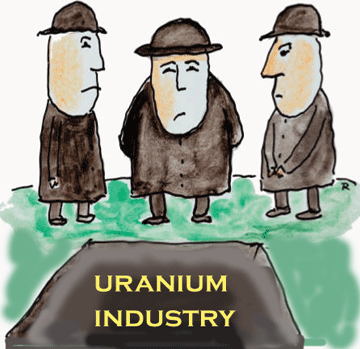 Uranium executives radiate sunny optimism at the start of each year when pitching their new project. This then disappears by the summer after it becomes clear that it’s not in fact next year, but the year after that. This time even that optimism has gone. All the executives I spoke to looked about as miserable as England football fans in the second week of a major tournament. …..
Let’s just have a quick look at the Hinkley C announcement. …..the decision to go ahead is probably a mistake, but not one the new prime minister could get out of without starting a war with France and China. The problems with Hinkley C are multiple. Yes, it is probably too expensive, yes, we should be looking at new technologies that create decentralised power generation, yes, the Chinese are probably spying on us and could turn the lights off at any time, and, yes, it just props up an ailing French nuclear industry and stops EDF from going bankrupt. Also, the, ahem, elephant in the room is that there is no actual evidence that European Pressurised Reactors even work. Bonne chance. http://www.proactiveinvestors.co.uk/columns/the-rfc-ambrian-metals-mining-and-oil-gas-overview/26047/in-the-news-the-nuclear-industry-26047.html
Britain’s nuclear gamble will cost every UK family an extra £1,000
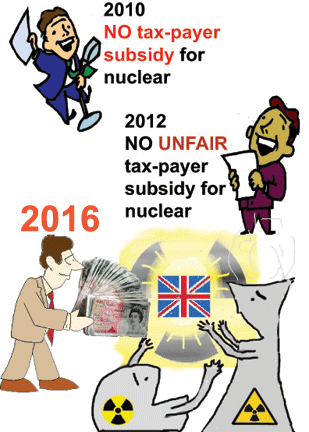
 The £18bn Hinkley gamble: Nuclear deal will cost every UK family an extra £1,000 as May signs off on the plans to protect Britain’s national security
- Prime Minister approved plans after restricting influence of Chinese state
- Britain will guarantee EDF £92.50 per megawatt hour, up on current market price of £38.91
- Tory MP Zac Goldsmith said the plant would generate ‘most expensive energy in the history of energy generation’
By JASON GROVES DEPUTY POLITICAL EDITOR FOR THE DAILY MAIL, 16 Sept 16
Electricity bill-payers will be forced to make up the difference once the plant in Somerset comes on stream in the 2020s.
The National Audit Office has warned these subsidies will add almost £30billion to electricity bills over the project’s lifetime. That is an extra £30 for the average annual bill over 35 years – totalling more than £1,000 per household.
Last night Tory MP Zac Goldsmith said by the end of the project ‘this new power plant will have generated the most expensive energy in the history of energy generation’.
And former Tory chancellor Lord Lawson said every independent energy expert believed the Hinkley project was a ‘thoroughly lousy deal’. He said EDF was ‘hopelessly behind schedule’ on similar plants in France and Finland and called on ministers to pull the plug if it encountered similar problems here……..
Last year, the French nuclear safety authority found weaknesses in the steel used to construct the pressure vessel at the heart of the reactor. These faults could mean that either the plant would have to operate at a much-reduced capacity, or the reactor would have to be rebuilt – or worse abandoned.
In extremis, if the vessel fails critics fear it could lead to a catastrophic nuclear accident on the scale of the Chernobyl disaster.
It is the same reactor design EDF plans to use for Hinkley, a so-called European Pressurized Reactor (EPR). This is similar to the Sizewell nuclear power station on the Suffolk coast, but on a larger scale and with extra safety features.
However, the British government has agreed to pay EDF much, much more for the electricity the Hinkley version would produce than the French government has for the electricity from Flamanville.
Controversially, the Cameron government guaranteed EDF a fixed price of £92.50 per megawatt hour over a period of 35 years, whereas EDF will charge the French government only €64 (£54) per megawatt hour for the electricity it hopes to produce in Normandy……….. http://www.dailymail.co.uk/news/article-3791895/The-18bn-Hinkley-gamble-nuclear-deal-cost-UK-family-extra-1-000-signs-plans-protect-Britain-s-national-security.html
At least 4 years before UK’s Bradwell nuclear plan could be approved
China must wait four years for decision on Bradwell nuclear plant
 After Hinkley Point C go-ahead, Essex reactor would be even more significant for China – and more controversial for UK, Guardian, Graham Ruddick and Tom Phillips, 17 Sept 16 China faces at least a four-year wait to find out whether its plans to build a nuclear power station in Essex will be approved.
If it got the go-ahead, Britain would be relying heavily on Chinese investment for its future energy supply after the government approved the construction of an £18bn nuclear power station at Hinkley Point in Somerset, which will be 33% owned by China General Nuclear (CGN).
Theresa May pushed through the Hinkley Point C project despiteopposition from MPs and the public over its cost and the involvement of China. However, the project in Bradwell, Essex, is even more controversial because it would be majority owned and designed by China………
Under the deal, CGN agreed to invest £6bn inHinkley Point C in return for leading its own power plant project at Bradwell.
The Bradwell plant is considered vital by the state-owned company because it would be the first Chinese nuclear reactor to be built in a developed country and an opportunity to promote China’s technological expertise.
CGN plans formally to submit its plan for a nuclear reactor at Bradwell within weeks. However, it would take at least four years for the Office of Nuclear Regulation (ONR) to assess the proposals and possibly approve them. This means that despite the government having approved Hinkley Point C, the shape of Britain’s future energy supply will remain unresolved for some time……..
The process for the Chinese company would be the same as for other new reactors and would take around four years, as long as the group met the timetable for submissions and provided sufficient detail…….
CGN would own two-thirds of the Bradwell B project, with the French energy company EDF owning the rest. This is the reverse of Hinkley Point C, which is two-thirds owned by EDF and of a French design…….
Johnny Hon, a Sino-British entrepreneur and vice-president of the 48 Group Club, which promotes trade links between the countries, said: “Although the news is most welcome from China’s perspective, their most anticipated deal is the third potential reactor in Bradwell in Essex – whose details are yet to be confirmed.
“This reactor would be the first in a developed country to use Chinese technology and [would] be a breakthrough in establishing China as a global leader in nuclear power.”…….
General Electric, the US industrial giant, has confirmed it is in line to receive $1.9bn (£1.5bn) by building steam turbines and generators for the power plant. https://www.theguardian.com/uk-news/2016/sep/16/china-must-wait-four-years-for-decision-on-bradwell-nuclear-plant
South Africa’s economy will be destroyed by this unnecessary nuclear power build
Watch: How South Africa’s nuclear plans will destroy the economy http://businesstech.co.za/news/energy/136935/watch-how-south-africas-nuclear-plans-will-destroy-the-economy/ By Staff Writer September 16, 2016
According to Outa, it is estimated that South Africa will have to borrow as much as R1.2 trillion to fund the plans, which would cripple the economy with R100 billion a year repayments needed.
The debt would be added to the over R1.89 trillion in debt the country already has, pushing the total to R3 trillion – a ‘nuclear bombing’ of the economy.
Outa argued further, saying that the nuclear build is unnecessary (echoing sentiments from energy expert Chris Yelland), with various renewable energy projects set to contribute more than enough power to the grid to meet needs over the next 15 years.
South Africa’s ‘s Nuclear Bomb – Why Government’s #Nuclear Deal Will Destroy SA
Climate Change Think Tank sets out 10 serious mistakes in Hinkley nuclear decision
 HINKLEY GREEN LIGHT A MASSIVE STRATEGIC MISTAKE, SAYS CLIMATE CHANGE
 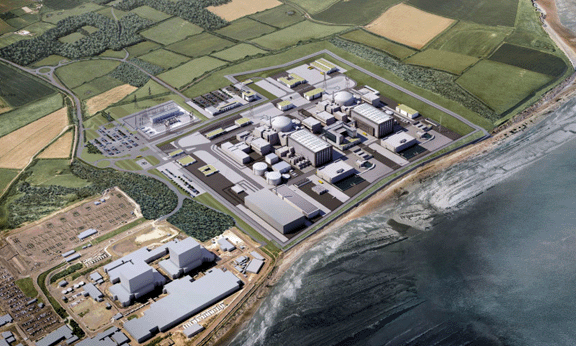 THINK TANK http://tomburke.co.uk/2016/09/15/hinkley-green-light-a-massive-strategic-mistake-says-climate-change-think-tank/ September 15, 2016 by tomburke Following reports today that the Government is about to give the green light to the Hinkley Point C nuclear power station, E3G, a leading climate change think tank said it would be a hugely expensive strategic mistake, using expensive 20th century technology that would soon be obsolete.
E3G Chairman, Tom Burke said: “It is a 20th Century solution to 21st Century problems. Bigger is no longer better. There are faster, cheaper, cleaner and smarter ways to deliver affordable, secure, low carbon electricity to Britain’s consumers.
Nothing about this deal is good for Britain’s hardworking families. They will pay the bill for decades but the jobs will go abroad. It is bad for consumers, bad for the climate and bad for the country.
The Prime Minister is missing a real opportunity to set Britain on course to a more productive and secure future. Instead she has committed us to an expensive and anachronistic energy policy that will leave Britain further behind in a rapidly changing world.”
- E3G sets out below ten reasons why this is a bad deal for British consumers and documents the range of cheaper, smarter, options for low carbon energy security that are better value for money.
HINKLEY POINT : The 10 Mistakes
The Investor Agreement that Greg Clark will sign with EDF is an irrevocable index-linked ‘take or pay’ contract to purchase 35 years’ worth of electricity from EDF at more than twice the current wholesale price. This will cost British consumers £37 billion in subsidy, four times that originally forecast[1]
- This deal binds future governments as well as the current Government. It will prevent Britain’s consumers buying cheaper electricity if it would displace that from EDF.
- It means Britain’s electricity consumers will pay more than £1 billion/year in subsidy to EDF for 35 years.
- The business case for this Agreement has never been subject to informed public scrutiny. The arguments for HPC and the rest of the nuclear programme have never been stress tested.
- The National Audit Office has already raised doubts that it represents value for money in the light of developments, including significant reductions in electricity demand forecasts, since it was first proposed[2].
- The National Infrastructure Commission has identified a package of other measures that could provide affordable, secure, low carbon electricity at lower cost.
- The National Grid has cut its forecast of the need for new centralised generation capacity in Britain by more than 50%, announcing its estimate of growth for decentralised generation was 50 times too low[3]
- EDF’s unions will argue in the French Courts that delaying a Hinkley decision until 2018 would allow for a design review to be completed that would reduce the subsidy needed from £92.50/MWh to £75/MWh[4].
- State Aids clearance for the UK subsidy is under challenge by the Austrian Government and others in the European Court. A further State Aids challenge is likely to the French Government’s re-financing of EDF. If either is successful the deal will fall.
- Hinkley will not produce electricity until 2030. There are cheaper, faster, cleaner and more reliable options available to deliver affordable, secure, low cost electricity to British consumers. These include:
- energy efficiency has reduced electricity demand by 25TWh ( 7% – the same as Hinkley will produce ) since 2010. A McKinsey report for the Government estimates that by 2030 demand could be reduced by a further 23% while reducing consumers bills;
- the National Infrastructure Commission reports that additional interconnectors could supply 2-3 Hinkleys by 2025;
- another National Infrastructure Commission report proposed investment in storage and smart grids that would provide the equivalent of 4 Hinkleys by 2030 and save £8 billion.
- Dong Energy, the world’s largest wind energy company, could replace all Hinkley’s electricity sooner and at lower cost. Offshore wind costs are continuing to fall.
- electricity from solar power is now also cheaper than Hinkley, having fallen by half in the last five years. From almost no solar panels in the UK, a third of a Hinkley has been added since 2010. Half of that was delivered in just 18 month.
- E3G is an independent global think tank, working to accelerate the transition to a low-carbon economy. E3G specializes in climate diplomacy, climate risk, energy policy and climate finance.
- In 2016, E3G was ranked the number one environmental think tank in the UK by the Go To Think Tank Index, second in Europe and sixth in the World.
Low Arctic sea ice in 2016 – close to record low level
These Images Show Near-Record Low 2016 Arctic Sea Ice, Climate Central , By Brian Kahn September 15th, 2016 Arctic sea ice is one of the grandaddy’s of climate indicators. And this grandaddy isn’t doing so good these days.This year’s sea ice extent has bottomed out as the second lowest on record, according to the National Snow and Ice Data Center. It continues a troubling trend as rapidly warming air and water eats away at the briny, frozen mantle on the top of the planet.
2016’s Arctic Sea Ice Melt Season in 9 Seconds
This year has been exceptional by many standards. March saw the lowest sea ice maximum ever recorded followed by a string of record low months. The Northwest Passage opened up, allowing a luxury cruise ship to travel from Anchorage to New York. And a freak storm in August turned ice thin and brittle near the North Pole.
Satellites show the last seven months of sea ice and reveal its steep decline this year. The late August breakup is particularly notable. Grist’s Amelia Urry compared the texture of sea ice near the North Pole to curdled milk or an exploded pillow (I’d go with broken glass personally, but to each their own)………
Most of what we tend to talk about with Arctic sea ice comes courtesy of satellites since they’re the most reliable way to monitor such a remote region. Recent research has reconstructed Arctic sea ice data back to 1850 using old ship logs, airplane survey and military records among other sources to provide a longer record than satellite data (though it does come with a little bit more uncertainty). What is certain is that there’s nothing in modern history like the recent string of low Arctic sea ice years we’ve seen.
Sea ice has declined precipitously across the Arctic, but particularly in the Beaufort and Chukchi Sea regions. In the coming decades, sea ice extent is only likely to keep shrinking and could reshape the region’s ecology, economy and ways of life for the plants, animals and people that call the region home. http://www.climatecentral.org/news/2016-low-arctic-sea-ice-20702
The miserable and ongoing history of EDF’s unfinished nuclear reactors in Flamanville and Olkiluoto
The £18bn Hinkley gamble: Nuclear deal will cost every UK family an extra £1,000 as May signs off on the plans to protect Britain’s national security
- Prime Minister approved plans after restricting influence of Chinese state
- Britain will guarantee EDF £92.50 per megawatt hour, up on current market price of £38.91
- Tory MP Zac Goldsmith said the plant would generate ‘most expensive energy in the history of energy generation’
By JASON GROVES DEPUTY POLITICAL EDITOR FOR THE DAILY MAIL, 16 Sept 16 “……..Construction at the site near Cherbourg began in 2007, with a scheduled completion date of 2012. But within a year, cracks were found in the concrete base and a quarter of the welds in the reactor’s secondary steel lining were found to be defective.
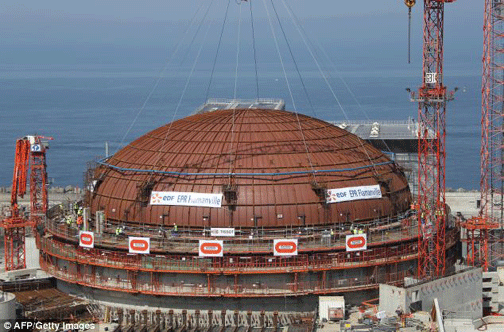
Inspections also revealed holes in concrete pillars and faults in buildings where nuclear fuel is to be stored.
A report by France’s nuclear safety authority in 2011 recorded 13 incidents of sub-standard safety measures. In 2013, a welder fell to his death. Then last year defects were discovered in safety valves in the cooling system.
Chillingly, this was similar to a problem that led to the Three Mile Island nuclear plant accident in Pennsylvania in 1979, which before Chernobyl was the world’s worst nuclear accident, and resulted in $1billion (£750million) of clean-up costs.
It was also in 2015 that Flamanville suffered a potentially killer-blow.
Tests on the steel used to construct the base and lid of the nuclear reactor vessel showed that too much carbon had been used, leading to weaknesses in the structure.
Professor Steve Thomas, of the University of Greenwich, said that if this led to the reactor failing, there would be no warning. ‘It will fail catastrophically and allow its radioactive contents into the environment,’ he said.
For their part, EDF and its project partner – the majority French state-owned company Areva, which makes nuclear reactors – have been forced to make more tests on the steel.
At the time the faults were found, the Financial Times said: ‘The scale of the risks to EDF if those tests identify a serious problem is hard to exaggerate.’
Whatever the findings of these new tests, Flamanville’s opening date – which has already been put back six years – is still nowhere in sight.
Professor Thomas warns that if it has to be rebuilt, the process could take up to five years, adding: ‘That might be prohibitively expensive and the whole plant could be abandoned.’
All this assumes that government-owned EDF doesn’t go bust in the meantime – which is a possibility.
In March, the company’s finance director Thomas Piquemal resigned, saying that taking on Hinkley as a project risked driving the firm to bankruptcy. Problems were compounded by the fact that Areva has had to be bailed out by the French government, with an injection of £3.4billion of public money in April. Inevitably, the European Commission has launched an investigation into this rescue package to check it did not ‘unduly distort competition’.
For some time, Areva – which is 87 per cent owned by the state – had been struggling with a downturn in the nuclear industry and has suffered big financial losses on its projects.
Once the pride of France, the reactor designer saw its credit rating downgraded last year, and in February it reported a €2billion (£1.7billion) net loss for 2015.
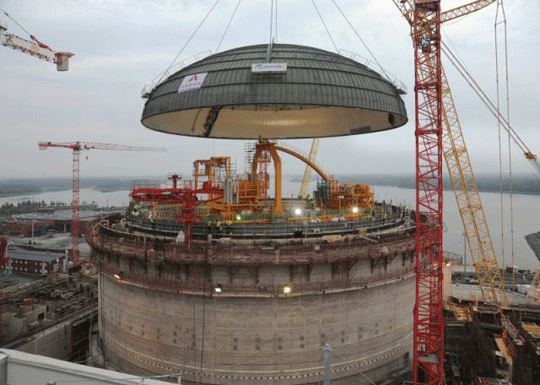
The project been subject to lawsuits, technology failure, construction errors and a bitter row between participant companies that has been described as ‘one of the biggest conflicts in the history of the construction sector’.
Work began on the EPR in 2005 and was scheduled to be completed in 2009. But from early on, problems emerged.
The concrete base on which the plant was to be built proved to be faulty, and had to be taken up and relaid. Then there was a problem with the electronic control systems.
Because it is absolutely vital that engineers can manage the temperature inside the reactor, a new nuclear plant must have two parallel control systems in case one fails.
The problem at Olkiluoto was that the two systems were too similar – meaning that if something caused the first one to shut down, there was a big risk that the second one would also close down.
The issue took five years to resolve – with the result that the power station is not expected to open until 2018 at the earliest.
Not surprisingly, the Finnish government has cancelled an option to buy a second reactor.http://www.dailymail.co.uk/news/article-3791895/The-18bn-Hinkley-gamble-nuclear-deal-cost-UK-family-extra-1-000-signs-plans-protect-Britain-s-national-security.html
Chaotic planning in South Africa: nuclear power not necessary
 Nuclear power call is based on outdated plans, warns Yelland, BD Live South Africa
BY CHARLOTTE MATHEWS, 16 SEPTEMBER 2016, SA DID not need to commission huge new inflexible nuclear power capacity because the government’s chaotic planning meant there was a big chance the country would have a surplus of electricity in the next few years, Chris Yelland, the MD of EE Publishers, said on Thursday.
“SA does not have an energy crisis, it has a management crisis,” he said.
Yelland was speaking at the launch of Powermode’s monitoring portal, shortly after Energy Minister Tina Joemat-Pettersson said a request for proposals for 9,600MW of nuclear power would be issued on September 30.
Yelland said government figures released in Parliament this week showed electricity demand since 2011 had trended significantly lower than in the low-growth scenario in the outdated 2010 Integrated Resource Plan, and its 2013 update. Flagging demand reflected slow global growth in recent years and an economy moving towards lower energy intensity.
“Government cannot forecast correctly for five years, let alone 50. If SA moves to nuclear newbuild, it is committing to one vendor for 9,600MW, based on 2010 estimates, which are clearly wrong.”………..
Members of the Energy Intensive Users Group, SA’s biggest power consumers, were installing more solar power to reduce their reliance on Eskom.
As Eskom’s market share was shrinking, its unit costs were rising, requiring ever-higher tariffs, which in turn forced more customers to become self-sufficient. Yelland said Eskom’s next application to recover costs was likely to be for a R22bn clawback, double what it was allowed in 2016.
In the past decade, Eskom’s tariffs have risen fourfold in nominal terms and were now increasing at double its historical average, adjusted for inflation.
Yelland said SA had to move away from centralised planning to a market-driven model for power-generation and create more distributed generation rather than generating most of its power on the Highveld. It needed a greater mix of different sources, not a large amount of new nuclear power. All this would provide the flexibility to meet changing demand patterns.http://www.bdlive.co.za/business/energy/2016/09/16/nuclear-power-call-is-based-on-outdated-plans-warns-yelland
Subsidies to France’s EDF, problems with France’s reactor build – UK MPs and analysts not happy about Hinkley nuclear decision
 MPs and analysts issue fresh nuclear warnings over Hinkley Point project, Business Matters, 16 Sept 16 Fresh warnings have been triggered over the cost, security, and deliverability of Britain’s first new nuclear reactors for decades following yesterday’s green light for the £18bn build at Hinkley Point in Somerset. Hinkley Point C will be built by France’s EDF with £6bn of
Chinese investment. It is effectively subsidised by the UK taxpayer under the terms of the guaranteed “strike price” that will be paid by consumers for the electricity generated, reports City AM.
This price is more than twice the current wholesale price of electricity, prompting the Energy Intensive Users Group to describe the subsidy as “astonishingly generous”.
Conservative MP Zac Goldsmith said the deal would produce “the most expensive energy in the history of energy generation”.
The Chinese state-backed firm that is investing in Hinkley, CGN, intends to take a majority stake in another reactor at Bradwell, in Essex. However, this has fuelled security concerns over Chinese involvement in UK strategic infrastructure.
“China has said it has ambitions to proceed with [Bradwell] but having China or a Chinese company running a nuclear reactor like that is always going to be difficult for national security concerns, so I’m not sure how you can bridge that gap,” said Alan Mendoza, executive director at The Henry Jackson Society……..There are also doubts over whether the reactors can be built in the allotted timeframe, and as to whether they can bridge the UK’s looming energy supply gap.
The new reactors are due for completion in 2023 but Whitman Howard utilities analyst Angelos Anastasiou believes a timescale of 2025 to 2030 is more realistic.
“Approval of Hinkley C is necessary but not sufficient to avoid a future supply crunch,” said Jeremy Nicholson, director of the Energy Intensive Users Group…….
the cost to billpayers will be substantial. It will be necessary to maintain a focus on cost for future plants,” Institute of Directors (IoD) chair Lady Barbara Judge said. She also said that despite the costs of the Hinkley project, the move signals a clear geo-political strategy being pursued in Whitehall.She added: “Approving Hinkley shows that the government believes China is an important and strategic market for Britain.”……….http://www.bmmagazine.co.uk/newswire/mps-analysts-issue-fresh-nuclear-warnings-hinkley-point-project/
West not keeping its commitment for Iran trade, in nuclear deal
West failing to deliver nuclear deal promises, says Iran vice-president
Ali Akbar Salehi attacks lack of progress on banking transactions and trade eight months after landmark agreement, Guardian, Saeed Kamali Dehghan, 17 Sept 16, Iran has fully complied with its commitments under last year’s landmark nuclear agreement, but eight months after the official removal of sanctions, the west is failing to deliver on its promises, the country’s vice president has told the Guardian.
Ali Akbar Salehi, the head of the country’s Atomic Energy Organisation, said that if the agreement was to remain intact, both sides had to meet their commitments.
The US-educated scientist, who also served as a former foreign minister of Iran, was the second most senior Iranian negotiator in nearly two years of talks between Tehran and world’s six leading powers that led to the final nuclear accord, known as the joint comprehensive plan of action (JCPOA), in Vienna in July 2015. The deal was implemented in January, and triggered the removal of sanctions.
“As has been stated by the International Atomic Energy Agency (IAEA), Iran has remained committed to its commitments,” Salehi said. “While the other side – it’s very clear now to public opinion and it’s not a secret – has not really delivered on the promises; that the sanctions would be removed and that banking transactions would go back to normal, that trade would speed up and economic relations would be enhanced. These have not been materialised to the extent that we expected.”……..
Although nuclear-related sanctions were lifted in January, big European banks remain reluctant to do business with Iran. European banks are concerned about existing US sanctions relating to terrorism as well as uncertainty in the US before the election of a new president…….
The banking issue has prevented Iran from capitalising on the interest shown by western businesses in returning to the country, or finalising lucrative deals with the west, such as the purchase of planes from Airbus and Boeing. Iran’s central bank chief told the Guardian in May that Tehran was still locked out of global financial system……..
The fate of the nuclear agreement will affect the next presidential elections in Iran, which are scheduled for spring next year. President Hassan Rouhani is seeking re-election and opponents, including former president Mahmoud Ahmadinejad, have indicated their willingness to challenge him. Rouhani would have to show Iranians tangible relief from sanctions if he is to maintain their support.
Relations between Tehran and London have significantly improved since the nuclear agreement, with both sides appointing new ambassadors in their respective capitals this month after nearly a five-year hiatus. https://www.theguardian.com/world/2016/sep/16/west-failing-deliver-nuclear-deal-promises-iran-vice-president-ali-akbar-salehi
South African govt says no nuclear deals made, but now there is one!
Zuma pals clinch first nuclear deal, Mail and Guardian, Jessica Bezuidenhout 16 Sep 2016 Shantan Reddy, the son of President Jacob Zuma’s friend Vivian Reddy, has clinched what appears to be a landmark deal for the country’s controversial multibillion-rand nuclear programme.
Details of the R171-million contract for “the procurement of the nuclear build programme management system” emerged after an innocuous-looking entry appeared on the department of energy’s website.
Listed under the category “awarded bids”, it is scant on detail, simply naming the winning bidder of BAC-10/2016 as Central Lake Trading 149, a company trading as Empire Technology.
The little-known company’s sole director is Shantan Reddy, the son of flamboyant power and property mogul Vivian Reddy, a longtime friend of the president.
Although there is no suggestion of wrongdoing on the part of Reddy or his company, the awarding of this contract has set off alarm bells with industry experts and politicians because the government continues to maintain that it has not entered into any nuclear deal.
The contract awarded to Reddy’s company, if indeed linked to the “nuclear build”, as stated by the energy department, suggests that work may have already begun behind the scenes.
“Considering that the minister of energy is on record stating no deal has been signed and the deputy president [has said] that South Africa will not commence on nuclear if it can’t afford it, the issuance of a contract is highly irregular,” said Gordon Mackay, the Democratic Alliance’s spokesperson on energy.
The Mail & Guardian briefly spoke to Shantan Reddy about the energy department deal. He asked for questions to be sent on SMS but did not respond by deadline….. (subscribers only) http://mg.co.za/article/2016-09-16-00-zuma-pals-clinch-first-nuclear-deal
Australia’s secret shame – the Maralinga nuclear bomb tests
This March, documents obtained exclusively by news.com.au revealed that hundreds of children and grandchildren of veterans exposed to radiation were born with shocking illnesses including tumours, Down syndrome, cleft palates, cerebral palsy, autism, missing bones and heart disease.
Other veterans posted to the Maralinga nuclear test site blamed the British Nuclear Test for an unusually high number of stillbirths and miscarriages among the group.
“The rest of the Aboriginal people in this country need to know the story as well,” “This one’s been kept very quiet.”
Nuclear will be on show at the National Aboriginal Cultural Institute in Adelaide, South Australia from 17 September to 12 November.
 The secret destruction of Australia’s Hiroshima, http://www.news.com.au/lifestyle/real-life/news-life/the-secret-destruction-of-australias-hiroshima/news-story/9eabf722dbe2f87e03a297c2a348a8e1 news.com.au, SEPTEMBER 17, 2016 WHEN nuclear explosions tore through Australia’s vast, arid centre, some people living there didn’t even know it was coming.
It devastated the country for miles around, annihilating every bird, tree and animal in its path.
Even today, the effects of our very own Hiroshima are still felt by the families it ripped apart, and those suffering horrific health problems as a result.
The British military detonated seven nuclear bombs in remote Maralinga, around 800km north-west of Adelaide, plus two at Emu Fields and three off the coast near Karratha, Western Australia.
They also staged hundreds of minor trials investigating the impact of non-nuclear explosions on atomic weapons, involving tanks, gun, mannequins in uniforms and even tethered goats. In many ways, these smaller tests were equally dangerous, spraying plutonium in all directions.
Yet most Australians know very little about the blasts that shattered communities, and the dramatic story now buried under layers of dust.
Archie Barton was just a child when the nuclear testing took place between 1956 and 1963, stretching across a huge now uninhabitable 120km of land where he and thousands of others lived.
“He was taken away from his mother,” his stepson Steve Harrison tells news.com.au. “He was part of the Stolen Generations. He grew up in homes around Australia, and led a very rough life.
“Before my mum, he was a full-blown alcoholic. He wanted to go back to his birthplace.
“He came into my life at a very young age. I was 14. I knew him as a strong, proud Aboriginal black man. He ended up getting an OBE.”
‘CHEAP AND NASTY SOLUTION’
Mr Barton’s family was not the only one scattered by the bombs. Many walked for days or even weeks to find new homes, deliberately going barefoot so their relatives could follow behind. British soldiers repeatedly turned them back south when they tried to head north.
Unsurprisingly, many never found each other.
“They were dispersed pretty much to the four points of the compass,” said Paul Brown, creative director of new showcase Nuclear, featuring Mr Harrison’s artwork. “It represented a massive dislocation from the watering holes and places that were important to Aboriginal people.
“If Aboriginal people weren’t caught up in the blast, it was by sheer luck, not design.
“People were very close at the time of the blast, they even had to take people into the decontamination area to scrub them down.”
Decades later, 57-year-old Mr Harrison’s village still isn’t a safe place for humans to live, despite numerous attempts to decontaminate the area, in 1967, 1985 and the late 1990s.
Ian Anderson’s 1993 New Scientist article “Britain’s dirty deeds at Maralinga” exposed negotiations between the UK and Australia to dispose of toxic plutonium that had been lightly covered with soil instead of being buried in concrete bunkers.
And as recently as 2007, nuclear engineer Alan Parkinson claimed the latest $100 million clean-up was a “cheap and nasty solution”.
IT RUINED QUITE A LOT OF LIVES’
The Anandu people fled to Oak Valley, Yalata, Renmark and almost anywhere between Kalgoorlie in WA and Adelaide.
Torn from family members and their homes, indigenous communities saw the consequences travel down the generations. Alcoholism is one of the biggest problems, along with drugs, crime, homelessness and lack of acceptance from new towns where these displaced people live on the fringes.
The Royal Commission found evidence of terrible disabilities caused by likely radiation impacts on both veterans and Aboriginal communities.
This March, documents obtained exclusively by news.com.au revealed that hundreds of children and grandchildren of veterans exposed to radiation were born with shocking illnesses including tumours, Down syndrome, cleft palates, cerebral palsy, autism, missing bones and heart disease.
Other veterans posted to the Maralinga nuclear test site blamed the British Nuclear Test for an unusually high number of stillbirths and miscarriages among the group.
A 2008 Department of Veterans’ Affairs study reported that the doses to Australians were small, with a spokesman tellingnews.com.au that studies into the descendants of Hiroshima and Nagasaki nuclear bombs survivors showed they “do not have an increased frequency of chromosome abnormalities or major birth defects.”
Yet a 1999 study for the British Nuclear Test Veterans Association found that 30 per cent of involved veterans had died from cancer, mainly in their 50s.
Troops flew through mushroom clouds from explosions without protection and marched to ground zero immediately after bomb detonation. Airborne drifts of radioactive material resulted in “radioactive rain” being dropped on Brisbane and Queensland country areas.
“When they created this problem, they didn’t picture it at the end,” says Mr Harrison. “People are fighting for their existence.
“We can go back, but cannot go back and live there. It’s ruined quite a lot of lives.
“I see people who’ve been taken away coming back trying to reconnect with family. Most now live in Yalata on the Nullabor Plains.
“It was so sad, so hard. You need to grow up with family from a young age. Now they’re telling people they’ve got to leave communities in the Northern Territory, they’re closing down a lot of these communities.”
THIS ONE’S BEEN KEPT QUIET’
The Maralinga bombs were set off in a way that officially satisfied safe firing requirements. The detonations were even celebrated as a “great success” in The Advertiser.
But Mr Brown says there is evidence the military was “deliberately misleading the public about the likely impact.”
Britain’s Parliament last year issued a statement of recognition and set up a benevolent fund for veterans who took part in the nuclear tests.
Mr Brown hopes his exhibition, 60 years on from the blasts, will show that these are not simply stories about victims. “Often people have gone on the front foot,” he said. “In Japan, the Hibakusha are world leaders in the peace movement. They’ve taken it upon themselves to campaign for disarmament and world peace.”
Mr Harrison, who has visited Hiroshima and Nagasaki survivors in Japan and presented them with a sculpture, says his main concern is making sure Australians know what happened in their own country.
“The rest of the Aboriginal people in this country need to know the story as well,” he added.
“This one’s been kept very quiet.”
Nuclear will be on show at the National Aboriginal Cultural Institute in Adelaide, South Australia from 17 September to 12 November.
1 This Month

of the week – Shut Down Drone Warfare!


Tell the Ukrainian Government to Drop Prosecution of Peace Activist Yurii Sheliazhenko

Petition to revoke the licensing of the Near Surface Nuclear Disposal Facility (NSDF) at Chalk River. https://www.ourcommons.ca/petitions/en/Petition/Details?Petition=e-7247
To see nuclear-related stories in greater depth and intensity – go to https://nuclearinformation.wordpress.com
-
Archives
- April 2026 (7)
- March 2026 (251)
- February 2026 (268)
- January 2026 (308)
- December 2025 (358)
- November 2025 (359)
- October 2025 (376)
- September 2025 (257)
- August 2025 (319)
- July 2025 (230)
- June 2025 (348)
- May 2025 (261)
-
Categories
- 1
- 1 NUCLEAR ISSUES
- business and costs
- climate change
- culture and arts
- ENERGY
- environment
- health
- history
- indigenous issues
- Legal
- marketing of nuclear
- media
- opposition to nuclear
- PERSONAL STORIES
- politics
- politics international
- Religion and ethics
- safety
- secrets,lies and civil liberties
- spinbuster
- technology
- Uranium
- wastes
- weapons and war
- Women
- 2 WORLD
- ACTION
- AFRICA
- Atrocities
- AUSTRALIA
- Christina's notes
- Christina's themes
- culture and arts
- Events
- Fuk 2022
- Fuk 2023
- Fukushima 2017
- Fukushima 2018
- fukushima 2019
- Fukushima 2020
- Fukushima 2021
- general
- global warming
- Humour (God we need it)
- Nuclear
- RARE EARTHS
- Reference
- resources – print
- Resources -audiovicual
- Weekly Newsletter
- World
- World Nuclear
- YouTube
-
RSS
Entries RSS
Comments RSS
 nuclear-news