US COULD LOSE NEARLY HALF ITS NUCLEAR POWER FLEET
 US COULD LOSE NEARLY HALF ITS FLEET, ALEXANDER SAYS
By 2038, 48 US reactors will be at least 60 years old, Alexander said, adding that the country would lose about half of its reactor fleet if their NRC operating licenses are not extended beyond 60 years. NRC’s initial operating licenses for power reactors are for 40 years. Most units have received, or are seeking, a 20-year license renewal, putting their total operating time at 60 years.
Exelon Generation said June 7 it will seek a second 20-year renewal, also known as a subsequent license renewal, of its NRC operating license for the Peach Bottom units 2 and 3 boiling water reactors in Delta, Pennsylvania. If NRC approves the renewal, the Peach Bottom units would be licensed to operate for a total of up to 80 years.
Exelon’s announcement came after Dominion said in November that it plans to seek subsequent license renewal for the two pressurized water reactors at its Surry station in Virginia.
–Elaine Hiruo, elaine.hiruo@spglobal.com
–Edited by Valarie Jackson, valarie.jackson@spglobal.com http://www.platts.com/latest-news/electric-power/washington/progress-on-waste-issue-key-to-support-for-nuclear-21519625
Extreme drought: the impact of climate change and El Nino on the Amazon rainforest
 El Niño, global warming combine to cause extreme drought in Amazon rainforest, Science daily September 14, 2016 Source: Asociación RUVID
- Summary:
- The impact the current 2015/2016 El Niño is having in Amazonia has been revealed by new research. Areas of extreme drought and changes to their typical distribution in the region are among the most evident consequences.
- A study led by researchers at the Global Change Unit at the Universitat de València (UV) shows the impact the current 2015/2016 El Niño is having in Amazonia. Areas of extreme drought and changes to their typical distribution in the region are among the most evident consequences.
- The El Niño effect is part of a cycle of global heating and cooling associated with the changing temperatures of a band of ocean water in the central and east-central equatorial Pacific ocean. Repeating every three to five years, it is one of the main drivers of climate variability. Although its consequences are felt at the global level, its impact on tropical forests — particularly the Amazon rainforests — are considered particularly significant, since this ecosystem is considered one of the planet’s main carbon sinks……
- The study, by researchers at the Universitat de València and published in Scientific Reports, shows how the current El Niño event is associated with an unprecedented heating of Amazonia, reaching the highest temperature in the last forty years and, probably, the last century. Additionally, extreme drought has hit a much larger area of this region than usual and is distributed atypically, with extremely dry conditions in the northeast and unusual wetting in the southeast (something which occurred in 2009/2010, though to a lesser extent).According to the UV scientists, this fact, not observed in the 1982/1983 and 1997/1998 events, implies that, the more the central equatorial Pacific is heated, the more marked the difference between and distribution of the wet zones and areas of extreme drought in the Amazon rainforest………https://www.sciencedaily.com/releases/2016/09/160914090454.htm
Protect Freedom of The Press! Drop Arrest Warrant for Amy Goodman
 http://www.thepetitionsite.com/268/169/575/protect-freedom-of-the-press-drop-arrest-warrant-for-amy-goodman/ By: Kelsey Bourgeois Target: North Dakota police
She was doing her job of reporting what was happening, which was security guards pepper spraying protectors and forcing attack dogs to bite protectors that didn’t pose a threat. Obviously, this is intimidation of the freedom of the press.
The pipeline threatens water supplies, sacred Native American sites, and the environment broadly and the amazing Native Americans and allies standing up against it deserve fair coverage from the press. The authorities want this pipeline so badly that they are willing to cover up reporting on misconduct at the construction site.
“This is an unacceptable violation of freedom of the press,” said Amy Goodman in a statement. “I was doing my job by covering pipeline guards unleashing dogs and pepper spray on Native American protesters.” Amy Goodman is an award-winning journalist.
This warrant sets a horrifying precedent. It restricts the freedom of the press, a constitutional right that our society requires to thrive. We demand this warrant be dropped immediately. The reporting Amy Goodman and Democracy Now did that day is crucial and we cannot allow them to silence it.
Hinkley nuclear station still might never happen
 Hinkley C nuclear go-ahead: May caves in to pressure from France and China, Ecologist Oliver Tickell 15th September 2016 It still might never happen
But despite today’s announcement there remains considerable uncertainty as to whether HPC will actually be built – among them legal challenges in the European Court to the unbelievably generous subsidy package for the project which appears to be incompatible with the EU’s ‘state aid’ regulations.
In addition both EDF and CGN, poised to take a 33.5% share in HPC, are unlikely to commit significant further capital to HPC until the Flamanville situation is resolved, and there is at least one working EPR to demonstrate that the design is constructable and operable – something that is still years away.
The highly risky (if potentially very profitable) project is also widely opposed within EDF as if it fails to ever generate power, or to operate reliably, it is likely to bankupt EDF. Also the company has yet to to line up the £16 billion (or more) it will need to finance its share of the project.
“This decision is unlikely to be the grand finale to this summer’s political soap opera”, said Greenpeace executive director John Sauven. “There are still huge outstanding financial, legal and technical obstacles that can’t be brushed under the carpet.
“There might be months or even years of wrangling over these issues. That’s why the Government should start supporting renewable power that can come online quickly for a competitive price.”
Richard Black, director of the Energy and Climate Intelligence Unit (ECIU), added:“Despite this being called a ‘final decision’ to build Hinkley C, other hurdles, including technical and legal challenges, may well lie ahead for the project.
“French trade unions don’t like it, nor do some of the likely candidates for the French Presidential Election next year, EDF’s finances are not the healthiest, and the French nuclear regulator is examining flaws in steel used for a similar reactor being built in France. So it may turn out not to be quite as ‘final’ as it looks now.
“Although China is reportedly happy with the new position, questions also remain over its main ambition – building its own nuclear reactors at Bradwell in Essex as a route into the Western market. The Chinese reactor hasn’t even begun the process of gaining UK safety approval, which usually takes four years, so negotiating a contract for Bradwell would fall to the next UK Government, not this one.
“And by then, electricity from other sources might look a whole lot cheaper than it does now.” http://www.theecologist.org/News/news_analysis/2988131/hinkley_c_nuclear_goahead_may_caves_in_to_pressure_from_france_and_china.html
New safeguards for Hinkley Point C nuclear power station “just window dressing”
Hinkley Point C nuclear power station gets government green light Labour and environmental groups say new safeguards for foreign investment are merely “window dressing”, Guardian, Rowena Mason, Simon Goodley, 16 Sept 16, Theresa May has been accused of backing down on security concerns about Chinese involvement in nuclear power after she gave the go-ahead to the £18bnHinkley Point C plant following a six-week review.
The government insisted the new plant in Somerset was only being approved with “significant new safeguards” to make sure China and other foreign investors could not own stakes in British nuclear plants without UK government approval.
However, Labour and environmental groups said the new security measures were merely “window dressing” and “hot air” that changed very little about the project, as the price remains the same and the new security powers already exist in law.
Under the proposals, EDF, the French firm building the plant with a £6bn investment from a Chinese state nuclear firm, will not be able to sell on its ownership without permission. For future projects, the UK government will own a “special share” that means it will have a veto over owners if there are national security concerns.
In a sign the new requirements do not appear to be overly stringent, both EDF and China General Nuclear said they were delighted by the approval, which they claimed will let them proceed with Hinkley and their wider plans for nuclear construction in the UK in future.
The Chinese are keen to proceed with a new plant at Bradwell in Essex in particular because it will be their own design built under the UK’s tough safety regulations, allowing the company to use it as a showcase to the rest of the world………
John Sauven, the Greenpeace executive director, also said the government’s review “appears to have been a lot of hot air”.
“The prime minister has baulked at the political embarrassment of irritating the French and offending the Chinese. Consequently, even if EDF manages to get the technology to work, the UK will pay the price by saddling themselves until 2060 with an out of date, flawed and expensive technology,” he said.
Clark, the business and energy secretary, said the new security restrictions were an improvement, claiming EDF would have been at liberty to sell its stake on without the revised contract.
His Department for Business, Energy and Industrial Strategy confirmed that this was the only new security requirement for Hinkley to proceed.
The controversial scheme in Somerset was approved six weeks after May unexpectedly placed the project under review, causing tensions with Beijing.
Following the review, the government is keeping a guaranteed price of £92.50 to EDF for every megawatt hour of electricity generated, despite concerns that is far higher than the market rate.
Chinese officials have previously given a series of veiled warnings that a decision by Britain to halt their investment in UK nuclear would be seen as a snub and would put at risk a supposed golden era of relations between the two countries.
The decision means Hinkley will be the first new nuclear reactor built in Britain in two decades……….https://www.theguardian.com/uk-news/2016/sep/15/hinkley-point-c-nuclear-power-station-gets-go-ahead
Why renewable energy is a better deal for Britain than Hinkley nuclear power
Nuclear power is risky and expensive; here’s a better idea https://www.theguardian.com/uk-news/2016/sep/15/nuclear-power-is-risky-and-expensive-heres-a-better-idea
It makes more sense to invest in renewables, efficiency and storage than spending billions on Hinkley Point C, Guardian, Damian Carrington, 15 Sept 16, In the 21st century, the UK will have to supply itself with power that is affordable, reliable and clean. But in almost every way, the proposed Hinkley Point C nuclear power station offers only expensive and risky solutions from the 20th century.
A nuclear power station is about as useful in solving the dilemma as a 20th-century nuclear weapon is in ending a 21st-century guerilla insurgency, because a ground-level energy revolution is taking place. The old regime of large, centralised power plants is being replaced a smart, efficient and widely distributed network, powered by increasing amounts of renewable energy.
If that sounds radical, it’s not – it’s just how the internet works to provide fast and reliable communications. If it sounds like a hippy dream, it’s not – New York State’s energy plan has embraced it in order to deliver 50% renewable electricity by 2030 and a 23% cut in energy use by buildings. In the UK, this government aims to improve the energy efficiency of just half the homes retrofitted by the last one.
If you think New York State is alone in its thinking – it’s not. Bodies including the government’s own National Infrastructure Commission(NIC), the National Grid and industry group Energy UK all point to a smart system that is more secure, cheaper and faster to build and they all use the same word: “revolution”, while the International Energy Agency talks of a rapid “transition”.
The momentum behind the revolution is straightforward: cost. While renewable energy and other energy technologies are plummeting in price, nuclear power continues its historical trend of getting ever more expensive. Even if the UK negotiates a sharp cut in the subsidies for Hinkley, it still could not be built before 2026 at the earliest. By then, a capacity crunch will have hit the UK as old power stations close.
Hinkley puts a lot of generation capacity in one plan , which is very risky given the financial, legal and technical obstacles it faces. EDF, the French company leading the project, is taking on considerable financial risk, with Martin Young, an energy analyst at investment bank RBC Capital Markets, saying the project “verges on insanity”.
Court challenges – including from EDF’s own trade unions – abound and the fiendishly complex project has been described by one nuclear engineer as unconstructable. Two attempts to build the same reactor in France and Finland are miles over budget and behind schedule.
In contrast, energy efficiency could deliver six Hinkleys’ worth of electricity by 2030, according to the government’s own research. Four Hinkleys’ worth could be saved by increasing the ability to store electricity and making the grid smarter, with the latter alone likely to save billpayers £8bn a year.
Capturing and storing carbon from fossil fuel plants is also vital, but has received scant attention from the government compared with Hinkley. It would halve the cost of beating global warming, according to government’s own official advisers, but in November ministers abruptly canned its plan. The government will not be able to get out of the Hinkley deal, however. Once signed, the deal with EDF contains a “poison pill” which could leave taxpayers with a £22bn bill if a future UK government shuts down the plant.
Closing down such a giant plant at short notice immediately puts the security of the nation’s electricity supply at risk. One back-up option recently favoured by the government is to deploy farms of diesel generators, which emit large volumes of carbon dioxide, ready to start up when needed.
Yet in a smart, distributed system, knocking out one wind turbine or solar panel is barely noticed by the grid.
The risk with Hinkley is that will it bring about the mutually assured destruction of both EDF and UK energy policy, with an expensive, hard-to-build reactor, in which the taxpayer will end up footing the bill.
World’s first large-scale tidal energy farm launched in Scotland

 All eyes on Scotland as world’s first large-scale tidal energy farm is launched on the Cromarty Firth, Thye National, SEPTEMBER 13TH, 2016 IT towers 49ft tall, weighs almost 200 tonnes and could mark the moment the tide turns for marine renewables, is is claimed.
The world’s first large-scale tidal energy farm was launched on Scotland’s coast yesterday.
The initial turbine for the MeyGen tidal stream project was unveiled at Nigg Energy Park on the Cromarty Firth, a former production centre for the oil and gas sector.
The massive structure, which will be installed in the Pentland Firth between Caithness and Orkney, has blades measuring 52 feet in diameter and developer Atlantis Resources eventually plans to add 268 others to create enough capacity to power 175,000 homes.
Maf Smith, deputy chief executive of industry body Renewables UK, hailed the development, saying: “New technology like this will be powering our nation for decades to come.”
Meanwhile, First Minister Nicola Sturgeon urged Westminster to honour a commitment to provide assurances for marine energy in its renewables support scheme or risk “irreparable damage” to the sector.
However, Tim Cornelius, chief executive of Edinburgh-based Atlantis Resources, said the launch was a “significant moment” for the green energy sector the world over…….http://www.thenational.scot/news/all-eyes-on-scotland-as-worlds-first-large-scale-tidal-energy-farm-is-launched-on-the-cromarty-firth.22312
Hinkley nuclear deal to be followed by an Essex nuclear deal with China?
 China to build nuclear reactor in Essex after Hinkley deal approved, Telegraph UK, Emily Gosden, energy editor 15 SEPTEMBER 2016
China is to begin developing a new nuclear power station in Essex after the Government heralded a new wave of UK reactors by approving the £18bn Hinkley Point plant in Somerset.
Chinese state nuclear firm CGN will fund one-third of Hinkley, which is led by French state energy giant EDF, in return for the chance to build its own design of reactor at Bradwell with EDF’s support………
The only change to the Hinkley deal is that the Government has taken powers to veto EDF selling its controlling stake in the project, leading critics to call Mrs May’s review “a lot of hot air”……..Both CGN and EDF made clear they did not regard the new safeguards as any obstacle to proceeding with the plans for a Chinese reactor at Bradwell.
Although ministers made no mention of Bradwell in their announcement, sources told the Telegraph that CGN had privately received Government assurance its plans, which were endorsed by the previous administration, were still welcome.
CGN said it was “delighted” by the Hinkley decision which would allow it to “move forward and deliver” Bradwell.
It is understood the firm hopes to begin the process of seeking UK safety approval for its Hualong One reactor design in the autumn. EDF has previously said such a plant could begin construction as early as 2022, subject to approval by UK regulators.
Mrs May’s joint chief of staff, Nick Timothy, has previously raised concerns that China could use its role in UK nuclear plants to “build weaknesses into computer systems which will allow them to shut down Britain’s energy production at will”………http://www.telegraph.co.uk/business/2016/09/15/china-to-build-nuclear-reactor-in-essex-after-hinkley-deal-appro/
Hinkley nuclear debacle should lead to a rethink of Britain’s nuclear programme
It’s astonishing. British governments have fiddled for a decade with the terms and structure of the Hinkley Point deal. The proposed agreement runs to thousands of pages, as you would expect with an £18bn contract to build the first new nuclear power station in the UK for a generation. Yet nobody seems to have considered what would happen if EDF, an over-indebted outfit over-reliant on the goodwill of current and future French politicians, ever wanted to sell Hinkley.
Theresa May’s review is a let-down on the central question of whether theHinkley Point C project should proceed; she should have binned the project because the technology was unproven and the financial terms a rip-off.
But she has addressed the question of future ownership. The UK government will be able to block EDF from selling its stake before and after construction. Similar powers will be secured in future by the UK government taking a special share in infrastructure projects deemed critical to the nation’s security.
This is welcome and overdue. Before the clause was inserted, it would have been possible, in theory, for EDF to sell its majority stake in Hinkley to its Chinese co-financiers, the state-backed CGN firm. Overnight, 7% of the UK’s energy supply could have been in the hands of a country with a long and dishonourable history of cyber espionage.
David Cameron and George Osborne, as they conducted their love-in with Beijing in recent years, ignored the worry in their desperation to find a new partner for EDF after Centrica, the owner of British Gas, dropped out of the Hinkley consortium in 2013. The energy select committee, shamefully, also danced around the subject of national security. May deserves some credit for addressing it.
The Brexit vote, incidentally, may have strengthened her hand. The EU tends to hate golden shares. Outside the club, it should be easier for the UK to adopt stronger protection over ownership of critical infrastructure. But the government is overstating matters when it says the UK’s policy will now fall into line with other big economies. The US imposes far stricter restrictions on foreign ownership of nuclear plants on its soil.
That is why, one assumes, the Chinese appear happy to accept May’s “significantnew safeguards”. For Beijing, the big prize has always been the chance to gain international recognition for Chinese technology by building a nuclear power station in Bradwell, Essex, to its own design. That prospect is still alive.
But let’s hope May’s brief probe of Hinkley heralds a deeper rethink on the UK’s entire nuclear programme. On cost and design, the adventure has lost touch with common sense.
First, cost. Hinkley, as everybody knows by now, is hideously expensive. If it were up and running today, EDF and CGN would be receiving annual revenues of £2.8bn, calculates Peter Atherton, of Cornwall Energy. But only £1.2bn would represent the market price of the electricity produced. The rest, £1.6bn, would be a top-up payment ultimately paid by the public.
The figure is large but, if it were a one-off, perhaps tolerable. The UK’s 27m households use about 40% of the country’s energy. Crunch the numbers and a theoretical “Hinkley subsidy” works out to about £24 per household a year at current prices.
The problem, of course, is that Hinkley in north Somerset is not a one-off. It will provide about 3,200MW of capacity. The government’s decarbonisation programme envisages up to 18,000MW of nuclear capacity by 2035. If Hinkley-style handouts are repeated, you’re talking serious money for consumers and a big hit to the competitiveness of UK industry.
That risk is real because of the second issue: the madness of a nuclear new-build programme in which all are invited to pitch. It’s not just China that wants to bring its kit – Japanese, South Korean and US firms are also on the ticket for new plants. The UK could end up building four different reactor designs from five different manufacturers. That is inherently more expensive than picking the best design, replicating it and harvesting economies of scale. The UK’s approach, argues Atherton, is “the equivalent of having the four new Trident nuclear subs built in different shipyards to different designs”.
It’s too late, it seems, to stop Hinkley. But May should order a rethink of the rest of the UK’s nuclear plan. It’s a badly designed mess that no other country would copy.
Podcast: Why nuclear war looks inevitable
http://www.reuters.com/article/us-nuclear-war-podcast-idUSKCN11K23T By Jason Fields
Several developments have the potential to move the hands of the nuclear doom clock closer to midnight.
A new U.S. nuclear policy has a chance of destabilizing the balance of terror by creating a larger arsenal of smaller weapons.
Why?Smaller weapons are more tempting to use. The argument for so-called “tactical” nukes is that they would destroy a smaller area and create less fallout, making them more “safe” to use than traditional many-megaton bombs. And that could lead to temptation to use them.
Just as importantly, that could give other nuclear-armed powers the impression that the U.S. would be more likely to use the weapons – a dangerous spiral that could culminate with…the end of the world, literally.
The United States is hardly the only nation adding stress to a system that is always a hands-breadth from tragedy.
Russia’s President Vladimir Putin has rattled the nuclear sabre, even threatening to station missiles in annexed Crimea. Pakistan, another nuclear-armed country, is a divided nation with government agencies linked to Islamic extremism and a beef with India. India has a beef with Pakistan and territorial disputes with China.North Korea is a wildcard with an accelerating nuclear program that may still be getting help from Pakistan – which denies it. Recent tests by North Korea and China’s lack of overt response has set U.S. teeth on edge.
In the end, the basic question is whether humanity can have such dangerous toys and not use them.
Incredible as it may seem, at the height of the Cold War the world might actually have been safer, experts say. Neither the United States nor the Soviet Union had a death wish, and those were clearly the stakes.
And, of course, nihilistic militants have no such qualms.
Hinkley nuclear and Brexit b- a bad deal for everyone concerned
How Hinkley delivers a bad deal for everyone http://blogs.reuters.com/breakingviews/2016/09/15/how-hinkley-delivers-a-bad-deal-for-everyone/ By John Foley
The economics of building Hinkley Point C for 18 billion pounds haven’t changed since last year, but they’re still not good. British energy users will effectively pay the difference between what operator EDF has been promised per megawatt hour, and the going market price. In September the UK government put that at 37 billion pounds over the contract’s 35-year life, or 15 billion pounds in today’s money.
It’s not much better for the French group. Should all go to plan, EDF could make a return on investment of around 9 percent a year, it says. But similar plants underway in France and Finland have run wildly over time and over budget.
Britain loses in another way too, because the new government is using Hinkley to launch a wide-ranging review of its authority to intervene in foreign takeovers of “critical infrastructure”. Over a decade ago, lawmakers deliberately took politics out of mergers. Interventions have been limited to matters of national security, media plurality and the stability of the financial system. The government now points out that other “major economies” have more stringent controls on foreign investment in infrastructure projects. That misses the point that Britain’s appeal has been that it is more open than places like France, China and the United States.
Why go ahead with such an unappealing project? The answer is Brexit. Voters’ decision to leave the European Union means Britain needs friends prepared to sign favourable trade deals. Scrapping Hinkley would poison the water for future talks with China, which is putting up a third of the cost of the project. Meanwhile, since almost half of Britain’s gas comes from continental Europe, developing more home-grown nuclear power may strengthen Britain’s hand ahead of negotiations over access to the single market.
Seen that way, going ahead with Hinkley may deliver a short-term benefit in the next couple of years, as Britain’s post-Brexit arrangements are hammered out. But the long-term disadvantages and financial costs will, like nuclear waste, contaminate the country for decades
Major USA utility sees Renewables and Efficiency as a Better Deal Than Nuclear
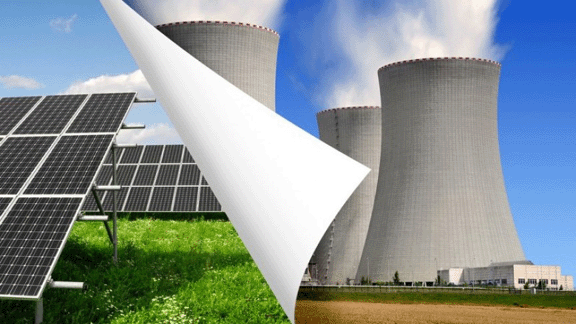 How a Major Utility Came to See Renewables and Efficiency as a Better Deal Than Nuclear Greeen Tech Media by Tam Hunt September 14, 2016 Pacific Gas & Electric, California’s biggest utility, made a historic proposal to shut down California’s last nuclear power plant, called Diablo Canyon. PG&E is arguing that replacing Diablo’s output with a mix of energy efficiency and renewables will not only cost less than relicensing Diablo, but will also lead to a more reliable and flexible grid. ……..
Energy efficiency and renewables come with none of the downsides of nuclear power. There is no radioactive waste that must be stored for literally thousands of years, there is no terrorist target, there is no ticking time bomb waiting for an earthquake to trigger it. There is a much larger footprint for renewables like solar and wind, but many countries around the world are demonstrating now that these resources can reach high penetration levels without spoiling views, impacting wildlife overly much, or taking up too much land.
Another benefit of shutting down Diablo that PG&E highlights in the joint application is the ability to better absorb increasing amounts of renewable energy. Diablo is a very large non-flexible “baseload” resource. It can’t be turned up or down to accommodate variable renewable resources — it’s either on or off. And as we push toward the current goal of 50 percent renewables by 2030, which is now mandated by law (SB 350), we need more flexible resources to accommodate an ever-increasing share of renewables.
Moreover, having such large, inflexible resources on the grid requires its own share of backup power, because if Diablo experiences a scheduled or unscheduled outage, such an outage will generally require replacement resources to make up for this loss. Renewables like wind and solar get a lot of negative attention for being variable and needing some grid backup, but this problem is actually far worse with very large inflexible generation assets like Diablo. By shutting down Diablo at the end of its current license, system-reserve requirements will actually be reduced.
How to avoid further nuclear boondoggles
The recent shutdown of San Onofre Nuclear Generating Station (SONGS) in Southern California turned into an extremely contentious battle over a number of issues, but primarily over who should bear the cost of this extremely expensive power plant.
PG&E’s joint application may entail some similar issues, as it requests a full reimbursement of all costs for the plant to date, without specifying exactly what those costs will be. As described above, the net cost of replacing Diablo with preferred resources will be about one-third less than the equivalent cost of relicensing Diablo.
That said, PG&E will need to present more information about the full costs of the shutdown, including the costs of decommissioning. With respect to SONGS, the total shutdown and decommissioning costs became a major issue. To avoid a similar fate, PG&E should be as transparent as possible as early as possible……http://www.greentechmedia.com/articles/read/how-a-major-utility-came-to-see-renewables-as-a-better-deal-than-nuclear
1 This Month

of the week – Shut Down Drone Warfare!


Tell the Ukrainian Government to Drop Prosecution of Peace Activist Yurii Sheliazhenko

Petition to revoke the licensing of the Near Surface Nuclear Disposal Facility (NSDF) at Chalk River. https://www.ourcommons.ca/petitions/en/Petition/Details?Petition=e-7247
To see nuclear-related stories in greater depth and intensity – go to https://nuclearinformation.wordpress.com
-
Archives
- April 2026 (103)
- March 2026 (251)
- February 2026 (268)
- January 2026 (308)
- December 2025 (358)
- November 2025 (359)
- October 2025 (376)
- September 2025 (257)
- August 2025 (319)
- July 2025 (230)
- June 2025 (348)
- May 2025 (261)
-
Categories
- 1
- 1 NUCLEAR ISSUES
- business and costs
- climate change
- culture and arts
- ENERGY
- environment
- health
- history
- indigenous issues
- Legal
- marketing of nuclear
- media
- opposition to nuclear
- PERSONAL STORIES
- politics
- politics international
- Religion and ethics
- safety
- secrets,lies and civil liberties
- spinbuster
- technology
- Uranium
- wastes
- weapons and war
- Women
- 2 WORLD
- ACTION
- AFRICA
- Atrocities
- AUSTRALIA
- Christina's notes
- Christina's themes
- culture and arts
- Events
- Fuk 2022
- Fuk 2023
- Fukushima 2017
- Fukushima 2018
- fukushima 2019
- Fukushima 2020
- Fukushima 2021
- general
- global warming
- Humour (God we need it)
- Nuclear
- RARE EARTHS
- Reference
- resources – print
- Resources -audiovicual
- Weekly Newsletter
- World
- World Nuclear
- YouTube
-
RSS
Entries RSS
Comments RSS
 nuclear-news