New Study: ‘Blow Torch’-Like Ocean Warming Advances Killer Seas, Shifts El Nino, Heats Hydrates

“Tampering can be dangerous. Nature can be vengeful. We should have a great deal of respect for the planet on which we live.” — Carl-Gustaf Rossby
But as the new study points out, 90% of the extra heat that our greenhouse gases trap is actually absorbed by the oceans. That means that the upper few meters of the sea have been steadily warming more than a tenth of a degree celsius per decade, a figure that’s accelerating. When you think of the volume of water that represents, and then try to imagine the energy necessary to raise its temperature, you get an idea of the blowtorch that our civilization has become. — Bill McKibben
The scale of ocean warming is truly staggering with the numbers so large that it is difficult for most people to comprehend. — Explaining Ocean Warming
*****
If there’s one simple fact about past Earth…
View original post 1,585 more words
September 8 Energy News

Opinion:
¶ “Beauty and power: how Norway is making green energy look good” • On the edge of a forest in northern Norway, an unusual hydroelectric plant is generating a buzz. Øvre Forsland is a big departure from the hulking power stations. It looks more like an elegant, custom‑built home from TV show Grand Designs. [The Guardian]
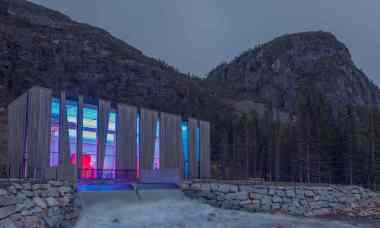 Øvre Forsland hydroelectric station.
Photograph: Pedro Alvarez for the Observer.
¶ “Dear Theresa: Let it go! Six powerful reasons to dump Hinkley C” • Theresa May ducked out of a signing ceremony to review the Hinkley C nuclear project. Soon she will have to make a decision. In this open letter Scientists for Global Responsibility set out six compelling reasons for her to let the monstrous white elephant go. [The Ecologist]
Science and Technology:
¶ Torrential rains unleashed on south Louisiana in August were made almost twice as…
View original post 787 more words
September 7 Energy News
Science and Technology:
¶ Shipping routes across the Arctic are going to open up significantly this century even with a best-case reduction in CO2 emissions, a new study suggests. University of Reading, UK, researchers have investigated how the decline in sea-ice, driven by warmer temperatures, will make the region more accessible. [BBC]
 Sea-ice is in decline but scientists expect a lot of annual variability. SPL
World:
¶ The G20 meeting in China may have been notable for the decision by both China and the US to ratify the Paris climate treaty. But the G20 nations are still taking little action on ending fossil fuel subsidies, despite agreeing to the move in 2009 to end what has been described as the “dumbest policy” in the world. [CleanTechnica]
¶ The London Metropolitan Police is now trialling the use of a range-extended BMW i3 as a patrol car, exploring the…
View original post 615 more words
What’s Swimming in the Open Water Near the North Pole These Days?
Globally, it’s been a record-hot year. But nowhere has seen so much anomalous warmth during 2016 as the Arctic. As melt season draws to a close, some dramatic effects are now becoming visible in the NASA satellite shots. Large regions near the North Pole are losing their white covering of sea ice and showing the telltale blue-black of open water:
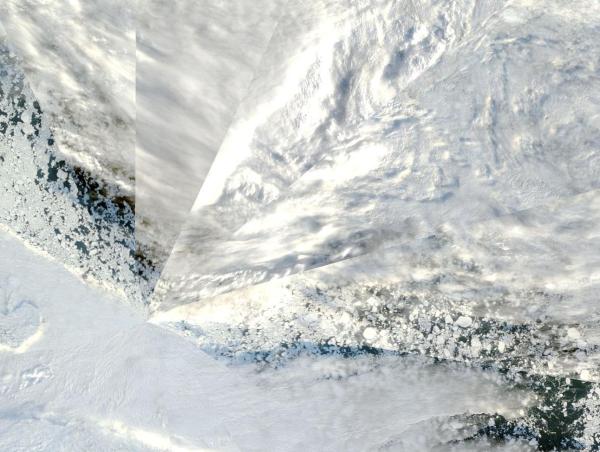
(Large areas of open water are visible near the North Pole in this LANCE MODIS satellite shot.)
The above image, provided by NASA, shows the Northern Hemisphere polar region on September 5, 2016. To get some sense of the size of this region of low-concentration sea ice, the bottom edge of this capture represents approximately 300 miles. For a point of reference, the North Pole can be seen where the lines of the satellite image frames converge in the lower left-hand side of the capture.
All throughout this satellite shot…
View original post 349 more words
1 This Month


Petition to revoke the licensing of the Near Surface Nuclear Disposal Facility (NSDF) at Chalk River. https://www.ourcommons.ca/petitions/en/Petition/Details?Petition=e-7247


of the week – STOP SMALL MODULAR REACTORS IN CANADA
To see nuclear-related stories in greater depth and intensity – go to https://nuclearinformation.wordpress.com
-
Archives
- March 2026 (163)
- February 2026 (268)
- January 2026 (308)
- December 2025 (358)
- November 2025 (359)
- October 2025 (376)
- September 2025 (258)
- August 2025 (319)
- July 2025 (230)
- June 2025 (348)
- May 2025 (261)
- April 2025 (305)
-
Categories
- 1
- 1 NUCLEAR ISSUES
- business and costs
- climate change
- culture and arts
- ENERGY
- environment
- health
- history
- indigenous issues
- Legal
- marketing of nuclear
- media
- opposition to nuclear
- PERSONAL STORIES
- politics
- politics international
- Religion and ethics
- safety
- secrets,lies and civil liberties
- spinbuster
- technology
- Uranium
- wastes
- weapons and war
- Women
- 2 WORLD
- ACTION
- AFRICA
- Atrocities
- AUSTRALIA
- Christina's notes
- Christina's themes
- culture and arts
- Events
- Fuk 2022
- Fuk 2023
- Fukushima 2017
- Fukushima 2018
- fukushima 2019
- Fukushima 2020
- Fukushima 2021
- general
- global warming
- Humour (God we need it)
- Nuclear
- RARE EARTHS
- Reference
- resources – print
- Resources -audiovicual
- Weekly Newsletter
- World
- World Nuclear
- YouTube
-
RSS
Entries RSS
Comments RSS
 nuclear-news