Theresa May is advised that now is the time to get out of Hinkley nuclear project.

 Hinkley Point: May told to pull the plug on nuclear project over China spying accusations THERESA MAY is being urged to quit the controversial Hinkley Point C project over Chinese spying allegations. Express By ZOIE O’BRIEN, Aug 11, 2016 A scandal has broken out in the US suggesting a Chinese man was attempting to recruit US atomic experts to steal technology secrets to help China’s nuclear power programme.
But the legal papers include the name of China General Nuclear Power (CGN), which holds a stake in the UK’s planned new nuclear power station – Hinkley Point C.
Szuhsiung Ho, a senior adviser to CGN, will appear in court next week to face charges. As a result the Prime Minister is being urged to pull the British project immediately.
May paused development last month over national security fears but now she is being told to scrap plans altogether.
Paul Dorfman, a senior research fellow at University College London, said the British prime minister does not have to offend the Chinese. He suggested she could blame poor reactor technology from France’s EDF.
He told the Guardian: “No other OECD country would let China into its critical nuclear infrastructure, given its history of nuclear weapon proliferation. May has already taken the diplomatic ‘hit’ for this, so what’s she got to lose?
“If government wanted to, it could avoid taking China to task on this by reframing the problem in the context of the failed French EPR reactor, which is three times over-cost and over-time where it’s being built in Finland and France.”
The Somerset power station has already caused huge debate with petitions and campaigns being launched to prevent its being built.
Now, spying allegations have caused huge concern in the UK. Angus MacNeil MP, the chair of the energy and climate change select committee, said there are now grave concerns about corporate integrity and must form a key part of the government’s current review of Hinkley.
He said: “I am not sure the Chinese have anything to steal from Britain in the way of nuclear secrets. That is after all why they are being brought in, but it does raise questions about how honourable the company is and whether it could cut corners on construction methods and issues like that.”……..http://www.express.co.uk/news/uk/698965/Hinkley-Point-May-China-spy-fears-Somerset-project
Time to pull the plug on unaffordable Hinkley Point nuclear power project
 UK must pull the plug on the exorbitant Hinkley Point nuclear power project Do we submit to blackmail or do we risk losing Chinese trade? IBT, By Michael Toner , 11 Aug 16, “…..Today we’re witnessing a folly so shambolic, so expensive, so eye-poppingly spectacular that it puts all others in the shade. It goes by the name of Hinkley Point, the proposed new nuclear power station in Somerset. And it’s the misbegotten creation of our entire political establishment, with Labour, Lib-Dem and Tory MPs all complicit.
One of the few politicians who emerges with some credit from this unfolding disaster is our new Prime Minister Theresa May, who stunned everybody when immediately on entering Downing Street she refused to rubber-stamp the deal and instead ordered a review of the whole project. As we shall see, her reasons for delaying a decision were eminently sensible.
But what howls of anguish it has provoked. The French-owned energy company EDF, which will build Hinkley Point, is appalled. President Hollande’s government makes no secret of its displeasure. And now China, which is providing billions to finance the project, is weighing in with threats of dire consequences for Britain if the deal doesn’t go ahead.
August 9, 2016……It’s time to examine how we ever came to be in this mess. And for that we must go back to the last Labour Government and an Energy Secretary named Ed Miliband. Remember him?………
, it enthused the then Energy Secretary Ed Davey of the Lib Dems, “For the first time, a nuclear power station in this country will not have been built with money from the British taxpayer. This is an excellent deal for Britain and British consumers”.
Oh dear. Let’s examine the details of Mr Davey’s “excellent” deal……
then there’s the eye-watering expense of this scheme. Hinkley Point will cost at least £18billion and will probably end up costing much more. The sums are so huge that ministers could only persuade EDF to accept such a burden by allowing it to charge sky-high prices for the electricity it produces. British consumers will end up paying for the world’s most expensive electricity for decades.
And for what? The plant won’t be built for at least another eight years, even if everything goes to plan – a big “if”, given the record so far. And if ever it eventually runs at full capacity, it would provide power only for six million homes – a pitiful return for such a huge and risky investment.
Theresa May has every right to re-examine this whole misconceived project. And given the reaction of the Chinese ambassador, wouldn’t the rest of us be equally right to re-examine the wisdom of sucking up to the bullies of Beijing? http://www.ibtimes.co.uk/uk-must-pull-plug-exorbitant-hinkley-point-nuclear-power-project-1575151
Sea level rise predicted by climate scientists
The three ways we know sea levels are rising are from physical tide gauges, from satellites that measure the water height, and from satellites that measure where ice is stored across the globe.

Climate scientists make a bold prediction about sea level rise http://www.skepticalscience.com/climate-scientists-bold-prediction-slr.html 10 August 2016 by John Abraham
One of the great things about science is that it allows you to make predictions. Three topclimate scientists just made a very bold prediction regarding sea level rise; we should know in a few years if they are correct.
As humans emit greenhouse gases, it’s causing the Earth to warm. That’s indisputable and proven. We can actually measure the amount of extra heat. Since most of it ends up in the oceans, we can also measure other changes in the oceans.
For instance, the oceans are rising. We know that’s indisputable. Measurements taken from physical gauges and from satellites confirm sea level rise. The cause of the rise is more complex.
Part of the rise is from ocean warming – warm water is less dense so the sea level rises as temperatures increase. Another part of the rise is from melting ice, especially ice that is currently on land (like glaciers and ice sheets). As this ice melts and flows into the oceans, the water levels rise. A third reason for sea level changes is from alterations of where water is stored on the planet. For instance, changing rainfall patterns and storage of water underground, in lakes, or in the atmosphere can affect sea levels.
The three ways we know sea levels are rising are from physical tide gauges, from satellites that measure the water height, and from satellites that measure where ice is stored across the globe. While tide gauge measurements go back many years, they only measure water levels at their location. Many tide gauges have to be in place to get an accurate sense of what is happening globally.
Satellites, on the other hand, are much more capable of taking global measurements. The problem with satellites is they have only been taking measurements since approximately 1993 (not nearly as long as tide gauges). So scientists try to combine these two measurements to get a long-term and global picture of what is really happening.
A very recent paper published in Nature has evaluated the history of sea level rise, and what they find is really interesting. The lead author (John Fasullo from the National Center for Atmospheric Research) and his colleagues tried to determine if the rate of sea level rise is changing. That is, are the water levels rising linearly, the same amount each year? Or, is the rate increasing (faster and faster each year)?
Using satellite data, the authors found little evidence of an acceleration. However, they show that this is because the satellites began measuring in 1993, right after a large volcanic eruption (Mount Pinatubo). This eruption temporarily reduced global warming because particles from the eruption blocked sunlight. Just by coincidence, the timing of the satellites and the eruption has affected the water rise so that it appears to be linear. Had the eruption not occurred, the rate would have increased.
This allows the scientists to make a prediction:
UK’s £31 billion Trident submarines programme on the skids
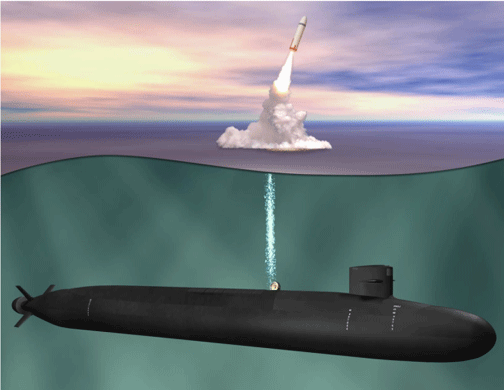 Trident plans ‘in doubt’, says government watchdog, The Ferret, Rob Edwards on August 8, 2016 The UK’s £31 billion programme to replace Trident submarines in on the skids, according to a high-level government spending watchdog.
A report by the Infrastructure and Projects Authority (IPA) to the Treasury and Cabinet Office has warned that the plan to build four new nuclear weapons submarines for the Clyde is “in doubt”.
This is despite the overwhelming vote in the House of Commons last month in favour of replacing Trident. The plan was opposed by every Scottish MP, except for the lone Tory, David Mundell.
The poor assessment of the Trident programme’s prospects was buried in a report about 143 projects published online by the IPA several days before the vote at Westminster. It gave the submarine successor programme its second worst rating of “amber/red”.
This means that the project is judged to be running into serious difficulties because of cost overruns, management problems and technical issues. “Successful delivery of the project is in doubt, with major risks or issues apparent in a number of key areas,” said the IPA.
“Urgent action is needed to address these problems and/or assess whether resolution is feasible.”
According to critics, costs have already risen by between £15 and £20 billion. The planned date for bringing the submarines into service has been delayed from 2024 to the “early 2030s”……….https://theferret.scot/trident-doubt-government-watchdog/
$700 million of public money goes to New York’s FitzPatrick nuclear deal. WHY?

 Watchdogs: Why transfer $700 million of public money in FitzPatrick nuclear deal? Syracuse.com, 9 Aug 16 SYRACUSE, N.Y. – Watchdog groups warned Tuesday that New York may be giving up too much by transferring $700 million from a public fund to Exelon Corp. as part of the deal to keep open the James A. FitzPatrick nuclear plant in Oswego County.
Under terms of the deal announced Tuesday, the state will transfer the cash from a New York Power Authority trust fund — set aside to pay for the eventual decommissioning of the FitzPatrick plant — to Exelon Corp.
Two watchdog groups who track the nuclear power industry say they are concerned about the transfer from public to private hands.
Jessica Azulay, program director for the Syracuse-based Alliance for a Green Economy, said the unprecedented deal announced Tuesday gave too much control to Exelon.
“Governor Cuomo has truly given away the store,” Azulay said in a statement. “As if the billions of dollars of consumer money gifted in subsidies to the nuclear industry weren’t enough, now we find out that another $700 million in public assets will be handed to Exelon in order to sweeten the deal for their purchase of FitzPatrick.”
Money in the state’s decommissioning fund is set aside to make sure that FitzPatrick and its nuclear waste will be safely handled and cleaned up when the plant reaches the end of its useful life and is taken off line.
Tim Judson, executive director of the Nuclear Information and Resource Service in Takoma Park, Md., said now the public will lose control over that process.
“Public ownership over FitzPatrick’s decommissioning fund provides a safeguard to prevent Exelon from misusing money New Yorkers paid to ensure a responsible cleanup, and for the state to have some control over when and how that cleanup will happen after it retires,” Judson said.
“Most states are not so lucky to have a way of reigning in nuclear owners who plan to mothball nuclear sites for decades, leaving the contamination and the waste to fester,” Judson said. “It is folly for New York to give up this fund over to Exelon.”…….. Contact Mark Weiner anytime: Email | Twitter | Facebook | 571-970-3751 http://www.syracuse.com/news/index.ssf/2016/08/watchdogs_why_transfer_700_million_of_public_money_in_fitzpatrick_nuclear_deal.html
UK government’s own projections find solar and wind ‘cheaper than new nuclear’
 Solar and wind ‘cheaper than new nuclear’ by the time Hinkley is built https://www.theguardian.com/environment/2016/aug/11/solar-and-wind-cheaper-than-new-nuclear-by-the-time-hinkley-is-built
UK government’s own projections expect onshore wind power and large-scale solar to cost less per megawatt hour than new nuclear by 2025, Guardian, Adam Vaughan, 11 Aug 16, The government expects solar and wind power to be cheaper than new nuclear power by the time Hinkley Point C is completed, its own projections show.
Theresa May’s government last month made a surprise decision to delay a deal on Hinkley, prompting a renewed look at what alternatives could power Britain if ministers this autumn fail to back new reactors in Somerset.
An unpublished report by the energy department shows that it expects onshore wind power and large-scale solar to cost around £50-75 per megawatt hour of power generated in 2025. New nuclear is anticipated to be around £85-125/MWh, in line with the guaranteed price of £92.50/MWh that the government has offered Hinkley’s developer, EDF.
The NAO cited the forecasts as coming from the energy department in March 2016. The department said the NAO had been provided with an early draft of its report, and the full version would be published soon.
Niall Stuart, chief executive of the trade body Scottish Renewables, said: “These numbers speak for themselves: onshore wind and solar will be significantly better value than all other large scale sources of power in the UK by 2025.
“It is time to start backing the two technologies to deliver the clean power we need to hit our climate change targets and the cheap electricity required to keep bills down for consumers.”
Molly Scott Cato, a Green party MEP, said: “These latest figures confirm what many of us have been saying for years: that the Hinkley project is a dud.
“The cost of renewables is tumbling and Hinkley will become a giant white elephant as it struggles to compete with cheaper renewable options. Research has shown that solar power would be a less costly way of generating the equivalent amount of power, and now the government’s own projections show that onshore wind too will be cheaper than nuclear by the time Hinkley is built.”
Since coming to power in May 2015, the government ended onshore wind subsidies and allowed communities to veto turbines near them, as well as axing and cutting various subsidies for solar.
Government data published on Thursday showed that renewables generated 25.1% of the UK’s electricity in the first quarter of this year. Around half of that came from on and offshore wind combined.
Stop the nuclear industry welfare programme
 After 60 years, the taxpayer should not continue to subsidise multibillion-dollar corporations in the nuclear energy sector Guardian, Bernie Sanders and Ryan Alexander, 13 Apr 2012 “……Nuclear welfare started with research and development. According to the non-partisan Congressional Research Service, since 1948 the federal government has spent more than $95bn (in 2011 dollars) on nuclear energy research and development (R&D). That is more than four times the amount spent on solar, wind, geothermal, biomass, biofuels, and hydropower combined. But federal R&D was not enough; the industry also wanted federal liability insurance too, which it got back in 1957 with the Price-Anderson Act. This federal liability insurance programme
 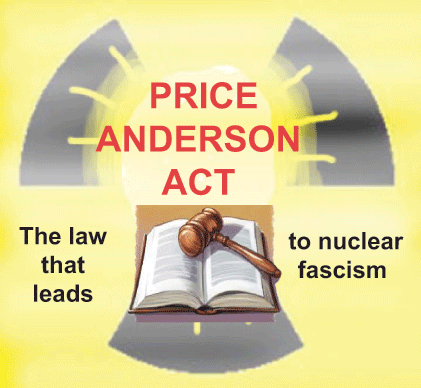 for nuclear plants was meant to be temporary, but Congress repeatedly extended it, most recently through 2025. Price-Anderson puts taxpayers on the hook for losses that exceed $12. 6bn if there is a nuclear plant disaster. When government estimates show the cost for such a disaster could reach $720bn in property damage alone, that’s one sweetheart deal for the nuclear industry!
R&D and Price-Anderson insurance are still just the tip of the iceberg. From tax breaks for uranium mining and loan guarantees for uranium enrichment to special depreciation benefits and lucrative federal tax breaks for every kilowatt hour from new plants, nuclear is heavily subsidised at every phase. The industry also bilks taxpayers when plants close down with tax breaks for decommissioning plants. Further, it is estimated that the cost to taxpayers for the disposal of radioactive nuclear waste could be as much as $100bn……https://www.theguardian.com/commentisfree/cifamerica/2012/apr/13/nuclear-industry-us-welfare
Are tax-payers paying for nutty space nuclear research?
BRINGING NUCLEAR POWER TO MARS – FRANK H. SHU (SETI TALKS 2016), Raw Science SETI Talks @ MicroSoft Silicon Valley – July 29, 2016 Dr. Frank Shu lectured with SETI Talks at MicroSoft Silicon Valley on July 29, 2016:
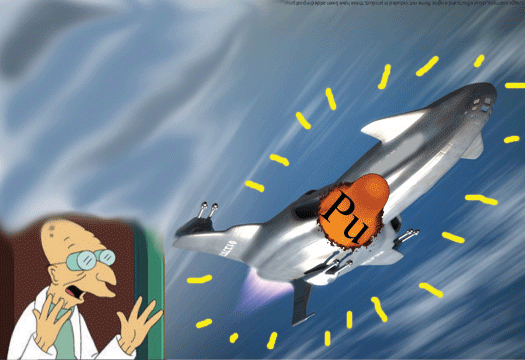
Establishing a lunar base is probably a wise first first step to colonizing Mars, and colonizing Mars will be a giant leap forward for humankind to travel to the stars…..
A reliable source of primary energy is needed for such tasks, but anywhere on the surface of the Moon, there is no sunlight two weeks out of four, and no wind whatsoever. Nuclear power is the default option, just as is the case of naval submarines where the crews need to live and work in closed environments submerged under the water of the ocean for months at a time. However, the light water reactors of naval submarines are not a good choice for environments that lack large bodies of water, and we argue, as first realized by a former NASA Engineer, Kirk Sorensen, that molten salt reactors, of the type invented by Oak Ridge National Lab in the 1960s, are much better suited for a lunar base, or for that matter, a Mars colony.
Dr. Shu discussed his patented design for the best possible two-fluid molten-salt breeder-reactor (2F-MSBR) that one could build, using thorium that can be mined locally without requiring shipments from mother Earth. He closed by considering two spin-off applications:
(1) saving civilization on Earth from the worst ravages of climate change by scaled-up 2F-MSBRs;
(2) using the fission fragments of related nuclear fission reactions for ion-propulsion that produces rockets two to three orders of magnitude faster than achievable with chemical rockets, making possible, perhaps, a first generation of starships. http://www.rawscience.tv/bringing-nuclear-power-to-mars-frank-h-shu-seti-talks-2016/
Offshore wind is cheaper and safer than Hinkley Point
 Winds of spare change, Breaking Views, 8 August 2016 By Olaf Storbeck Theresa May should look to Denmark instead of France to secure Britain’s future energy needs. ……As things stand, the UK is proposing to guarantee French state-controlled utility EDF a minimum price of 92.50 pounds for each megawatt-hour of electricity produced at the 18-billion-pound Hinkley Point project. Back in 2013, when the deal was struck, offshore wind was almost 50 percent more pricey.
Wind technology’s costs have plummeted since then. The latest generation of wind farms on the ocean is producing electricity for less than 85 pounds per megawatt hour rather than 130 pounds, new data from state-controlled Danish utility DONG Energy shows. Bigger and more efficient turbines contribute, as well as improvements in construction and grid connection.
This progress, which is faster than even DONG expected, is undermining the economic case for Hinkley Point. Offshore wind is already 8 percent cheaper. And the gap is likely to widen, as the industry continues to be on a steep learning curve, while construction costs for nuclear plants have a notorious tendency to creep upwards.
Renewable energy’s usual issue is intermittency. But offshore wind out at sea is strong and steady, so turbines generate power 98 percent of the time. Replacing Hinkley Point’s planned capacity of 3.2 gigawatts with offshore wind would admittedly require building wind parks of twice that size – offshore turbines on average deliver only around half of their nominal capacity. But as there is no shortage in potential locations for offshore wind farms, such a large scale ramp-up is technologically possible.
Offshore wind is not just cheaper, but also less risky than Hinkley Point. Wind parks usually go on the grid within four years, compared to at least a decade for planned nuclear plants. Similar reactors in Finland and France are dogged by a tripling of costs and years of delay. And the UK taxpayer would have to pay the nuclear subsidies over 35 years, while those for wind farms usually run less than half that long.
That’s before the wind turbines’ other obvious benefit: they don’t leave toxic radioactive waste behind. If May wants to pull the plug on Hinkley Point, she has a ready-made case. https://www.breakingviews.com/considered-view/cheap-wind-energy-can-deal-final-blow-to-hinkley/
Many decades after closure, UK’s Dounreay Fast Reactor is still dangerously radioactive
Coolant removed from Dounreay Fast Reactor, WNN 05 August 2016 A ten-year process to remove 68 tonnes of highly-radioactive liquid metal coolant from the primary circuit of the UK’s Dounreay Fast Reactor (DFR) has now been completed, marking a major milestone in its decommissioning.
Dounreay’s experimental fast breeder reactor, housed inside a steel sphere, led British nuclear R&D during the 1950s and 60s. It became the world’s first fast reactor to provide electricity to a national grid in 1962…..Dounreay Site Restoration Limited (DSRL) announced today that some 68 tonnes of the liquid metal coolant – a blend of sodium and potassium called NaK – have been removed from the primary circuit of the DFR and destroyed over a ten-year period.

Most of the NaK had been removed by 2012, since when work has been under way to remove the last of the coolant from the difficult to access pipework and base of the structure…….
DSRL said the destruction of the DFR’s liquid metal coolant has removed “one of the highest hazards remaining in the Nuclear Decommissioning Authority (NDA) estate”.
NDA chief operating officer Pete Lutwyche said, “The difficulty of this task can’t be understated, and I welcome the news that this work is complete. Everyone involved should be proud of their achievement.”
The focus of decommissioning work at the DFR will now be the removal of some 1000 breeder elements that remain in the reactor vessel, DSRL said. This must be completed before cleaning and removal of the reactor and its nine kilometres of cooling pipework. http://www.world-nuclear-news.org/WR-Coolant-removed-from-Dounreay-Fast-Reactor-0508164.html
Canadian Nuclear Safety Commission’s sham review of safety allegations
 CNSC review dismissing nuclear-safety concerns called a ‘sham’ GLORIA GALLOWAY OTTAWA — The Globe and Mail – Corrected version, Aug. 09, 2016 An internal review by the Canadian Nuclear Safety Commission dismisses allegations that important information was withheld during the licensing of nuclear plants but two nuclear scientists say the review is “less than impartial” and a “sham” that should give Canadians no comfort.
In June, CNSC president Michael Binder received an anonymous letter, purported to have been written by employees at the nuclear regulator, that pointed to five separate cases in which the commission’s staff sat on relevant information that might have called the safety of a nuclear plant into question.
Peter Elder, a strategic adviser within the CNSC’s regulatory operations branch, who says he was able to maintain a neutral position because he did not work on the safety of nuclear power plants between 2008 and 2015, conducted a review that concluded late last week that none of the five cases point to any safety issues………
But two nuclear experts have written subsequent letters to Mr. Binder asking him to discard Mr. Elder’s review and to allow an arm’s-length inquiry into the allegations of the anonymous whistle-blowers.
Frank Greening, a nuclear chemist who is a former senior research scientist at Ontario Hydro, the predecessor of Ontario Power Generation, wrote that Mr. Elder’s claim to have conducted an independent investigation was “quite extraordinary and ridiculous.”
Mr. Elder “cannot possibly be independent because he is an employee of the CNSC,” wrote Dr. Greening. He asked Mr. Binder to “reject Mr. Elder’s less than impartial review.”
In a telephone interview, Dr. Greening said PSAs have, for many years “been taken very very seriously and formed the backbone of a licence renewal. And now the CNSC turns around and says well actually, they’re really not that important. That’s absurd.
“If I was one of those whistle-blowers, I would be very very distressed at this stage of the game.”
In a second letter, Sunil Nijhawan, a nuclear safety engineer with more than 35 years in the industry, wrote that Mr. Elder’s conclusions display an ignorance of basic safety principles and the legislated role of the CNSC.
“After a lifetime of working in PSAs I am now asking why so many of us toiled for years and why the industry was forced to spend well over $50-million on PSAs so far?” Dr. Nijhawan wrote. “Why are many in the rest of the world doing brilliant peer-reviewed PSAs and using the findings to not only improve operations, reduce risk and also come up with improved designs?”
Mr. Elder’s “sham” review only reinforces that view held by international nuclear professionals that there is an “incestuous” relationship between the CNSC and the utilities, Dr. Nijhawan wrote.
CNSC officials said in an e-mail on Tuesday that Mr. Elder’s review would be discussed at a commission meeting next week and they could make no further comment.
Tom Mulcair, the Leader of the federal New Democrats, wrote to Natural Resources Minister Jim Carr after the anonymous letter became public to say he found the allegations alarming and warning that they must not be ignored……..http://www.theglobeandmail.com/news/national/cnsc-review-dismissing-nuclear-safety-concerns-called-a-sham/article31338092/
Implementing storage technologies – necessary in transition from nuclear power
 As nuclear power plants close, states need to bet big on energy storage Skeptical Science 9 August 2016 by dana1981 Eric Daniel Fournier, Post Doctoral Researcher, Spatial Informatics, University of California, Los Angeles and Alex Ricklefs, Research Analyst in Sustainable Communities, University of California, Los Angeles This article was originally published on The Conversation . Read the original article.
“……due to negative opinion and costly renovations, we are now observing a trend whereby long-running nuclear power plants are shutting down and very few new plants are being scheduled for construction in the United States.
Utilities are moving toward renewable electricity generation, such as solar and wind, partially in response to market forces and partially in response to new regulations that require utilities to reduce greenhouse gas emissions. In California, in particular, the shift toward renewable energy for market and environmental reasons, along with the public’s negative perception of nuclear energy, has caused utilities to abandon nuclear power.
While opponents can view the shutdown of nuclear power plants as a health and environmental success, closing nuclear plants intensifies the challenges faced by utilities to meet electricity consumption demand while simultaneously reducing their carbon footprint. PG&E, for example, has pledged to increase renewable energy sources and energy efficiency efforts, but this alone will not help them supply their customers with electricity around the clock. What can be used to fill the sizable gap left by Diablo Canyon’s closing?
Solar and wind energy sources are desirable as they produce carbon-free electricity without producing toxic and dangerous waste byproducts. However, they also suffer from the drawback of being able to produce electricity only intermittently throughout the day. Solar energy can be utilized only when the sun is out, and wind speeds vary unpredictably.
In order to meet customer electricity demand at all hours, energy storage technologies, alongside more renewable sources and increased energy efficiency, will be needed.
Enter energy storage
Energy storage has long been touted as the panacea for integrating renewable energy into the grid at large scale. Replacing the power generation left by Diablo Canyon’s closing will require expansive additions to wind and solar. However, more renewable energy generation will require more storage.
There are many different energy storage technologies currently available or in the process of commercialization, but each falls into one of four basic categories: chemical storage as in batteries, kinetic storage such as flywheels, thermal storage and magnetic storage.
The different technologies within each of these category can be characterized and compared in terms of their:
- power rating: how much electrical current produced
- energy capacity: how much energy can be stored or discharged, and
- response time: the minimum amount of time needed to deliver energy. [excellent graphs provided here on original]
The key challenge that utilities are now faced with is how to integrate energy storage technologies for specific power delivery applications at specific locations.
This challenge is further complicated by the electric power transmission system and consumer behaviors that have evolved based on a energy supply system dominated by fossil fuels. Additionally, storage technologies are expensive and still developing, which makes fossil fuel generators look more economically beneficial in the short term.
Implementing storage technologies
Currently in California, energy storage is effectively provided by fossil fuel power plants. These natural gas and coal-powered plants provide steady “baseload” power and can ramp up generation to meet peaks in demand, which generally happen in the afternoon and early evening.
A single energy storage device cannot directly replace the capacity potential of these fossil fuel sources, which can generate high rates of power as long as needed.
The inability to perform a like-for-like replacement means that a more diversified portfolio strategy toward energy storage must be adopted in order to make a smooth transition to a lower carbon energy future. Such balanced energy storage portfolio would necessarily consist of some combination of:
- short-duration energy storage systems that are capable of maintaining power quality by meeting localized spikes in peak demand and buffering short term supply fluctuations. These could include supercapacitors, batteries and flywheels that can supply bursts of power quickly.
- Lower speed energy storage that can supply a lot of power and store a lot of energy. These systems, such as pumped hydro and thermal storage with concentrated solar power, are capable of shifting the seasonality of solar production and servicing the unique power requirements for large scale or sensitive power users in the commercial and industrial sectors.
This set of storage technologies would have to be linked up in a kind of chain, nested and tiered by end use, location and integration into the grid. Additionally, management systems will be needed to control how the storage technologies interact with the grid.
Currently without sufficient energy storage in place, utilities now use natural gas to fill in the gaps in electricity supply from renewable sources. Utilities use “peaker” plants, which are natural gas-fueled plants that can turn generation up or down to meet electricity demand, such as when solar output dips in the late afternoon and evening, while producing air pollution and greenhouse gas emissions in the process.
With natural gas consumption for electricity generation on the rise, would it be better to keep nuclear power while energy storage technologies mature? Although less polluting than coal, natural gas produces greenhouse gas emissions and has the potential to causeenvironmentally dangerous leaks, as seen in Aliso Canyon.
With nuclear, it is still not clear what to do with nuclear waste, and the disaster at Japan’s Fukushima nuclear power plant in 2011 highlights how catastrophically dangerous nuclear power plants can be.
Regardless of which situation you believe is best, it is clear that energy storage is the major limitation to achieving a carbon-free electricity grid.
California’s commitment to renewable energy sources has helped shift the state to using less fossil fuels and emitting less greenhouse gases. However, careful planning is needed to ensure that energy storage systems are installed to take over the baseline load duties currently held by natural gas and nuclear power, as renewables and energy efficiency may not be able to carry the burden.
Don’t DELAY Hinkley Point C nuclear project – JUST SCRAP IT!
The Hinkley Point C nuclear reactor shouldn’t be delayed – it should be scrapped Hayden Wood, City AM, 10 Aug 16 Hayden Wood is co-founder of Bulb, a renewable gas and electricity supplier “……the government should stop agonising and cancel the project. There is no commercial or environmental sense in investing billions into a project that is outdated before construction has even begun.
The UK government agreed a deal with EDF, the French energy company behind the project, which locks in the price of energy at £92.5 per MWh, indexed at 2012 prices for 35 years. This cost is more than 50% higher than the cost of new onshore wind projects at £61.10 per MWh today.
Not only does the deal look bad at today’s prices, but other renewable sources, such as solar, are experiencing such rapid efficiency improvements, they are expected to reach £50-60 per MWh by 2025. As the National Audit Office has stated: “the cost competitiveness of nuclear power is weakening as wind and solar become more established.”
Advocates of Hinkley Point argue the 3.2 GW of power, equivalent to 7% of the UK’s energy requirement, is necessary to manage the intermittency of solar and wind energy. But this reveals a misunderstanding of the rapidly changing energy market. The cost of energy storage has fallen rapidly in recent years.
Today lithium-ion battery prices are around 30% third of what they were in 2010.
By investing in storage technology and renewable energy sources like wind and solar that are cheaper than the large scale nuclear project, not to mention better for the environment, Britain could create an energy market that works better for consumers and the planet.
But the government has to make smarter investments in the future of energy. Hinkley Point C is not the answer. http://www.cityam.com/247271/hinkley-point-nuclear-reactors-shouldnt-delayed-they-should
New York will regret hasty decision to bail out upstate nuclear facilities
Not everyone is smiling about saving upstate nuclear facilities http://cnycentral.com/news/local/not-everyone-is-smiling-about-saving-upstate-nuclear-facilities BY JUSTIN PAGE THURSDAY, AUGUST 11TH 2016 The Fitzpatrick Nuclear Plant was set to close in January, but Governor Cuomo announced it will stay open as part of a $110 million dollar agreement between current owner Entergy and Exelon – securing more than six hundred jobs.
Governor Cuomo made the announcement yesterday saying everyone in New York should be smiling, but not everyone is happy about the deal.
Jessica Azulay is a program director with the Alliance for a Green Economy and she feels the decision to save Fitzpatrick was made too quickly. “The public and the Public Service Commission never got the chance to look at alternatives and compare different scenarios to see what was in the best interest of all New York’s consumers and communities,” Azulay said.
She says alternatives like energy efficiency, wind, and solar are all better options for the environment and your wallet.”When you start comparing the cost of alternatives you can really see how much of a rip off the nuclear bailout really is for consumers if we’re trying to get to clean energy,” she said.
As far as the impact on the environment, Le Moyne Professor of Environmental Science Systems Lawrence Tanner says one issue is nuclear waste, and how to get rid of it.
“That’s the major problem with nuclear energy still, but for plants that have already been built and are operating, they generate electricity without generating any carbon,” Tanner explained.
However, the subsidies that are keeping upstate nuclear facilities in business will only last for 12 years, and aging plants like Fitzpatrick, aren’t built to last forever.
“We think the replacement should be happening now instead of paying a bunch of money to these nuclear operators just to be in the same situation,” Azulay said.
Hinkley Point and the fading nuclear power dream
The dreams of nuclear power fading with Hinkley Point, CARL MORTISHED, The Globe and Mail, Aug. 10, 2016 The future of nuclear power generation in Europe, North America and most of the developed world is being decided on an English coastal headland called Hinkley Point. Sadly, for the U.K., this is no great British engineering breakthrough; the technology of the new nuclear reactors is French and a third of the money is Chinese. Instead of celebrating a big foreign investment, the new post-Brexit British Prime Minister, Theresa May, has kicked into the long grass a £25-billion project that could deliver more than a tenth of Britain’s electricity for the next six decades.
It’s all gone wrong because of different perceptions of risk – political, financial or public and personal. Hinkley Point is iconic of everything that has gone wrong in the nuclear power industry since the first civil reactor, Calder Hall, began to deliver electrons into the U.K.’s electricity grid in 1956. There was huge excitement when the Queen signalled the start of the “atomic age” and the government promised electricity that would be “too cheap to meter.” Instead, electricity generated by nuclear fission has turned out to be very expensive, and the contract underpinning EDF’s investment in Hinkley Point has been struck at £92.5 per megawatt hour, twice the prevailing market price when the deal was done in 2012.
1 This Month
Chernobyl: The Lost Tapes – A good documentary on Chernobyl on SBS available On Demand for the next 3 weeks– https://www.sbs.com.au/ondemand/tv-program/chernobyl-the-lost-tapes/2352741955560

of the week–London Campaign for Nuclear Disarmament

Tell the Ukrainian Government to Drop Prosecution of Peace Activist Yurii Sheliazhenko
To see nuclear-related stories in greater depth and intensity – go to https://nuclearinformation.wordpress.com
-
Archives
- April 2026 (143)
- March 2026 (251)
- February 2026 (268)
- January 2026 (308)
- December 2025 (358)
- November 2025 (359)
- October 2025 (376)
- September 2025 (257)
- August 2025 (319)
- July 2025 (230)
- June 2025 (348)
- May 2025 (261)
-
Categories
- 1
- 1 NUCLEAR ISSUES
- business and costs
- climate change
- culture and arts
- ENERGY
- environment
- health
- history
- indigenous issues
- Legal
- marketing of nuclear
- media
- opposition to nuclear
- PERSONAL STORIES
- politics
- politics international
- Religion and ethics
- safety
- secrets,lies and civil liberties
- spinbuster
- technology
- Uranium
- wastes
- weapons and war
- Women
- 2 WORLD
- ACTION
- AFRICA
- Atrocities
- AUSTRALIA
- Christina's notes
- Christina's themes
- culture and arts
- Events
- Fuk 2022
- Fuk 2023
- Fukushima 2017
- Fukushima 2018
- fukushima 2019
- Fukushima 2020
- Fukushima 2021
- general
- global warming
- Humour (God we need it)
- Nuclear
- RARE EARTHS
- Reference
- resources – print
- Resources -audiovicual
- Weekly Newsletter
- World
- World Nuclear
- YouTube
-
RSS
Entries RSS
Comments RSS
 nuclear-news