International nuclear tensions: Russia builds ‘nuclear bomb proof’ underground bunkers

 Russia builds underground bunkers strong enough to
  survive a nuclear war, INQUISITR, Tara Dodrill 17 Aug 16 The Russians are reportedly building dozens of underground bunkers. The bunkers are not just simple underground storage units. They reportedly have been constructed in a manner that would allow them to survive a nuclear war.
A shocking report by United States intelligence officials also revealed the nuclear-proof bunkers have been under construction for several years in Russia, according to the Washington Free Beacon.
“Russia is getting ready for a big war which they assume will go nuclear, with them launching the first attacks,” former Pentagon nuclear policy official Mark Schneider said. “We are not serious about preparing for a big war, much less a nuclear war.”
Since the Cold War ended, both Russia and the United States had been working to reduce their respective nuclear arsenals. However, news of the underground bunkers and reports of enhanced missile production in the former Soviet Union have caused concern among some national security and intelligence officials.
Russia built similar underground bunkers during the peak of the Cold War, the Daily Mail reports. The bunkers were reportedly built underground in both Moscow and in the Ural Mountains.
Designed to sustain an atomic blast, the underground bunkers are also reportedly being built in Moscow. A report from the state-run media in Russia maintains the project is part of a “new national security strategy.”
As previously reported by the Inquisitr, Vladimir Putin vowed to possess both the largest and best-equipped military in the world by 2020…….
The Russian bunkers are reportedly costing the nation billions. According to the Daily Mail, some are wondering if Putin is using aid funds from the United States to help cover the construction costs. Military and intelligence experts are predicting American officials will respond to the stunning turn of events by creating new deep-penetrating nuclear weapons that are capable of reaching and destroying the underground bunkers……http://www.inquisitr.com/3423417/russia-builds-underground-bunkers-strong-enough-to-survive-a-nuclear-war/
Climate change is more urgent than we realised

Climate urgency:we’ve locked in more global warming than people realize Skeptical Science 15 August 2016 While most people accept the reality of human-caused global warming, we tend not to view it as an urgent issue or high priority. That lack of immediate concern may in part stem from a lack of understanding that today’s pollution will heat the planet for centuries to come, as explained in this Denial101x lecture:
So far humans have caused about 1°C warming of global surface temperatures, but if we were to freeze the level of atmospheric carbon dioxide at today’s levels, the planet would continue warming. Over the coming decades, we’d see about another 0.5°C warming, largely due to what’s called the “thermal inertia” of the oceans (think of the long amount of time it takes to boil a kettle of water). The Earth’s surface would keep warming about another 1.5°C over the ensuing centuries as ice continued to melt, decreasing the planet’s reflectivity.
To put this in context, the international community agreed in last year’s Paris climateaccords that we should limit climate change risks by keeping global warming below 2°C, and preferably closer to 1.5°C. Yet from the carbon pollution we’ve already put into theatmosphere, we’re committed to 1.5–3°C warming over the coming decades and centuries, and we continue to pump out over 30 billion tons of carbon dioxide every year.
The importance of reaching zero or negative emissions
We can solve this problem if, rather than holding the amount of atmospheric carbon dioxide steady, it falls over time. As discussed in the above video, Earth naturally absorbs more carbon than it releases, so if we reduce human emissions to zero, the level of atmospheric carbon dioxide will slowly decline. Humans can also help the process by finding ways to pull carbon out of the atmosphere and sequester it.
Scientists are researching various technologies to accomplish this, but we’ve already put over 500 billion tons of carbon dioxide into the atmosphere. Pulling a significant amount of that carbon out of the atmosphere and storing it safely will be a tremendous challenge, and we won’t be able to reduce the amount in the atmosphere until we first get our emissions close to zero.
There are an infinite number of potential carbon emissions pathways, but the 2014 IPCC report considered four possible paths that they called RCPs. In one of these (called RCP 2.6 or RCP3-PD), we take immediate, aggressive, global action to cut carbon pollution, atmospheric carbon dioxide levels peak at 443 ppm in 2050, and by 2100 they’ve fallen back down to today’s level of 400 ppm. In two others (RCPs 4.5 and 6.0) we act more slowly, and atmospheric levels don’t peak until the year 2150, then they remain steady, and in the last (RCP8.5) carbon dioxide levels keep rising until 2250.
This is the critical decade
We don’t know what technologies will be available in the future, but we do know that the more carbon pollution we pump into the atmosphere today, the longer it will take and more difficult it will be to reach zero emissions and stabilize the climate. We’ll also have to pull that much more carbon out of the atmosphere.
It’s possible that as in three of the IPCC scenarios, we’ll never get all the way down to zero or negative carbon emissions, in which case today’s pollution will keep heating the planet for centuries to come. Today’s carbon pollution will leave a legacy of climate change consequences that future generations may struggle with for the next thousand years.
Five years ago, the Australian government established a Climate Commission, which published a report discussing why we’re in the midst of the ‘critical decade’ on climate change…..http://www.skepticalscience.com/climate-urgency-locked-in-more-gw-people-realize.html by dana1981
Regions hit by world’s hottest month
 World’s hottest month shows challenges global warming will bring
July was hotter than any month globally since records began – but some areas, such as the Middle East, suffer more than others, Guardian, Emma Graham-Harrison, 17 Aug 16, In Siberia, melting permafrost released anthrax that had been frozen in a reindeer carcass for decades, starting a deadly outbreak. In Baghdad, soaring temperatures forced the government to shut down for days at a time. In Kuwait, thermometers hit a record 54C (129F).
July was the hottest month the world has endured since records began in 1880, scientists have said, and brought a painful taste of the troubles people around the world may have to grapple with as global warming intensifies. Results compiled by Nasa showed the month was 0.84C hotter than the 1951-1980 average for July, and 0.11C hotter than the previous record set in July 2015.
The temperature increase last month was not all due to climate change. Part of the increase came from the tail end of the El Niño phenomenon, which spreads warm water across the Pacific, giving a boost to global temperatures.
But scientists said the July record, which came after a string of new month-high temperatures, was particularly striking because it came as the impact of El Niño faded, and added weight to fears that 2016 will go down in history as the hottest year since records began.
“Even if we have it augmented by El Niño, it’s quite concerning as a citizen to see that we are flirting with very high numbers, and a record is a record,” said Jean-Noël Thepaut, head of Europe’s Copernicus climate change service……
The challenge for climate scientists, and politicians seeking to drive climate policy, has often been linking changes in global averages to shifting weather patterns at home that may or may not appear to reflect the worldwide data.
“This is a global average, so it can be difficult for people everywhere to perceive it themselves,” said Bob Ward, policy and communications director at the LSE’s Grantham research institute on climate change and the environment……https://www.theguardian.com/environment/2016/aug/16/worlds-hottest-month-shows-challenges-global-warming-will-bring
Hear Dr Perry on The Nuclear Brink

 http://www.abc.net.au/radionational/programs/latenightlive/the-nuclear-brink/7747886 16 August 2016 (view full episode)
nuclear threat as a clear and present danger. However experts argue that the risk of nuclear catastrophe is greater today than during the Cold War.In spite of earlier efforts by President Barack Obama to bring the world towards a nuclear free course, we are actually getting further away from reducing the nuclear weapons stockpiles. And a relations between Russia and the USA remain strained, Dr William J. Perry, former US Secretary of Defence warns that we’re on the verge of a new nuclear arms race, and drifting back into Cold War mentality.
Dr Perry has completed his memoirs about his extensive experience in foreign policy and weapons analysis to send a message to the world.
Secretive manouvres involve tax-payer funds for Bill Gates’ small nuclear reactors
months have elapsed since the Microsoft Corp. co-founder and 27 other billionaires rolled out their Breakthrough Energy Coalition (BEC) — a promise to invest billions of dollars with a very long payback horizon on groundbreaking new carbon-neutral technologies. And the group has barely been heard from since.
Jonah Goldman, a spokesman for the coalition, said much of the work is happening behind the scenes.
Gates brought his message to Capitol Hill, where he met twice with Sen. Lamar Alexander (R-Tenn.) in the past year to press the Energy and Water Appropriations Subcommittee chairman for federal support for research and development.
The two men discussed small modular nuclear reactors and carbon capture and storage technology at the meetings, an Alexander aide said.
Nineteen countries joined the United States in backing Mission Innovation in Paris, and the European Union signed on in June. Since then, the Obama administration has followed up with a fiscal 2017 funding request of $7.7 billion for clean energy R&D across the federal government, with $5.9 billion of that going to DOE programs
What’s happening with Bill Gates’ multibillion-dollar energy fund? EENews, Jean Chemnick, E&E reporter, ClimateWire: Monday, August 15, 2016 Bill Gates believes the key to addressing climate change is an “energy miracle,” and in November, he set about trying to conjure one.
Flanked by President Obama and more than a dozen other world leaders in Paris for the first day of a landmark climate summit, Gates claimed a role for the private sector in delivering new solutions.
“We must … add the skills and resources of leading investors with experience in driving innovation from the lab to the marketplace,” Gates said that morning. “The private sector knows how to build companies, evaluate the potential for  success, and take the risks that lead to taking innovative ideas and bringing them to the world.”
But months have elapsed since the Microsoft Corp. co-founder and 27 other billionaires rolled out their Breakthrough Energy Coalition (BEC) — a promise to invest billions of dollars with a very long payback horizon on groundbreaking new carbon-neutral technologies. And the group has barely been heard from since.
Jonah Goldman, a spokesman for the coalition, said much of the work is happening behind the scenes. The fund, he said, will make announcements about the kinds of investments that will be made when it is up and running, likely toward the end of this year.
“But the focus is definitely more on doing the work we’ve committed to than making public pronouncements,” he said.
A few things are clear. Some of the group’s contributions will flow through a fund that will concentrate on certain kinds of investments. The group is currently hiring scientists and investment professionals who will direct those decisions. Goldman declined to say how many people are working to stand up the fund or how many employees it will eventually have.
Other things remain a mystery, including the coalition’s eventual capitalization target. Gates promised to invest an additional $1 billion of his own dollars when he launched BEC, and predicted the other members would contribute a collective “couple” billion more toward the venture. But it is unclear how much of that $3 billion — if it is $3 billion — will flow through the fund, versus members investing it independently. Goldman said the total size of the fund and targets for investment will be based on this year’s fundraising.
He said the goal would be to raise a level of capital that the fund could deploy effectively, with the understanding that some of the group’s members will continue to invest in projects outside the fund.
“We feel tremendously confident that we will get significant participation in the ultimate funding vehicle, but each of the potential investors will have to make that decision based on the terms presented, and we’re not quite there yet,” he said…..
Gates brought his message to Capitol Hill, where he met twice with Sen. Lamar Alexander (R-Tenn.) in the past year to press the Energy and Water Appropriations Subcommittee chairman for federal support for research and development.
The two men discussed small modular nuclear reactors and carbon capture and storage technology at the meetings, an Alexander aide said.
Then, in the three months before Paris, Gates bore down. He joined Energy and State department officials and White House personnel on calls with foreign governments to urge them to sign on to Mission Innovation, a commitment by countries to double their individual R&D budgets by 2020. Energy Secretary Ernest Moniz spearheaded the initiative, which was unveiled in Paris alongside BEC (EnergyWire, Dec. 17, 2015).
On those calls, former officials say Gates offered the private investors fund as a kind of carrot, promising to help carry technologies produced in national laboratories across the “valley of death” — where ideas often perish for lack of investment — toward greater development that leads to commercialization.
But first governments had to put up the money…….
DOE vague on BEC relationship
Nineteen countries joined the United States in backing Mission Innovation in Paris, and the European Union signed on in June. Since then, the Obama administration has followed up with a fiscal 2017 funding request of $7.7 billion for clean energy R&D across the federal government, with $5.9 billion of that going to DOE programs…….
DOE was less forthcoming about its work with BEC post-Paris. A department spokesman said in response to an inquiry only that the agency “is in communication with thousands of researchers, entrepreneurs, inventors, small businesses and large corporations.”
While the spokesman asserted that the investors’ group and Mission Innovation are “separate” and “complementary,” the private-sector group has popped up in DOE communications with interested members of civil society. It figured, for example, in a slideshow presentation that Office of International Science and Technology Collaboration Director Robert Marlay prepared for the U.S. Energy Information Administration earlier this year.
The presentation states that the fund would provide “seed, angel and series A” investments. Seed capital is offered in exchange for a stake in a company, while angel investments help startup companies. “Series A” investments are typically the first round of venture capital investments that are made in a new company….
Some of the Gates group’s radio silence appears to be strategic.
Bodnar said Gates and his partners opted not to put forward a concrete pledge of dollars in Paris because it wasn’t a venue where the contribution would appear in its best light. Even a funding target that would be enough to fulfill the group’s goal of readying promising technologies for the market would pale in comparison to the hundreds of billions or even trillions of dollars that are routinely discussed in the multilateral climate process…..
what the 28 billionaires managed to do was to signal there will now be “truly patient, flexible” capital available for promising technologies that make it through the basic research phase. Patient capital is seen to be key, because the high risk and very long time horizons for payback have generally made these technologies unattractive to conventional investors.
Bodnar said Gates and his colleagues were confident that the money they put up would be sufficient to ensure the gap is bridged between federally funded basic research and ready-to-deploy commercial technologies……http://www.eenews.net/stories/1060041571
The health impacts of wildfires in America’s West
 Mapping the health threat of wildfires under climate change in US West Tens of millions will experience longer, more intense ‘smoke waves’ YALE SCHOOL OF FORESTRY & ENVIRONMENTAL STUDIES, Eureka Alert, 15 Aug 16 A surge in major wildfire events in the U.S. West as a consequence of climate change will expose tens of millions of Americans to high levels of air pollution in the coming decades, according to a new Yale-led study conducted with collaborators from Harvard.
The researchers estimated air pollution from past and projected future wildfires in 561 western counties, and found that by mid-century more than 82 million people will experience “smoke waves,” or consecutive days with high air pollution related to fires.
The regions likely to receive the highest exposure to wildfire smoke in the future include northern California, western Oregon, and the Great Plains.
Their results, published in the journal Climatic Change, point to the need for new or modified wildfire management and evacuation programs in the nation’s high-risk regions, said Jia Coco Liu, a recent Ph.D. graduate at the Yale School of Forestry & Environmental Studies (F&ES) and lead author of the study.
“Our study illustrates that smoke waves are likely to be longer, more intense, and more frequent under climate change,” Liu said. “This raises critical health, ecological, and economic concerns. Identifying communities that will be most affected in the future will inform development of fire management strategies and disaster preparedness programs.”…..http://www.eurekalert.org/pub_releases/2016-08/ysof-mt081516.php
US Congress weighs problem of nuclear warheads stored in volatile Turkey
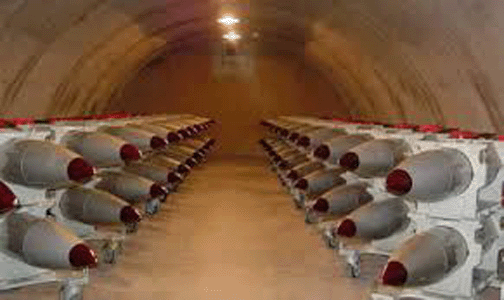 Congress was briefed on possibly moving the US’s nuclear weapons from Turkey’s Incirlik Air Base, Business Insider ALEX LOCKIE AUG 16, 2016, Business Insider previously reported on power being cut to Turkey’s Incirlik Air Base during thefailed July 15 coup and the situation of some 50 B61 nuclear bombs there, but a new report from the Congressional Research Service shows that Congress was also briefed on the matter.
The brief may be the most official confirmation of the location of the bombs on record, and it goes into detail on why and how the bombs are stored.
Essentially, the presence of nuclear weapons at Incirlik owes to Cold War tensions and postures between the US and the former Soviet Union. The report asserts that nuclear weapons were stored in Europe, Japan, South Korea, and elsewhere, with a total of about 200 nuclear bombs in Europe.
The weapons at Incirlik are the shorter-range variety, and they are mainly valuable to deter potential aggression and demonstrate the US’s commitment to NATO. However, Incirlik is unusual in that Turkey does not own or maintain nuclear-capable aircraft, and Ankara does not allow the US to fly nuclear-capable bombers to that airbase.
So the bombs that sit in Incirlik can’t actually be used, or they would have to be hauled to another base first.
Are the bombs secure? The report finds the security situation of the bombs adequate, as they are stored in facilities last updated in 2015, are heavily guarded by US troops, and are stored securely underground……
Should the US move the nukes? In its conclusion, the report weighs the alternatives to stationing nuclear weapons at Incirlik. Moving the warheads could possibly encourage Russia to cooperate more and possibly reduce their nuclear stockpile, though nothing guarantees that.A move could be seen as prudent in light of the evolving and uncertain relationship of the US to Turkey, and the weapon’s current proximity to ISIS territory and the Syrian quagmire….http://www.businessinsider.com.au/congress-briefing-nuclear-weapons-at-incirlik-air-base-2016-8?r=US&IR=T
Environmental groups in America take legal action against transport of nuclear wastes

 Greens Sue to Stop Nuclear Waste Transport http://www.courthousenews.com/2016/08/15/greens-sue-to-stop-
 nuclear-waste-transport.htm By BRITAIN EAKIN WASHINGTON (CN)– The U.S. Energy Department’s unprecedented proposed transfer of “a toxic liquid stew” containing nuclear waste between Canada and the U.S violates federal law, seven environmental groups claim in court.
Terry J. Lodge, attorney for the environmental groups, did not respond Monday to an emailed request for comment.
UK’s Crown Estate recommends UK switching attention from nuclear power to offshore wind

 Hinkley C’s future is in doubt. Let’s turn our sights to offshore wind
Falling costs and increased reliability mean this clean power now offers a mature part of the solution for the UK’s energy mix Guardian 15 Aug 16 Huub den Rooijen Director of energy, minerals and infrastructure at Crown Estate
With the government re-examining the case for new nuclear reactors at Hinkley Point, it’s a good time to reflect on recent breakthroughs in another low carbon technology: offshore wind.
Offshore wind is already meeting about 5% of the UK’s electricity demand, more than any other country globally, and is on course to meet 10% by 2020. The sector has undergone a sea change over the last few years, driven by rapid advances in technology, cost, and industry’s ability to deliver on time and to budget.
In fact, over the last three years, construction costs have come down by more than 40% in the UK alone. And by 2025, industry and government expect UK prices to be comparable with new gas generation at about £85 per megawatt hour (MWh).
In the Netherlands, there has been an even bigger step change. Although there are differences in terms of regulation, most would agree that after a recent offshore wind tender the Dutch are now going to be paying the equivalent of about £80 per MWh for their 700MW windfarm. That is significantly lower than Hinkley Point C at £92.50per MWh.
As active managers of the UK seabed, including awarding leases for offshore wind, we take a keen interest in this result. After all, the Dutch windfarm is only about 75 miles away from UK waters, and has very similar conditions like water depth, wind speeds, and distances to ports. If costs can be slashed in the Netherlands, geography tells us they can be slashed here too……..
As the Committee on Climate Change urges government to consider alternatives if there are delays to renewing our nuclear fleet, we should remember our seabed is a powerful energy asset.
At present, we have 2,200 wind turbines in operation and under construction, taking up less than 1% of our total seabed. National Grid estimates that nearly half of all power could be generated from our seabed by 2030 through offshore wind, combined with tidal power lagoons and strong electrical connections to our neighbouring countries.
We have an inexhaustible supply of reliable and clean power right on our doorstep, and competitively priced offshore wind now offers a mature part of the solution for the UK’s energy mix. https://www.theguardian.com/environment/2016/aug/14/hinkley-cs-future-is-in-doubt-lets-turn-our-sights-to-offshore-wind
UK Tories waking up to the diseconomics of nuclear power
 UK Tories wake up to nuclear folly, as wind and solar found to be cheapest http://reneweconomy.com.au/2016/uk-tories-wake-up-to-nuclear-folly-as-wind-and-solar-found-to-be-cheapest-92800 By Giles Parkinson on 16 August 2016
The fact that the cost of wind and solar is falling and the cost of nuclear is moving in the opposite direction is of little surprise to anyone involved in the energy markets, even if the nuclear industry and its supporters wish it were not so. But it is news, apparently, to the Tories.
New data uncovered from a previously unheralded National Audit Office report shows that the UK government is now advised that the cost of wind and solar could be around half that of new nuclear by 2025 – between £50-£75/MWh compared to between £80 and £125/MWh for nuclear.
The Guardian reported that previous forecasts, made in 2010 and 2013, showed that the two renewable technologies were expected to be more expensive than nuclear or around the same cost by the time that Hinkley was built. This is the first time the government has shown it expects renewables to be a cheaper option.
The Hinkley Point nuclear project has already blown out in costs and relies on significant government guarantees and subsidies over and above the £92.50/MWh tariff it promises to pay should it ever get built. That tariff then rises with inflation over the course of the 35-year contract, meaning it could more than double in price by 2050, even as the cost of wind and solar fall even further.
“The [energy] department’s forecasts for the levelised cost of electricity of wind and solar in 2025 have decreased since 2010. The cost forecast for gas has not changed, while for nuclear it has increased,” the NAO said, with a degree of understatement. The detailed energy department findings have yet to be released…..
Before the Brexit vote, the UK Tories had appeared entirely smitten by new nuclear, despite the evident folly of the project, which had not just blown out in cost from £16 billion to £24.5 billion, but because of the falling price of wholesale electricity, would require a lifetime subsidy of £29.7 billion compared to original estimates of £6.1 billion.
As Bridget Woodman from the University of Exeter wrote recently, accommodating Hinkley meant that the UK government had to essentially redesign the electricity market over the past few years in an effort to create a situation where investment in a new plant looked attractive.
“Pretty much every major policy design has been geared towards creating a perfect environment for Hinkley Point C. That’s why it’s such a surprise to see the government has now stepped back – a bit – from the brink,” she wrote.
And what the UK government was proposing to build was in sharp contrast to what is being recommended. The head of National Grid, for instance, had last year called for a complete rethink about the nature of energy systems.
“The idea of baseload power is already outdated,” he told Energy Post.
“I think you should look at this the other way around. From a consumer’s point of view, baseload is what I am producing myself. The solar on my rooftop, my heat pump – that’s the baseload.
“Those are the electrons that are free at the margin. The point is: this is an industry that was based on meeting demand. An extraordinary amount of capital was tied up for an unusual set of circumstances: to ensure supply at any moment. This is now turned on its head.”
Those thoughts are now being echoed by other experts. David Elmes, the head of Warwick Business School Global Energy Research Network, wrote in the UK edition of The Conversation that the UK had painted itself into a corner, and needed to get over the idea that megaprojects were the solution to everything.
“Instead, it should think of a new mix between smaller and larger, be more joined up in considering consumption as well as supply and think more decentralised than central. That expands the industries, companies, institutions and government departments involved.”…… http://reneweconomy.com.au/2016/uk-tories-wake-up-to-nuclear-folly-as-wind-and-solar-found-to-be-cheapest-92800
French Polynesia’s Protestant church takes action against France over nuclear testing

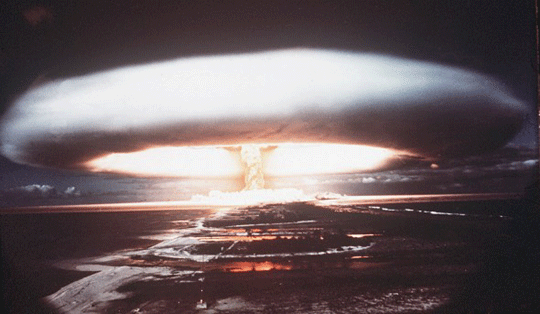 Tahiti Protestants take France to court, Radio New Zealand, 9 August 2016 French Polynesia’s Protestant church has decided to take France to the International Criminal Court over the legacy of the French nuclear weapons tests. The decision was announced at the conclusion of the Maohi Protestant Church Synod in Tahiti.
Its secretary general Celine Hoiore said the case will be filed in The Hague for alleged crimes against humanity as a result of 193 nuclear weapons tests in the South Pacific.
The action is being taken for all the consequences of the tests, including contempt for the illnesses Polynesians suffer from as a result of the tests she said.
Oscar Temaru, a pro-independence opposition politician, has welcomed the church decision as historic.
The church will also raise its concern with the United Nations (UN) where Mr Temaru has already been campaigning on the matter as part of his decolonisation effort.
In October, the French Polynesian president Edouard Fritch is due to go to the UN as his government is against decolonisation.
He is yet to react to the church decision.
In 2010, France passed a law to compensate victims but the law’s scope has been too narrow to allow more than just a handful of people to get recognition and there have been calls to review the law…….http://www.radionz.co.nz/international/pacific-news/310514/tahiti-protestants-take-france-to-court
Nuclear power a poor deal for India, despite aggressive marketing by USA, France Russia
India is better advised to put money instead into its abundant solar energy, which will definitely be less expensive and less risky. “Investing in new solar photovoltaic capacity would be a much lower-cost, significantly less environmentally harmful and far more sustainable alternative to the Mithi Virdi and Kovvada projects,”

Nuclear power costly, inefficient, SANKAR RAY | Fri, 12 Aug 2016- , Mumbai , dna Reactors reduced to status of old furniture as no new ones are being made With Prime Minister Narendra Modi and US President Barrack Obama, finalising the import of 12 AP1000 nuclear reactors plants – six from the Westinghouse Electric — for Mithi Virdi, Gujarat, and another six from the GE-Hitachi’s Economic Simplified Boiling Water Reactor for Kovvada, Andhra Pradesh, nuclear hawks have become super-active. The US Export-Import Bank is about to complete a financing package for the  project. The Nuclear Power Corporation of India and Toshiba Corp’s (6502.T) Westinghouse Electric too confirmed that engineering and site design work would begin shortly. Small wonder, anti–US hawks too have swung into action to nail the very concept of importing nuclear power reactors from the US, arguing that the cost from the US reactors is very high, estimated provisionally at $7.5 million per megawatt in stark contrast to $ 2.9 million of the Russian ones that are installed at Kudankulam.
Prof Sujay Basu, a doyen among energy experts and former — the first too – director, School of Energy Studies, Jadavpur University, expressed his chagrin against import of reactors. “First, the Kudankulam reactors were sold by Russia at distressed price. Second, reactor manufacture, from the very beginning of the new century, ceased to be a profitable business. American nuclear industry is worried for want of buyers and escalation of cost.
France tried to sell one or two reactors to Finland but backed out. Nowhere in the world, except Japan, are new reactors marketable without political lobbying. Energy gap cannot be narrowed by setting up more nuclear plants. In India, the more pressing problem is how to retire several ageing with effective disposal of nuclear hazards.” Indeed, almost all the components of the reactor were manufactured during the 1980s and were rendered surplus due to post-Chernobyl cancellation of over two dozen reactors after the mega-catastrophe in the twilight years of Soviet Union.
V T Padmanabhan, noted analyst and member of the Nuclear Consultancy Group, considered as a crusader for nuclear safety and health effects (genetic and somatic) of ionising radiation, divulged in countercurrents.org about six months ago that the Kudankulam reactor tripped 20 times and was off-grid for 468 days.
Kudankulam Nuclear Power Plant (KKNPP-1), the first reactor, built jointly by the NPCIL and Russia’s Atomstroyexport (ASE), is the only operating Generation-III pressurised water reactor (VVER-1000) the world over. During the 840 days of its grid connection since 22 October 2013, the reactor worked for 372 days, although this so-called brand new Russian machine, commissioned a year ago, underwent a seven-month-long overhaul since 24 June 2015 and achieved criticality in the afternoon of 21 Jan 2016.
Following a series of experiments, the generator was connected to the grid in the morning of 30 Jan 2016. According to the database of Power Reactor Information systems of the International Atomic Energy Agency, the KKNPP-1 operated for only 4,212 hours in 2014, less than half the time-schedule. Mentioning this, Prof M V Ramana, a nuclear physicist and currently associated with the Programme on Science and Global Security at Princeton University, a good fraction of those operations evidently involved the reactor generate below the corresponding rated power capacity. “In all, the reactor generated less than a third of the electricity that it could have if it had operated at full power, 24 hours a day, 365 days a year.” Things worsened in the following year. The NPCIL website admitted that between April 2015 and January 2016, the plant had an abysmally load factor of 20 per cent.
There is no denying that the KKNPP-1 is a congenitally sick baby, a junk reactor. Maybe, the sickly state of KKNPP-1, prompted the NDA government (if not an alibi) to opt for the US plants. But in end-March this year, the Institute for Energy Economics and Financial Analysis, which is engaged in research and analysis on financial and economic issues related to energy, in order to quicken the transition to a diverse, sustainable and profitable energy economy, released a report, Bad Choice: The Risks, Costs and Viability of Proposed US Nuclear Reactors in India, which negates the economic viability of Indian plan to build 12 new nuclear-powered plants using untested technology. The lead author of it, IEEFA’s director of resource planning analysis, David Schlissel, stated that these nuclear plants are “first-of-kind” designs by Toshiba-Westinghouse and General Electric-Hitachi planned for the Mithi Virdi and Kovvada complexes, are neither economically nor financially viable.“They would take much longer than expected to build, they would result in higher bills for ratepayers, and, if they are built, they might not work as advertised.”
The IEEFA pointed out that it would take 11 to 15 years to build, if approved, the first new reactors at Mithi Virdi and Kovvada, provided there is no time lag. These reactors can’t start generation for the electric grid before 2029.
Furthermore, stated Schlissel, even if there is zero time-and-cost overruns, “both projects would require massive investment over the next two decades, ranging from Rs 6.3 lakh crores (US $95 billion) to 11.3 lakh crore rupees (US $170 billion).” The IEEFA warned against slowdown in project implementation due to lengthy land-acquisition and complicated nuclear liability issues. India is better advised to put money instead into its abundant solar energy, which will definitely be less expensive and less risky. “Investing in new solar photovoltaic capacity would be a much lower-cost, significantly less environmentally harmful and far more sustainable alternative to the Mithi Virdi and Kovvada projects,” quipped Schlissel…….http://www.dnaindia.com/analysis/column-nuclear-power-costly-inefficient-2244012
70% jump in renewable energy’s share of global electricity
Renewables jump 70% in shift away from fossil fuels, http://www.iran-daily.com/news/166891.html The share of electricity that the world’s 20 major economies are generating from the sun and the wind has jumped by more than 70 percent in the space of five years, new figures show.
In a sign of the shift away from fossil fuels that is starting to take hold in some regions, G20 countries collectively produced eight percent of their electricity from solar farms, wind parks and other green power stations in 2015, up from 4.6 percent in 2010, FT reported.
Seven G20 members now generate more than 10 percent of their electricity from these sources, compared with three in 2010. The seven were led by Germany, home of the Energiewende — a policy shift towards green power. Renewables made up 36 percent of its electricity mix, according to data compiled for the FT by the Bloomberg New Energy Finance research group.
The UK, Italy and France all generated more than 19 percent of their electricity from renewables while Australia and Brazil reached 11 percent and 13 percent respectively. For the 28 members of the EU, the number was 18 percent.
The figures do not include hydropower, one of the oldest sources of renewable electricity.
Instead, the data underline the growth of newer forms of green energy such as solar and wind farms that have been heavily subsidized in many countries as governments try to combat global warming.
This growth has been especially striking in the UK, which generated 24 percent of its electricity from such renewables last year compared with just six percent in 2010.
Still, fossil fuels continue to dominate the electricity supply in many countries, including the US and China, two of the most powerful proponents of the UN climate change accord struck in Paris in December.
China is the world’s largest clean energy market, accounting for nearly a third of the $329 billion invested in clean energy globally last year as the government continued to boost its renewables industry.
4 Year nuclear leak not fixed at FitzPatrick nuclear plant
The U.S. Nuclear Regulatory Commission said the accumulation of spilled radioactive waste in the basement of a building at FitzPatrick is of “very low safety significance” because it occurred in a locked, highly shielded area that is already highly radioactive.
“The bottom line is, we have been aware of this issue for some time, but it poses no immediate risks to any residents or the environment,” said Neil Sheehan, speaking for the NRC.
Nevertheless, plant owner Entergy Corp.’s failure to address the leak is of “more than minor significance” because the company knew about the problem for at least four years, the NRC reported.
Nuclear plant owners are required to minimize the accumulation of residual radioactive waste in their plants, which can “greatly increase the cost and complexity of future decommissioning” after a reactor shuts down, according to the NRC……..
Anti-nuclear activists said the NRC report should raise concerns about the aging FitzPatrick plant, which started operation in 1975.
“These violations highlight the ongoing dangers posed by the upstate nuclear reactors and the lax enforcement by the Nuclear Regulatory Commission,” said Tim Judson, of the Nuclear Information and Resource Service. “Entergy has known that this highly radioactive waste spill is a problem for four years, but the NRC has not imposed any fines or other penalties.” http://www.syracuse.com/news/index.ssf/2016/08/minor_radiation_leak_at_fitzpatrick_nuclear_plant_has_gone_unfixed_for_4_years.html
More delay hampers India-Japan nuclear deal

 Ratification of India, Japan civil nuclear deal may face further delay THE HINDU Business Line,
 NAYANIMA BASU NEW DELHI, 16 AUGUST: The ratification of India-Japan Civil Nuclear deal is likely to be delayed further.
“It is unlikely that the Diet (wich is likely to meet for a special session end of next month) will take up the India-Japan Civil Nuclear deal for ratification. There are still some issues that need to be discussed,” a top official, involved in the talks, told BusinessLine.
The Diet had its session last in June. However, this year it will be meeting once again, which is also known as an extraordinary session from September 26.
However, like last time, it seems even in this session the nuclear deal with India will not go through due to “domestic pressure and compulsions”, according to the official. Once the Diet ratifies the deal, the deal will be officially signed.
According to sources, Japan has not been able to build a support for the deal within its political sections, as there are apprehensions that export of Japanese nuclear technology might get routed for military purposes.
There are also “strong concerns” on the Japanese side regarding nuclear cooperation because India is still not a signatory to nuclear Non-Proliferation Treaty (NPT).
The India-Japan Civil Nuclear deal had been under discussion for over six years now………
Meanwhile, India is also concerned with the fact that technical negotiations on the deal might take a backseat as the Japanese Cabinet has undergone a major reshuffle. Japan now has a new Defence Minister Tomomi Inada, who is known to be having anti-nuclear agenda……http://www.thehindubusinessline.com/economy/ratification-of-india-japan-civil-nuclear-deal-may-face-further-delay/article8995337.ece
1 This Month
Chernobyl: The Lost Tapes – A good documentary on Chernobyl on SBS available On Demand for the next 3 weeks– https://www.sbs.com.au/ondemand/tv-program/chernobyl-the-lost-tapes/2352741955560

of the week–London Campaign for Nuclear Disarmament

Tell the Ukrainian Government to Drop Prosecution of Peace Activist Yurii Sheliazhenko
To see nuclear-related stories in greater depth and intensity – go to https://nuclearinformation.wordpress.com
-
Archives
- April 2026 (139)
- March 2026 (251)
- February 2026 (268)
- January 2026 (308)
- December 2025 (358)
- November 2025 (359)
- October 2025 (376)
- September 2025 (257)
- August 2025 (319)
- July 2025 (230)
- June 2025 (348)
- May 2025 (261)
-
Categories
- 1
- 1 NUCLEAR ISSUES
- business and costs
- climate change
- culture and arts
- ENERGY
- environment
- health
- history
- indigenous issues
- Legal
- marketing of nuclear
- media
- opposition to nuclear
- PERSONAL STORIES
- politics
- politics international
- Religion and ethics
- safety
- secrets,lies and civil liberties
- spinbuster
- technology
- Uranium
- wastes
- weapons and war
- Women
- 2 WORLD
- ACTION
- AFRICA
- Atrocities
- AUSTRALIA
- Christina's notes
- Christina's themes
- culture and arts
- Events
- Fuk 2022
- Fuk 2023
- Fukushima 2017
- Fukushima 2018
- fukushima 2019
- Fukushima 2020
- Fukushima 2021
- general
- global warming
- Humour (God we need it)
- Nuclear
- RARE EARTHS
- Reference
- resources – print
- Resources -audiovicual
- Weekly Newsletter
- World
- World Nuclear
- YouTube
-
RSS
Entries RSS
Comments RSS
 nuclear-news