Indigenous Americans still paying the health price of uranium mining, long after mines shut
Years after mining stops, uranium’s legacy lingers on Native land http://www.environmentalhealthnews.org/ehs/news/2016/tribal-series/crow-series/years-after-mining-stops-uraniums-legacy-lingers-on-native-land August 22, 2016 By Brian Bienkowski
Editor’s Note: This story is part of “Sacred Water,” EHN’s ongoing investigation into Native American struggles—and successes—to protect culturally significant water sources on and off the reservation.

CROW AGENCY, Mont.—The Crow are not alone in their struggle with uranium. The toxic metal is irrefutably intertwined with Native Americans, long a notorious national environmental injustice. Some 15,000 abandoned uranium mines with uranium contamination pocket 14 Western states. Of those, 75 percent are on federal and tribal lands, according to the U.S. Environmental Protection Agency (EPA). Contamination is especially concentrated across the Colorado Plateau near the Four Corners region of Arizona, Utah, Colorado and New Mexico, leaving a lasting impact on tribes such as Navajos, Utes, Hopi and Zuni.
The area became saturated with the dangerous metal from the heavy mining fueled by Cold War-era anxieties in the 1940s and ’60s, and the lax cleanup of the 1980s.
Most of the mines were on federal land—managed by the Forest Service or Bureau of Land Management. But tribes, namely the Navajo, were swept into the uranium-mining boom for both their labor and land and are still dealing with the mess it left.
More than 521 abandoned uranium mines pocket Navajo land alone. Some 90 percent of uranium milling in the United States took place on or just outside the boundaries of Native American reservations, according to a 2015 study. This left a legacy of dirty water, leftover toxic waste and health problems such as lung cancer and developmental delays for children in many Western tribes.
Such pollution becomes a force multiplier for Native Americans—on the Crow reservation it adds to economic, health and historical burdens, and further complicates the ability to cultivate and sustain their culture.
In the body, most—but not all—uranium is excreted. What remains settles mostly in the kidneys and bones. Excess uranium has been linked to increased cancer risk, liver damage, weakened bone growth, developmental and reproductive problems.
Even at low levels uranium may play a role in some cancers and fertility problems. Studies have shown it acts as an endocrine disruptor, mimicking the hormone estrogen. Hormones are crucial for proper development, and such altering can lead to some cancers and fertility and reproductive problems.
For the Navajo Nation, many men worked in mining or milling, unaware of the risks, and later dealt with various cancers and failing kidneys. In 2000 researchers reported that from 1969 to 1993 Navajo uranium miners had a lung-cancer rate about 29 times that of non-mining Navajos, according to the study published in the Journal of Occupational and Environmental Medicine.
Most of the mining tunnels, pits and waste piles remain on the reservation today near Navajo families. Water, already scarce, remains tainted with uranium and other metals. In one report, researchers found elevated uranium levels in the urine of 27 percent of almost 600 Navajo tribal members tested. The U.S. population as a whole is closer to 5 percent.
The uranium-mining legacy also left contaminated groundwater on the Wind River Reservation in Wyoming, home to the Eastern Shoshone and Northern Arapaho Indians. In Washington state, two mines were shuttered in the 1980s, but more than 30 million tons of radioactive rock and ore remain at the site. Today it is a federal Superfund site. Researchers are now tracking cancer rates on the Spokane Indian Reservation.
“We see a high percentage of wells contaminated with trace elements like uranium in the double digits all over the U.S, but they are certainly more prevalent in Western, more arid areas.”
– Joe Ayotte, USGSThis toxic trail spreads throughout the West. Some uranium mining took place near the Crow Reservation, but naturally occurring levels can infiltrate drinking water wells too. And private wells don’t have the same safeguards of testing and treatment that public water does.
“We see a high percentage of wells contaminated with trace elements like uranium in the double digits all over the U.S, but they are certainly more prevalent in Western, more arid areas,” says Joe Ayotte, chief of groundwater quality studies section for the U.S. Geological Survey.
The USGS reported 20 percent of untreated water samples from public, private and monitoring wells nationwide contained concentrations of at least one trace element, such as uranium, arsenic and manganese. Manganese and uranium were found at levels at or above human health standards in 12 percent and 4 percent of wells nationwide, respectively, according to the study.
Like the rest of the country, Montana home wells have historically not been tested for elements such as uranium and manganese, so it’s unclear if Crow is an outlier or the norm for the state.
The Montana Department of Environmental Quality does not have regulatory authority over private wells on tribal lands, says Lisa Peterson, an agency spokesperson, adding that they haven’t received any information about contamination on the Crow Reservation.
For questions or feedback about this piece, contact Brian Bienkowski at bbienkowski@ehn.org.
Climate emergency requires action now – Jill Stein USA Greens Party
 Green Party candidate Jill Stein calls for climate state of emergency Presidential hopeful points to California wildfires and Louisiana flooding in push for Green New Deal to address both environment and economy, Guardian, Edward Helmore, 20 Aug 16, “We need to acknowledge the true state of emergency we are in,” Stein said. “The fires in California and floods in Louisiana are going to become day-by-day occurrences, and, within our lifetimes, there is going to be potentially catastrophic sea-level rise.
“We need to ensure that these disasters do not become a daily way of life for all Americans and people all over the world,” she said, “and this is why we need to declare a climate state of emergency so that we can respond in real time in the ways that we need to.”
In poll after poll, Stein added, the American people say they want substantial action on climate change that meets the severity of the crisis. She called for empowering Americans to instruct their elected officials – namely Congress – to act in their interests, not in the interests of lobbyists.
Stein remarked that she was astonished to be witnessing a Republican party that appeared to be “unravelling at the seams”. But she also warned that Democrats were moving to the right………
The Green party nominee, currently polling as high as 6% but well below the 15% threshold required for a podium position in the coming presidential TV debates, said declaring a state of emergency would address two related crises in the climate and the economy….
Part of the solution would be the Green New Deal, a plan that would rapidly create 20m new jobs, lead to a sustainable economy and transition the US to 100% clean energy by 2030.
The New Deal, Stein said, would help revive the economy, turn the tide on climate change and make wars for oil obsolete. “When you have 100% renewable energy, you do not need and you cannot justify a military budget that distributes soldiers and weapons all around the world.”
The plan includes “restoring critical infrastructure, including the ecosystem, cleaning up rivers and waterways, restoring our wetlands and forests and ensuring that we have water systems for our communities that are not toxic”.
Part of the program, she added, would be to call for a complete ban on new fossil fuel and nuclear infrastructure. Communities dependent on coal or fracking would be assured that jobs would be replaced before they were laid off.
Stein estimates the costs of the transition would be completely offset by the money saved by not using fossil fuels. The savings, she suggested, would include billions of dollars related to healthcare costs from asthma, emphysema, heart attacks, strokes and cancers related to exposure to fossil fuels.
The party’s vice-presidential nominee, Ajamu Baraka, also appeared at the event. A longtime human rights activist, he told the gathering that participatory job creation and planning was paramount in the development of a Green New Deal economy. “It’s imperative that the people are direct participants,” he said. “It’s a principle that this party and this campaign stands for.”…..
As a medical doctor, of course I support vaccinations,” she tweeted. “I have a problem with the FDA [Food and Drug Administration] being controlled by drug companies.”
But on the campaign trail, Stein largely limited her remarks to concerns over climate change. She proposed introducing a carbon tax of $60 a ton that would yield around $360bn annually and increasing the estate tax to its level during the Reagan administration. Her proposals, she argued, were now a necessity.
“Each month now, we’re seeing records set for climate change and global warming. Science is telling us that the day of reckoning is coming closer. This is not something that can wait another four years.
“We are in an existential moment where we have to decide if we want a future or not,” she said. https://www.theguardian.com/us-news/2016/aug/20/jill-stein-green-party-climate-state-of-emergency
Westinghouse puts on hold plans to build nuclear fuel plant in Ukraine
US Westinghouse gives no confirmation of decision to build nuclear fuel plant in Ukraine,
Ukrainian Energy and Coal Industry Minister Nasalik earlier announced that Westinghouse and Kiev had reached a deal on building a nuclear fuel factory in Ukraine.
KIEV, August 16. /TASS/. The US-based Westinghouse has not confirmed a decision to finance the construction of a nuclear fuel factory in Ukraine as was previously announced by Ukrainian Energy and Coal Industry Minister Igor Nasalik.
As Westinghouse Vice-President and Managing Director for Northern and Eastern Europe Aziz Dag told Deutsche Welle publication, surplus capacities for nuclear fuel production can be observed in the world at present and, therefore, the construction of a new factory won’t bring any considerable economic benefits for the country….. http://tass.ru/en/economy/894536
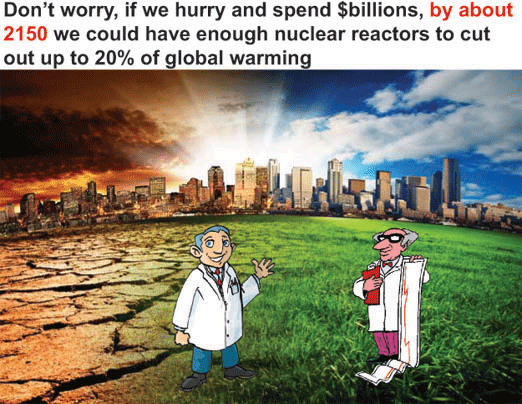
Nuclear power holds back action on climate change – new study shows
New Study Shows How Clinging to Nuclear Power Means Climate Failure http://www.commondreams.org/news/2016/08/22/new-study-shows-how-clinging-nuclear-power-means-climate-failure “By suppressing better ways to meet climate goals, evidence suggests entrenched commitments to nuclear power may actually be counterproductive” by Andrea Germanos, staff writer 23 Aug 16
While it’s been touted by some energy experts as a so-called “bridge” to help slash carbon emissions, a new study suggests that a commitment to nuclear power may in fact be a path towards climate failure.
For their study, researchers at the University of Sussex and the Vienna School of International Studies grouped European countries by levels of nuclear energy usage and plans, and compared their progress with part of the European Union’s 2020 Strategy.
That 10-year strategy, proposed in 2010, calls for reducing greenhouse gas emissions by least 20 percent compared to 1990 levels and increasing the share of renewable energy in final energy consumption to 20 percent.
The researchers found that “progress in both carbon emissions reduction and in adoption of renewables appears to be inversely related to the strength of continuing nuclear commitments.”
For the study, the authors looked at three groupings. First is those with no nuclear energy. Group 1 includes Denmark, Ireland and Portugal. Group 2, which counts Germany and Sweden among its members, includes those with some continuing nuclear commitments, but also with plans to decommission existing nuclear plants. The third group, meanwhile, includes countries like Hungary and the UK which have plans to maintain current nuclear units or even expand nuclear capacity.
“With reference to reductions in carbon emissions and adoption of renewables, clear relationships emerge between patterns of achievement in these 2020 Strategy goals and the different groupings of nuclear use,” they wrote.
For non-nuclear Group 1 countries, the average percentage of reduced emissions was 6 percent and they had an average of a 26 percent increase in renewable energy consumption.
Group 2 had the highest average percentage of reduced emissions at 11 percent and they also boosted renewable energy to 19 percent.
Pro-nuclear Group 3, meanwhile, had their emissions on average go up 3 percent and they had the smallest increase in renewable shares—16 percent.
“Looked at on its own, nuclear power is sometimes noisily propounded as an attractive response to climate change,” said Andy Stirling, professor of science and technology policy at the University of Sussex, in a media statement. “Yet if alternative options are rigorously compared, questions are raised about cost-effectiveness, timeliness, safety and security.”
“Looking in detail at historic trends and current patterns in Europe, this paper substantiates further doubts,” he continued. “By suppressing better ways to meet climate goals, evidence suggests entrenched commitments to nuclear power may actually be counterproductive.”
The new study focused on Europe and Benjamin Sovacool, professor of energy policy and director of the Sussex Energy Group at the University of Sussex, stated, “If nothing else, our paper casts doubt on the likelihood of a nuclear renaissance in the near-term, at least in Europe.”
Advocates of clean energy over on the other side of the Atlantic said the recent plan to close the last remaining nuclear power plant in California and replace it with renewable energy marked the “end of an atomic era” and said it could serve as “a clear blueprint for fighting climate change.”
Natural Resources Defense Council President Rhea Suh wrote of the proposal: “It proves we can cut our carbon footprint with energy efficiency and renewable power, even as our aging nuclear fleet nears retirement. And it strikes a blow against the central environmental challenge of our time, the climate change that threatens our very future.”
Renewable energy, energy efficiency would create over 145,000 jobs in Alberta, Canada
 Alberta could produce over 145,000 jobs by going green: report HTTP://EDMONTONJOURNAL.COM/BUSINESS/ENERGY/ALBERTA-COULD-PRODUCE-OVER-145000-JOBS-BY-GOING-GREEN-REPORT GORDON KENT April 22, 2016 Alberta could create more than 145,000 jobs by investing more heavily in renewable energy, energy efficiency and public transit, a report by three environmental organizations says.
The move would boost employment when oil prices have dropped, reduce carbon emissions and help shift the economy toward green industries, according to the report released Friday by Greenpeace, the Alberta Green Economy Network and Gridworks Energy Group.
“The government can start putting people back to work without having to wait for the price of oil to go back up,” co-author David Thompson said Friday, which was also Earth Day.
The report estimates 68,400 positions are available from energy efficiency upgrades on more than 183,000 older homes and other buildings, requiring spending of $1 billion over five years.
Another 30,000 to 40,000 places would come from building LRT lines at a cost of more than $3.6 billion, along with the unpriced expansion of bike lanes, sidewalks and other sustainable transportation.
As well, there could be 46,780 jobs created by 2020 by almost doubling the amount of wind power to seven per cent of the electricity grid, boosting solar and geothermal production, and improving energy efficiency and storage.
No price tag is attached to this development. The provincial budget calls for investing $6.2 billion raised by the new carbon levy in green infrastructure, renewable energy, energy efficiency and other work over five years.
Many communities are already shifting toward renewable power.
The Lubicon Lake First Nation of Little Buffalo, 465 kilometres northwest of Edmonton, put in an 80-panel, 20.8-kilowatt solar electricity system next to its health centre last summer. The Louis Bull First Nation at Maskwacis, 70 kilometres south of Edmonton, will start installing 340 solar panels on four public buildings next month, training residents to work in this field and cutting electricity bills, councillor Desmond Bull said.
The approximately $300,000 cost is being covered with money from the federal government.
The project is intended to help the environment as well as produce economic development, Bull said.
“There’s not really any template or model for how First Nations can move in this direction.”
City of Edmonton chief economist John Rose cautioned this week that governments need to be prudent about major investments in renewable energy, but Thompson said Alberta has big wind and solar resources.
“We can learn from the mistakes others have made … We can go down the tunnel and hopefully get less scratched.”
Barack Obama’s climate change achievements
 Obama’s science legacy: climate (policy) hots up President sidesteps Congress to curb US greenhouse-gas emissions. http://www.nature.com/news/obama-s-science-legacy-climate-policy-hots-up-1.20468 Jeff Tollefson 23 August 2016 Global warming was one of Barack Obama’s top priorities — and one of the most difficult to address, given strong opposition from Republicans in Congress. Yet he managed to help broker a global climate accord and push through regulations to curb greenhouse-gas emissions from cars, trucks and power plants.
“Obama has established a terrific climate legacy,” says David Doniger, who directs the climate and clean-air programme at the Natural Resources Defense Council, an advocacy group in New York.
The president’s earliest actions capitalized on the global financial crisis. In February 2009, Obama signed economic-stimulus legislation that included nearly $37 billion for clean-energy research and development (R&D) at the Department of Energy. Four months later, with failing car companies seeking a federal bailout, the Obama administration proposed higher fuel-efficiency requirements and the first greenhouse-gas standards for passenger vehicles. Theregulations, which took effect in 2012, will nearly double the average fuel efficiency of vehicles by 2025, to around 23 kilometres per litre.
And after his campaign for a comprehensive climate bill failed in 2010, an emboldened Obamaused existing laws to issue regulations that curbed greenhouse-gas emissions, bolstered energy-efficiency standards and expanded energy R&D programmes.
But the president’s big push on climate came in advance of the United Nations climate summit in Paris in 2015. He committed the United States to reduce emissions by at least 26% below 2005 levels by 2025, and negotiated directly with countries such as China to build support for a global climate agreement. The final version, adopted on 12 December, aims to hold average global temperatures to 1.5–2 °C above pre-industrial levels.
“Paris is a major achievement for the world,” says Robert Socolow, a climate scientist at Princeton University in New Jersey. “I don’t think it would have happened without Obama.”
Yet Obama’s domestic achievements could be undone by legal challenges. In February, the US Supreme Court temporarily blocked a federal regulation to reduce emissions from existing power plants. The fate of that rule— the cornerstone of Obama’s plan to reduce emissions — could depend on the election in November. The Supreme Court is down one member and the next president will choose a replacement, who could decide whether the climate rule stands.
Some environmental experts say that Obama should have pushed harder for a comprehensive climate bill, rather than settling for piecemeal regulations. “All of these things are actually small bites at the apple that won’t achieve meaningful emissions reductions over time,” says Catrina Rorke, director of energy policy at the R Street Institute, a conservative think tank in Washington DC.
Others criticize Obama for encouraging a vast expansion of domestic oil and gas development, even as he sought to wean the country off coal and curb its greenhouse-gas emissions. “The administration is still trying to have it both ways,” says Stephen Kretzmann, executive director of Oil Change International, an advocacy group in Washington DC.
Obama rejected the Keystone XL pipeline, which would have carried oil from the Canadian tar sands to US refineries, and has said that some fossil fuels should be kept “in the ground”. But his administration continues to push an ‘all-of-the-above’ energy strategy that leads to higher production of domestic fossil fuels, Kretzmann says.
Nonetheless, Obama has helped to change the conversation about global warming at home and abroad, says Doniger. “The next president needs to do more,” he says, “but did the Obama administration move the ball forward? They sure did.”
Climate Change Gravest Health Threat of 21st Century
 Leading Doctor Calls Climate Change Gravest Health Threat of 21st Century http://commondreams.org/news/2016/08/23/leading-doctor-calls-climate-change-gravest-health-threat-21st-century?utm_campaign=shareaholic&utm_medium=twitter&utm_source=socialnetwork
‘When you cannot feed your children, you will do anything, even if it means going to war. This is the reality of climate change’
Climate change is the greatest threat to public health worldwide and doctors must step up to help mitigate it, according to a leading advocate speaking at the annual Canadian Medical Association (CMA) meeting in Vancouver on Monday.
Dr. James Orbinski, a former top official with the medical charity Doctors Without Borders/Médecins Sans Frontières (MSF), who is now an an associate professor of Medicine at the University of Toronto, urged physicians to “step up and step out” in the fight against climate change as part of their duties to create “health-in-all” policies.
“We’re not separate from our biosphere, or our planet,” Orbinski told the audience of 600. “We can’t possibly live, survive, and thrive without our biosphere. It affects us and we affect it.”
“Climate change is very much of our own making…but as doctors, we have a vital responsibility to urge the development of a health-in-all-policies approach,” he said.
The summit is taking place following extreme weather events and other environmental catastrophes throughout Canada, from wildfires in Fort McMurray to a massive oil spill in Saskatchewan.
The Vancouver Sun reports on Orbinski’s comments:
Droughts, fires like the one in Fort McMurray in May, floods, food security and infectious diseases are all linked to climate change.
Mental health problems and respiratory ailments from air pollution as well as rising rates of infectious diseases like West Nile virus and Lyme disease are also some of the consequences of climate change.
He also noted that Canada’s yearly rate of warming is twice the global pace, which means the effects of climate change will increase as time goes on, absent a concerted effort to reduce greenhouse gases.
“The implications are utterly profound,” Orbinski said.
“People go to war over water, food and territory, and when you cannot feed your children, you will do anything, even if it means going to war. This is the reality of climate change.”
CMA president Dr. Cindy Forbes said the organization would attempt to create an action plan. “I appreciated greatly Dr. Orbinski’s call to action, and I agree as a nation and as a planet we cannot ignore climate change,” she said.
Entergy and Exelon ask New York regulators to approve sale of FitzPatrick nuclear plantby Nov 18
Companies ask regulators to approve sale of FitzPatrick nuclear plant , syracuse.com, 23 Aug 16 By Tim Knauss | tknauss@syracuse.com Email the author | Follow on Twitter SYRACUSE, N.Y. – The companies involved in the $110 million sale of FitzPatrick nuclear plant have asked New York regulators to approve the transaction by Nov. 18, saying the deal could fall apart without prompt regulatory approval.
Entergy Corp., the current owner, and Exelon Corp., the buyer, filed a petition Monday asking the state Public Service Commission to approve the sale. They also will seek approvals soon from the U.S. Nuclear Regulatory Commission, the Federal Energy Regulatory Commission, the IRS and other agencies.
The sale will be automatically canceled, unless Entergy and Exelon mutually agree to move ahead, if PSC approval and other conditions are not met by Nov. 18, according to a copy of the sales agreement provided to state regulators.
Exelon wants state regulators to approve the sale before investing “tens of millions of dollars” in a planned refueling outage in January that would extend FitzPatrick’s operating life, according to the petition…..
Exelon and Entergy could face other obstacles to completing the deal, including court challenges.
Several parties, including the owners of non-nuclear power plants, warned the PSC that nuclear subsidy payments might violate federal rules over wholesale energy markets……..
Before they approve the sale of FitzPatrick, New York regulators will examine whether the transaction would give Exelon the ability to manipulate the wholesale market by giving it control over too many power plants…..http://www.syracuse.com/news/index.ssf/2016/08/companies_ask_regulators_to_approve_sale_of_fitzpatrick_nuclear_plant.html

 Inadvertent’ Nuke Risks Still Not Tracked Eight Years After Warning http://dailycaller.com/2016/08/23/inadvertent-nuke-risks-still-not-tracked-eight-years-after-warning/
Sandia National Laboratories’ system designed to track how problems with the nuclear weapons safety program were addressed was never completed, according to the IG report. The watchdog warned the contractor that such a system was necessary in 2008.
The safety program is intended to “minimize the possibility of accidental or inadvertent nuclear explosive detonation,” the report said. (RELATED: US Nuclear Weapons Could Die Thanks To $20 Million Of Neglect)
“[T]he project that Sandia established in 2011 to improve the formal tracking system has languished for several years without a defined scope or firm completion date,” the IG wrote. “Sandia officials postponed any updates to the tracking system.”
The contractor started a tracking system in 2008, but stopped updating it in 2011 when it launched an improvement project.
“As a result, the information that is needed to make informed decisions about safety improvements in future weapon refurbishment programs may not be readily accessible,” the watchdog continued. “[F]uture engineers may have difficulty finding the latest information on soft spots if Sandia does not maintain its tracking system.”
Employee turnover could also decrease the amount of knowledge surrounding the gaps in the nuclear weapons safety program, the IG noted. A system that tracks problems with nuclear weapons safety would reduce the knowledge lost from such turnover.
Sandia “identified 23 high priority nuclear weapons safety issues” in 2008, “for which there were either no plans to resolve the issues or plans were incomplete,” but wasn’t tracking how the contractor tracked corrections for those problems, the IG wrote.
The national security case against Trans Pacific Partnership
 The national security case against TPP, By John Adams, BG USA (Ret), The Hill, 17 Aug 16 “……..Our military is now shockingly vulnerable to major disruptions in the supply chain, including from substandard manufacturing practices, natural disasters, and price gouging by foreign nations. Poor manufacturing practices in offshore factories lead to problem-plagued products, and foreign producers—acting on the basis of their own military or economic interests—can sharply raise prices or reduce or stop sales to the United States.
Cheapest unsubsidized power plant in the world – Chile leads in the solar age
Solar Delivers Cheapest Electricity ‘Ever, Anywhere, By Any Technology’ https://thinkprogress.org/solar-delivers-cheapest-electricity-ever-anywhere-by-any-technology-c2ef759ac33f#.mxa8earjt Dr. Joe Romm , Founding Editor of Climate Progress, “the indispensable blog,” 24 Aug 16
Half the price of coal! Chile has just contracted for the cheapest unsubsidized power plant in the world, Bloomberg New Energy Finance (BNEF) reports.
In last week’s energy auction, Chile accepted a bid from Spanish developerSolarpack Corp. Tecnologica for 120 megawatts of solar at the stunning price of $29.10 per megawatt-hour (2.91 cents per kilowatt-hour or kwh). This beats the 2.99 cents/kwh bid Dubai received recently for 800 megawatts. For context, the average residential price for electricity in the United States is 12 cents per kilowatt-hour.
“Solar power delivers cheapest unsubsidised electricity ever, anywhere, by any technology,” BNEF Chair Michael Liebreich said on Twitter after this contract was announced.
Carlos Finat, head of the Chilean Renewable Energies Association (ACERA) told Bloomberg that the auction is “a strong warning sign that the energy business continues on the transition path to renewable power and that companies should adapt quickly to this transition process.” Indeed, in the same auction, the price of coal power was nearly twice as high!
Grid-connected solar power on Chile has quadrupled since 2013. Total installed capacity exceeded 1,000 megawatts this year — the most by far in South America. Another 2,000 megawatts is under construction, and there are over 11,000 megawatts that are “RCA Approved” (i.e. have environmental permits).
Chile is aided by the fact that its Atacama desert is “the region with the highest solar radiation on the planet,” according to the Inter-American Development Bank. So much solar is being built in the high-altitude desert that Northern Chile can’t use it all, and the government is rushing to buildnew transmission lines.
Chile is part of a global trend where solar energy has doubled seven times since 2000. In the U.S. alone, it has grown 100-fold in the past decade thanks to a sharp drop in prices that has brought the cost of solar (with subsidies) to under four cents a kilowatt hour in many places, as I detailed last month.
The future for solar could not be sunnier.
World needs a longer-term view on climate – beyond the Paris agreement
Without a longer-term view, the Paris Agreement will lock in warming for centuries, The Conversation, Eelco Rohling, August 24, 2016 The Paris climate agreement set a “safe” global warming limit of below 2℃, aiming below 1.5℃ by 2100. The world has already warmed about a degree since the Industrial Revolution, and on our current emissions trajectory we will likely breach these limits within decades.
However, we could still come back from the brink with a massive effort.
But let’s take a closer look at that warming limit. If we accept that 1.5-2℃ of warming marks the danger threshold, then this is true whether it applies tomorrow, in 2100, or some time thereafter. What we need is to stay below these limits for all time……https://theconversation.com/without-a-longer-term-view-the-paris-agreement-will-lock-in-warming-for-centuries-64169
Trends in Europe’s changing energy systems
Europe’s Energy Transition: Megatrends & Tipping Points (Part 3) Shifting Power-Generating Resources, Forbes, 18 Aug 16 By Mark Livingstone & Jan Vrins In our initial blog on Europe’s energy transition, we discussed seven megatrends that are fundamentally changing how we produce and use power. In this third blog in the series, we discuss the shift in power generation fuel mix and how this is transforming the European power industry.
European electricity-generating facilities that use oil, coal, and nuclear are devaluing and at risk of becoming stranded as generation sources shift to less expensive renewable generation and natural gas generation. This shift is playing out in different ways across Europe.
According to the US Energy Information Administration (EIA), net European generation capacity will increase by 7 GW in 2016. Much of Europe’s new capacity comes from renewables, with close to 75% of new capacity coming from wind (44%) and solar (29%). While new coal (16%) and gas (6%) capacity was added, far more coal assets were decommissioned. As a result, net new capacity in Europe is virtually 100% renewables. While recent subsidy cuts have tempered solar’s growth, wind is marching onward. There is still no effective utility-scale solution to the inherent intermittency in renewable generation, as storage solutions and grid interconnection/active management are still lacking penetration at scale. Natural gas is the bridging fuel during the shift to renewables, supported by the abundance of natural gas available globally, lower long-term prices, and increasing import capacity in Europe.
What Are the Drivers Behind This Shift?
We see five main drivers for the shift in generation resources described above:
- Climate Change Policy: Europe has taken definitive steps to decarbonize its power generation, including relatively generous support for renewables and economic penalties for carbon emitters via the EU Emissions Trading System (EU ETS). See our previous blog on the rising number of carbon emissions reduction policies and regulations.
- European Market Coupling: A second aspect of Europe’s power sector is the physical and economic integration of markets. Interconnection growth has been strong, and the economic incentives via use of power exchanges for dynamic price signaling has provided further support for low-carbon generation.
- Generation Economics: While policy and regulatory support for low-carbon generation has taken centre stage, the economics of various forms of generation have also been shifting. Within 7 years, solar power has gone from a heavily subsidized resource to a key component of the generation mix, even with zero or minimal subsidies. Europe continues to lead the world in development of offshore wind, particularly in the North Sea. Thermal generation economics have also changed—despite relatively low gas and coal prices, low marginal cost renewables are increasingly forcing thermal plants to shift from stable baseload operation to less efficient cycling and reliance on ancillary service contracts.
- Decentralization of Generation: The scale of distributed energy resources (DER) is not yet huge across Europe; however, this trend is already shaking the traditional utility business models. The rise of the prosumer is gathering momentum, be it an industrial customer who invests in combined heat and power, a new commercial building with a biomass boiler, or a housing development with rooftop solar panels.
- Public Sentiment: This driver cannot be underestimated given the prevalence of democratically elected governments in Europe. Public support for action to curb climate change despite the costs has been most obvious in Germany, where the changes via nuclear shutdowns and solar growth have been massive—and expensive. In the UK, it is more expensive to construct offshore wind than onshore, but the public and political preference is that location trumps economics.
How Does This Play Out Across Europe?……. http://www.forbes.com/sites/pikeresearch/2016/08/18/europes-energy-transition-megatrends-tipping-points-part-3/#6d68a5b124e8
August 23 Energy News

Science and Technology:
¶ According to a report by the New York Times, the coral reef on the floor of a remote island lagoon halfway between Hawaii and Fiji started to become a dead zone in the early 2000s. However, a team of biologists in 2015 was “stunned and overjoyed to find Coral Castles, genus Acropora, once again teeming with life.” [The Weather Channel]
 AP Photo / Keith A. Ellenbogen
¶ In a new study, scientists who study the largest ice mass on Earth, East Antarctica, have found that it is showing a surprising feature reminiscent of the fastest melting one: Greenland. The satellite-based study found that meltwater lakes have been forming, nearly 8,000 of them in summer between the year 2000 and 2013. [The Independent]
World:
¶ Navigating through the icy waters of the Arctic, a Greenpeace ship is delivering solar panels to the…
View original post 705 more words
Socialist Nuclear Power (i.e. Unfair Nuclear Subsidies; Corporate Welfare) in America (and Elsewhere)

“There are many forms of government subsidization of the nuclear power industry. These subsidies include the sponsorship of research, enrichment of fuels, and disposal of nuclear wastes… the one government-furnished privilege that the nuclear industry could find it hardest to live without is the Price-Anderson Act’s limitation on a nuclear power plant’s liability in case of an accident“. (Barry Brownstein for the CATO Institute 1984 – see more below)
Home insurance won’t pay in the event of a nuclear accident. Imagine the sort of surprise flooding that Louisiana just suffered, in conjunction with a nuclear disaster. The aftermath of the Fukushima nuclear accident offers a glimpse into disasters which may happen at any moment – most likely in North America or Europe, simply because there are more nuclear reactors operating there.

Waterford Nuclear Power Station sits behind an earthen dam (levee) in the direction that the Mississippi…
View original post 954 more words
1 This Month
Chernobyl: The Lost Tapes – A good documentary on Chernobyl on SBS available On Demand for the next 3 weeks– https://www.sbs.com.au/ondemand/tv-program/chernobyl-the-lost-tapes/2352741955560

of the week–London Campaign for Nuclear Disarmament

Tell the Ukrainian Government to Drop Prosecution of Peace Activist Yurii Sheliazhenko
To see nuclear-related stories in greater depth and intensity – go to https://nuclearinformation.wordpress.com
-
Archives
- April 2026 (139)
- March 2026 (251)
- February 2026 (268)
- January 2026 (308)
- December 2025 (358)
- November 2025 (359)
- October 2025 (376)
- September 2025 (257)
- August 2025 (319)
- July 2025 (230)
- June 2025 (348)
- May 2025 (261)
-
Categories
- 1
- 1 NUCLEAR ISSUES
- business and costs
- climate change
- culture and arts
- ENERGY
- environment
- health
- history
- indigenous issues
- Legal
- marketing of nuclear
- media
- opposition to nuclear
- PERSONAL STORIES
- politics
- politics international
- Religion and ethics
- safety
- secrets,lies and civil liberties
- spinbuster
- technology
- Uranium
- wastes
- weapons and war
- Women
- 2 WORLD
- ACTION
- AFRICA
- Atrocities
- AUSTRALIA
- Christina's notes
- Christina's themes
- culture and arts
- Events
- Fuk 2022
- Fuk 2023
- Fukushima 2017
- Fukushima 2018
- fukushima 2019
- Fukushima 2020
- Fukushima 2021
- general
- global warming
- Humour (God we need it)
- Nuclear
- RARE EARTHS
- Reference
- resources – print
- Resources -audiovicual
- Weekly Newsletter
- World
- World Nuclear
- YouTube
-
RSS
Entries RSS
Comments RSS
 nuclear-news