Huge volume of Greenland Ice Sheet lost each year, due to global warming
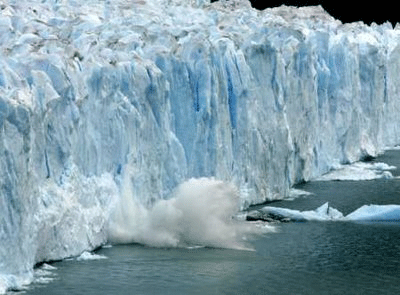 Global warming is melting the Greenland Ice Sheet, fast The Greenland Ice Sheet is losing 110 million Olympic size swimming pools worth of water each year, Guardian, John Abraham, 25 Aug 16 A new study measures the loss of ice from one of world’s largest ice sheets. They find an ice loss that has accelerated in the past few years, and their measurements confirm prior estimates.
As humans emit heat-trapping gases, we expect to see changes to the Earth. One obvious change to be on the lookout for is melting ice. This includes ice atop mountains, ice floating in cold ocean waters, and the ice within large ice sheets or glaciers. It is this last type of ice loss that most affects ocean levels because as the water runs into the oceans, it raises sea levels. This is in contrast to melting sea ice – since it is already floating in ocean waters, its potential to raise ocean levels is very small.
So measuring ice sheet melting is important, not only as a signal of global warming but also because of the sea level impacts. But how is this melting measured? The ice sheets on Greenland and Antarctica are huge and scientists need enough measurements in space and time to really understand what’s going on. That is, we need high-resolution and long duration measurements to fully understand trends.
In a very recent publication in the journal Geophysical Research Letters, an international team reported on a new high-resolution measurement of Greenland. The lead author, Malcolm McMillan from the Centre for Polar Observation and Modeling, and his colleagues mapped Greenland with incredibly high resolution (5 km distances).
They accomplished this mapping by obtaining data from the Cryosat 2satellite. This satellite uses a technique called radar altimetry to measure the height of surfaces. It is able to track the elevation of the ice sheets on Greenland with high precision. If the height of the ice sheet is growing, it means the ice is getting thicker. If the heights are decreasing, it means the ice layers are getting thinner.
A simplistic view would be that if ice sheets become taller, then they contain more frozen water. If they are shorter, they contain less water. But, this isn’t the entire story. Scientists also have to account for other changes, such as changes to density, surface roughness, and water content. When you realize that the Greenland Ice Sheet is thousands of meters thick, and the top layers include both snow and firn (which later get buried and compressed into ice), it becomes apparent that accounting for the constitution of the ice sheet is important when estimating how much water is being delivered to the ocean.
The authors of this study did such an accounting and they discovered that not only is Greenland losing a lot of ice, but the loss varies a lot depending on location and year. https://www.theguardian.com/environment/climate-consensus-97-per-cent/2016/aug/25/global-warming-is-melting-the-greenland-ice-sheet-fast
No comments yet.
1 This Month

of the week – Shut Down Drone Warfare!


Tell the Ukrainian Government to Drop Prosecution of Peace Activist Yurii Sheliazhenko

Petition to revoke the licensing of the Near Surface Nuclear Disposal Facility (NSDF) at Chalk River. https://www.ourcommons.ca/petitions/en/Petition/Details?Petition=e-7247
To see nuclear-related stories in greater depth and intensity – go to https://nuclearinformation.wordpress.com
-
Archives
- March 2026 (251)
- February 2026 (268)
- January 2026 (308)
- December 2025 (358)
- November 2025 (359)
- October 2025 (376)
- September 2025 (257)
- August 2025 (319)
- July 2025 (230)
- June 2025 (348)
- May 2025 (261)
- April 2025 (305)
-
Categories
- 1
- 1 NUCLEAR ISSUES
- business and costs
- climate change
- culture and arts
- ENERGY
- environment
- health
- history
- indigenous issues
- Legal
- marketing of nuclear
- media
- opposition to nuclear
- PERSONAL STORIES
- politics
- politics international
- Religion and ethics
- safety
- secrets,lies and civil liberties
- spinbuster
- technology
- Uranium
- wastes
- weapons and war
- Women
- 2 WORLD
- ACTION
- AFRICA
- Atrocities
- AUSTRALIA
- Christina's notes
- Christina's themes
- culture and arts
- Events
- Fuk 2022
- Fuk 2023
- Fukushima 2017
- Fukushima 2018
- fukushima 2019
- Fukushima 2020
- Fukushima 2021
- general
- global warming
- Humour (God we need it)
- Nuclear
- RARE EARTHS
- Reference
- resources – print
- Resources -audiovicual
- Weekly Newsletter
- World
- World Nuclear
- YouTube
-
RSS
Entries RSS
Comments RSS
 nuclear-news
Leave a comment