China seriously overestimating the global market for their nuclear reactors
Beijing is “seriously underestimating” how hard global sales will be, said Schneider. He said obstacles include strict quality controls, regulations that differ from country to country and competition from the falling cost of wind and solar.
“There is simply no market out there,” said Schneider.
Overseas, China’s nuclear companies face questions over their status as arms of the state
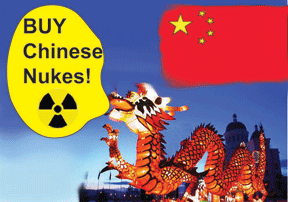 Here comes a new Chinese export: Nuclear reactors, CBS, 24 Aug 16 BEIJING – On a seaside field south of Shanghai, workers are constructing a nuclear reactor that’s the flagship for Beijing’s ambition to compete with the U.S., France and Russia as an exporter of atomic power technology.
The Hualong One, developed by two state-owned companies, is one multibillion-dollar facet of the Communist Party’s aspirations to transform China into a creator of profitable technology from mobile phones to genetics.
Still, experts say Beijing underestimates how tough it will be for its novice nuclear exporters to sell abroad. They face political hurdles, safety concerns and uncertain global demand following Japan’s Fukushima disaster.
China’s government-run nuclear industry is based on foreign technology but has spent two decades developing its own with help from Westinghouse Electric, France’s Areva and EDF, and other partners. A separate export initiative is based on an alliance between Westinghouse and a state-owned reactor developer.
The industry is growing fast, with 32 reactors in operation, 22 being built and more planned, according to the World Nuclear Association, an industry group. China accounted for eight of 10 reactors that started operation last year and six of eight construction starts.
Abroad, builders broke ground in Pakistan last year for a power plant using a Hualong One, supported by a $6.5 billion Chinese loan. Also last year, Argentina signed a contract to use the reactor in a $15 billion plant financed by Chinese banks.
Sales come with financing from state banks, a model that helped Chinese companies break into the market for building highways and other public works in Africa and the Middle East. State-owned companies also are lining up to invest in nuclear power plants in Britain and Romania.
“This is generating significant build-up of skills and industrial experience,” said Mycle Schneider, a nuclear energy consultant in Paris, in an email.
Still, Beijing is “seriously underestimating” how hard global sales will be, said Schneider. He said obstacles include strict quality controls, regulations that differ from country to country and competition from the falling cost of wind and solar.
“There is simply no market out there,” said Schneider.
At home, Beijing faces public unease about nuclear power following an avalanche of industrial accidents and product safety scandals.
This month, thousands of residents of Lianyungang, north of Shanghai, protested after rumors spread that a facility to process nuclear waste might be built there. Authorities said the city, home to one of China’s biggest nuclear power plants, was only one of several being considered. After more protests, they announced the search for a site was suspended.
Overseas, China’s nuclear companies face questions over their status as arms of the state………
China’s nuclear industry has yet to report a major accident but reflexive official secrecy makes it hard for outsiders to assess its safety.
Changes in Chinese-designed models based on foreign technology, such as making reactors bigger while using cooling techniques for smaller units, “raise questions about safety and the good judgment of Chinese reactor engineers,” said Edward Lyman, a nuclear power specialist for the Union of Concerned Scientists in Washington, in an email.
“It is crucial for countries importing Chinese nuclear technology to rigorously conduct their own oversight over the products they are buying,” Lyman said………http://www.cbsnews.com/news/here-comes-a-new-chinese-export-nuclear-reactors/
No comments yet.
1 This Month

of the week – Shut Down Drone Warfare!


Tell the Ukrainian Government to Drop Prosecution of Peace Activist Yurii Sheliazhenko

Petition to revoke the licensing of the Near Surface Nuclear Disposal Facility (NSDF) at Chalk River. https://www.ourcommons.ca/petitions/en/Petition/Details?Petition=e-7247
To see nuclear-related stories in greater depth and intensity – go to https://nuclearinformation.wordpress.com
-
Archives
- March 2026 (244)
- February 2026 (268)
- January 2026 (308)
- December 2025 (358)
- November 2025 (359)
- October 2025 (376)
- September 2025 (257)
- August 2025 (319)
- July 2025 (230)
- June 2025 (348)
- May 2025 (261)
- April 2025 (305)
-
Categories
- 1
- 1 NUCLEAR ISSUES
- business and costs
- climate change
- culture and arts
- ENERGY
- environment
- health
- history
- indigenous issues
- Legal
- marketing of nuclear
- media
- opposition to nuclear
- PERSONAL STORIES
- politics
- politics international
- Religion and ethics
- safety
- secrets,lies and civil liberties
- spinbuster
- technology
- Uranium
- wastes
- weapons and war
- Women
- 2 WORLD
- ACTION
- AFRICA
- Atrocities
- AUSTRALIA
- Christina's notes
- Christina's themes
- culture and arts
- Events
- Fuk 2022
- Fuk 2023
- Fukushima 2017
- Fukushima 2018
- fukushima 2019
- Fukushima 2020
- Fukushima 2021
- general
- global warming
- Humour (God we need it)
- Nuclear
- RARE EARTHS
- Reference
- resources – print
- Resources -audiovicual
- Weekly Newsletter
- World
- World Nuclear
- YouTube
-
RSS
Entries RSS
Comments RSS
 nuclear-news
Leave a comment