Nuclear reactors, old or new designs, doomed without hefty tax-payer subsidies
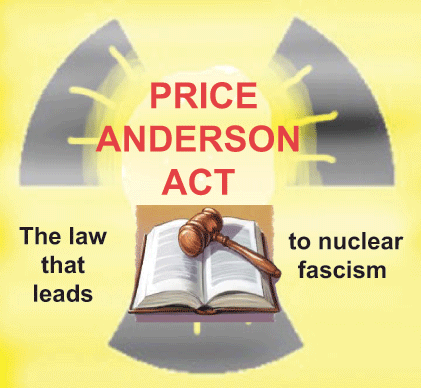 under the 1957 Price-Anderson Act, each plant owner’s accident liability is limited to some $300 million per year, even though the Fukushima disaster showed that nuclear accident costs can exceed $100 billion. If private companies that own U.S. nuclear power plants had been responsible for accident liability, they would not have built reactors. The same is almost certainly true of responsibility for spent fuel disposal.
 free or low-carbon-emitting –What they discovered is that each nuclear power plant releases huge amounts of Radioactive Carbon14 which converts to CO2 in the atmosphere.
 Bradford, The Conversation, August 18, 2016 “…….The nuclear industry, led by the forlornly named lobbying group Nuclear Matters, still obtains large subsidies for new reactor designs that cannot possibly
compete at today’s prices. But its main function now is to save operating reactors from closure brought on by their own rising costs, by the absence of a U.S. policy on greenhouse gas emissions and by competition from less expensive natural gas, carbon-free renewables and more efficient energy use.
Only billions more dollars in subsidies and the retarding of rapid deployment of cheaper technologies can save these reactors. Only fresh claims of unique social benefit can justify such steps……..
Now a majority of U.S. power generation is sold in competitive markets. Companies profit by producing the cheapest electricity or providing services that avoid the need for electricity.
To justify their current subsidy demands, nuclear advocates assert three propositions. First, they contend that power markets undervalue nuclear plants because they do not compensate reactors for avoiding carbon emissions, or for other attributes such as diversifying the fuel supply or running more than 90 percent of the time.
Second, they assert that other low-carbon sources cannot fill the gapbecause the wind doesn’t always blow and the sun doesn’t always shine. So power grids will use fossil-fired generators for more hours if nuclear plants close.
Finally, nuclear power supporters argue that these intermittent sources receive substantial subsidies while nuclear energy does not, thereby enabling renewables to underbid nuclear even if their costs are higher.
Nuclear power producers want government-mandated long-term contracts or other mechanisms that require customers to buy power from their troubled units at prices far higher than they would pay otherwise.
Providing such open-ended support will negate several major energy trends that currently benefit customers and the environment. First, power markets have been working reliably and effectively. A large variety of cheaper, more efficient technologies for producing and saving energy, as well as managing the grid more cheaply and cleanly, have been developed. Energy storage, which can enhance the round-the-clock capability of some renewables is progressing faster than had been expected, and is now being bid into several power markets – notably the market serving Pennsylvania, New Jersey and Maryland.
Long-term subsidies for uneconomic nuclear plants also will crowd out penetration of these markets by energy efficiency and renewables. This is the path New York state has taken by committing at least $7.6 billion in above-market payments to three of its six plants to assure that they operate through 2029.
Nuclear power vs. other carbon-free fuels
While power markets do indeed undervalue low-carbon fuels, all of the other premises underlying the nuclear industry approach are flawed. In California and in Nebraska, utilities plan to replace nuclear plants that are closing early for economic reasons almost entirely with electricity from carbon-free sources. Such transitions are achievable in most systems as long as the shutdowns are planned in advance to be carbon-free.
In California these replacement resources, which include renewables, storage, transmission enhancements and energy efficiency measures, will for the most part be procured through competitive processes. Indeed, any state where a utility threatens to close a plant can run an auction to ascertain whether there are sufficient low-carbon resources available to replace the unit within a particular time frame. Only then will regulators know whether, how much and for how long they should support the nuclear units.
If New York had taken this approach, each of the struggling nuclear units could have bid to provide power in such an auction. They might well have succeeded for the immediate future, but some or all would probably not have won after that.
Closing the noncompetitive plants would be a clear benefit to the New York economy. This is why a large coalition of big customers, alternative energy providers and environmental groups opposed the long-term subsidy plan.
The industry’s final argument – that renewables are subsidized and nuclear is not – ignores overwhelming history. All carbon-free energy sources together have not received remotely as much government support as has flowed to nuclear power.
Nuclear energy’s essential components – reactors and enriched uranium fuel – were developed at taxpayer expense. Private utilities were paid to build nuclear reactors in the 1950s and early ‘60’s, and received subsidized fuel. According to a study by the Union of Concerned Scientists, total subsidies paid and offered to nuclear plants between 1960 and 2024 generally exceed the value of the power that they produced.
The U.S. government has also pledged to dispose of nuclear power’s most hazardous wastes – a promise that has never been made to any other industry. By 2020 taxpayers will have paid some $21 billion to store those wastes at power plant sites.
Furthermore, under the 1957 Price-Anderson Act, each plant owner’s accident liability is limited to some $300 million per year, even though the Fukushima disaster showed that nuclear accident costs can exceed $100 billion. If private companies that own U.S. nuclear power plants had been responsible for accident liability, they would not have built reactors. The same is almost certainly true of responsibility for spent fuel disposal.
Finally, as part of the transition to competition in the 1990s, state governments were persuaded to make customers pay off some $70 billion in excessive nuclear costs. Today the same nuclear power providers are asking to be rescued from the same market forces for a second time…….https://theconversation.com/compete-or-suckle-should-troubled-nuclear-reactors-be-subsidized-62069
Dr. John Gofman, Premier scientist, predicted thousands of cancer deaths per year due to nuclear energy, and studies have already shown higher incidences of childhood leukemia and breast cancer in populations living around nuclear power plants.
Nuclear power plants also use massive amounts of precious water. Only 2% of all of the water on Earth is usable, and nuclear energy is eating up that water as each nuclear power plant can use up to 30 MILLION gallons of water per HOUR.
Finally, there is NO solution for the nuclear waste, and the cost to store it for up to 250,000 years is INFINITE.
Nuclear waste is the largest form of long-term debt any country with nuclear energy will ever have.
All of the above show why nuclear energy is NOT clean, NOT carbon-free, and NOT a smart choice.
I recommend anyone interested in learning more about nuclear energy scroll through the headlines at ENENEWS. https://theconversation.com/compete-or-suckle-should-troubled-nuclear-reactors-be-subsidized-62069
No comments yet.
1 This Month


Tell the Ukrainian Government to Drop Prosecution of Peace Activist Yurii Sheliazhenko

Petition to revoke the licensing of the Near Surface Nuclear Disposal Facility (NSDF) at Chalk River. https://www.ourcommons.ca/petitions/en/Petition/Details?Petition=e-7247


of the week – STOP SMALL MODULAR REACTORS IN CANADA
To see nuclear-related stories in greater depth and intensity – go to https://nuclearinformation.wordpress.com
-
Archives
- March 2026 (212)
- February 2026 (268)
- January 2026 (308)
- December 2025 (358)
- November 2025 (359)
- October 2025 (376)
- September 2025 (258)
- August 2025 (319)
- July 2025 (230)
- June 2025 (348)
- May 2025 (261)
- April 2025 (305)
-
Categories
- 1
- 1 NUCLEAR ISSUES
- business and costs
- climate change
- culture and arts
- ENERGY
- environment
- health
- history
- indigenous issues
- Legal
- marketing of nuclear
- media
- opposition to nuclear
- PERSONAL STORIES
- politics
- politics international
- Religion and ethics
- safety
- secrets,lies and civil liberties
- spinbuster
- technology
- Uranium
- wastes
- weapons and war
- Women
- 2 WORLD
- ACTION
- AFRICA
- Atrocities
- AUSTRALIA
- Christina's notes
- Christina's themes
- culture and arts
- Events
- Fuk 2022
- Fuk 2023
- Fukushima 2017
- Fukushima 2018
- fukushima 2019
- Fukushima 2020
- Fukushima 2021
- general
- global warming
- Humour (God we need it)
- Nuclear
- RARE EARTHS
- Reference
- resources – print
- Resources -audiovicual
- Weekly Newsletter
- World
- World Nuclear
- YouTube
-
RSS
Entries RSS
Comments RSS
 nuclear-news
Leave a comment