Get used to extreme floods: climate change is becoming urgent
 Extreme Floods May Be the New Normal Communities should plan defenses and emergency responses based on the climate of the future, not the past, Scientific American By Erika Bolstad, ClimateWire on August 18, 2016
Over the past year alone, catastrophic rain events characterized as once-in-500-year or even once-in-1,000-year events have flooded West Virginia, Texas, Oklahoma, South Carolina and now Louisiana, sweeping in billions of dollars of property damage and deaths along with the high waters.
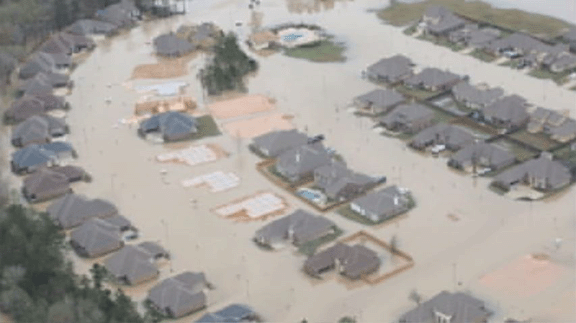
These extreme weather events are forcing many communities to confront what could signal a new climate change normal. Now many are asking themselves: Are they doing enough to plan for and to adapt to large rain events that climate scientists predict will become more frequent and more intense as global temperatures continue to rise?
The answer in many communities is no, it’s not enough.
They could be doing much, much more to adapt—not just people and how they respond to climate change, but homes, buildings, roads, and levees and other infrastructure, said Gavin Smith, director of the Department of Homeland Security’s Coastal Resilience Center of Excellence and a research professor at the University of North Carolina’s Department of City and Regional Planning.
One of the first shifts that must happen, many experts in hazard mitigation say, is to stop using the climate of the past to plan for the future.
“One of the great challenges is to recognize that a lot of communities, a lot of cities, a lot of human settlements in general were designed to reflect the climate of the past,” said Smith, who also served as the director of the Mississippi Office of Recovery and Renewal after Hurricane Katrina.
“These issues, they are happening and they’re going to become worse, and the changes are occurring within a context where we’ve designed cities to reflect a previous climate,” he said…….
What climate scientists do know is that the intensity of extreme precipitation events is on the rise. With rising global temperatures, the 2014 National Climate Assessment predicts that many communities will see such extreme precipitation events more frequently.
More frequent events could defy traditional methods of planning for floods, like using 100- and 500-year floodplain maps to plan communities and develop flood insurance rates and who has to have it. It could also radically shift how engineers and architects design buildings. Coupled with sea-level rise in some places, such rain events could also affect how emergency response teams issue storm warnings or prepare people for weather events…….
Climate change could expose vast swaths of U.S. infrastructure to additional natural hazards that are likely to intensify as sea levels rise, temperatures increase and precipitation patterns shift, the report found. Power transmission lines, ports, refineries and wastewater treatment facilities across the country are vulnerable to climate change……http://www.scientificamerican.com/article/extreme-floods-may-be-the-new-normal/
No comments yet.
1 This Month


Tell the Ukrainian Government to Drop Prosecution of Peace Activist Yurii Sheliazhenko

Petition to revoke the licensing of the Near Surface Nuclear Disposal Facility (NSDF) at Chalk River. https://www.ourcommons.ca/petitions/en/Petition/Details?Petition=e-7247


of the week – STOP SMALL MODULAR REACTORS IN CANADA
To see nuclear-related stories in greater depth and intensity – go to https://nuclearinformation.wordpress.com
-
Archives
- March 2026 (212)
- February 2026 (268)
- January 2026 (308)
- December 2025 (358)
- November 2025 (359)
- October 2025 (376)
- September 2025 (258)
- August 2025 (319)
- July 2025 (230)
- June 2025 (348)
- May 2025 (261)
- April 2025 (305)
-
Categories
- 1
- 1 NUCLEAR ISSUES
- business and costs
- climate change
- culture and arts
- ENERGY
- environment
- health
- history
- indigenous issues
- Legal
- marketing of nuclear
- media
- opposition to nuclear
- PERSONAL STORIES
- politics
- politics international
- Religion and ethics
- safety
- secrets,lies and civil liberties
- spinbuster
- technology
- Uranium
- wastes
- weapons and war
- Women
- 2 WORLD
- ACTION
- AFRICA
- Atrocities
- AUSTRALIA
- Christina's notes
- Christina's themes
- culture and arts
- Events
- Fuk 2022
- Fuk 2023
- Fukushima 2017
- Fukushima 2018
- fukushima 2019
- Fukushima 2020
- Fukushima 2021
- general
- global warming
- Humour (God we need it)
- Nuclear
- RARE EARTHS
- Reference
- resources – print
- Resources -audiovicual
- Weekly Newsletter
- World
- World Nuclear
- YouTube
-
RSS
Entries RSS
Comments RSS
 nuclear-news
Leave a comment