 And for 2020 Olympic Games, what about the nuclear radiation risk, too – close to Fukushima’s continuing disaster?
Climate change puts heat on future Games venues http://www.nzherald.co.nz/climate-change/news/article.cfm?c_id=26&objectid=11692866 Ben Hill 13 Aug 16 Climate change is set to make it too hot to host the Olympics in the world’s biggest cities, according to a university study.
University of Auckland collaborative research found about 90 per cent of the Northern Hemisphere’s most populous cities will become too hot and humid over the next 70 years to safely hold the Games.
Professor Alistair Woodward said the study focused on whether cities in the Northern Hemisphere would be able to stage the marathon without posing a significant risk to athletes.
“Only three cities in North America, two in Asia and none in Africa will fall in the low risk category,” he said.“Projections suggest the last cities with low-risk summer conditions will be Belfast, Dublin, Edinburgh and Glasgow.
“Increasing restrictions on when, where, and how the Games can be held owing to extreme heat are a sign of a much bigger problem,” Woodward said.
“If the world’s most elite athletes need to be protected from climate change, what about the rest of us?”
The study has been published in British medical journal the Lancet.
August 13, 2016
Posted by Christina Macpherson |
2 WORLD, climate change |
Leave a comment
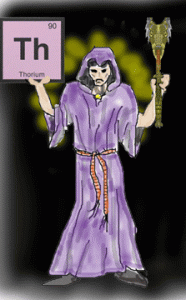 Thorium: new and improved nuclear energy? https://www.wiseinternational.org/nuclear-energy/thorium-new-and-improved-nuclear-energy
There is quite some – sometimes tiresome – rhetoric of thorium enthusiasts. Let’s call them thor-bores. Their arguments have little merit but they refuse to go away.
Here are some facts:
- There is no “thorium reactor.” There is a proposal to use thorium as a fuel in various reactor designs including light-water reactors–as well as fast breeder reactors.
- You still need uranium – or even plutonium – in a reactor using thorium. Thorium is not a fissile material and cannot either start or sustain a chain reaction. Therefore, a reactor using thorium would also need either enriched uranium or plutonium to initiate the chain reaction and sustain it until enough of the thorium has converted to fissile uranium (U-233) to sustain it.
- Using plutonium sets up proliferation risks. To make a “thorium reactor” work, one must (a) mix the thorium with plutonium that has been stripped of the highly radioactive fission products; (b) use the mixed-oxide thorium-plutonium fuel in a reactor, whereby the plutonium atoms fission and produce power while the thorium atoms absorb neutrons and are turned into uranium-233 (a man-made isotope of uranium that has never existed in nature); (c) strip the fission products from the uranium-233 and mix THAT with thorium in order to continue the “cycle”. In this phase, the U-233 atoms fission and produce power while the thorium atoms absorb neutrons and generate MORE uranium-233. And so the cycle continues, generating more and more fission product wastes.
- Uranium-233 is also excellent weapons-grade material. Unlike any other type of uranium fuel, uranium-233 is 100 percent enriched from the outset and thus is an excellent weapons-grade material and as effective as plutonium-239 for making nuclear bombs. This makes it very proliferation-prone and a tempting target for theft by criminal and terrorist organizations and for use by national governments in creating nuclear weapons.
- Proliferation risks are not negated by thorium mixed with U-238. It has been claimed that thorium fuel cycles with reprocessing would be much less of a proliferation risk because the thorium can be mixed with uranium-238. In fact, fissile uranium-233 must first be mixed with non-fissile uranium-238. If the U-238 content is high enough, it is claimed that the mixture cannot be used to make bombs with out uranium enrichment. However, while more U-238 does dilute the U-233, it also results in the production of more plutonium-239, so the proliferation problem remains.
- Thorium would trigger a resumption of reprocessing in the US. In most proposed thorium fuel cycles, reprocessing is required to separate out the U-233 for use in fresh fuel. Reprocessing chemically separates plutonium and uranium and creates a large amount of so-called low-level but still highly radioactive liquid, gaseous and solid wastes.
- Using thorium does not eliminate the problem of long-lived radioactive waste. Fission of thorium creates long-lived fission products including technetium-99 (half-life of over 200,000 years). Without reprocessing, thorium-232 is itself extremely long-lived (half-life of 14 billion years) and its decay products will build up over time in irradiated fuel. Therefore, in addition to all the fission products produced, the irradiated fuel is also quite radiotoxic. Wastes that pose long-term hazards are also produced at the “front end” of the thorium fuel cycle during mining, just as with the uranium fuel cycle.
- Attempts to develop “thorium reactors” have failed for decades. No commercial “thoriumreactor” exists anywhere in the world. India has been attempting, without success, to develop a thorium breeder fuel cycle for decades. Other countries including the US and Russia have researched the development of thorium fuel for more than half a century without overcoming technical complications.
- Fabricating “thorium fuel” is dangerous to health. The process involves the production of U-232 which is extremely radioactive and very dangerous in small quantities. The inhalation of a unit of radioactivity of thorium-232 or thorium-228 produces a far higher dose than the inhalation of uranium containing the same amount of radioactivity. A single particle in the lung would exceed legal radiation standards for the general public.
- Fabricating “thorium fuel” is expensive. The thorium fuel cycle would be more expensive than the uranium fuel cycle. Using a traditional light-water (once-through) reactor, thorium fuel would need both uranium enrichment (or plutonium separation) and thorium target rod production. Using a breeder reactor makes costly reprocessing necessary.
The bottom line is this.Thorium reactors still produce high-level radioactive waste. They still pose problems and opportunities for the proliferation of nuclear weapons. They still present opportunities for catastrophic accident scenarios–as potential targets of terrorist or military attack, for example. Proponents of thorium reactors argue that all of these risks are somewhat reduced in comparison with the conventional plutonium breeder concept. Whether this is true or not, the fundamental problems associated with nuclear power have by no means been eliminated.
August 13, 2016
Posted by Christina Macpherson |
Reference, technology, thorium |
Leave a comment
WHAT LEGACY DO WE WANT FOR SOUTH AFRICA? http://safcei.org/what-legacy-do-we-want-for-south-africa/
On 6 July they announced that they would withdraw their current uranium mining application and reapply for a much smaller area – in essence only 12% of the original application – and start the process at the beginning again. This we celebrated as an important step towards stopping uranium mining in its tracks, as well as nuclear down the line.
For, as Dr Stefan Cramer, who was instrumental in lifting the veil of silence on this new threat to the Karoo, points out, uranium mining is the dirty underbelly of the nuclear industry and where it all begins.
One must stop nuclear industries in (their) tracks because it leaves future generations with an immeasurable task and legacy. The best point to start is at the source, where the whole cycle of nuclear technology begins, and that is at uranium mining. Uranium mining is very much the dirtiest part of the entire industry,” he says.
Kim Kruyshaar writes on Green Audits that choosing between renewable energy and nuclear is about much more than just an energy option. Instead it is “a choice between two divergent socio-economic opportunities and the consequent legacies.” This rings even more true when one looks at the building blocks of nuclear energy.
Uranium mining will leave us with our iconic Karoo damaged for centuries to come and many people without a future or income as the jobs gained through uranium mining would in no way compensate for those lost in the agricultural, tourism and renewable industry businesses.
Mining will also deplete the already scarce water reserves of the Karoo and present serious health problems to all living beings there, as the radioactive dust can be carried for kilometres by winds.
Renewable energy in contrast presents us with a far brighter future that, very importantly, doesn’t contain a radioactive legacy. Far more jobs are created in the renewable energy industry than the nuclear industry ever can.
The speed in which renewable energy projects can be installed and the lower investment costs also make it highly attractive to a country like South Africa, where many people need access to energy now, not in 15 years time when a nuclear reactor would only come online.
Decentralising the power from Eskom and putting it into the hands of individuals and local companies would also only serve to empower South Africans and the economy. Nuclear energy would instead indebt us and future generations to a foreign company and leave us with the further enormous cost of decommissioning.
So it’s not simply a choice between two energy options, as Kim sums it up, it is a choice about what path we would like to take South Africa down.
What is needed to stop uranium mining and nuclear for good?
August 13, 2016
Posted by Christina Macpherson |
environment, politics, South Africa |
Leave a comment
 Phelim Mac Cafferty: Nuclear is a dirty expensive relic, Brighton and Hove Independent by Phélim Mac Cafferty on August 12, 2016 I was relieved to hear the government delay its final decision on the Hinkley Point C new nuclear power plant. Nuclear power is a dirty, expensive relic from a bygone era. Construction costs are estimated by EDF energy at £18.5 billion, while the National Audit Office (NAO) estimates that the taxpayer could face up to £30bn in costs from top up payments. Costs for the whole project will be far higher, particularly when ‘disposal’ of radioactive waste is factored in. It seems it is one rule for councils to ‘tighten their belts’ but quite another for nuclear power or Trident……..
Nuclear isn’t a clean energy as many of its backers claim. Mining uranium results in waste rock which is toxic for hundreds of thousands of years. Pollution from radioactive toxic waste hangs around for millenia. Waste is also created as a by-product of generating nuclear power itself. The Irish Sea is the most radioactively contaminated sea in the world with millions of litres of nuclear waste discharged into it daily from Sellafield. The fact that massive subsidies continue to be needed for the nuclear energy industry after over 60 years is testament to the rip off that is nuclear power. All this while the government continues to cut subsidies for renewables, particularly solar, arguing the industry must stand on its own two feet. 20,000 jobs have been shed in the fledgling industry as a result.
What is environmentally reprehensible is also economically illiterate. In Brighton and Hove, we have a considerable number of small and medium-sized energy, engineering and construction firms that would all benefit from a government investment programme in renewable energy. A major boost to our local economy and thousands of new jobs, it would simultaneously help us to cut carbon emissions and tackle climate change. This week scientists warned us we will miss global climate change targets so we have no choice but to abandon dated energy that threatens to make us the first species on the planet to consciously make itself extinct. The pressure continues to ensure the Conservative government abandon the white elephant that is Hinkley and provide energy for the 21st century by 21st century means. Councillor Phélim Mac Cafferty is convenor of the Green Group on Brighton and Hove City Council.
http://brightonandhoveindependent.co.uk/phelim-mac-cafferty-nuclear-dirty-expensive-relic/
August 13, 2016
Posted by Christina Macpherson |
general |
Leave a comment
Bulgaria to revive Belene nuclear power project with private help http://www.reuters.com/article/us-bulgaria-nuclear-idUSKCN10N154 Bulgaria wants private investors to help it restart the Belene nuclear power project after a court ruled Sofia must pay hefty compensation to Russia over equipment ordered for it, Prime Minister Boiko Borisov said on Friday.
The Balkan country had canceled the 2,000 megawatt project on the Danube River in 2012 due to financial constraints and after pressure from Brussels and Washington, who said it would only increase Bulgaria’s dependence on Russian energy imports.
An international arbitration court ruled in June that Sofia should pay more than 550 million euros ($623 million) in compensation to Russian nuclear giant Rosatom over the two nuclear reactors ordered.
“We have a very changed situation,” Borisov told local media. “We are obliged to pay for these two reactors.”
Borisov, however, said that the Black Sea state still does not have enough financial resources to build the nuclear plant.”Let us make it a private project through the privatization agency with various options for the state’s share. This is the solution,” he said.
Bulgaria had been hoping to sell the equipment or the whole project to Iran and Borisov visited Tehran in July to test the ground for a possible deal, for which the consent of Rosatom was also needed. (Reporting by Tsvetelia Tsolova and Angel Krasimirov)
August 13, 2016
Posted by Christina Macpherson |
Bulgaria, business and costs, politics |
1 Comment






 nuclear-news