Opposition to Obama’s goal of a ‘No First Use’ Nuclear Policy
 ‘No First Use’ Nuclear Policy Proposal Assailed by U.S. Cabinet
  Officials, Allies
Obama’s disarmament agenda hits significant roadblock on opposition from Kerry, Carter and Moniz, WSJ, By PAUL SONNE, GORDON LUBOLD and CAROL E. LEE Aug. 12, 2016 WASHINGTON—A proposal under consideration at the White House to reverse decades of U.S. nuclear policy by declaring a “No First Use” protocol for nuclear weapons has run into opposition from top cabinet officials and U.S. allies.
The opposition, from Secretary of State John Kerry, Secretary of Defense Ash Carter and Secretary of Energy Ernest Moniz, as well as allies in Europe and Asia, leaves President Barack Obama with few ambitious options to enhance his nuclear disarmament agenda before leaving office, unless he wants to override the dissent.
The possibility of a “No First Use” declaration—which would see the U.S. explicitly rule out a first strike with a nuclear weapon in any conflict—met resistance at a National Security Council meeting in July, where the Obama administration reviewed possible nuclear disarmament initiatives it could roll out before the end of the president’s term…….
Mr. Obama ultimately didn’t issue a decision on the “No First Use” proposal at the National Security Council meeting, but people familiar with the White House deliberations say opposition from the critical cabinet members and U.S. allies reduces the likelihood of the change. They say a decision by Mr. Obama to press ahead with the declaration appears unlikely in his remaining months, given the controversy it would stir in the midst of a presidential election, but it isn’t impossible.
Other possible initiatives the administration has discussed also have met opposition, including calls to roll back a planned modernization of U.S. nuclear forces and proposals to reduce the U.S.’s deployed nuclear weapons without a reciprocal pledge from Russia……
The pushback on “No First Use” and other proposals shows the difficulty Mr. Obama has encountered in trying to advance a nuclear disarmament agenda that he first articulated less than three months after taking office.
 During a 2009 speech in Prague, Mr. Obama promised the U.S. would put an end to Cold War thinking and “take concrete steps toward a world without nuclear weapons,” staking his legacy on an effort that months later would garner him the Nobel Peace Prize.
The following year, Mr. Obama signed the New Strategic Arms Reduction Treaty, or New START, with then Russian PresidentDmitry Medvedev, holding the signing in Prague to show progress on the disarmament agenda. The treaty re-established lapsed oversight and limited the number of deployed strategic nuclear warheads for each country to 1,550.
But to secure ratification of the treaty in the U.S. Senate, Mr. Obama agreed to a multidecade modernization of the U.S. nuclear force, prompting dismay among antinuclear advocates. The vast overhaul includes the development of a new nuclear cruise missile, a new intercontinental ballistic-missile system and other measures the U.S. military says are necessary to keep its nuclear capabilities up-to-date……..http://www.wsj.com/articles/no-first-use-nuclear-policyproposal-assailed-by-u-s-cabinet-officials-allies-1471042014
Drone crash into Koeberg Nuclear Power Station
 DRONE CRASHES INTO KOEBERG NUCLEAR POWER STATION http://www.htxt.co.za/2016/08/10/drone-crashes-nuclear-power-station/ An small unmanned aerial vehicle (UAV) – commonly known as drones – has crashed into the nuclear power station at Koeberg near Cape Town.
While it appears that no damage was done, South Africa’s drone regulations are clear: you are not allowed to fly drones over roads and you keep them at least 50 meters away from buildings.
According to Eskom, the drone not only flew towards and over Koeberg, but crashed into a building on site. Surprisingly, Eskom says that the drone pilot had his UAV returned to him after the incident.
“A drone crashed on the Koeberg site in contravention of the nuclear safety regulations and was returned to its owner without the investigation having been completed,” the parastatal said in a statement.
Eskom says that it has subsequently suspended the Koeberg safety officer as a precautionary measure ahead of an investigation. It also highlighted the dangers of flying drones close to government installations.
“Eskom has placed the Koeberg power station manager and the plant manager on precautionary suspension as a result of the distribution of documentation containing unauthorised facts and assumptions relating to Koeberg’s Production Plan and in particular, the steam generator replacement,” it said.
Eskom is this week facing strike action by 15 000 National Union of Mineworkers (NUM) members. In essence, it is illegal for any Eskom employees to strike, and NUM is protesting this.
“The decision to strike was taken at an urgent NUM Eskom national shop stewards council held at the NUM head office today. All 15 000 members of the NUM at Eskom will be fighting for the restoration of the right to strike at Eskom,” NUM said in a statement.
USA needs to face up to the nightmare of high burn-up, and indeed, of all, nuclear wastes

Spent nuclear power fuel accumulated over the past 50 years is bound up in more than 241,000 long rectangular assemblies containing tens of millions of fuel rods. The rods, in turn, contain trillions of small, irradiated uranium pellets. After bombardment with neutrons in the reactor core, about 5 to 6 percent of the pellets are converted to amyriad of radioactive elements with half-lives ranging from seconds to millions of years. Standing within a meter of a typical spent nuclear fuel assembly guarantees a lethal radiation dose in minutes.
Heat from the radioactive decay in spent nuclear fuel is also a principal safety concern. Several hours after a full reactor core is offloaded, it can initially give off enough heat from radioactive decay to match the energy capacity of a steel mill furnace. This is hot enough to melt and ignite the fuel’s reactive zirconium cladding and destabilize a geological disposal site it is placed in. By 100 years, decay heat and radioactivity drop substantially but still remain dangerous. For these reasons, the US Government Accountability Office (GAO) informed the Congress in 2013 that spent nuclear fuel is “considered one of the most hazardous substances on Earth.”
US commercial nuclear power plants use uranium fuel that has had the percentage of its key fissionable isotope—uranium 235—increased, or enriched, from what is found in most natural uranium ore deposits. In the early decades of commercial operation, the level of enrichment allowed US nuclear power plants to operate for approximately 12 months between refueling. In recent years, however, US utilities have begun using what is called high-burnup fuel. This fuel generally contains a higher percentage of uranium 235, allowing reactor operators to effectively double the amount of time the fuel can be used, reducing the frequency of costly refueling outages. The switch to high-burnup fuel has been a major contributor to higher capacity factors and lower operating costs in the United States over the past couple of decades.
While this high-burnup trend may have improved the economics of nuclear power, the industry and its regulator, the Nuclear Regulatory Commission (NRC), have taken a questionable leap of faith that could, according to the Electric Power Research Institute, “result in severe economic penalties and in operational limitations to nuclear plant operators.” Evidence is mounting that spent high-burnup fuel poses little-studied challenges to the temporary used-fuel storage plans now in place and to any eventual arrangement for a long-term storage repository.
High burnup significantly boosts the radioactivity in spent fuel and its commensurate decay heat. Of particular concern is the effect of high-burnup fuel on the cladding that contains it in the fuel assemblies used in commercial reactors. Research shows that under high-burnup conditions, that cladding may not be relied upon as the primary barrier to prevent the escape of radioactivity, especially during prolonged storage in the “dry casks” that are the preferred method of temporary storage for spent fuel. Resolution of these problems remains elusive.
For instance, research shows that in regard to high-burnup waste the fuel cladding thickness of used fuel is reduced and a hydrogen-based rust forms on the zirconium metal used for the cladding, and this thinning can cause the cladding to become brittle and fail. In addition, under high-burnup conditions, increased pressure between the uranium fuel pellets in a fuel assembly and the inner wall of the cladding that encloses them causes the cladding to thin and elongate. And the same research has shown that high burnup fuel temperatures make the used fuel more vulnerable to damage from handling and transport; cladding can fail when used fuel assemblies are removed from cooling pools, when they are vacuum dried, and when they are placed in storage canisters.
The NRC and the nuclear industry do not have the necessary information to predict when storage of high-burnup fuel may cause problems. To err on the side of caution, high-burnup fuel might have to be left in cooling pools for 25 years—as opposed to the current three to five years for lower burnup spent fuel— to allow cladding temperatures to drop enough to reduce risks of cladding failure before the fuel is transferred to dry storage. Also, the cooling pools at US commercial reactors are rapidly filling, with more than 70 percent of the nation’s 77,000 metric tons of spent fuel in reactor pools, of which roughly a fourth is high burnup. So far, a small percentage of high-burnup used fuel assemblies are sprinkled amid lower burnup fuel in dry casks at reactor sites. But by 2048—the Energy Department’s date for opening a permanent geologic disposal site—the amount of spent fuel could double, with high burnup waste accounting for as much as 60 percent of the inventory.
What’s next? In 2014, the NRC adopted a “continued storage” rule that recognized the strong likelihood of long-term surface storage of used nuclear fuel—but that rule basically ignored high-burnup spent fuel. Under the rule, the agency currently permits dry storage casks to accommodate a uniform loading of spent fuel below a certain level of use in reactors. The average burnup for the US reactor fleet is measured by the amount of energy produced, expressed in gigawatt days per metric ton of uranium; at present, used fuel assemblies are allowed to go up to 62,000 gigawatt days per metric ton.
Accordingly, a few high burnup assemblies, with higher decay heat, may be mixed with lower burnup assemblies in a storage canister. But there is little guidance on how this can be done without exceeding NRC peak temperature requirements. NRC’s current regulatory guidance concedes that “data is not currently available” supporting the safe transportation of high burn spent nuclear fuel. Owners of the shuttered Maine Yankee and Zion reactors are not taking a chance and have packaged high burnup spent fuel as it were damaged goods, stored in double-shell containers instead of single-shell, to allow for safer transport.
The impacts of decay heat from high-burnup spent fuel on the internal environment of commercial dry casks are virtually impossible to monitor, according to a 2014 NRC-sponsored study, “because of high temperatures, radiation, and accessibility difficulty.” The uncertainties of storing a mix of high- and low-burnup spent fuel in a canister are compounded by the lack of data on the long-term behavior of high-burnup spent fuel. This problem was highlighted by the Nuclear Waste Technical Review Board, an expert panel that provides scientific oversight for the Energy Department on spent fuel disposal. That panel said there is little to no data to support dry storage and transport for spent fuel with burnups greater than 35 gigawatt days per metric ton of uranium. In a May 2016 letter to the Energy Department, the board raised elemental questions that should have been answered before the NRC and reactor operators took this leap of faith: “What could go wrong? How likely is it? What are the consequences?” The board provided no answers to those questions.
It will take the Energy Department at least a decade to complete a study involving temperature monitoring in a specially designed dry cask containing high burnup fuel. Meanwhile, as high-burnup inventories increase, the higher amounts of radioactivity and decay heat associated with high-burnup fuel assemblies are putting additional stress on cooling pool storage systems.
This is happening at a time when concerns over spent fuel pool storage conditions are increasing. “As nuclear plants age, degradations of spent fuel pools … are occurring at an increasing rate,” a study by Oak Ridge National Laboratory concluded in 2011. “During the last decade, a number of NPPs [nuclear power plants] have experienced water leakage from the SFPs [spent fuel pools] and reactor refueling cavities.” As a result of increasing high burnup loadings, spent nuclear pool storage systems are likely to require upgrading, which will certainly drive up costs at a time when age and deterioration are of growing concern.
These concerns were given greater prominence in May of this year by a National Academy of Sciences panel established by Congress to review the response of the NRC to the Fukushima nuclear accident. In its report, the panel warned the NRC about terrorist attacks for the second time since 2004 and urged the agency to “ensure that power plant operators take prompt and effective measures to reduce the consequences of loss-of-pool-coolant events in spent fuel pools that could result in propagating zirconium cladding fires.” Allison Macfarlane, then chair of the U.S. Nuclear Regulatory Commission (NRC), noted in April, 2014 that “land interdiction [from a spent nuclear fuel pool fire at the Peach Bottom Reactor in Pennsylvania] is estimated to be 9,400 square miles with a long term displacement of 4,000,000 persons.”
Down the road, it is likely that spent nuclear fuel will have to be repackaged to mitigate decay heat into smaller containers ahead of final disposal. High-burnup fuel will only complicate the process, and increase costs, currently estimated in the tens of billions of dollars. Depending on the geologic medium, a maximum of four assemblies for high burnup, as opposed to the dozens in current storage casks, would be permitted after 100 years of decay; larger packages containing no more than 21 assemblies might have to be disposed if there is forced ventilation for 50 to 250 years—driving up repository costs.
The basic approach undertaken in this country for the storage and disposal of spent nuclear fuel needs to be fundamentally revamped. Instead of waiting for problems to arise, the NRC and the Energy Department need to develop a transparent and comprehensive road map identifying the key elements of—and especially the unknowns associated with—interim storage, transportation, repackaging, and final disposal of all nuclear fuel, including the high-burnup variety. Otherwise, the United States will remain dependent on leaps of faith in regard to nuclear waste storage—leaps that are setting the stage for large, unfunded radioactive waste “balloon mortgage” payments in the future.
USA sends three strategic bombers to Pacific region, in unspoken threat to China
US Nuclear-Bomber Triad in Pacific for First Time as China Reaches Boiling Point http://sputniknews.com/military/20160812/1044182905/nuclear-bomber-triad-china-pyongyang.html With tensions in the South China Sea and throughout the Pacific Rim at increasing levels, the Obama Administration adds fuel to the fire by dispatching enough nuclear weaponry to kill everyone in the region.
The United States has dispatched its three strategic bomber types to the Pacific region for the first time, in a bid to reassure allies amid growing aggression from China in the wake of the Hague-based Court of Arbitration ruling against Beijing’s claim to territories in the South China Sea, and the deployment of the THAAD anti-missile system.
Announced Wednesday, the US Air Force will dispatch a Boeing B-52H Stratofortress, a Rockwell B-1B Lancer, and a Northrup Grumman B-2A Spirit bomber to operate concurrently in the US Pacific Command region in support of the Continuous Bomber Presence (CBP) and Bomber Assurance and Deterrence (BAAD) missions.
The move by the United States supplements a sizeable but undisclosed number of B-52s stationed at Andersen Air Force Base on the Island of Guam since 2006. The move called for the transfer of a fleet of B-1Bs and three B-2s to be deployed to Andersen Air Force Base to assist with the BAAD mission.
The US Air Force announcement cited the need to ward off potential adversaries but refused to explicitly name China, whose growing military strength puts Beijing on other side of the American nuclear barrel, though the connection is “clear,” according to IHS Jane’s Defence. Additionally, the region has become increasingly unstable due to a proliferation of nuclear weapons and ballistic missiles at the hand of the unstable regime of Kim Jong-Un in North Korea.
While the United States mission to deter and contain North Korea is understandable, the willingness of the White House to escalate tensions with Beijing marks a shift in the Obama Administration’s posture toward China, previously focused on strengthening defense and economic relationships with regional allies to provide a countervailing political force in the Pacific, as opposed to embarking on a path toward increased militarism.
The movement of US B-1Bs, B-2As, and B-52Hs to the Pacific region has not only incensed of China, but has left North Korea feeling cornered, accusing the US of planning a preemptive nuclear strike against Pyongyang, according to a report by Agence France-Presse (AFP).
Citizen groups organise for legal action to stop Japan’s nuclear restarts

 Shikoku MOX plant restarts amid outcry over fresh quake fears, Japan Times, BY ERIC JOHNSTONSTAFF WRITER, 12 Aug 16, MATSUYAMA, EHIME PREF. – Shikoku Electric Power Co. restarted the Ikata No. 3 reactor Friday at its plant on the narrow Sadamisaki Peninsula in Ehime Prefecture as citizens groups sought injunctions in three different prefectures to turn it back off amid various safety concerns, including the viability of evacuations.
The reactor is the fifth to be switched back on since all of the nation’s atomic reactors were closed due to the March 2011 triple core meltdown at the Fukushima No. 1 power plant following a mega-quake and tsunami.
However, a March decision by the Otsu District Court to place a temporary injunction on two Kansai Electric Power Co. reactors in Takahama, Fukui Prefecture, left only two reactors at Kyushu Electric Power Co.’s Sendai plant in Kagoshima Prefecture in operation. They were restarted a year ago.
The Ikata No. 3 unit is also the only reactor burning the mixed uranium-plutonium oxide (MOX) fuel…….
the reactor’s restart has not gone unchallenged. The Otsu District Court decision, which shut down Kepco’s Takahama No. 3 and 4 reactors less than two months after they were restarted, has energized residents who opposed the Ikata restart. In light of the quakes in Kyushu earlier this year, many now fear a natural disaster could also damage the reactor, and that official evacuation plans for the slender peninsula could prove unrealistic.
Petitions seeking a temporary injunction on the Ikata reactor have been filed in the district courts of Matsuyama in Ehime, as well as Hiroshima and Oita, by people living relatively close to the plant. Matsuyama is about 60 km from Ikata and Hiroshima is within 100 km. Oita’s Saganoseki Peninsula is about 45 km away.
A temporary injunction from any one of the three courts would almost certainly mean Ikata No. 3 would have to shut down immediately. For this reason, anti-nuclear lawyers involved with the petitions remain hopeful the courts will do what politicians have not.
“The Otsu court decision to shut down the Takahama reactors sent a shock wave through the government and the utilities. Political measures including demonstrations are needed. But I’ve come to believe the best way to stop the restart of nuclear power plants is through legal means, such as filing lawsuits and requests for temporary injunctions,” Hiroyuki Kawai, a lawyer involved with the Matsuyama, Hiroshima and Oita petitions, said at a news conference in Matsuyama late last month.
The Otsu decision angered Kepco and senior corporate leaders in the Kansai region who fear it will spark a nationwide movement against nuclear power plants. Some are now pushing the government to establish a separate court presided over by judges with specialized knowledge, or to establish separate legal measures to review petitions by citizens’ groups targeting restarts in the hope of obtaining more favorable rulings.
“From the viewpoint of a stable energy supply, it’s necessary to reduce the legal risks as much as possible,” Kansai Economic Federation chairman and former Kepco Chairman Shosuke Mori said at his regular news conference last month.
Other pro-nuclear Kansai economic leaders support Mori’s call for legal changes.
“Why should the nation’s energy policy be impaired by a judge at a district court? I hope the law is quickly changed so this doesn’t happen,” said Kansai Economic Federation Vice Chairman and Hankyu Railways Chairman Kazuo Sumi after the initial Oita ruling in March.
In their request for a temporary injunction on the Ikata unit, citizens’ groups cite the fact that it lies about 5 km from the Median Tectonic Line, which runs from Kyushu to Honshu. They also say that evacuation plans in the event of a natural disaster that damages the plant could prove impossible if the roads along the narrow, landslide-prone peninsula hosting it collapse or are washed away by a tsunami…….http://www.japantimes.co.jp/news/2016/08/12/national/shikoku-electric-poised-fire-ehime-plant-mox-reactor-amid-protests/#.V642mlt97Gg
Lawsuit claims that US aid to Israel is illegal under the Foreign Aid Act

 Lawsuit claims US aid to Israel violates nuclear pact Institute for Research:
  Middle Eastern Policy says atomic powers who don’t sign NPT aren’t legally eligible for American money, Times of Israel, BY JTA August 12, 2016 A lawsuit filed in a US district court claims that American aid to Israel is illegal under a law passed in the 1970s that prohibits aid to nuclear powers who don’t sign the Nuclear Non-Proliferation Treaty.
Discussing his August 8 lawsuit in an interview to Court House News, Smith said the litigation has been 10 years in the making.
Though Israel is not a signatory to the Nuclear Non-Proliferation Treaty, Smith noted that it is a known nuclear power and recipient of US aid. Israel has neither confirmed nor denied possession of nuclear weapons but is widely believed to possess dozens if not hundreds of nuclear warheads.
The US has had a long-standing policy of keeping mum on the existence of Israel’s nuclear weapons program, an open secret that successive US administrations since Gerald Ford have refused to publicly acknowledge.
Smith’s lawsuit comes on the eve of an aid deal that would boost US assistance to the country by between $1 billion and $2 billion per year over a decade. Israel already gets $3 billion a year in US aid.
In addition to the United States and President Barack Obama, the complaint names as defendants Secretary of State John Kerry, CIA Director John Brennan, Defense Secretary Ash Carter, and the secretaries of the Treasury, Energy and Commerce Departments.
“Defendants have collectively engaged in a violation of administrative procedure and the Take Care Clause by unlawful failure to act upon facts long in their possession while prohibiting the release of official government information about Israel’s nuclear weapons program, particularly ongoing illicit transfers of nuclear weapons material and technology from the US to Israel,” the 33-page lawsuit states.
To sustain a policy of “nuclear ambiguity” on Israel’s weapons program, Smith says the government uses improper classification and threatens federal employees and researchers with prosecution, fines and imprisonment.
The gag is driven, according to the complaint, by a Department of Energy directive known as WNP-136, Foreign Nuclear Capabilities. Smith says his digging under the Freedom of Information Act brought a version of the document to light that was “nearly 90 percent redacted.”
“This is an Energy Department directive that demands imprisonment for any federal official or contractor who even mentions that Israel might have a nuclear weapons program,” Smith said in an interview.
In the lawsuit, Smith says foreign aid to Israel violates two amendments of the 1961 Foreign Aid Act, known as the Symington and Glenn amendments, which ban aid to clandestine nuclear powers……..http://www.timesofisrael.com/lawsuit-claims-us-aid-to-israel-violates-atomic-pact/
Chinese executives charged with spying on USA nuclear technology, particularly Small Nuclear Reactor plans
 US government accuses Hinkley point partner of nuclear espionage, SC Magazine, Max Metzger, Reporter, 12 Aug 16 Major partners in the controversial nuclear power plant at Hinkley Point have been accused in American courts of attempting to steal US nuclear technology. Fears over Chinese involvement in a new nuclear power plant at Hinkley Point have been reinforced as a major partner in the plant’s development has been accused by the US government of nuclear espionage.
Szuhsiung Ho, an advisor to the state-owned China General Nuclear Power (CGN) company, which would have a 33 percent stake in the new plant at Hinkley, has been charged with “conspiracy to unlawfully engage and participate in the production and development of special nuclear material outside the United States”.
Essentially, the US Department of Justice has accused Szuhsiung Ho, otherwise known as Allen Ho, of trying to steal US nuclear technology.
Ho, under orders from CGN, is supposed to have tried to get US nuclear experts to help develop nuclear material in China. According to a statement released by the DoJ, for nearly 20 years, between 1997 and 2016, Ho “identified, recruited and executed contracts with US-based experts from the civil nuclear industry who provided technical assistance related to the development and production of special nuclear material”.
Of particular interest to Ho and his co-conspirators was assistance with CGN’s programmes on small modular reactors, advanced fuel assembly and fixed in-core detectors.
If one is to act as an agent of a foreign power within the United States, their status must be declared to the US attorney general. Not only did Ho not do this but explicitly told those he was trying to recruit that he was acting on behalf of the Chinese state. The DoJ records him as telling his potential recruits that he was working surreptitiously to help China “to design their Nuclear Instrumentation System independently and manufacture them independently”.
None of the accusations have yet been proven but the charges could carry a sentence of life and a US$250,000 (£192,000) fine.
The case is being pursued by a number of US law enforcement agencies including the Department of Energy – National Nuclear Security Administration and the US Federal Bureau of Investigation (FBI). Executive assistant director of the FBI’s national security branch Michael Steinbach said in a statement, “The arrest and indictment in this case send an important message to the US nuclear community that foreign entities want the information you possess”.
“The federal government has regulations in place to oversee civil nuclear cooperation, and if those authorities are circumvented, this can result in significant damage to our national security. The US will use all of its law enforcement tools to stop those who try to steal US nuclear technology and expertise.”…….http://www.scmagazineuk.com/us-government-accuses-hinkley-point-partner-of-nuclear-espionage/article/515702/
Residents vow to fight on, despite Abe govt restarting Ikata nuclear reactor
Japan reactor restarts, despite protests, boosting Tokyo’s nuclear push, http://www.abc.net.au/news/2016-08-12/japan-reactor-restarts-in-post-fukushima-nuclear-push/7729892Japan has restarted a nuclear reactor despite a court challenge by local residents, in a boost for Tokyo’s faltering post-Fukushima push to bring back atomic power.
Operator Shikoku Electric Power said it switched on the No 3 reactor at its Ikata nuclear power plant in Ehime prefecture, about 700 kilometres south-west of Tokyo.
The reactor — shuttered along with dozens of others across Japan in the wake of the March 2011 Fukushima accident — was expected to be fully operational by August 22.
The prefecture’s governor and the mayor of the plant’s host town agreed on the restart in October, in the face of opposition from some local residents who filed a lawsuit to halt the refiring.
Japan’s Prime Minister Shinzo Abe and utility companies have been pushing to get reactors back in operation after a huge earthquake and tsunami caused a disastrous meltdown at the Fukushima nuclear power plant in north-eastern Japan.
The accident forced all of Japan’s dozens of reactors offline in the face of public worries over the safety of nuclear power and fears about radiation exposure, forcing a move to pricey fossil fuels.
Opposition to nuclear power has seen communities across the country file lawsuits to prevent restarts, marking a serious challenge for Mr Abe’s pro-nuclear stance.
In April, a court ruled that Japan’s only two working nuclear reactors could remain online, rejecting an appeal by residents who said tougher post-Fukushima safety rules were still inadequate. Two other reactors in central Japan had also been restarted before a court in March ordered them offline in response to a legal challenge.
Including the reactor restarting on Friday, Japan will have just three operating reactors — and furious local residents have vowed to fight on.
“We protest this restart of the Ikata nuclear reactor and are extremely angry,” the residents’ group said in a statement, adding that the reactor’s use of a plutonium-uranium MOX fuel made it especially dangerous.
“We can’t have another Fukushima.”
The utility said it would make “ceaseless efforts” to ensure the plant was safe and to keep residents informed about key details of the restart.
Iran permitted to build 2 new nuclear stations, under the nuclear agreement
 Obama Admin Gives Green Light for Iran to Build Two New Nuclear Plants
New Iranian nuclear plants will not violate nuclear deal, officials say Washington Free Beacon, BY: Adam Kredo August 12, 2016
Iran is permitted to pursue the construction of two newly announced nuclear plants under the parameters of last summer’s nuclear agreement, Obama administration officials informed the Washington Free Beacon, setting the stage for Tehran to move forward with construction following orders from President Hassan Rouhani.
Ali Salehi, Iran’s top nuclear official, announced on Thursday that Iran has invested $10 billion into the construction of two new nuclear plants after receiving orders from Rouhani, according to reports in Iran’s state-controlled media.
A State Department official said to the Free Beacon following the announcement that Iran is allowed to move forward with this venture under the nuclear agreement, which does not prohibit this type of nuclear construction.
“The [nuclear deal] does not prevent Iran from pursuing new light-water reactors,” a State Department official not authorized to speak on record said to the Free Beacon in response to questions about Iran’s latest announcement. “Any new nuclear reactors in Iran will be subject to its safeguards obligations.”………http://freebeacon.com/national-security/obama-admin-gives-green-light-iran-build-two-new-nuclear-plants/
China General Nuclear Power Group (CGN) is accused of stealing US nuclear secrets
Chinese investor in Hinkley Point faces nuclear espionage charges http://www.rsc.org/chemistryworld/2016/08/chinese-investor-hinkley-point-nuclear-espionage , 12 August 2016Matthew Gunther
The charges only add to a growing sense of uncertainty around the Hinkley Point project. Earlier this month, the UK government announced it will reassess the investment plan and only make a final decision on whether the plant should be built this autumn.
Although the main investor, EDF Energy, has played down fears the project will be scrapped, China has warned the UK it must reach a decision quickly. Writing in the Financial Times, the Chinese ambassador to the UK, Liu Xiaoming, said: ‘Right now, the China–UK relationship is at a crucial historical juncture.’
Ho, who is a US citizen with dual residency in China, is set to appear in court next week.
Global warming brings worse wildfires – United Nations Office for Disaster Risk Reduction
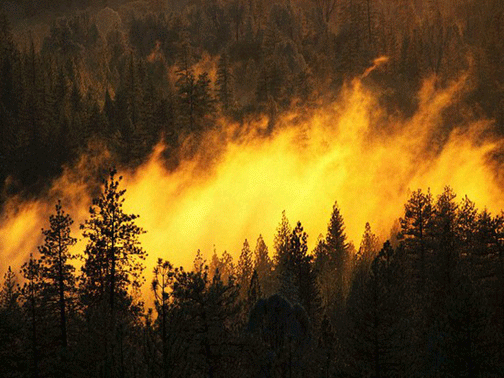 Threat of wildfires expected to increase as global temperatures rise http://www.enn.com/wildlife/article/49892The United Nations Office for Disaster Risk Reduction (UNISDR) has warned that wildfires could become more frequent and more destructive as global temperatures rise and drought conditions plague many regions of the world.
“Last year was the hottest year on record and was above average for the number of reported major droughts and heatwaves. This year we are seeing a similar pattern with new temperature records being set on a monthly basis,” UNISDR chief Robert Glasser said yesterday in a news release issued by the Office.
He noted that a number of risk factors, such as lack of forest management, growth of urban areas in proximity to forests and human induced fires need to be addressed by disaster management authorities.
“The most frightening scenario is when major towns are threatened as we have seen this week in the case of Funchal and Marseille,” the senior UN official added.
Continue reading at UN News Centre
Huge majority of Scarborough-Rouge River residents oppose keeping Pickering Nuclear operating beyond 2018

 Ontario Clean Air Alliance, 12 Aug 16, Residents in the Scarborough Rouge River riding oppose keeping the Pickering Nuclear Station operating beyond 2018 by a wide margin. Informed about Pickering’s high costs and large surrounding population – including all the homes in this riding — close to 70% of voters said the plant should be shut down in 2018 when its current licence expires. (Click here for full polling results.)
Voters in Scarborough-Rouge River will head to the polls on Sept. 1st to elect a new MPP in a provincial by-election. Currently, it is a race between PC candidate Raymond Cho (49%) and Liberal candidate Piragal Thiru (43%). Liberal supporters overwhelmingly support closing the plant, as do a strong majority of PC voters concerned about costs. NDP and Green supporters support closure in even greater numbers.
Living as little as 10 kilometers from Canada’s oldest nuclear plant – which is also the 4th oldest nuclear plant in North America – residents also felt they had been poorly informed about emergency measures in case of an accident at the aging plant. Fifty-nine percent rated safety-related communications poor or very poor.
Riding residents overwhelmingly supported closing Pickering when told that the province has a large surplus of electricity and lower cost options for keeping the lights on. We hope local candidates — and party leaders — will listen to Scarborough voters and promise to direct Ontario Power Generation to drop its plan to apply for a ten-year licence extension for the old and trouble-prone Pickering station.
The costs of New York nuclear bailout – both financial and environmental
N.Y. Public Service Commission OKs multi-billion dollar nuclear industry bailout funded by ratepayers statewide, Riverhead Local, by Karl Grossman Aug 12, 2016 Riverhead and Southold Town residents, indeed people throughout Suffolk County and New York State, will be getting higher utility bills because the State Public Service Commission this month approved — despite strong opposition — a $7.6 billion bailout of aging nuclear power plants in upstate New York. Their owners have said are uneconomic to run without government support.
As a result, there will be a surcharge for 12 years on electric bills paid by residential and industrial customers through the state.
Governor Andrew Cuomo — who appoints the members of the PSC — has called for the continued operation of the nuclear plants in order to, he says, save jobs at them.
The bailout would be part of a “Clean Energy Standard” advanced by Mr. Cuomo. Under it, 50 percent of electricity used in New York by 2030 would come from “clean and renewable energy sources” — with nuclear power considered clean and renewable.
A North Fork resident, PSC member Patricia Acampora of Mattituck, joined the other three members of the commission in voting Aug. 1 for the bailout and “Clean Energy Standard.” She is a former New York State assemblywoman representing a district including Riverhead and Southold Towns. She is also ex-chairwoman of the Suffolk County Republican Party.
“Nuclear energy is neither clean nor renewable,” testified Pauline Salotti, vice chair of the Green Party of Suffolk County, at a recent hearing in Riverhead on the plan.
“Without these subsidies, nuclear plants cannot compete with renewable energy and will close. But under the guise of ‘clean energy,’ the nuclear industry is about to get its hands on our money in order to save its own profits, at the expense of public health and safety,” Jessica Azulay, program director of the Syracuse-based Alliance for a Green Economy, declared. Moreover, she emphasized, “Every dollar spent on nuclear subsidies is a dollar out of the pocket of New York’s electricity consumers—residents, businesses and municipalities” that should “instead” go towards backing “energy efficiency, renewable energy and a transition to a clean energy economy.”
The “Clean Energy Standard” earmarks twice as much money for the nuclear power subsidy than it does for renewable energy sources such as solar and wind. Its claim is that nuclear power is comparable because nuclear plants don’t emit carbon or greenhouse gasses—the key nuclear industry argument for nuclear plants nationally and worldwide these days because of climate change. What the industry does not mention, however, is that the “nuclear cycle” or “nuclear chain”—the full nuclear system—is a major contributor to carbon emissions. Numerous statements sent to the New York PSC on the plan pointed to this.
“Nuclear is NOT emission-free!” Manna Jo Greene, environmental director of the Hudson River Sloop Clearwater, wrote the PSC. The claim of nuclear power having ‘zero-emission attributes’ ignores emissions generated in mining, milling, enriching, transporting and storing nuclear fuel.” Further, “New York no longer needs nuclear power in its energy portfolio, now or in the future.
“Nuclear power is not carbon-free,” wrote Michel Lee, head of the Council on Intelligent Energy and Conservation Policy. “If one stage,” reactor operation itself, “produces minimal carbon…every other stage produces prodigious amounts.” Thus the nuclear “industry is a big climate change polluter…Nuclear power is actually a chain of highly energy-intensive industrial processes which—combined—consume large amounts of fossil fuels and generate potent warming gasses. These include: uranium mining, milling enrichment, fuel fabrication, transport” and her list went on. Further, “New York no longer needs nuclear power in its energy portfolio, now or in the future. Ten years ago the transition to a renewable energy economy was still a future possibility. Today it is well underway.”

In opposing the New York nuclear subsidy, Dr. Mark Z. Jacobson, professor of civil and environmental engineering and director of the Atmosphere/Energy Program at Stanford University, wrote in an op-ed in Albany Times Union, the newspaper in the state’s capitol, that he was “shocked” by the PSC’s “proposal that the lion’s share of the Clean Energy Standard funding would be a nuclear bailout.” He said “allowing the upstate nuclear plants to close now and replace them with equal energy output” from offshore wind and solar power “would be cheaper and would create more jobs.” The closure of the upstate plants “would jeopardize fewer than 2,000 jobs” while a “peer-reviewed study” he has done “about converting New York State to 100 percent clean, renewable energy – which is entirely possible now — would create a net of approximately 82,000 good, long-term jobs.”
The upstate nuclear power plants to be bailed out under the plan would be FitzPatrick, Nine Mile Point 1 and 2 and Ginna.
Reported Tim Knauss of the Post-Standard of Syracuse: “Industry watchers say New York would be the first state to establish nuclear subsidies based on environmental attributes, a benefit typically reserved for renewable energy sources such as wind and solar.” The ‘zero emission credits’ would be paid to nuclear plants based on a calculation of the economic value of avoiding greenhouse gas emissions that contribute to climate change.” Cuomo “directed the PSC to create subsidies for upstate reactors,” he wrote.
Reuters has reported that the nuclear “industry hopes that if New York succeeds, it could pressure other states to adopt similar subsidies” for nuclear plants. The headline of the Reuters story: “New York could show the way to rescue U.S. nuclear plants.”
The two Indian Point nuclear power plants 26 miles north of New York City are not now included in the plan but it “leaves the door open to subsidies” for them, Azulay says.
This would mean “the costs [of the bailout] will rise to over $10 billion.”…….http://riverheadlocal.com/2016/08/12/n-y-public-service-commission-oks-multi-billion-dollar-nuclear-industry-bailout-funded-by-ratepayers-statewide/
Carefully considered findings are the basis for Diablo Canyon nuclear shutdown plan
 Huge Step for Zero-Carbon Replacement of Diablo Canyon, NRDC August 11, 2016 Ralph Cavanagh Operating California’s Diablo Canyon nuclear power plant past its 2025 license expiration would cost more than twice what many had anticipated, and significantly more than replacing it with energy efficiency and renewable resources, according to an analysis submitted today to the California Public Utilities Commission (CPUC) by the plant owner. The filing can be found here. NRDC continues to believe that substituting those zero-carbon resources for Diablo Canyon will save electricity users at least $1 billion.
 The operating cost estimate (more than 10 cents per kilowatt-hour) is among the important new details that Pacific Gas & Electric Company (PG&E) filed with the CPUC on the widely supported Joint Proposal to retire and replace Diablo Canyon. NRDC helped negotiate and joined that proposal, announced in late June, and while critics claim that polluting natural gas will fill the gap, today’s filing reaffirms that this is incorrect (as has been clearly stated from the start)……..
Important information in today’s filing
The PG&E analysis concludes with a telling statement : “Finally, as California continues to move closer to a cleaner energy future, a large non-dispatchable unit such as Diablo Canyon no longer ‘fits’ the needed generation profile of the changing energy landscape.”
PG&E reinforces this point with specific references to California’s climate and clean energy leadership, which the utility fully embraces. Important excerpts from the filing include:
- “Over the course of the past decade, California has continued to lead in creating a new energy future for the State, a future that is focused on reducing greenhouse gas emissions by providing additional energy supply options . . . Policies to support this vision have accelerated in the past several years, including the passage of Senate Bill (SB) 350, which calls for a doubling of energy efficiency goals and achieving a 50 percent Renewable Portfolio Standard (RPS) by 2030.”
- “PG&E has conducted extensive analysis on the cumulative impacts of these policy changes . . . These forecasts show that a substantial portion of [Diablo Canyon’s] energy output is anticipated to not be needed to serve PG&E’s [customers] beyond 2025. In addition, if [Diablo Canyon] were not retired but instead its license renewed, the generation from Diablo Canyon could exacerbate the challenges of integrating increasing amounts of wind and solar into the system . . . PG&E’s analysis projects that it would be more expensive from a consumer perspective to continue to operate Diablo Canyon . . . than to retire Diablo Canyon when the licenses expire in 2024 and 2025 and implement the joint proposal.”
- In conclusion: “the most efficient and effective path forward for achieving California’s SB 350 policy goal for deep reductions in GHG (greenhouse gas) emissions would be to retire Diablo Canyon at the expiration of its current operating licenses and replace it with a portfolio of GHG-free resources, as provided in the Joint Proposal.”
These are not quotes from NRDC, remember, although we are in full support: these are the carefully considered findings of one of the nation’s largest natural gas and electric utilities, with more than three decades of experience in nuclear power generation……
Comments on the filing are due in 30 days. NRDC will work with other supporters, including PG&E and its workers, to encourage CPUC approval of the Joint Proposal at the earliest possible date. https://www.nrdc.org/experts/ralph-cavanagh/huge-step-zero-carbon-replacement-diablo-canyon
Plan filed for shutdown of California’s last nuclear power plant – Diablo Canyon
 PG&E files plan to shut down Diablo Canyon nuclear power plant, http://www.latimes.com/business/la-fi-nuclear-power-pacific-gas-20160811-snap-story.html Rob Nikolewski , 11 Aug 16 A joint proposal calling for the shutdown of California’s lone remaining nuclear power plant was formally submitted by Pacific Gas & Electric to the California Public Utilities Commission on Thursday.
A number of environmental organizations and labor unions joined PG&E in the proposal to close both units at the Diablo Canyon nuclear facility near San Luis Osbispo by 2025. The plan would replace Diablo Canyon’s 2,160 megawatts of electricity generation with a combination of renewable sources, energy storage, better energy efficiency and changes to the power grid.
“Today’s action represents a major milestone,” PG&E President Geisha Williams said in an email to the utility’s employees. The proposal was first announced on June 21.
PG&E plans to pay nearly $50 million to San Luis Obispo County to help offset property taxes that would decline because of the plant closing.
“Retiring nuclear power plants and replacing them with energy efficiency and solar is good for California’s environment and good for our economy,” said Dan Jacobson, legislative director for Environment California, one of the environmental groups involved in crafting the joint proposal.
PG&E officials say they don’t expect long-term customer rates will increase if Diablo Canyon is shut down. They believe re-licensing the plant and operating it through 2044 will be more expensive than adopting the joint proposal. The proposal anticipates declining costs for renewable power, as well as lower demand from customers.
Following the shuttering of the San Onofre Nuclear Generating Station in January 2012, Diablo Canyon is the last nuclear power plant in California. According to the most recent data from the California Energy Commission, nuclear power accounted for 9.2% of the state’s power mix. rob.nikolewski@sduniontribune.com
1 This Month

of the week – Shut Down Drone Warfare!


Tell the Ukrainian Government to Drop Prosecution of Peace Activist Yurii Sheliazhenko

Petition to revoke the licensing of the Near Surface Nuclear Disposal Facility (NSDF) at Chalk River. https://www.ourcommons.ca/petitions/en/Petition/Details?Petition=e-7247
To see nuclear-related stories in greater depth and intensity – go to https://nuclearinformation.wordpress.com
-
Archives
- March 2026 (230)
- February 2026 (268)
- January 2026 (308)
- December 2025 (358)
- November 2025 (359)
- October 2025 (376)
- September 2025 (257)
- August 2025 (319)
- July 2025 (230)
- June 2025 (348)
- May 2025 (261)
- April 2025 (305)
-
Categories
- 1
- 1 NUCLEAR ISSUES
- business and costs
- climate change
- culture and arts
- ENERGY
- environment
- health
- history
- indigenous issues
- Legal
- marketing of nuclear
- media
- opposition to nuclear
- PERSONAL STORIES
- politics
- politics international
- Religion and ethics
- safety
- secrets,lies and civil liberties
- spinbuster
- technology
- Uranium
- wastes
- weapons and war
- Women
- 2 WORLD
- ACTION
- AFRICA
- Atrocities
- AUSTRALIA
- Christina's notes
- Christina's themes
- culture and arts
- Events
- Fuk 2022
- Fuk 2023
- Fukushima 2017
- Fukushima 2018
- fukushima 2019
- Fukushima 2020
- Fukushima 2021
- general
- global warming
- Humour (God we need it)
- Nuclear
- RARE EARTHS
- Reference
- resources – print
- Resources -audiovicual
- Weekly Newsletter
- World
- World Nuclear
- YouTube
-
RSS
Entries RSS
Comments RSS
 nuclear-news