Australian Aboriginals’ gift from one atomic survivor community to another
Indigenous Australia’s Shared Legacy With Nagasaki’s Atomic History
“An Australian gift from one atomic survivor community to another.”http://www.huffingtonpost.com.au/2016/08/08/indigenous-australias-shared-legacy-with-nagasakis-atomic-hist/ On August 9, 1945, Nagasaki became the second city in the world to be targeted by atomic bombs in warfare, killing 80,000 people. Over the next 70 years, thousands more would die from the effects of the bombing alone.
In the 1950s British nuclear testing saw nine atomic bombs tested on Australian soil in the Maralinga and Emu fields of South Australia. This forced the migration of the Pitjantjatjara Anangu community away from their traditional land into Yatala. For the Indigenous people of Maralinga, they were unable to return to their land and hunt because of contamination.
To mark not only the 71st anniversary of the Nagasaki bomb, but also International Day of the World’s Indigenous Peoples, this short documentary Peace Gift to Nagasaki unites both communities in their efforts to promote peace and expose the legacy of the atomic age through creative arts.
Until now, Australia has not been one of those countries. In Peace Gift to Nagasaki, the Yatala Aboriginal community present a sculpture called ‘The Tree of Life’ to the Japanese community, a sculpture made of wood and cast in bronze so it can survive many hundreds of years.
“The Yatala sculpture will be an Australian gift from one atomic survivor community to another,” the narrator of the documentary explains.
To find out more about this project you can head to the Nuclear Futures page over here.
After huge public protest Chinese town halts nuclear waste project

 Chinese town suspends nuclear waste project, DW, 10 Aug 16 A city in the eastern part of China has said it’s suspending preliminary work on a nuclear waste processing plant after days of protests by local residents over health concerns. No final decision has been made yet. The Chinese city of Lianyungang in the eastern province of Jiangsu announced Wednesday it would suspend preparations for a possible Sino-French nuclear waste processing project after thousands of local residents had taken to the streets to protest the plan.
The protesters had called for the project to be canceled altogether on health grounds, clashing with police.
French nuclear fuel group Areva agreed in 2012 to cooperate with state-run China National Nuclear Group (CNNC) to build a reprocessing facility in China, without stating any specific location…….
The $12.05-billion (10.81-billion-euro) waste processing project had been scheduled to get off the ground in 2020 to be completed by 2030, but its future is now unclear.
The project had been opposed by US authorities saying it would harm efforts to limit the spread of materials that could be used in weapons.
The Lianyungang protests highlighted local opposition to nuclear projects across China, which is increasing its atomic power capacity on a huge scale and encouraging state-run firms to build plants abroad.……http://www.dw.com/en/chinese-town-suspends-nuclear-waste-project/a-19462414
China keen to market its nuclear reactors to UK, warns Britain not to dump Hinkley

That’s not sitting well with China.
“Right now, the China-U.K. relationship is at a crucial historical juncture,” China’s ambassador to Britain, Liu Xiaoming, wrote in an article for the Financial Times.
“I hope the U.K. will keep its door open to China and that the British government will continue to support Hinkley Point — and come to a decision as soon as possible so that the project can proceed smoothly,” he added.His warning comes at a delicate time for the U.K. economy. The Bank of England last week forecast lost growth and higher unemployment as it cut interest rates in response to the decision to leave the European Union.
Having thrown the future of its relationship with its biggest trading partner up in the air, Britain is looking to boost trade and investment ties with the rest of the world.
Liu pointed out in his article that Chinese companies have invested more in the U.K. over the past five years than in France, Germany and Italy combined. China also accounted for just over 3% of U.K. exports last year.
Under the deal announced in October, China General Nuclear Power Corporation (CGN) would have a 33.5% stake in the power plant. France’s EDF (ECIFY) will hold the rest.
The bigger prize for China, though, is a related deal to build another nuclear power plant some 60 miles northeast of London, using its own reactor technology. It would have 66.5% of that venture.
May hasn’t given much away about her reasons for delaying the decision on Hinkley Point.
But the deal was controversial from the start, with critics warning that giving China access to vital infrastructure could compromise national security. The plan has also come under fire for guaranteeing an electricity price way above market levels……… http://money.cnn.com/2016/08/09/news/companies/china-uk-nuclear-power-plant-hinkley/
Dangerous errors at Belarus nuclear plant. Secrecy denounced by European neighbours
 Belarus under fire for ‘dangerous errors’ at nuclear plant
Neighbouring countries denounce ‘Soviet-style secrecy’ over accidents during energy site’s construction, RFE/RL reports, Guardian, Tony Wesolowsky ,9 Aug 16, Thirty years after world’s worst nuclear accident at Chernobyl, Belarus, which saw a quarter of its territory contaminated in the disaster, is building its first energy plant powered by the atom.
However a series of mishaps at the site in Astravets are raising concerns over safety, particularly in Lithuania whose capital, Vilnius, lies less than 31 miles (50km) from the site.
In July it was reported by local news that a nuclear reactor shell had been dropped while being moved. Local resident Nikolai Ulasevich, who is a member of the opposition United Civic Party, claimed the 330-tonne shell had fallen from a height of 2-4m in preparation for installation.
Two weeks later the Belarusian Energy Ministry confirmed that an “emergency situation” had occurred at the construction site. It said that the incident took place at the warehouse facility, while the reactor was being moved.
The Russian state-owned company Rosatom, the nuclear plant’s main contractor, denied the reactor shell had been damaged, and should be installed as planned pending permission from supervisors.
Despite such assurances, the Belarusian deputy energy minister Mikhail Mikhadyuk has since reportedly said the installation of the reactor shell was being suspended pending further safety checks.
The Lithuanian foreign minister Linas Linkevicius said the lack of transparency on the part of Belarusian officials was unacceptable. “These incidents, happening from time to time, lack of transparency, we’re learning about them from open sources, usually too late…. This is not how it should be in reality. This last incident when a nuclear reactor vessel was possibly damaged is very dangerous,” he said…….
It’s not the first mishap at the construction site, nor the first time Belarusian officials have resisted divulging any details.
The structural frame of the nuclear service building at the site collapsed in April, as first reported by the Belsat independent TV station. According to the report, supervisors, under pressure to meet a deadline, ordered workers to pour too much concrete causing the structure to collapse.
No mention of the accident was made in the Belarusian state media or by officials, with the spokesman at the plant first denying anything had happened. In May, the Belarusian energy ministry, however, did confirm an “incident” had occurred during the pouring of concrete, but the “defect” had been dealt with………
Lithuanian president Dalia Grybauskaite said in late July that Vilnius would work with the international community to block the plant coming online if Minsk failed to take steps to ensure international safety standards at the site…….https://www.theguardian.com/world/2016/aug/09/belarus-under-fire-for-dangerous-errors-at-nuclear-plant
U.S. electricity consumers could end up paying more than $2.5 billion for nuclear plants that never get built.

 Customers Could Pay $2.5 Billion for Nuclear Plants That Never Get Built http://www.bloomberg.com/news/articles/2016-08-08/customers-could-pay-2-5-billion-for-nukes-that-never-get-built, Mark Chediak markchediak August 9, 2016 —
-
Only two of 18 plants proposed since 2007 under construction
-
At least seven states allow billing before building starts
-
U.S. electricity consumers could end up paying more than $2.5 billion for nuclear plants that never get built.
Utilities including Duke Energy Corp., Dominion Resources Inc. and NextEra Energy Inc. are being allowed by regulators to charge $1.7 billion for reactors that exist only on paper, according to company disclosures and regulatory filings. Duke and Dominion could seek approval to have ratepayers pony up at least another $839 million, the filings show.
The practice comes as power-plant operators are increasingly turning to cheaper natural gas and carbon-free renewables as their fuels of choice. The growth of these alternatives is sparking a backlash from consumers and environmentalists who are challenging the need for more nuclear power in arguments that have spilled into courtrooms, regulatory proceedings and legislative agendas.
“Anything that hasn’t gotten off the ground yet isn’t getting built,” said Greg Gordon, a utility analyst at Evercore ISI, a New York-based investment advisory firm. “There is no economic rationale for it.” - Only two of 18 nuclear projects proposed since 2007 are under construction. Those units, being built by Southern Co. in Georgia and Scana Corp. in South Carolina, are billions of dollars over budget and years behind schedule. In the meantime, the price of natural gas has dropped 38 percent since 2010. It’s now used to generate more than a third of the nation’s power, up from 24 percent six years ago.
- Utilities that are moving forward with their nuclear plans say they want to preserve the option to build if market or regulatory conditions change. Nuclear power offers around-the-clock, carbon-free electricity that becomes more valuable if federal rules limiting greenhouse gases take hold, the utilities say.“One way to mitigate these risks is to spend money now, so that you have a license to build a nuclear plant if and when you need to,” said Richard Myers, vice president of the Nuclear Energy Institute, an industry trade group.
Critics of policies that allow utilities to bill for planned reactors say they’re likely unneeded, and the practice shifts upfront financial risks from shareholders to customers.
“The rich get richer and the ratepayers get poorer,” said Mark Cooper, a research fellow at Vermont Law School who submitted testimony in July opposing Dominion’s planned reactor in Virginia on behalf of the Virginia Citizens Consumer Council.
Duke fell 1 cent to $84.73 in New York. NextEra rose 8 cents to $126.07 and Dominion fell 26 cents to to $74.73.
-
Nuke Spending
Money collected from ratepayers so far has gone for items including federal licensing, permitting, land purchases, financing and equipment. Nuclear developers have sunk at least $1.2 billion of their own cash into proposals where they aren’t allowed or won’t ask to recover expenses from consumers, the disclosures and filings show.
At least seven states including Florida allow utilities to collect nuclear licensing and planning costs from customers before any construction begins.
In Virginia and Florida, utilities are seeing increased scrutiny of their plans. The Virginia attorney general has raised concerns about the rising expense of Dominion’s proposed new reactor at its North Anna facility, estimating the total cost at $19 billion.
“If Dominion proceeds on this ruinous path, it will extract $6 billion to $12 billion in needlessly higher energy bills,” said Irene Leech, president of the Virginia Citizens Consumer Council.
Shareholder Vote
In May, Dominion faced a shareholder resolution that would have required the company to analyze the financial risks of not getting regulatory approval for the new reactor. The proposal didn’t pass.
- Dominion intends to spend $647 million to get a federal nuclear license next year and $302 million of that has already been collected from ratepayers.“We’ve done a lot of work for licensing North Anna 3, which is prudent and valuable to our customers to maintain a diverse, carbon-free baseload source of electricity,” said Richard Zuercher, a Dominion spokesman.
- In Florida, multiple efforts in the state legislature to repeal a law that allows advanced collection of nuclear costs have failed.“I just never thought nuclear power plants made sense,” said Florida State Representative Michelle Rehwinkel Vasilinda, a Democrat, who has proposed bills to overturn the advance fee collection law.
In February, a federal lawsuit was filed on behalf of consumers that seeks to overturn the Florida statute and recover fees charged by Duke and NextEra for nuclear power plants that might not be completed. The suit alleges the companies overcharged customers for projects including Duke’s proposal for two reactors in Levy County and NextEra’s plan for two units at Turkey Point.
Legal Action
Duke and NextEra have asked a judge to dismiss the suit. Four other lawsuits challenging the state law have been rejected by Florida courts, said Rita Sipe, a Duke spokeswoman. The suits were filed on behalf of an environmental group and customers, according to court records.
As part of an agreement with Florida regulators in 2013, Duke was allowed to collect $926 million from customers to cover expenses including land and equipment purchases for its Levy facility, Sipe said. Duke also canceled its engineering, procurement and construction contract for the site in 2013.
- The company is pursuing a federal license for the plant but won’t charge customers for the costs of doing so, said Chris Fallon, vice president for nuclear development for Duke. The company sees the option to build as a hedge against pending environmental rules and possible natural gas price hikes, Fallon said.
Carolina Plants
Separately, Duke said it hasn’t decided if it will ask regulators for permission to collect $494 million in planning expenses for two proposed reactors in South Carolina.
Regulators have allowed NextEra to recoup $282 million of federal licensing costs for two new units at its Turkey Point facility, said Peter Robbins, a company spokesman. NextEra doesn’t see getting a license until the end of 2017 and will delay pre-construction work until at least 2020, Robbins said.
Critics say the issue is still whether companies should be allowed to bill for facilities that may never get finished.
“Customers can get stuck with the bill long before a single kilowatt of power is produced and may never recoup anything if the nuclear project is later abandoned,” said Jeremiah Lambert, an energy attorney and author of “The Power Brokers,” a history of the electric power industry.
Nuclear plants, USA nuclear industry, saved from oblivion by big New York subsidies
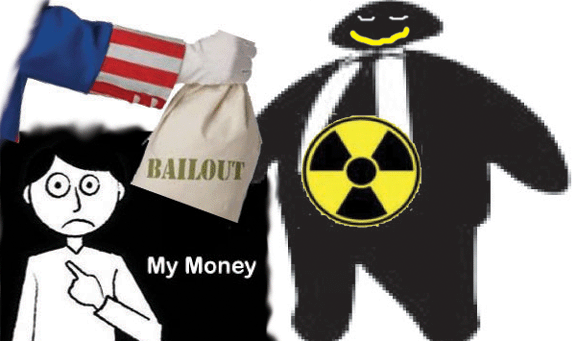 New York state just rescued a nuclear plant from oblivion. Why that’s a very big deal. WP By Steven Mufson August 9 Just one week after New York Gov. Andrew Cuomo unveiled a plan to subsidize his state’s six nuclear power plants, Exelon, the country’s biggest nuclear power producer, announced it would rescue one of the plants from being shut down in January.
Exelon said it would pay $110 million to the plant’s current owner, Entergy, for the operating license and would refuel the James A. FitzPatrick plant in Scriba, N.Y. in January. Exelon said the roughly 600 people working there would keep their jobs. The plant’s license, renewed in 2008, does not expire until 2034.
Cuomo, who has been caught up in the politics of energy, hailed the deal. …….
Entergy had said last November that it would close the nuclear unit because of “market conditions,” making the 838-megawatt plant another victim of low natural gas prices. Those low prices are a product of the fracking boom, especially in neighboring Pennsylvania.
But last week Cuomo announced a plan that would effectively subsidize the state’s nuclear power plants by forcing the utilities that rely on them to pay “zero emission credits” to the operators of those reactors. That is expected to help the plants, which provide 30 percent of New York state’s electricity, to stay open — though critics say that it could drive up electricity rates…….
Exelon operates two other nuclear plants in upstate New York, R.E. Ginna and Nine Mile Point, which lies adjacent to the FitzPatrick unit. The company said it would spend $400 million to $500 million on operations, integration and refueling of those plants and Fitzpatrick as a result of the state subsidy plan.
The Cuomo plan to subsidize the nuclear plants carries a hefty price, which the utilities will be allowed to pass along to consumers. An analysis of the proposal, by the staff of the Public Service Commission, found it might cost $965 million over a span of two years,…..https://www.washingtonpost.com/news/energy-environment/wp/2016/08/09/new-york-state-just-rescued-a-nuclear-plant-from-oblivion/?utm_term=.8f12fd955785
Following $1 billion subsidy, Exelon buys failing Fitzpatrick nuclear station
Exelon buys upstate New York nuclear plant http://thehill.com/policy/energy-environment/290879-exelon-buys-upstate-new-york-nuclear-plant Exelon Generation has agreed to buy an upstate New York nuclear power plant that seemed on the verge of closing just last year.
Entergy Corp. will sell its James A. FitzPatrick plant outside of Syracuse to Exelon for $110 million, officials announced on Tuesday. The companies expect regulatory approval by early next year, when Exelon plans to refuel the plant.
In a statement, Exelon President and CEO Chris Crane specifically thanked New York Gov.Andrew Cuomo (D) for his work on the Clean Energy Standard.
“We look forward to bringing Fitzpatrick’s highly-skilled team of professionals into the Exelon Generation nuclear program, and to continue delivering to New York the environmental, economic and grid reliability benefits of this important energy asset,” Crane said.
In a statement announcing the deal Tuesday, Cuomo said the deal is important for both the local economy and the state’s environmental policies.
“This state needs a clean energy policy that is realistic and can be implemented before we destroy this planet and I believe that nuclear plays an important rule in that clean energy policy,” he said, according to a video of his speech from the Syracuse Post-Standard. Entergy in November said it would be forced to close the 838-megawatt FitzPatrick plant by 2017, citing cheap natural gas and state policies that made nuclear plants expensive to operate.
Officials and the nuclear industry had looked for ways to keep the plant operating. The state’s Public Service Commission last week approved a clean energy standard requiring half the state’s electricity to come from renewable sources by 2030, and provided $1 billion over two years to subsidize FitzPatrick and two other nuclear plants in the state.
Exelon and Entergy have been negotiating a potential sale of the plant since last year. Regulatory agencies — including the Public Service Commission and the federal Nuclear Regulatory Commission — still need to sign off on the deal.
European Commission investigating French government’s financing of AREVA nuclear comnpany
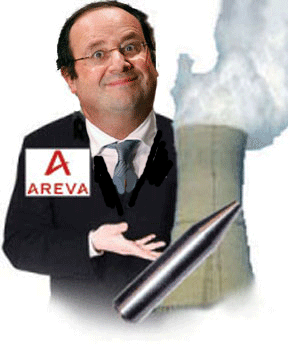 Europe checks French state aid for Areva restructuring, WNN 20 July 2016 The European Commission has launched an investigation to determine whether the French government’s contribution of €4.0 billion ($4.4 billion) towards the financing of the restructuring of Areva meets EU rules on state aid.
In late July 2015, EDF and Areva announced they had signed a memorandum of understanding setting out the principal terms and conditions for EDF to take a majority share in Areva’s reactor business, Areva NP. Areva – which has been experiencing financial difficulties for over five years – plans to create a new group later this year that will bring together all its fuel cycle operations: mining, chemistry, enrichment, recycling, dismantling, logistics and related engineering. And in April 2016 France notified the European Commission of a restructuring plan to return the Areva Group’s competitiveness and improve its financial position. The plan includes state aid in the form of a public capital injection of €4.0 billion. It also involves a renewed focus on the nuclear fuel cycle through various divestments and withdrawal from certain activities.
Areva – in which the French state owns, either directly or indirectly, an 86.5% stake – plans to launch a capital increase by the first quarter of 2017. The company earlier said, “The French state has indicated its intention of subscribing to it and ensuring its complete success, in compliance with European regulations.”
According to European guidelines on state aid for rescuing and restructuring companies in difficulty, aid to rescue such firms can only be granted for up to six months. Beyond this period, aid must either be reimbursed or a restructuring plan must be approved by the European Commission to allow aid for the company’s restructuring. The plan must ensure that the long-term viability of a company is restored without further state support, that the distortions of competition induced by the state aid are addressed by specific measures and that the company contributes to the cost of restructuring. Restructuring aid may only be granted once over a period of ten years.
The European Commission announced yesterday it has opened an in-depth investigation into the French government’s financial contribution to Areva’s restructuring…..http://www.world-nuclear-news.org/C-Europe-checks-French-state-aid-for-Areva-restructuring-2007164.html
In 1967, nuclear war was almost set off due to a giant solar storm
 A giant solar storm nearly triggered a nuclear war in 1967, Business Insider DAVE MOSHER AUG 10, 2016 Cold War history is rife with close calls that nearly led to nuclear holocaust.
In September 1983, for example, sunlight reflecting off a patch of clouds fooled a Soviet missile-warning system into detecting the launch of five US intercontinental ballistic missiles that never were. A colonel in a bunker ignored the alarm on a 50/50 hunch, narrowly averting a nuclear holocaust.
Two months later, US forces staged “Able Archer 83” — a massive nuclear-strike drill on the doorstep of the USSR. Soviet commanders panicked at the show of force and nearly bathed America in thermonuclear energy. Once again, an act of human doubt saved the planet.
Now scientists have one more event to add to the history books: The “Great Storm” of May 1967.
“The storm made its initial mark with a colossal solar radio burst causing radio interference … and near-simultaneous disruptions of dayside radio communication,” a group of atmospheric scientists and military weather service personnel wrote in a new study, published August 9 in the journal Space Weather.
Hours later, high frequency communications dropped out near US military installations in and near the Arctic — one of the closest places to station nuclear weapons and launch them at a Cold War-era Soviet Union.
“Such an intense, never-before-observed solar radio burst was interpreted as jamming,” the study authors wrote. “Cold War military commanders viewed full scale jamming of surveillance sensors as a potential act of war.”……
While The Washington Post wrote up the 1967 story as “City Gets Rare Look at Northern Lights,” top US military commanders sounded the alarms.
The Air Weather Service (AWS) — a relatively new branch of the Air Force — had warned military leadership about the possibility of a solar storm, but US commanders believed the Soviet forces were jamming NORAD systems designed to detect threatening planes and missiles.
As the Strategic Air Command warmed up the engines of bombers and taxied toward the runway, the decision to go airborne was kicked all the way up to the “highest levels of government,” which would imply President Lyndon B. Johnson was involved.
“Just in time, military space weather forecasters conveyed information about the solar storm’s potential to disrupt radar and radio communications,” according to a press release from the American Geophysical Union. “The planes remained on the ground and the U.S. avoided a potential nuclear weapon exchange with the Soviet Union.”………http://www.businessinsider.com.au/cold-war-geomagnetic-storm-radio-disruption-2016-8?r=US&IR=T
Rejection of expert knowledge – Clexit after Brexit
 In 2007, the US Supreme Court ruled that the State of Massachusetts had legal standing to sue the EPA for its refusal to regulate greenhouse gases, specifically because Massachusetts showed that it was being harmed by global warming via sea level rise encroaching on its shores. In that case, the Supreme Court ruled that carbon dioxide is a pollutant.
In response to the Supreme Court decision, the EPA issued an endangerment finding concluding that, based on the available scientific evidence, carbon dioxide endangers public health and welfare, and must therefore be regulated as a pollutant.
The Clexiters deny that vast body of scientific evidence.
Rejection of experts spreads from Brexit to climate change with ‘Clexit’ http://www.skepticalscience.com/rejection-experts-from-brexit-to-clexit.html August 2016 by dana1981
Brexit support and climate denial have many similarities. Many Brexit Leave campaignleaders also deny the dangers of human-caused climate change. Older generations were more likely to vote for the UK to leave the EU and are more likely to oppose taking action on climate change; younger generations disagree, and will be forced to live with the consequences of those decisions. On both issues there’s also a dangerous strain of anti-intellectualism, in which campaigners mock experts and dismiss their evidence and conclusions.
With Brexit, the Leave campaign won the vote, and the UK economy is already feeling the consequences. As Graham Readfearn reported, a new group called “Clexit” (Climate Exit) has formed in an effort to similarly withdraw countries from the successful internationalclimate treaty forged last year in Paris. As
As the group describes itself:
Brexit was Britain’s answer to the growing over-reach of EU bureaucracies. Clexit is our answer to the push for global control through climate hysteria.
Clexit leaders are heavily involved in tobacco and fossil fuel-funded organizations, in what’s become known as “the web of denial.” The group’s president is Christopher Monckton, whose extensive misunderstanding of basic climate science was revealed in a thorough debunking by John Abraham, and who insists that President Obama was born in Kenya, among his many controversial and conspiratorial public statements. Its vice president is Marc Morano, who began his career working for Rush Limbaugh and is essentially the real-life version of the character Nick Naylor from the film Thank You for Smoking. Its secretary is Viv Forbes, who has been involved with coal industry for over 40 years and is associated with many fossil fuel-funded groups.
With feedback from the rest of the group’s members, Forbes prepared Clexit’s summary statement, which is full of myths and misinformation about economics, energy, laws, andclimate science. It includes this expression of compassionate concern over the plight of low-lying island nations that are being engulfed by rising seas:
Some of the biggest supporters of the Paris accord are small oceanic nations seeking welfare through handouts to save them from baseless predictions of rising sea levels, even though actual changes in sea levels are tiny and not unusual.
The fact is that sea level rise in Tuvalu has been effectively zero since accuratemeasurements commenced in 1993, on tide gauges set up by the Australiangovernment
This purported fact is actually a fiction: the tide gauge data show the rate of sea level rise in Tuvalu since 1993 is 4.3 mm per year, which is faster than the global average of 3.4 mm per year. And Tuvalu is only one among the many small island nations facing the loss of their homelands at the hands of global warming-caused sea level rise.
However, when it comes to energy use, Clexit’s compassion for developing countries becomes even clearer yet:
For developing countries, the Paris Treaty would deny them the benefits of reliable low-cost hydrocarbon energy, compelling them to rely on biomassheating and costly weather-dependent and unreliable power supplies, thus prolonging and increasing their dependency on international handouts. They will soon resent being told to remain forever in an energy-deprived wind/solar/wood/bicycle economy.
The problem with energy from burning fossil fuels is that it’s only “low-cost” if we ignore the tremendous costs of the damages its carbon pollution causes via climate change. Poorer countries are particularly vulnerable to those costs, both because they lack the wealth and resources to adapt to them, and because they tend to be located in already-hot geographic regions near the equator.
There’s a reason why 95% of expert economists agree that we should cut carbon pollution. Of course, the Clexiters deny that carbon dioxide is a pollutant:
Carbon dioxide is NOT a dangerous pollutant – it is a natural, non-toxic and beneficial gas which feeds all life on earth.
However, this was long ago decided in the courts. In 2007, the US Supreme Court ruled that the State of Massachusetts had legal standing to sue the EPA for its refusal to regulate greenhouse gases, specifically because Massachusetts showed that it was being harmed by global warming via sea level rise encroaching on its shores. In that case, the Supreme Court ruled that carbon dioxide is a pollutant.
In response to the Supreme Court decision, the EPA issued an endangerment finding concluding that, based on the available scientific evidence, carbon dioxide endangers public health and welfare, and must therefore be regulated as a pollutant.
The Clexiters deny that vast body of scientific evidence.
Clever payment systems, such as Oxfam’s plan, could revolutionise Zimbabwe with decentralised solar energy
Affordable solar schemes light way to energy for all in Zimbabwe BY TONDERAYI MUKEREDZI HARARE (Thomson Reuters Foundation) Aug 8, 2016 – Innovative ways to pay for solar power systems could make clean energy affordable for many of Zimbabwe’s 1.5 million households that lack electricity, campaigners say. Zimbabwe produces only around 60 percent of the electricity it needs when demand is highest, and relies on costly imports to make up some of the shortage, particularly when drought hits hydropower facilities, as happened this year.
That means solar panels and other clean energy sources not connected to the southern African nation’s power grid are likely the cheapest and fastest way to bring electricity to those without it, say sustainable energy experts. “Only focusing on grid extension and increasing generation capacity will not allow us to attain energy access for all by 2030,” said Chiedza Maizaiwana, manager of the Power for All Zimbabwe Campaign.
To meet the internationally agreed goal, so-called “decentralised” renewable energy is “a critically needed solution”, she told the Thomson Reuters Foundation. “It is imperative that we create the opportunity for families and businesses to access (these) services rapidly and affordably,” she said.
Getting connected to the grid in a rural area can cost thousands of dollars, a huge obstacle when many people earn between $20 and $100 a month, said Ngaatendwe Murimba, a program officer for Ruzivo Trust, a non-governmental organization (NGO) working to improve rural energy access.
But families without electricity do pay for energy, buying firewood or charcoal – which drive deforestation – batteries, or polluting fuels such as paraffin……..
 Jonathan Njerere, head of programs in Zimbabwe for charity Oxfam, said that in Gutu district, 230 km east of Harare, his organization and others had helped set up a community-owned, self-financing solar energy scheme.
It has enabled more than 270 farmers to irrigate about 16 hectares (39.5 acres) of crops.
Oxfam gave the community solar equipment for irrigation and an initial batch of solar lanterns, which were sold to members. The proceeds were pooled in a savings and lending scheme, allowing others to join and buy solar products for home and business use.
Community funds are used to purchase solar equipment for sale to the public through energy kiosks, and the revenue is kept for repairs and relief in natural disasters.
Njerere said the program, assisted by 2 million euros ($2.22 million) from the European Union, had helped chicken farms, fisheries, tailors and shopkeepers acquire hire-purchase solar panels, so they can work in the evening as well as during the day.
Other entrepreneurs use the solar panels to sell mobile phone charging services for $0.20 a time………
Providing subsidized solar equipment would hugely improve uptake, Ruzivo Trust’s Murimba said. Communities are asking for free installation of solar systems, zero taxes on solar equipment, and government-accredited dealers who can provide them with quality solar equipment and technical support, he added.
One local company had to discontinue a popular package including a mobile phone and a $45 solar lamp. It sold some 400,000 lights to around a third of the country’s households, but they were poor quality, and many developed problems with no mechanism for repair or return.
In Harare, vegetable vendor Regina Meki, 40, uses a solar lamp she bought on credit to hawk her wares well into the night. Under a payment plan offered by a local solar company, she pays $1 a day for the $50 rented lamp, which has helped boost her monthly earnings from $70 to $120. “Solar energy has brought nothing but happiness to me, increasing my income. Besides payment for the equipment was easy on the pocket,” she said. http://www.reuters.com/article/us-zimbabwe-energy-solar-financing-idUSKCN10J0L3
USA Dept of Energy not protecting nuclear whistleblowers
 Is the Energy Department doing enough to protect nuclear whistleblowers? BY LINDSAY WISE wise@mcclatchydc.com WASHINGTON , 9 Aug 16 Changes announced by the U.S. Department of Energy to strengthen protections for nuclear whistleblowers don’t go far enough to fix deep-rooted problems unearthed in a recent audit, lawmakers and worker advocates say.
The audit, released last month, found that the DOE’s nuclear program rarely holds its civilian contractors accountable for unlawful retaliation against contract employees who raise concerns about health, safety, fraud and waste.
The lack of enforcement has led to the creation of chilled work environments at nuclear sites across the country, according to the audit performed by the Government Accountability Office at the request of three Democratic senators: Claire McCaskill of Missouri, Ron Wyden of Oregon and Ed Markey of Massachusetts.
The senators had asked the GAO in 2014 to look into persistent incidents of retaliation against whistleblowers reported at the Hanford nuclear reservation in Washington state.
Over the next two years, the probe expanded to review the handling of 87 contractor employee complaints filed at 10 of the DOE’s largest nuclear facilities, including Savannah River Site near Aiken, South Carolina.
One whistleblower, Sandra Black, said she was fired from her job as head of the employee concerns program at the Savannah River Site, also known as SRS, after she cooperated with GAO officials on the audit.
Steven Croley, the Department of Energy’s general counsel, did not mention the audit last week when he announced steps to strengthen protections for nuclear whistleblowers on the department’s website. Croley wrote in a blog post that the department plans to issue detailed guidance to its personnel to clarify “if and when” the agency will reimburse contractors’ legal costs in whistleblower cases.
The Department of Energy paid more than $62 million in legal fees for contractors in 36 settlements from 2009 to 2013, even though there was no documented evidence that the costs were allowable under department policy, according to another audit released in February by the DOE’s inspector general. Three of those cases involved whistleblower complaints……..
Nuclear safety watchdogs complain the reforms outlined by Croley are neither new nor effective. “It is the same thin gruel offered up for the past 30 years, dressed up as news,” said Tom Carpenter, director at Hanford Challenge, a regional public interest group in Seattle.
The DOE put similar reforms in place in the 1990s – including a zero tolerance policy for reprisals and a proposed limit on the reimbursement of contractors’ legal defense costs – but those measures failed to address the problem,
Specifically, the reform about civil penalties has limited value, Carpenter said. He pointed out that the DOE has had the power to bring civil penalties against contractors for whistleblower retaliation for decades, but has only done so twice in 30 years, as noted in the recent audit.
Carpenter also worries that the DOE seems to be narrowing the application of this provision to only include whistleblowers who raise nuclear safety or radiation issues, and not concerns about chemical vapor exposures, fraud, waste and abuse, violations of environmental regulations, etc.
“DOE keeps touting their broken programs to protect whistleblowers as if they actually work,” Carpenter said…. http://www.mcclatchydc.com/news/politics-government/congress/article94458847.html
US Dept Energy ordered by court to hand over Idaho nuclear waste documents
 Court orders feds to turn over Idaho nuclear waste documents http://www.seattletimes.com/nation-world/court-orders-feds-to-turn-over-idaho-nuclear-waste-documents/ August 9, 2016 By KEITH RIDLER The Associated Press
BOISE, Idaho (AP) — A federal judge has ordered the U.S. Department of Energy to make available to the court documents sought by former Idaho Gov. Cecil Andrus involving nuclear waste shipments to eastern Idaho.
U.S. District Court Judge B. Lynn Winmill on Monday ordered the agency to produce the documents within a week so Winmill can determine whether to make them public.
Andrus filed a lawsuit in September after Energy Department officials responded to Andrus’ Freedom of Information Act request with heavily redacted documents. Andrus wants information on research shipments of spent nuclear fuel to the Idaho National Laboratory that require a waiver to a 1995 agreement.Andrus says the waiver would make the state a nuclear waste repository.
Energy Department officials didn’t immediately respond to inquiries from The Associated Press on Tuesday.
New York “s Clean Energy standard drafted with an effort to avoid legal challenges about nuclear subsidy
 NY Attempts to Thread Legal Needle with Clean Energy Standard, Nuke Incentives, RTO Insider,
The U.S. Supreme Court cast a long shadow as New York regulators drafted the Clean Energy Standard and its incentives to preserve upstate nuclear power plants.
Audrey Zibelman, chair of the state Public Service Commission, said that the order adopted last week was drafted to avoid legal challenges that could jeopardize the standard’s goal of generating 50% of the state’s power from renewable resources by 2030. PSC lawyers feared challenges to the zero-emission credit (ZEC) program for nuclear plants and the way in which renewable energy development is encouraged. (See New York Adopts Clean Energy Standard, Nuclear Subsidy.)……
ZEC Pricing
New York has priced ZECs based on EPA’s social cost of carbon, minus prices for carbon allowances sold under the nine-state Regional Greenhouse Gas Initiative, in which New York participates. Load-serving entities must purchase ZECs, which recognize the carbon-free attribute of nuclear power, proportionate to their annual energy sales.
Although it was designed to be similar to the REC procurement, the ZEC program may face a legal challenge that the mandate would suppress energy and capacity prices.
A group of power generators advanced that argument during the public comment period last month.
The comments were “a dry run driving right at the heart of ZEC,” said David Appelbaum, an attorney for the New York Power Authority. “They’re going to try to derail this. I don’t know if they’re going to be successful.”
The suppliers, 11 power generators and marketers, say the ZEC proposal violates the Federal Power Act and impinges on FERC jurisdiction over wholesale markets. “It conflicts with FERC’s policy that the NYISO’s capacity market provide the necessary price signals to encourage maintenance of existing, and development of new, facilities to meet reliability needs,” the suppliers contend. “But for the artificial price suppression, prospective new generators that may have been economic may forego entry, and existing generators that may have been economic may prematurely retire.”
The PSC order sought to head off this line of attack. The proposal “does not establish wholesale energy or capacity prices; it only establishes pricing for attributes completely outside of the wholesale commodity markets administered by NYISO,” the order states. “To the contrary, it addresses a well recognized externality that otherwise would lead to economic inefficiencies with respect to the costs incurred due to environmental damage, in particular, climate change.”
John Reese, the senior vice president of Eastern Generation, one of the suppliers, told RTO Insider on Monday that no decisions on any appeal have been made.
“We continue to look at all of the options, so we are in the process of deciding what is the best action to take,” he said. http://www.rtoinsider.com/new-york-clean-energy-standard-30101/
Short term gain for nuclear companies: long term pain for New York

Christina Macpherson’s websites & blogs
The claim that nuclear power is “clean” and “does not emit C02” is a devious lie. Hard to believe that the American public fall for this lie – that conveniently ignores the entire nuclear fuel chain – uranium mining, milling, enrichment, conversion, fuel fabrication, reactor building, building waste pools, concrete waste containers, deep burial facilities. All those steps, and all the transport in between, emit greenhouse gases. The nuclear lobby lied – calling their product, cheap, safe, clean, no connection with weapons, no terrorism risk. Why is New York buying their latest hypocritical lie about climate change?
Judson and environmentalists say the cost of keeping these aging nuclear plants online for another 12 years could be incalculable should one of them malfunction……
1 This Month

of the week – Shut Down Drone Warfare!


Tell the Ukrainian Government to Drop Prosecution of Peace Activist Yurii Sheliazhenko

Petition to revoke the licensing of the Near Surface Nuclear Disposal Facility (NSDF) at Chalk River. https://www.ourcommons.ca/petitions/en/Petition/Details?Petition=e-7247
To see nuclear-related stories in greater depth and intensity – go to https://nuclearinformation.wordpress.com
-
Archives
- April 2026 (98)
- March 2026 (251)
- February 2026 (268)
- January 2026 (308)
- December 2025 (358)
- November 2025 (359)
- October 2025 (376)
- September 2025 (257)
- August 2025 (319)
- July 2025 (230)
- June 2025 (348)
- May 2025 (261)
-
Categories
- 1
- 1 NUCLEAR ISSUES
- business and costs
- climate change
- culture and arts
- ENERGY
- environment
- health
- history
- indigenous issues
- Legal
- marketing of nuclear
- media
- opposition to nuclear
- PERSONAL STORIES
- politics
- politics international
- Religion and ethics
- safety
- secrets,lies and civil liberties
- spinbuster
- technology
- Uranium
- wastes
- weapons and war
- Women
- 2 WORLD
- ACTION
- AFRICA
- Atrocities
- AUSTRALIA
- Christina's notes
- Christina's themes
- culture and arts
- Events
- Fuk 2022
- Fuk 2023
- Fukushima 2017
- Fukushima 2018
- fukushima 2019
- Fukushima 2020
- Fukushima 2021
- general
- global warming
- Humour (God we need it)
- Nuclear
- RARE EARTHS
- Reference
- resources – print
- Resources -audiovicual
- Weekly Newsletter
- World
- World Nuclear
- YouTube
-
RSS
Entries RSS
Comments RSS
 nuclear-news