Fukushima: A Nuclear War Without A War: The Unspoken Crisis Of Worldwide Nuclear Radiation Fukushima Watch 1 Aug 16
“…………The crisis in Japan has also brought into the open the unspoken relationship between nuclear energy and nuclear war.
Nuclear energy is not a civilian economic activity. It is an appendage of the nuclear weapons industry which is controlled by the so-called defense contractors. The powerful corporate interests behind nuclear energy and nuclear weapons overlap.
In Japan at the height of the disaster, “the nuclear industry and government agencies [were] scrambling to prevent the discovery of atomic-bomb research facilities hidden inside Japan’s civilian nuclear power plants”.1 (See Yoichi Shimatsu,Secret Weapons Program Inside Fukushima Nuclear Plant?Global Research, April 12, 2011)
It should be noted that the complacency of both the media and the governments to the hazards of nuclear radiation pertains to the nuclear energy industry as well as to to use of nuclear weapons. In both cases, the devastating health impacts of nuclear radiation are casually denied. Tactical nuclear weapons with an explosive capacity of up to six times a Hiroshima bomb are labelled by the Pentagon as “safe for the surrounding civilian population”.
No concern has been expressed at the political level as to the likely consequences of a US-NATO-Israel attack on Iran, using “safe for civilians” tactical nuclear weapons against a non-nuclear state.
Iran executes nuclear scientist who returned to country from US Iranian judiciary confirms hanging of Shahram Amiri who it claims was a spy who had given away state secrets, Guardian, Saeed Kamali Dehghan, 7 Aug 16 Iran An Iranian nuclear scientist, whose disappearance in Saudi Arabia in 2009 and subsequent return to Tehran a year later from Washington was shrouded in mystery, has been executed in his home country.
The family of Shahram Amiri, an expert in radioactive isotopes at Tehran’s Malek Ashtar University, which is affiliated to Iran’s ministry of defence, told two overseas Persian-language TV networks at the weekend that he had been executed earlier in the week at an unknown location.
The spokesman for the Iranian judiciary confirmed on Sunday that Amiri had been hanged, claiming he had given away state secrets. The semi-official Tasnimnews agency quoted Gholam-Hossein Mohseni-Eje’i as saying that Amiri had been convicted of spying and put to death after his sentence was upheld by the supreme court.
“This person had obtained top secret information and established contacts with our number one sworn enemy, America, and passed on our country’s most crucial intelligence to the enemy,” Mohseni-Eje’i said.
Amiri’s execution marks the final dark chapter in a real-life spy drama that was the subject of much speculation. It also gives more weight to claims that he defected to the US after going missing on a pilgrimage to Mecca some time in spring 2009.
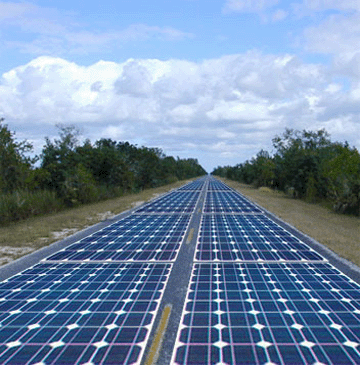
France gets a step closer to solar roadshttp://reneweconomy.com.au/2016/france-gets-step-closer-solar-roads-56433By Ilias Tsagas on 5 August 2016 French energy minister Ségolène Royal has inaugurated a manufacturing plant that will produce the so-called “Wattway” paving, made of solar PV. One of its pilot projects will be a 1 kilometer solar road, built in the same region as where the plant is located.
On 26 July French energy minister Ségolène Royal inaugurated a manufacturing unit for the Wattway photovoltaic panels in Tourouvre, Orne. Wattway is a French innovation and is the result of 5 years of research undertaken by Colas, a transport infrastructure company, and the French National Institute for Solar Energy (INES).
The joint patent for the product is based on crystalline silicon, and although it is very thin, Colas argues it is also “very sturdy, skid-resistant and designed to last,” with the durability to bear all types of vehicles, including trucks. Wattway panels can be applied directly to existing pavements, with the aim of generating green electricity while also allowing traffic to flow.
The new manufacturing facility is adjacent to Colas’ headquarters in the village of Tourouvre, in France’s north western department Orne. The new facility is expected to speed up the panel production time, as the Wattway panels had previously been manufactured at the INES laboratory.
Colas is already taking orders for panels ranging from 10 m2 to 50 m2, however, as of 2017, Wattway panels will be included in the Colas product line and the panel surface will increase.
One of the first applications of the Wattway panels will be a 1 kilometer road in the Onre region, the local council has announced.
France’s energy minister took the opportunity at the event to also announce the mobilization of €5 million in state funding to support the development of the Wattway photovoltaic panel. Royal herself is a great support of the innovative patent and has often spoken publicly of the variety of projects the Wattway can be applied to.
A Wattway panel, said Colas, can last “at least 10 years depending on the traffic, which speeds up wear. If the section is not covered by heavy traffic – a stadium parking lot for example – then Wattway panels can last roughly 20 years.”
Furthermore, “given the technical issues involved in the connection process, the panels need to be installed by an authorized technician,” added Colas, who also expressed that “within the next two to three years, it will be possible to install Wattway panels on private roads and driveways.”
Inside the Institutions for the Chernobyl Victims Forgotten by Society, VICE By Tom Usher, Photos: Jadwiga Bronte January 18, 2016The Chernobyl disaster took place 30 years ago this April, but its effects are still being felt. The meltdown of the nuclear power plant in northern Ukraine thrust a huge amount of radioactive particles into the Earth’s atmosphere, contaminating much of the surrounding area, with neighboring Belarus taking 70 percent of the fallout.
In her photo series “The Invisible People of Belarus,” photographer Jadwiga Bronteexplored the effects of the Chernobyl disaster on the people of Belarus, specifically those living in governmental institutions called “internats.” These institutions are part asylum, part orphanage, and part hospice, where thousands of Belarusians spend their lives, hidden from public view, often “handed over” to the government by relatives soon after birth.
I spoke to Jadwiga about her project.
VICE: What drew you to the story of the internats? Jadwiga Bronte: This topic has always been very personal to me. I was born in neighboring Poland, a satellite state of the USSR at the time of the Chernobyl disaster. After learning more about the aftermath of this disaster from an amazing photo essay—“Chernobyl Legacy,” by Paul Fusco—I felt like it was my duty to go to Belarus and work on this subject……..https://mail.google.com/mail/u/0/#inbox/15662659a8d2ba4c?compose=1566729b3d2417d4
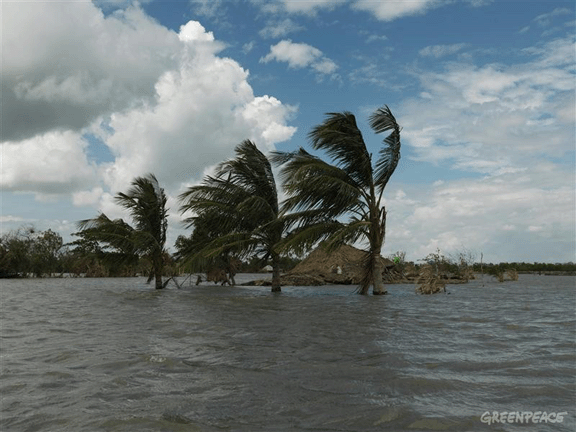
Carteret climate refugees seek home A grassroots group in Bougainville is scrambling to relocate the Carteret Islanders before rising sea levels swallow their land forever. ABC News 7 Aug 16 By Lauren Beldi for Pacific BeatAt only 1.5 metres above sea level at their highest point, the Carteret Islands are some of the first to succumb to the rising ocean tides.
The grassroots Tulele Peisa group, which means “sailing the waves on our own” in the local Halia language, is hoping to relocate more than half of the population by 2020. They have secured land for new homes on the main island of the Autonomous Region of Bougainville, to the east of mainland Papua New Guinea.Tulele Peisa formed in late 2006 after the Council of Elders on the islands decided to establish their own relocation program. The group’s chief executive, Ursula Rakova, says the encroaching tides on the islands have a major impact on people’s health. “We’re beginning to get more requests for people wanting to move because of the situation and the dire need for food,” she says.
The storm surges not only wash away houses, but also vegetable gardens, which are critical for the islanders’ survival.
With no cash economy on the Carterets, the only source of food is what people are able to grow for themselves……
Tulele Peisa has also provided thousands of mangrove seedlings to prevent the erosion of the coastline, and helped to build raised garden beds. But this will only stave off the inevitable for so long.
“Those are adaptation strategies, they aren’t really long-term solutions to containing the islands, because we know the islands are going, but we are looking at supporting our families,” Ms Rakova says.
She says the islanders want to maintain their independent way of living but that the international community should provide more support.
“The islanders on the Carterets are victims of what other people have caused and the international community needs to aid and support the work that we are doing,” she says.
Don Hancock, a nuclear waste expert with the nonprofit Southwest Research and Information Center, is skeptical officials will make the December 2016 deadline. He thinks it could take several million dollars more and a few more years to fully reopen WIPP.
“DOE was overly optimistic about scheduling and overly optimistic about costs,” Hancock said. “Unfortunately, DOE continues to not learn from its past. This is not unique to WIPP.”
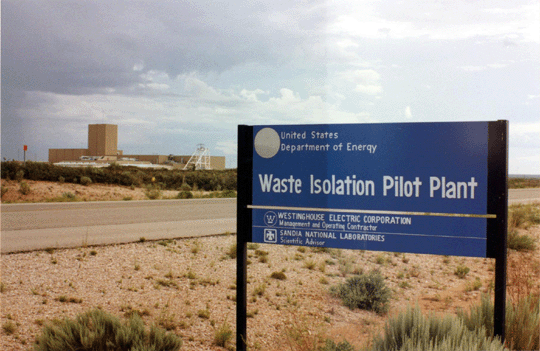
That prediction comes after federal officials once promised the Waste Isolation Pilot Plant would be cleaned up and reopened by this March, the Santa Fe New Mexican reports (http://goo.gl/9QvNEq).
The New Mexico plant has been closed since February 2014, when an inappropriately packed container of waste from Los Alamos National Laboratory ruptured and contaminated part of the facility.
The closure derailed cleanup at federal sites around the nation and recovery is costing the Energy Department hundreds of millions of dollars.
A Government Accountability Office audit released this week said the agency knew it had only a 1 percent chance of meeting that March 2016 deadline.
In 2015, the agency admitted it couldn’t safely reopen the Waste Isolation Pilot Plant, even for limited operations, until at least December 2016 — and at a higher cost. Now auditors say even the revised cost estimate was flawed. The agency “did not follow all best practices for cost and schedule estimates,” federal auditors found, including having an independent analyst review them.
The report says the Energy Department also admitted in May 2015 that the pressure to meet the March 2016 deadline “contributed to poor safety practices in WIPP recovery efforts.”
The result of missteps in the process of reopening the facility, according to auditors, was a nine-month delay and a price tag $64 million higher than the original cleanup estimate. The Energy Department initially estimated it would cost $242 million to restore WIPP for limited waste disposal and an additional $77 million to $309 million to install a new ventilation system critical to providing clean air to workers.
The delays led to an additional $61.4 million in operating costs at WIPP, and the cost to prepare the facility for limited activity went up another $2 million.
Don Hancock, a nuclear waste expert with the nonprofit Southwest Research and Information Center, is skeptical officials will make the December 2016 deadline. He thinks it could take several million dollars more and a few more years to fully reopen WIPP.
“DOE was overly optimistic about scheduling and overly optimistic about costs,” Hancock said. “Unfortunately, DOE continues to not learn from its past. This is not unique to WIPP.”
New facility in Moyock makes massive spent nuclear fuel storage casksBy Jeff Hampton The Virginian-Pilot MOYOCK, N.C., 7 Aug 16 Marlin Stoltz put on a hard hat and bright yellow vest before walking out into the four-acre work area of the Moyock Casting Facility, a new operation in the business of spent nuclear fuel storage.
A line of concrete cases, each 21 feet long and weighing 100 tons, rested along a rail spur, ready for shipment. Several men stood atop a steel form where hydraulic power vibrated and settled four truckloads of concrete for the next case. A concrete plant operated less than 100 yards away.
The property along N.C. 168 near the Chesapeake border is a short trip by rail or truck from the Norfolk ports, where barges haul in cement and rock. A rail line, a concrete plant, a good highway, proximity to the ports and isolation from residential development all make the site nearly perfect for its purposes, Stoltz said.
“This allows us to work very efficiently,” said Stoltz, supervisor of the Moyock Casting Facility and a deputy of the services business line for parent company Areva TN, a division of Areva, Inc, based in Charlotte.
Areva, Inc. has operations within the entire nuclear cycle, including uranium mining.
The Moyock facility with 25 employees opened in January. It makes concrete modules that encase steel canisters containing spent nuclear fuel. From here, the modules head to nuclear plants elsewhere……
demand for spent fuel storage remains strong, Stoltz said. The Moyock plant means to deliver.
An entire district in Rajasthan to be powered by solar energy, will end all water woes in the desert state! Rajasthan Electronics and Instrumentation Ltd, the firm currently handling the project has been given the green signal to spend Rs 11.91 crore for the entire project. India.com By Rutu Ladage on August 2, 2016“……..For Rajasthan government, coming up with newer techniques to ensure that the water issues never crop up, Barmer district in Jaiselmer is coming up with a unique solution. While we do have villages and homes in India that boast of solar power and using solar energy to meet their electricity needs, there are hardly any complete districts that boast of running solely on solar power. If the project works out, it will definitely be one of the major firsts in India and set the benchmark for other regions too. The Mukhyamantri Solar Adharit Nalkoop Yojana (MSANY). will provide 70 solar tubewells in Barmer district to help people become reliant on solar energy and use solar power even for agriculture.
GAO: DOE fails in cost, schedule best practices Maddy Hayden, Carlsbad Current-Argus August 5, 2016 The U.S. Government Accountability Office says the Department of Energy did not meet initial cost and schedule estimates for restarting waste emplacement at the Waste Isolation Pilot Plant in part because it did not follow “best practices.”
A report by the office released Thursday said that by not meeting the original anticipated reopening date of March 2016, an operational cost increase of about $64 million, a $2 million increase in recovery costs and a delay of nearly nine months were incurred.
“In particular, DOE’s schedule did not include extra time, or contingency, to account for known project risks,” the report says.
It is pretty stupid for the State to take over an uneconomic business, just in order to provide jobs. Even more absurd, considering the costs, to ignore the opportunity to develop genuinely clean jobs in renewable energy and energy efficiency.
Is this news journal also continuing to mindlessly perpetrate the nuclear lobby lie, that nuclear power combats global warming?
New York Nuclear Plants Deemed A “Public Necessity”, Oil Price, By Leonard Hyman & William Tilles – Aug 06, 2016 Last week the New York Public Service Commission approved a Clean Energy Standard for the state. The two key components are a mandate for 50 percent renewables by 2030 and a subsidy mechanism for four, and possibly six, aging nuclear facilities upstate.
The renewables standard is not controversial. Not so the planned nuclear subsidies. The new directive will require all electricity buyers in the state to purchase power from these nuclear facilities at a relatively high price in the interest of carbon reduction. The state does not use its own money.
The need for nuclear subsidies, at least in the minds of state officials, appears to be fairly straightforward. Entergy Corp., which owns the FitzPatrick nuclear facility, has decided to shutter the unit permanently on the grounds that it is no longer economic to operate. Entergy has also arrived at a similar conclusion for its older, smaller nuclear facilities in Vermont and Massachusetts. But with the subsidy passed, Exelon, which owns two other stressed nukes upstate, may buy FitzPatrick and keep it open.
The subsidies on offer run for a period of 12 years starting April 2017, and begin at about 2 cents for every kilowatt hour of electricity produced and escalate to almost 3 cents per kwh by the end of the deal. Published reports set a $7.6 billion price tag for these subsidies, but the amount could be much higher since the agreement provides for the subsequent inclusion of the Indian Point nuclear units.
There being no apparent economic rationale for the continued operation of these units, given low natural gas prices, the state has justified its economic intervention by designating these facilities a “public necessity”. However, as far as we know, there is neither a looming power shortage nor a particular systems engineering requirement necessitating the ongoing operation of the units. More likely there is a political motive. Perhaps the Governor is using energy policy to shore up support with upstate constituencies where local economies have enjoyed less of the finance-fueled dynamism of downstate…….http://oilprice.com/Alternative-Energy/Nuclear-Power/New-York-Nuclear-Plants-Deemed-A-Public-Necessity.html
Question of nuclear liabilities is just one problem weighing on Germany’s energy companies , FT.COM by: Guy Chazan in Berlin and Paul McClean in London, 7 Aug 16 German utilities Eon and RWE report second-quarter earnings this week, on Wednesday and Thursday respectively, with investors looking for an update on talks with the government over how to finance the future storage of Germany’s nuclear waste.
A government commission announced in April that Germany’s big utilities should pay €23.3bn towards the cost of waste storage — about €6.3bn more than they had provisioned for.
Eon said in May it might have to raise capital in order to pay its share of the waste storage costs. But it has been less vociferous than RWE in its criticism of the commission’s decision.
The question of nuclear liabilities is just one of the problems weighing on the energy companies. Germany’s Energiewende — its radical move towards renewables — has squeezed the power they produce from fossil fuels out of the market.
Meanwhile, the abundance of wind and solar power in Germany has driven down wholesale energy prices, making the conventional power plants Eon and RWE operate uneconomic.
The Potassium Iodide Project May 26, 2016 by mutantdaisys MutantDaisys is campaigning for mandatory distribution of Potassium Iodide tablets for all residents living within a 50 mileradius of every Nuclear power station within the United Kingdom. Once we have achieved this goal we want to expand the catchment area further to incorporate all residents living with a 50 miles radius of every Nuclear power station in the world.
Currently, the Nuclear industry in the UK only provides Potassium Iodide tablets to all residents living within a 1.5 mileradius of any given Nuclear power plant. This is nothing more than a token inadequate gesture given that the exclusion zone at Chernobyl incorporates a 50 mile radius.
The campaign aims to serve three main purposes:
1) To raise awareness of the dangers and consequences on public health posed by Nuclear power, hopefully stimulating organic thought and education on the subject leading to the public questioning the safety of Nuclear power.
2) To expose just how unprepared the country (and the rest of the World) is in the event of a Nuclear emergency at any one of our Nuclear power stations, highlighting the inept emergency and contingency plans that are the responsibility of the Government and the UK Nuclear Industry. This is also designed to provoke thought and questions at just why the UK is so unprepared, and showcase how the authorities are playing ‘Nuclear Russian Roulette’ with public safety by continuing to produce power from our aging fleet of Nuclear reactors.
3) To get mandatory distribution of Potassium Iodide tablets to all residents living within a 50 mile radius of all Nuclear power stations in the UK. This goal is still a very conservative one, given that radiation fallout has been proven to travel hundreds of miles from Fukushima and Chernobyl respectively. Radiation has no consideration for borders. The project will eventually grow to incorporate ALL Nuclear power stations worldwide.