Germany still struggling with legacy of old nuclear wastes
Sticker Shock: The Soaring Costs Of Germany’s Nuclear Shutdown, Yale Environment 360 25 JUL 2016: REPORT“……….Radioactive water was first detected leaking at Asse II in 2008, and the German Bundestag passed a law five years later that mandated removal of the waste. Above ground, the complex is just a few fenced-in buildings amid forests and farms. Underground, passageways have closed or collapsed. One main elevator shaft going down into the mine can be used for transporting large machinery, such as front loaders, some of which has to be welded together in underground workshops. As for the areas with actual waste, workers have spent years drilling into just one of 13 chambers to test for gas and radioactivity.
“No one goes in,” said Stelljes. “We haven’t even developed the machines we would need for moving the waste.”
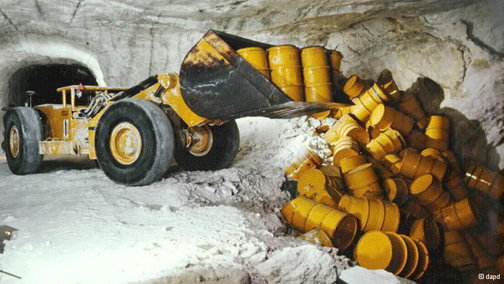
A former iron mine, Konrad, is being converted into a site to store low- and medium-level waste; it is expected to be completed in 2022. Low- and medium-level waste account for 90 percent of Germany’s total nuclear waste, but just 0.1 percent of the total radioactivity of the nation’s waste.
The most dangerous and controversial waste is heavy-metal-laden, heat-producing waste from spent fuel rods. Germany expects the total of that high-level waste to take up 28,100 cubic meters (1 million cubic feet) — a fraction of the volume of low- and medium-level waste the country must eventually store. Preliminary plans from Germany’s Federal Office for Radiation Protection call for a high-level waste repository to be built by 2050, with storage complete by 2130, and final sealing of the repository as late as 2170.
“No one has a finished concept [for storage of high-level waste], so no one can give us a finished budget,” Haverkamp said. “I won’t give an estimate anymore, but the numbers are in the billions. How many? No one knows. That’s the problem in Germany, you have to reserve a certain amount of money, but how much?” …. http://e360.yale.edu/feature/soaring_cost_german_nuclear_shutdown/3019/
French government propping up nuclear company EDF with a cash boost
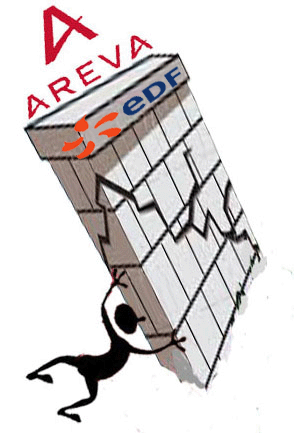
 French nuclear company EDF to get cash infusion http://www.dw.com/en/french-nuclear-company-edf-to-get-cash-infusion/a-19428058
The French government has said it will go ahead with a 4-billion-euro share issue for state-controlled electricity firm EDF. The move will help finance the construction of two controversial nuclear reactors in the UK. The French state – which holds 85 percent of EDF – said it will buy three billion euros’ worth of the newly issued EDF shares sometime this year. The fourth billion will be chipped in by other investors.
EDF’s board of directors is expected to give final investment approval this week for the construction of two EPR nuclear reactors at Hinkley Point in southwestern England, home to two old Magnox reactors that are no longer in operation and two AGR gas-cooled reactors whose construction began in 1967 and are still in operation, but whose decommissioning date is currently set for 2023.
EDF had delayed the final investment decision on the new Hinkley Point reactors several times, as it sought other investors to share the costs amid concerns the heavily indebted company will struggle to meet its financial commitments.
Internal skeptics abound The six labor-union representatives sitting on EDF’s 18-member board have repeatedly opposed the project. They wanted to see it delayed by three years to give EDF time to complete the construction of similar reactors in France, Finland and China, which are several years behind schedule.
The company’s works council secretary, Jean-Luc Magnaval, told the news agency Reuters that his union had filed a complaint on the matter with a Paris court, which has scheduled a hearing on the case for August 2.
EDF’s chief financial officer has resigned over the threat the project represents to the company’s finances.
EDF is also planning to speed up renovation of its 58 nuclear reactors in France, a task expected to cost about 51 billion euros.
EDF, which has already spent about 3 billion euros on Hinkley Point C, needs the project “to maintain its know-how and prepare for the retirement and renewal of its aging French and British nuclear fleet,” chief executive Jean-Bernard Levy told shareholders on Tuesday. He added that the new capital would also help the bolster the company’s credit rating and its ability to refinance its 37.4 billion euro debt.
Sparing no expense The Hinkley Point project is a joint venture between EDF and China General Nuclear Power Corporation. It’s one of the world’s most costly nuclear power plant projects.
The most recently projected price tag was a whopping 18 billion pounds ($24 billion, 21.7 billion euros), before Brexit lowered the value of the pound.
However, a complex system of subsidies approved by former UK finance minister, George Osborne, could cost up to 37 billion pounds, according to a recent estimate published by the UK Department of Energy and Climate Change.
Nuclear renaissance?
The UK’s environment secretary, Andrea Leadsom, recently reiterated that the Hinkley Point project will kick-start a “nuclear renaissance” in Britain that would see 18 gigawatts of new capacity added if sites at Sizewell, Bradwell, Moorside, Wylfa and Oldbury are developed along with Hinkley Point C.
Nuclear power accounts for around 16 percent of the UK’s energy requirements, which could drop to three per cent in 2030 unless new reactors are built in the meantime, Leadsom said.
EPR reactors are third-generation nuclear reactors which use pressurised water as their cooling fluid. At present, most operating reactors around the world are second-generation reactors; only around a dozen Generation 3 reactors are in operation so far.
A variety of Generation 4 reactor designs, which engineers hope will be more inherently safe and more cost-efficient than previous generations, are in various stages of prototype development, but none are expected to be commercially available before about 2030 or 2040.
By that time, however, renewable energy technologies and battery storage systems may have attainedsuch a low cost that construction of new nuclear power stations may prove a tough sell financially. That’s already the case for the Hinkley Point C project and for EDF’s other three existing EPR reactor projects around the world, all of which have proven to be far more expensive than optimistic early estimates, and very likely none of which would be getting built had they not been supported by heavy government subsidies.
‘Stop Hinkley’ campaign urges UK govt to switch to renewables, and yes, to Stop Hinkley nuclear
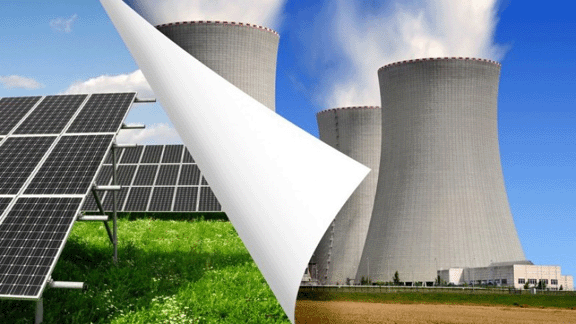 Campaigners call on government to stop Hinkley Point http://www.energylivenews.com/2016/07/26/campaigners-call-on-government-to-stop-hinkley-point/ Jul 26, 2016 Jacqueline Echevarria A group of campaigners are calling on the government to ditch the new nuclear power station at Hinkley Point C (HPC) in Somerset.
Called ‘Stop Hinkley’, the group has sent a letter to Business, Energy and Industry Strategy Secretary Greg Clark ahead of a final investment decision for the project by EDF’s Board onThursday. They say a final investment decision for Hinkley would be “little more than spin as problems mount for nuclear delusion”.
They believe the nuclear project is too expensive, will kill British manufacturing, is bad for consumers, the taxpayer, business and potentially the environment and is a total waste of money.
Renewable energy and energy efficiency projects could be implemented very quickly and much more cheaply, they added.
They stated ditching EDF’s plans for HPC would provide the country with a “wonderful” opportunity to turn Somerset into a sustainable energy hub for England.Allan Jeffery from Stop Hinkley said: “Now even the financial press says Hinkley Point C has become a laughing stock. The cost keeps rising while the cost of renewables is falling rapidly and the potential to make savings with energy efficiency is huge. We could replace Hinkley much more quickly and cheaply without the safety fears and without producing dangerous waste we don’t know what to do with.”
According to the former Department of Energy and Climate Change, the estimated cost of the Hinkley Point C project over its lifetime could reach £37 billion.
French authorities have raided EDF’s headquarters in France before the Hinkley decision.
ELN has contacted BEIS for a comment.
Japan Atomic Energy Agency again fails to do safety tests at Monju fast-breeder nuclear reactor
 Japan Atomic again flubs maintenance checks at Monju reactor http://www.japantimes.co.jp/news/2016/07/22/national/japan-atomic-again-flubs-maintenance-checks-at-monju-reactor/?utm_source=feedburner&utm_medium=feed&utm_campaign=Feed%3A+japantimes+%28The+Japan+Times%3A+All+Stories%29#.V5gV29J97Gj JIJI The Japan Atomic Energy Agency again failed to conduct checks on a device at its experimental Monju fast-breeder reactor and overlooked a warning signal from a maintenance management system for about three months, it was learned Friday.
The state-affiliated agency, which recently came under fire for failing to inspect thousands of devices at Monju, is investigating the cause of the latest mishap and devising measures to prevent a recurrence.
According to sources familiar with the matter, the device in question controls the temperature of sodium coolant for the prototype reactor, which is situated in Tsuruga, Fukui Prefecture.
The JAEA was slated to complete the inspection by the end of March, after moving up the previous deadline, which was set at the end of May
Around the end of February, the maintenance management system installed at Monju started to display a warning signal. But it was not until May 27 that agency officials noticed it, the sources said.
JAEA reported the problems to the Nuclear Regulation Authority and completed the inspection of the temperature-controlling device on May 31, the sources said.
A massive sodium leak and coverup bid in December 1995 caused Monju’s operations to be suspended. It was eventually brought back online in May 2010, but halted again by a different problem in August the same year.
In November 2012, it was found that JAEA failed to carry out maintenance checks on more than 10,000 devices at Monju. After that, the NRA effectively banned the JAEA from operating the reactor.
In November last year, the NRA recommended to science and technology minister Hiroshi Hase that JAEA be replaced as Monju’s operator. The ministry is studying the matter.
Report questions value of new nuclear projects in Wales compared with renewables
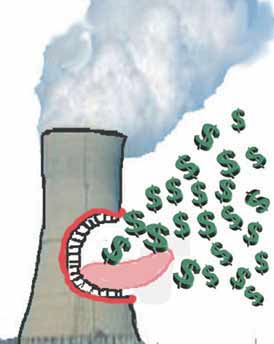
 New nuclear projects in Wales must be ‘cost-competitive’ with renewables, say MPs , Business Green, 26 July 16 Planned nuclear sites in North Wales should only go ahead if government can prove development is ‘value for money’, as Business Secretary Greg Clark visits Japan to fan investor interest in UK nuclear projects
Lawmakers on the Welsh Affairs Committee have published a new report insisting that before proposed nuclear developments at Wylfa Newydd and Trawsfynydd in North Wales go ahead the government must prove the financial viability and community benefit of the projects.
“The government must prove that the cost of any nuclear development is well understood and competitive with renewable sources. These costs must be made public in a format that can be easily understood,” Committee chair David Davies MP said.
“There has to be a demonstrable benefit for the local community as well,” he added. “Local businesses must form a key part of the supply-chain and be given sufficient information to allow this to happen.”………
The report concludes the government should only support the development at Wylfa Newydd if the strike price for the project’s electricity is competitive with renewables and below that of Hinkley Point C, EDF’s controversial nuclear project in Somerset which is due to receive a final investment decision this week. Hinkley’s strike price is £92.50 per MWh – more than double the current market price of power. In comparison, the strike price for onshore wind is around £80 per MWh with some experts now arguing new onshore wind farms can be built at a lower levelised cost than new gas power plants. ……..
Cost estimates for Wylfa Newydd must cover the lifetime of the project, including decommissioning and waste disposal, MPs said, after concerns were raised during their investigation that nuclear power projects are often subject to delays and cost schedule overruns. Cost estimates for Hinkley Point C have ballooned from £16bn in 2012 to almost £21bn earlier this year, while last week EDF’s Paris headquarters were raided by the French finance authorities investigating concerns about its reporting of maintenance and development costs………http://www.businessgreen.com/bg/news/2465917/new-nuclear-projects-in-wales-must-be-cost-competitive-with-renewables-say-mps
 |
Click here to Reply or Forward
|
Cost of Hitachi nuclear plant for North Wales is far too high
Hitachi U.K. Nuclear Plant Should Get Less Than EDF, Panel Says http://www.bloomberg.com/news/articles/2016-07-25/hitachi-u-k-nuclear-plant-should-get-less-than-edf-panel-saysAlex Morales AlexJFMorales
-
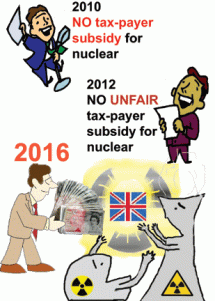 EDF’s Hinkley Point is set for $39 billion of future subsidies
 -
Hinkley secured guaranteed power price at twice current rate
-
Hitachi Ltd. should be paid less for the power from its planned nuclear plant in North Wales than Electricite de France SA has been promised for reactors in western England, a panel of U.K. lawmakers said, seeking to keep a lid on energy prices paid by consumers.
The government should also ensure the cost of the Wylfa Newydd project by Hitachi’s Horizon unit is competitive with renewable-power plants such as onshore wind farms, the cross-party Welsh Affairs Committee said Tuesday in an e-mailed report. The lawmakers called for a “clear and comprehensible explanation” of the lifetime costs of the 2.7-gigawatt project and for a “demonstrable benefit” to the local community.
The U.K. is struggling to build generating capacity fast enough to keep up with the closure of aging nuclear power stations and a phase-out of coal-fired plants. EDF is set to make a final investment decision on Thursday on whether to proceed with an 18-billion-pound ($24 billion) plan to build two reactors at Hinkley Point. The utility has repeatedly postponed a decision on the long-delayed project, despite securing a U.K. government guarantee that it’ll receive 92.50 pounds per megawatt-hour of power, more than double current rates.
- “The government should only build Wylfa Newydd if the strike price is below that agreed for the Hinkley Point C and competitive with renewable sources,” the committee said in a statement. “They must be transparent on cost and provide a clear and comprehensible explanation of the lifetime cost of the project, including decommissioning and waste disposal.”
Fixed Amount
Power from Hinkley Point and Wylfa will be paid for under a so-called contract for difference, which fixes the amount the utility receives per megawatt-hour, making its income predictable. If prevailing power prices are lower than the agreed “strike price,” utilities recoup the difference through consumer bills. If the prevailing price is greater, the utility returns the difference to consumers.
- Because prices have fallen since the EDF contract was agreed in 2013, the future subsidy cost to consumers of Hinkley has increased, according to areport earlier this month from the National Audit Office, which scrutinizes government spending. Using current projections for the wholesale power price, it estimated the lifetime cost of the top-ups has ballooned to 29.7 billion pounds from 6.1 billion pounds originally.The Welsh Affairs Committee also called on ministers to draw up contingency plans in case the Wylfa plant, consisting of two Hitachi advanced boiling-water reactors, isn’t completed as planned by 2025. EDF had originally envisaged its new reactors would generate power by Christmas 2017. Under its current schedule, Hinkley won’t come online until 2025, the same year as Hitachi aims to complete Wylfa.
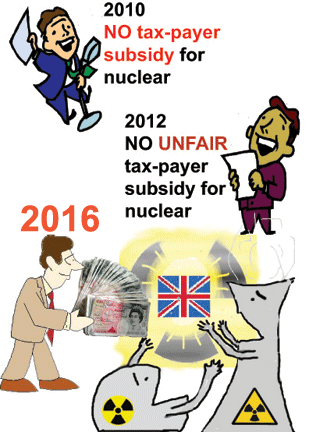
“Thirty Seconds to Midnight” – coming film, encouraged by Dr Helen Caldicott
Dr. Helen Caldicott’s Prognosis for Humanity – “Not Good” “We are like lemmings walking toward the cliff of nuclear annihilation, worrying about things that don’t matter.” http://registremblay.com/dr-helen-caldicotts-prognosis-humanity-not-good/
On Wednesday, July 20, 2016, I had the distinct pleasure of interviewing another person of great importance with an urgent message for humanity. Dr. Helen Caldicott is an internationally acclaimed Australian physician and antinuclear activist. She is a co-founder of Physicians for Social Responsibility, and founder of the Women’s Action for Nuclear Disarmament, and International Physicians to Save the Environment.
As a physician who has studied and researched the biological effects of radiation throughout her entire career, she warns the world that nuclear technology threatens life on our planet with extinction. This is a chilling message at a time when nuclear power, the threat of an imminent nuclear holocaust, and climate change have humanity on the brink of extinction. These three threats are the principle theme of my current film project which had been titled, 11:57 – Three Minutes to Midnight. When I told Helen that I had an alternative title 11:59:30 – Thirty Seconds to Midnight, she told me “that’s it.”
Helen’s message and the message of my new film are disturbing because they present the irrefutable facts screaming out for attention before it is too late. As a species, we are running out of time to save ourselves and all life on the planet. Dr. Caldicott’s prognosis: “not good.”
Pending my October trip to Russia to complete filming, I anticipate that 11:59:30 – Thirty Seconds to Midnight will be ready for release early in 2017.
Growth spurt for green bonds in the financial market
Green bonds the new black in the market as environmental financing surges, ABC News, 26 July 16 By business reporter Stephen Letts The environmentally sensitive shoots developing in the global bonds market appear to be heading for a serious growth spurt with another record quarter of “green bonds” issuance.
In a research note on the sector, the credit ratings agency Moody’s found environmentally focused green bond issuance in the June quarter hit a record $US20.3 billion ($27 billion), well above the $US16.9 billion ($22.5 billion) recorded in the first quarter of the year.
Added together, the two quarters raised almost 90 per cent more capital than in the first half of 2015.
“The global green bond market is now poised to reach $US75 billion ($100 billion) in total volume for 2016 and so set a new record for the fifth consecutive year, given the strong issuance already observable in the first two weeks of Q3,” Moody’s senior vice president Henry Shilling said.
That fresh flow in the third quarter includes $300 million worth of bonds from Victoria put out to tender earlier this month, the first green issuance from an Australian state or federal government……
Clean energy projects dominate the market
The increasing demand has been supported by many big pension funds now carrying mandates that stipulate portfolios must hold required levels of environmentally friendly investments.
Around two-thirds of green bond proceeds in the quarter were directed to renewable energy and energy efficient projects, with clean transport accounting for a further 17 per cent of the money raised.
The US dominated issuance, with 23 per cent of the market, followed by the big development agencies such as the World Bank, with 17 per cent, although China is expected to bounce back to its dominant position in the market with $US3 billion worth of bonds in the pipeline for sale in coming months……. http://www.abc.net.au/news/2016-07-27/green-is-new-black-in-the-bonds-market-environmental-finance/7664414
A disruptive technology: Elon Musk’s energy master plan
Sophie Vorrath: Musk’s energy master plan: Is this the beginning of the end of the utility? July 27, 2016. When Elon Musk published part 2 of his Tesla Masterplan last week, it was his vision of a future where cars from a huge shared fleet of driverless electric vehicles could be summoned by the touch of a mobile phone app that dominated headlines.
But Musk’s vision for a world of energy self-sufficient households with solar and battery storage was equally ambitious – and threatens to be as disruptive to the world’s electricity industry as his autonomous shared vehicle plan could be to the automotive industry, not to mention Uber. http://onestepoffthegrid.com.au/musks-energy-master-plan-is-this-the-beginning-of-the-end-of-the-utility/
Little hope for commercialisation of Small Nuclear Reactors (SMRs)
“Despite the optimism among some in the industry, there remain significant hurdles to widespread use of SMRs. Firstly, even those building them privately admit the first ones will cost roughly the same per unit of electricity produced by a large reactor until costs can be driven down. One executive says: “Over time, we think we can get the costs down — as long as enough of them are commissioned.” – Financial Times 26 July 16
French staff in last bid to block Hinkley Point,
 French staff in last bid to block Hinkley Point, Times, Adam Sage, 26 July 16 Paris Staff at the French electricity giant planning to build an £18 billion nuclear plant in Britain have made a final attempt to block the project, which they fear will cripple the state-owned group.
The works council at Eléctricité de France (EDF) is seeking an injunction to prevent a board meeting called to discuss the scheme on Thursday.
EDF’s directors are expected to approve the plan to build two new-generation European pressurised reactors at Hinkley Point in Somerset to supply 7 per cent of Britain’s electricity.
Lawyers for the works council will seek to have any decisions concerning the plant struck…(registered readers only) http://www.thetimes.co.uk/article/french-edf-staff-in-last-bid-to-block-hinkley-point-flxxstghk
USA marketing nuclear power to Mexico
 US and Mexico map out agreement on nuclear power issues Utility Dive| July 26, 2016
Dive Brief:
- United States and Mexico have committed to negotiate a bilateral agreement for peaceful nuclear cooperation, according to the White House.
- The agreement is aimed at strengthening the existing legal framework and providing an enhanced basis for the transfer of nuclear technology, fuel, and components between the countries.
- In addition to enhancing potential power sector emissions reductions, the agreement aims to enhance the capacities of both nations in the supply chain and nuclear fuel services and to facilitate the sharing of best practices.
Nuclear industry to get a heft subsidy from New York residents
 A hefty nuclear subsidy Times Union, July 25, 2016 “……… It’s one thing to keep nuclear plants running temporarily while the state transitions to green energy. It’s another to hand nuclear plant operators billions of dollars that could instead be used to move New York that much more quickly to a clean energy future.
The nuclear subsidies are being proposed in the state’s Clean Energy Standard. The CES, also known as the “50-by-30” plan — because it seeks to achieve the 50 percent clean energy goal by 2030 — would shift more of the state’s electricity supply to sources like wind, solar, hydropower and biomass, and away from fossil fuels.
Some want nuclear power in the mix, too, but it has some not-insignificant problems — the risk of an accident, and the still-unresolved question of safe disposal of radioactive waste. It’s hard to see nuclear power plants as being part of an environmentally sound energy future.
As a short-term bridge to that future, however, they could play a part, if they can stand on their own. Supporters say they can’t in the current market.
So the CES would include a program of “zero emissions credits” — a charge that utilities and energy service companies would pay to keep nuclear plants open. Those costs are expected to start at $965 million for the first two years, rising to about $1 billion a year, paid for by, well, pretty much anyone with an electricity bill……
What, however, is a reasonable windfall? Just how much do these plants realistically need to stay open? Is the state fattening nuclear plant profits with money that could be used to fund more alternative energy, and more energy savings programs, and achieve the CES goals even sooner?…….http://www.timesunion.com/tuplus-opinion/article/Editorial-A-hefty-nuclear-subsidy-8416153.php
Pro nuclear propaganda revs up in South Africa
 Why Eskom’s Brian Molefe is pumping up the nuclear propaganda
The issue of relative costs is an area in which Eskom likes to play fast and loose with facts. Molefe, for instance, loves to talk about the relative cheapness of nuclear power Rand Daily mail CAROL PATON
26 JULY 2016 “……..As Eskom prepares to roll back the rise of independent power producers (IPPs) and lay the basis for the nuclear build, the propaganda war is going to be critical. This is because, on the facts alone, Eskom’s central argument — that SA’s energy future is a straight choice between variable and unreliable renewables and reliable base load nuclear — is nonsense.
What SA needs to do to break Eskom’s stranglehold
Even before Eskom’s letter to Energy Minister Tina Joemat-Pettersson drawing the line under the IPP programme surfaced last week, Molefe and Eskom’s head of generation, Matshela Koko, have been pushing this line. As SA can’t have more coal plants because of its commitments to reduce emissions, and as renewable energy is available during the day, when it’s not really required, the only solution lies with nuclear power.
This is a misrepresentation of the choices available. A great deal of technical work and international experience has shown that the next round of large investments SA should be making should be in gas. Unlike renewable energy, nuclear energy or a coal-fired power station, gas can be switched on and off to provide peaking power. The turbines need to turn only when you need them. With large discoveries in Mozambique, investing in gas is the logical next step. The CSIR has done detailed work on this and has put forward a third option to the baseload debate: to use gas and renewables — now by far the cheapest — in concert to create baseload power.
The issue of the relative costs of the technologies is another area in which Eskom likes to play fast and loose with the facts. Molefe, for instance, loves to talk about the relative cheapness of nuclear power. Koeberg — built in 1985 and long since paid for — supplies energy at R0.43/kWh. This should be compared with solar thermal power — the only renewable energy technology that can store energy — he says, the cost of which ranges between R2/kWh and R6/kWh. It’s a ridiculous comparison. In the absence of an agreed-on and updated Integrated Resource Plan (IRP) that would provide an authoritative view on the relative costs of the technologies, the CSIR’s Energy Centre calculated the following in 2015: new nuclear power is projected to cost at least R1/kWh, but very likely more; new coal R0.80/kWh — it is now much higher at about R1; wind R0.60/kWh and solar R0.80/kWh.
A new draft of the IRP by Eskom’s technical modellers — that has been sent back to the drawing board by the Department of Energy — has suggested that the overnight cost (capital cost excluding interest) of building new nuclear power would be $6 000/kW. The department reckoned on about $4 166/kW.
These are not numbers Eskom is likely to use in the public debate. Eskom, in particular Molefe, has a talent for spinning a good story. After less than five months in the job, he made the startling and completely untrue statement that Eskom’s plant performance had improved vastly. At that point, Eskom’s plant performance was still in decline. More recently, in May, he insisted at a news conference in Parliament that Eskom’s ability to meet demand had nothing to do with lower-than-anticipated demand. This too, turned out not to be true, with Eskom’s own demand curve showing real decline over 2015.
These are perhaps minor skirmishes with the truth. But getting the nuclear build on track is a far bigger fight. Expect Eskom to pump up the propaganda war. — Business Day http://www.rdm.co.za/business/2016/07/26/why-eskom-s-brian-molefe-is-pumping-up-the-nuclear-propaganda
NASA to send nuclear powered spacecraft to Mars (hope it doesn’t crash)
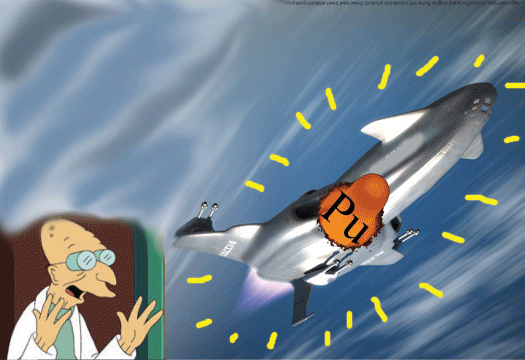 NASA books nuclear-certified Atlas 5 rocket for Mars 2020 rover launch, Spacefilght Now, July 25, 2016 Justin Ray CAPE CANAVERAL — America’s next Mars rover, a $2.1 billion nuclear-powered vehicle to search for evidence that life once existed there, will be launched to the Red Planet in the summer of 2020 by a powerful Atlas 5 rocket.
Jim Green, planetary science division director, revealed the selection of the United Launch Alliance vehicle at the NASA Advisory Council meeting in Cleveland this afternoon.
“It will be the Atlas 5 carrying Mars 2020 to Mars,” Green said.
ULA’s Atlas 5 and Delta 4-Heavy and SpaceX’s Falcon Heavy were studied as possible launch vehicles for the intermediate-to-heavy classed payload. It was not immediately known if SpaceX submitted a bid for this launch contract.
But, currently, Atlas 5 is the only launch vehicle that holds a NASA certification for launching the nuclear batteries made of plutonium that will power the 2,000-pound rover.
The six-wheeled robot will use by a Multi-Mission Radioisotope Thermoelectric Generator, enabling surface operations day and night by converting heat into electricity.
Atlas 5 has successfully performed the only launches of nuclear-equipped spacecraft for NASA in recent history: New Horizons to Pluto in 2006 and the Mars Science Laboratory’s Curiosity rover in 2011.
The Mars 2020 mission will search for indications of past Martian life, building upon the ongoing field geology work by the Curiosity rover that shows the planet’s early history had conditions suitable for life…….https://spaceflightnow.com/2016/07/25/nasa-books-nuclear-certified-atlas-5-rocket-for-mars-2020-rover-launch/
-
Archives
- February 2026 (211)
- January 2026 (308)
- December 2025 (358)
- November 2025 (359)
- October 2025 (376)
- September 2025 (258)
- August 2025 (319)
- July 2025 (230)
- June 2025 (348)
- May 2025 (261)
- April 2025 (305)
- March 2025 (319)
-
Categories
- 1
- 1 NUCLEAR ISSUES
- business and costs
- climate change
- culture and arts
- ENERGY
- environment
- health
- history
- indigenous issues
- Legal
- marketing of nuclear
- media
- opposition to nuclear
- PERSONAL STORIES
- politics
- politics international
- Religion and ethics
- safety
- secrets,lies and civil liberties
- spinbuster
- technology
- Uranium
- wastes
- weapons and war
- Women
- 2 WORLD
- ACTION
- AFRICA
- Atrocities
- AUSTRALIA
- Christina's notes
- Christina's themes
- culture and arts
- Events
- Fuk 2022
- Fuk 2023
- Fukushima 2017
- Fukushima 2018
- fukushima 2019
- Fukushima 2020
- Fukushima 2021
- general
- global warming
- Humour (God we need it)
- Nuclear
- RARE EARTHS
- Reference
- resources – print
- Resources -audiovicual
- Weekly Newsletter
- World
- World Nuclear
- YouTube
-
RSS
Entries RSS
Comments RSS
 nuclear-news