Climate change will drive voter turnout in America

 DEMOCRATIC CONVENTION: Steyer: Climate change will drive voter turnout EE News Evan Lehmann, E&E reporter ClimateWire: Tuesday, July 26, 2016 PHILADELPHIA — Billionaire climate advocate Tom Steyer believes young Americans will cast more votes this year based on rising temperatures than in past presidential elections.
In an interview with ClimateWire last night, the founder of NextGen Climate also downplayed the idea of placing a price on carbon dioxide and dismissed the notion of swapping the Clean Power Plan for a carbon tax.
That’s a huge wedge issue,” Steyer said of young voters’ concern about climate change. “I think it’s a critical issue as to whether they turn out.”
NextGen is spending more than $25 million to encourage millennials to vote in November. Young adults currently account for the largest and most diverse population in the United States, and Steyer believes that could help Hillary Clinton beat Donald Trump on Nov. 8.
Separately, Steyer’s group is partnering with five different unions to canvass working-class and minority neighborhoods, where the issue of climate change could help compel young voters to turn out this fall. Large percentages of African Americans and Latinos believe that global warming is occurring, and Steyer’s group is trying to turn those concerns into electoral action.
We’re spending a lot of time trying to do voter-to-voter contact in the swing states, trying to make sure they are aware of the facts, know the difference between the candidates and know how important their vote is,” Steyer said.
Inside the Wells Fargo Center last night, Sen. Bernie Sanders of Vermont and other speakers raised their own concerns about climbing temperatures on the first day of the Democratic National Convention.
“This election is about climate change, the greatest environmental crisis facing our planet,” Sanders told the audience packing the basketball arena.
“Hillary Clinton is listening to the scientists who tell us that — unless we act boldly and transform our energy system in the very near future — there will be more drought, more floods, more acidification of the oceans, more rising sea levels. She understands that when we do that, we can create hundreds of thousands of good-paying jobs,” he said. “Donald Trump? Well, like most Republicans, he chooses to reject science. He believes that climate change is a ‘hoax,’ no need to address it.”
Trump aims for Bernie supporters
Last night’s program also included a short video on climate change and its impact on the Everglades.
“The effects of climate change can no longer be ignored,” the narrator in the video said, noting that warming threatens seagrass and mangroves in the Everglades, which absorb carbon. It touted the Obama administration’s $2.2 billion funding for restoration of the Everglades, which among other things will help improve the local drinking water supply.
The video was followed by a speech from Sen. Jeff Merkley (D-Ore.), the lone senator to endorse Sanders during the presidential primary campaign. He said Sanders “emboldened us” to push for 100 percent renewables but added, “We need to fight together with Bernie and Hillary.”…..Reporters Josh Kurtz, George Cahlink and Mike Soraghan contributed. http://www.eenews.net/stories/1060040774
New York Times continues to ignore the renewable energy revolution, and talk up nuclear
you’d never know any of this big picture once-in-a-century transformation from reading the New York Times, which just continues to write article after article that misses the forest for the trees.
the clean energy revolution means other low-carbon or zero-carbon technologies that haven’t reached the point of exponential growth — and that are not experiencing learning curve improvements in cost and performance — are very likely to fall further and further behind. That is where nuclear power finds itself. As do hydrogen fuel cell cars.
It also means that the electric grid in particular will go through some growing pains as it starts to integrate renewables at a faster pace than anybody thought possible just a few years ago. The Times, bizarrely, has chosen to publish article after article over-emphasizing and indeed exaggerating those growing pains, while projecting a future for nuclear power that currently doesn’t exist
 Nuclear Power Advocates Claim Cheap Renewable Energy Is A Bad Thing, Climate Progress BY JOE ROMM JUL 28, 2016 Nuclear power advocates are trying a new line of attack on solar and wind energy — it’s too darn cheap!
In the real world, however, the unexpectedly rapid drop in the price of cleantech, especially renewable power and batteries, is a doubly miraculous game-changer that is already cutting greenhouse gas emissions globally and dramatically increasing the chances we can avoid catastrophic climate change.
As I detailed on Monday, the New York Times in particular keeps running slanted articles talking up nuclear and talking down renewables — articles that totally miss the forest for the trees. That culminated in a truly absurd piece last week, “How Renewable Energy Is Blowing Climate Change Efforts Off Course,” which is the exact opposite of reality, as Goldman Sachs has detailed in its recent reports on “The Low Carbon Economy.”
This post will focus primarily on the big picture, the forest. I will deal in later posts with a few of the more interesting trees, such as whether, the U.S. should consider give existing nukes some sort of short-term carbon credit so they are not shut down prematurely and replaced by natural gas.
The big picture reality of the clean energy revolution
The big picture reality is this: The world is finally starting to take some serious action to avoid catastrophic climate change, which means first the electric grid will decarbonize, and then the transportation system. That means global coal use peaks or plateaus first — and then oil does. Continue reading
Future of UK’s Bradwell and Sizewell nuclear projects now in doubt as government to review Hinkley plan

 Bradwell & Sizewell futures unclear after delayed Hinkley decision http://www.itv.com/news/anglia/story/2016-07-28/bradwell-sizewell-futures-unclear-after-delayed-hinkley-decision/
A late move by the government to review all of the component parts of the proposed nuclear power deal in the region has cast doubt that it will go ahead in its current form.
The French Energy giant EDF has agreed to fund a new nuclear power station at Hinkley Point in Somerset which was expected to pave the way for new plants to be constructed at Sizewell in Suffolk and Bradwell in Essex.
In a dramatic twist though, the Government says it now won’t decide whether to proceed with the projects until the autumn.
The £18 billion Hinkley project is “on ice” to allow the prime minister Theresa May to “make up her mind”, ITV News understands.
EDF approved UK Hinkley nuclear project, but now there’s a new delay
 Hinkley nuclear plant faces fresh delay after EDF approves investment, Ft.com 28 July 16
Ministers announce new review immediately after EDF gives green light to £18bn project The plan to build an £18bn nuclear reactor at Hinkley Point was hit with a last-gasp delay on Thursday night as the government decided to hold a new review hours after EDF, the project’s French developer, gave it the go-ahead.
He said: “The UK needs a reliable and secure energy supply and the government believes that nuclear energy is an important part of the mix. The government will now consider carefully all the component parts of this project and make its decision in the early autumn.”
One person said the scheme was expected to proceed after the review but the fresh delay had been a surprise.
The news came after EDF had given the go-ahead for the UK’s first nuclear power plant in 20 years, approving the Hinkley Point scheme at a board meeting on Thursday.
Directors approved the long-delayed project during a meeting in Paris. But opposition from within the company was underlined by the resignation in protest of a board member as the meeting started. The board was more divided than had been expected…….
critics say the project could also risk the financial future of EDF, the highly indebted French utility, whose chief financial officer Thomas Piquemal quit in March, warning that its future was being put in danger by Hinkley Point.
The scheme has been subject to multiple delays and budget revisions since first being proposed in the mid-2000s as part of what Tony Blair’s government promised would be a “nuclear renaissance” for the UK.
New reactors are also being planned in north Wales and in Cumbria, while EDF wants to help develop two sites after Hinkley Point — at Sizewell in Suffolk and Bradwell in Essex.
EDF had hoped to take the final investment decision earlier this year but it was postponed amid growing opposition from board members and executives.
That opposition persisted until the end, despite the company’s decision to push ahead with the scheme. As the meeting got under way, Gérard Magnin quit as a state representative on EDF’s board, calling the company’s nuclear strategy “highly risky”.
In the end, the vote was carried by 10 to 7. It was closer than expected, with all six union representatives and one shareholder representative voting against the measure.
Ministers in the UK must now give their final sign-off to the scheme, having already agreed to pay £92.50 — double the current wholesale price — for each megawatt hour of electricity it produces for 35 years………https://next.ft.com/content/181077e2-54dc-11e6-befd-2fc0c26b3c60
EDF board member resigns, attacking Hinkley Point nuclear project as financially ‘risky’
Telegraph.co.uk -26 July 16
Like Brexit, UK’s Hinkley nuclear plan is based on shaky politics, not on economic reality
Areva, the French state-owned company which makes the reactors, is being taken over by EDF but it is being investigated by France’s Nuclear Safety Authority over “irregularities” in 400 parts. Areva also faces a state aid investigation.
 Even many of the staff inside EDF think Hinkley is a colossal white elephant. The company’s unions, who are represented on the board, fear the project will sink the company and have started legal action to delay the decision, while its finance director resigned in March.
For Hinkley, as with Brexit itself, political chicanery has triumphed over economic reality.
Hinkley’s nuclear plant fails all tests – bar the politics https://www.theguardian.com/environment/damian-carrington-blog/2016/jul/28/hinkley-point-c-nuclear-plant-fails-all-tests-bar-the-politics
Huge, expensive and difficult to build, Hinkley is a throwback to the last century, just as the world is embracing the smart energy systems of the future, Guardian, Damian Carrington, 29 July 16 The new nuclear reactors now given the go-ahead at Hinkley Point have failed every test bar the one that finally mattered – political expediency.
The plant, to be paid for by UK energy customers, could cost them £37bn and is a leading contender for the most expensive object ever built on the face of the Earth. A former Conservative energy secretary calls it “one of the worst deals ever” for Britain.
It faces formidable commercial, technical and legal obstacles to getting built remotely on time or budget, or indeed at all. And while the rest of the world is accelerating ahead with the smart energy systems of the 21st century, Hinkley is a throwback to the nuclear age of the 20th.
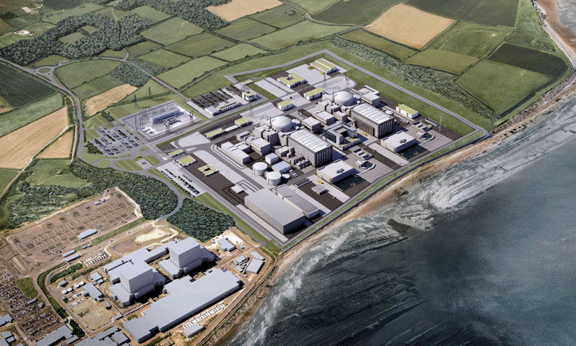
But the French government, which majority-owns Hinkley’s builders EDF, wants to preserve its national nuclear industry. The UK government, blinded by the dazzle of a mega-project, is happy to let its citizens pick up the bill.
It has taken almost a decade to get to this point. In 2007, EDF said British Christmas turkeys would be being roasted with its nuclear electricity in 2017. The earliest possible switch-on now is 2026, another decade away.
What is scary is that reaching the final decision to go ahead was the easy bit. Now they have to deliver a giant and fiendishly complex construction project, described by one nuclear engineer as like “building a cathedral within a cathedral”, that is, “unconstructable”.
EDF has never managed to build the types of reactors intended for Hinkley. Its two attempts so far, in France and Finland, remain many years behind schedule and many billions over budget. Perhaps they are hoping for third time lucky.
UK nuclear power generation is £27.5 more expensive per MWh than that generated by gas power plants
Yet the commercial foundations for this engineering miracle are incredibly shaky. EDF is on the ropes financially and had to be given a €3bn bailout in April by the French government. That may well be challenged under EU state aid rules, which would join an ongoing state aid legal case brought by Austria against UK subsidies for Hinkley.
It gets worse. The French Financial Markets Authority raided EDF this month, investigating allegations that it misrepresented the cost of Hinkley and other projects. Banks and other financial institutions already loathed the Hinkley plan, with EDF warned of further credit rating downgrades if it goes ahead, making its huge debt more expensive to maintain.
Areva, the French state-owned company which makes the reactors, is being taken over by EDF but it is being investigated by France’s Nuclear Safety Authority over “irregularities” in 400 parts. Areva also faces a state aid investigation.
Even many of the staff inside EDF think Hinkley is a colossal white elephant. The company’s unions, who are represented on the board, fear the project will sink the company and have started legal action to delay the decision, while its finance director resigned in March.
With foundations this unsound, you would think the UK could get out of the deal easily if it turns sour. But think again. The deal to be signed with EDF contains a “poison pill” which could leave taxpayers with a £22bn bill if a future UK government shuts the plant down.
The government is adamant that Hinkley, which could provide 7% of the UK’s electricity, is a vital part of a secure low-carbon future. But a barrage of recent reports from serious players say the opposite. The future is not gigantic centralised energy plants, but widespread networks of renewable energy and storage, interconnected across the continent, bolstered by energy efficiency measures and the smart management of demand.
Hinkley Point C will provide 7% of UK electricity when it starts to produce electricity in 2025
Bodies including the government’s own National Infrastructure Commission(NIC), the National Grid, industry group Energy UK, all point to a smart system that is more secure, cheaper and faster to build. They all use the same word – “revolution” – for the fast changes now happening in energy, while theInternational Energy Agency talks of a rapid “transition”.
Hinkley’s reactors are a revolution only in the sense that they overturn all logic. Energy efficiency could deliver six Hinkley’s worth of electricity by 2030, interconnector cables to Norway, Denmark and France could add another two or three Hinkleys to the grid by 2025 and four Hinkleys’ worth of electricity could be saved by 2030 by increasing the ability to store electricity and making the grid smarter, with the latter alone saving bill payers £8bn a year. Solar and wind power are also cheaper than Hinkley’s nuclear power.
EDF had said its decision on Hinkley would be made in September at the earliest. So why the sudden rush, after so many years of delay? The company’s announcement that the decision was being brought forward came on the evening after Theresa May, keen to signal post-Brexit Britain remains open for business, had met Francois Hollande for talks. For Hinkley, as with Brexit itself, political chicanery has triumphed over economic reality.
Accuracy of climate modelling in predicting ocean and atmospheric warming
since 1992, the models have been within 3 % of the measurements. In my mind, this agreement is the strongest vindication of the models ever found, and in fact, in our study we suggest that matches between climate models and ocean warming should be a major test of the models
Climate models are accurately predicting ocean and global warming, Skeptical Science 27 July 2016 by John Abraham
For those of us who are concerned about global warming, two of the most critical questions we ask are, “how fast is the Earth warming?” and “how much will it warm in the future?
The first question can be answered in a number of ways. For instance, we can actually measure the rate of energy increase in the Earth’s system (primarily through measuring changing ocean temperatures). Alternatively, we can measure changes in the net inflow ofheat at the top of the atmosphere using satellites. We can also measure the rate of sea-level rise to get an estimate of the warming rate.
Since much of sea-level rise is caused by thermal expansion of water, knowledge of the water-level rise allows us to deduce the warming rate. We can also use climate models (which are sophisticated computer calculations of the Earth’s climate) or our knowledge from Earth’s past (paleoclimatology).
Many studies use combinations of these study methods to attain estimates and typically the estimates are that the planet is warming at a rate of perhaps 0.5 to 1 Watt per square meter of Earth’s surface area. However, there is some discrepancy among the actual numbers.
So assuming we know how much heat is being accumulated by the Earth, how can we predict what the future climate will be? The main tool for this is climate models (although there are other independent ways we can study the future). With climate models, we can play “what-if scenarios” and input either current conditions or hypothetical conditions and watch the Earth’s climate evolve within the simulation.
Two incorrect but nevertheless consistent denial arguments are that the Earth isn’t warming and that climate models are inaccurate. A new study, published by Kevin Trenberth, Lijing Cheng, and others (I was also an author) answers these questions.
The study was just published in the journal Ocean Sciences; a draft of it is available here. In this study, we did a few new things. First, we presented a new estimate of oceanheating throughout its full depth (most studies only consider the top portion of the ocean). Second, we used a new technique to learn about ocean temperature changes in areas where there are very few measurements. Finally, we used a large group of computer models to predict warming rates, and we found excellent agreement between the predictions and the measurements.
According to the measurements, the Earth has gained 0.46 Watts per square meter between 1970 and 2005. Since, 1992 the rate is higher (0.75 Watts per square meter) and therefore shows an acceleration of the warming. To put this in perspective, this is the equivalent of 5,400,000,000,000 (or 5,400 billion) 60-watt light bulbs running continuously day and night. In my view, these numbers are the most accurate measurements of the rate at which the Earth is warming.
What about the next question – how did the models do? Amazingly well. From 1970 through 2005, the models on average showed a warming of 0.41 Watts per square meter and from 1992-2005 the models gave 0.77 Watts per meter squared. This means that since 1992, the models have been within 3 % of the measurements. In my mind, this agreement is the strongest vindication of the models ever found, and in fact, in our study we suggest that matches between climate models and ocean warming should be a major test of the models……..http://www.skepticalscience.com/climate-models-accurately-predicting-ocean-global-warming.html
The New York Times utterly misrepresents whats happening in Germany
Nuclear Power Advocates Claim Cheap Renewable Energy Is A Bad Thing, Climate Progress BY JOE ROMM JUL 28, 2016
“…………..For instance, in their “How Renewable Energy Is Blowing Climate Change Efforts Off Course” story, the Times asserts:
In Germany, where renewables have mostly replaced nuclear power, carbon emissions are rising, even as Germans pay the most expensive electricity rates in Europe.
I have kept both of the hyperlinks from the Times piece so you can see for yourself what game they are playing. It is quite rare that a newspaper story links to two articles that so thoroughly debunk the points the story is trying to make.
The first hyperlink is apparently meant to cover the assertion, “In Germany, where renewables have mostly replaced nuclear power.” But as you can see, the link goes to a December 2015 “Clean Energy Wire” story with this lead chart: [on original]
This chart does not, however, show “renewables have mostly replaced nuclear power” (orange). Quite the reverse. The chart explicitly shows that, for example, from 2013 to 2015, renewable generation rose 42 billion kilowatt-hours (bkwh) — while natural gas dropped 11 bkwh, hard coal dropped 9 bkwh, lignite dropped 6 bkwh, and nuclear dropped 5 bkwh. In short, renewables up 42 bkwh, fossil fuels down 26 bkwh, and nuclear down 5 bkwh (while overall, generation was up). Oops!
Since renewables have been mostly replacing fossil fuels, as the chart shows, you can probably guess that carbon emissions haven’t actually been rising. The second hyperlink goes to a March 2016 story that contains this chart: [on original].
As you can plainly see, this chart does not show that “carbon emissions are rising.” Quite the reverse. German emissions have generally been falling.
So how does the Times get to its claim that German will “carbon emissions are rising” when the most one can objectively say is in recent years they have been flat? Well the links do note that CO2 emissions rose a whopping 1 percent in 2015. Or, as the first article put it, “Germany’s CO2 emissions have inched up in 2015 despite a rapidly increasing share of renewables in electricity production.”
Why did emissions inch up? The first link immediately goes on to explain, “The main cause for the year-on-year rise were cooler temperatures compared to 2014.” Not exactly a compelling argument for “How Renewable Energy Is Blowing Climate Change Efforts Off Course.”
Yes, German electrical rates are high. The Times could have written an interesting story on why. It is actually a gift the Germans gave the world in its fight against global warming. The Germans decided to rapidly deploy solar power during a time when it was quite expensive to do so. Indeed, it was over five times more expensive to deploy in Germany back then than it is to deploy in the U.S. Southwest now!
That massive German investment helped solar power come down the learning curve faster than people expected, and today, as I’ve reported, utilities in this country and around the world are signing contracts for solar power at the unheard-of price of four cents a kilowatt hour or less — which is roughly one third of the average residential rate in this country.
Rather than trashing the Germans the way the New York Times does, we should all be thanking them! But the Times is not in the thanking business. They are in the slanting business.
The bottom line is that nothing that has happened in Germany supports the ridiculous thesis: “How Renewable Energy Is Blowing Climate Change Efforts Off Course.” The truth, as the second link the Times itself provides explains, is that “a 2011 decision to phase out nuclear power within a decade, lent impetus by Japan’s Fukushima disaster, has seen dirty coal maintain a significant share of the energy mix.”
It was Germany’s decision to speed up the shutdown of its nuclear reactors that caused the drop in CO2 emissions to (temporarily) stall. Personally, I wouldn’t have made that decision, since the short-term consequences were almost inevitable. But for reasons only known to itself, the Times seems to be trying to make one of the biggest heroes of the climate action story in Germany — renewable power — into a villain.
The Times piece tries to do the same thing in its discussion of the competition between renewables and nuclear power (and natural gas) in this country. I’ll deal with that in my next piece. http://thinkprogress.org/climate/2016/07/28/3802326/nuclear-power-renewables-cheap/
Hinkley Point nuclear station – not just a folly – but a massive folly
Why Hinkley Point is a nuclear folly of Titanic proportions https://www.newscientist.com/article/2099287-why-hinkley-point-is-a-nuclear-folly-of-titanic-proportions/ French utility company EDF is going ahead with plans for a massive new nuclear reactor in the UK, but there are many reasons to doubt it will ever be finished, says Michael Le Page
It’s also crucial for France, which largely owns EDF, the company that will build Hinkley. France needs the project to help cover the huge cost of revamping its ageing collection of nuclear plants, which currently supply three-quarters of the country’s electricity. And Hinkley matters to China, too, as one of its state-owned companies will be stumping up a third of the cost.
But despite today’s much-delayed decision by EDF to go ahead with the megaproject, its future still looks doubtful. There are huge financial, legal, technical and safety-related icebergs lurking in the seas ahead.
Behind schedule
One reason why is that the two reactors planned for Hinkley are based on a new design. The EPR design is supposed to be safer and more efficient, but it has proved so difficult to construct that not one has yet been completed.
EDF started building the first EPR, at Olkiluoto in Finland, in 2005. It was supposed to start up in 2009. Work on the second, at Flamanville in France, began in 2007 and was due to be finished in 2012. Another two EPRs are being built in Taishan, China. All four projects are years behind schedule and have cost billions more than expected.
There are also worries about the fact that a state-owned Chinese company will be supplying some of the parts and workers for the project. The UK’s intelligence agencies are said to be concerned that a “back door” could be built into the control systems, allowing China to shut down the plant if it wanted to.
Last but not least, there are various legal challenges pending. The Austrian government, for instance, is appealing against the European Commission’s decision to approve state aid for the project, saying it breaches European laws. Meanwhile, French authorities are investigating possible financial misreporting by EDF.
Even in the unlikely event that the Hinkley project dodges all these icebergs, there may not be a happy ending. Many analysts think it’s a bad deal for the UK, because it has had to promise to pay a very high price for Hinkley’s electricity.
The worst-case scenario is that the project sails on for many more years before finally sinking. That will be a disaster for everyone.
How many nuclear detonations would create a global wasteland?
 How Close Are We to Nuclear War? By William Boardman Global Research, July 28, 2016 “I believe that the risk of a nuclear catastrophe today is greater than it was during the Cold War – and yet our public is blissfully unaware of the new nuclear dangers they face.” – William J. Perry, U.S. Defense Secretary (1994-1997), January 2016
Former Bill Clinton cabinet member Perry perceives a danger that none of this year’s presidential wannabes have paid much if any attention to. The most recent candidate to make nuclear arms a central issue was Congressman Dennis Kucinich in 2008. President Obama has played both sides of the nuclear dilemma: rounding up and securing nuclear materials around the world, but also modernizing and miniaturizing American nuclear weapons to make them more “usable.” These days, no one in leadership – or aspiring to leadership – seems committed to actually making the world any safer from nuclear catastrophe. With rare exceptions like Kucinich, this unquestioned reliance on nuclear weapons is mainstream American military group-think, endlessly echoed in mainstream media, and that’s the way it’s been for decades
In November 2015, William J. Perry published “My Journey at the Nuclear Brink” with Stanford University Press, a short book (234 pages) with a global warning that goes unheeded and almost unmentioned in out denial-drenched culture. A quick Google search turns up no reviews of the book – none – in mainstream media. Pro forma book trade reviews by outfits like Kirkus or Publishers Weekly or Amazon make Perry’s book sound pretty bland and boring, but then so does the publisher’s own blurb. It’s as if these people are saying: yes, we know there’s a pack of wolves in the woods, and that’s not necessarily such a good thing, but we don’t want to be accused of crying wolf, and besides we’ve got our own wolves at home, and they’re trim and well fed, and they haven’t attacked anybody since 1945, so why is anyone worried?
That’s Perry’s point, of course, that nobody’s worried – worse: “our people are blissfully unaware.” He doesn’t go on to argue that our people are deliberately kept unaware by a government and media pyramid that manages public consciousness for its own ends. Listen, Perry was free to publish his book, people are free not to read it, what more can one ask? That’s the nature of repressive tolerance.
“A Stark Nuclear Warning”
California governor Jerry Brown reviewed Perry’s book in the New York Review of Books for July 14, 2016, under the headline: “A Stark Nuclear Warning.” William J. Perry spent an adult lifetime working in the world of nuclear weapons. Perry has long expressed his concern that the detonation of just one nuclear weapon could produce a “nuclear catastrophe … that could destroy our way of life.” Perry has been a manager of nuclear weapons “deterrence,” which he now considers “old thinking.” The fact that deterrence hasn’t failed for more than 70 years is not evidence that the policy is successful. In Perry’s view, nuclear weapons do not provide security for anyone, and the more nuclear weapons there are in more and more and more hands, the more they endanger us all.
In his review, Brown tried to break through the complacent collective quiet in response to the bipartisan American nuclear risk-taking that Perry objects to:
… as a defense insider and keeper of nuclear secrets, he is clearly calling American leaders to account for what he believes are very bad decisions, such as the precipitous expansion of NATO, right up to the Russian border, and President George W. Bush’s withdrawal from the Anti-Ballistic Missile Treaty, originally signed by President Nixon.
Twenty years of American stealth aggression against Russia, particularly in Ukraine and Georgia, is only the most obvious flashpoint, though perhaps not the most dangerous one……..
How many nuclear detonations would create a global wasteland?………http://www.globalresearch.ca/how-close-are-we-to-nuclear-war/5538453
Britain’s blank cheque for massive new nuclear project, that will soon be obsolete anyway
To get Hinkley built, ministers have had to agree an ever-lengthening and more humiliating list of concessions, including, almost unbelievably, virtually penalty free scope for contract over-runs of up to eight years beyond the planned completion date of 2025. With Hinkley Point scheduled to provide Britain with 7 per cent of its electricity needs, any such delay would leave consumers disastrously exposed to Britain’s looming energy shortfall, as existing nuclear and coal fired plants come to the end of their natural lives.
In any case, a project of always questionable value to the UK economy has been left looking like a total white elephant by the collapse in the price of fossil fuels. The National Audit Office recently estimated that over the lifetime of the project, the extra cost to consumers of Hinkley’s output had risen from an already punishing £6.1bn when the strike price was originally agreed three years ago,to a jaw-dropping £29.7bn today. Together with other policies designed to deliver a low carbon future, Hinkley’s costs will add approximately £230 a year to the average household electricity bill, according to Government estimates……..
Interactive tool shows you what would happen if a nuclear bomb hit London
 What would happen if a nuclear bomb hit London? Use this interactive tool to discover your fate, Mirror, UK 28 July 16 What would happen if a nuclear bomb hit Britain?
The effects would be devastating but this tool shows just how widespread they would be.
It’s a highly unlikely scenario, of course.
However, 60 years ago, crisis planners were desperately worried about the threat of a nuclear attack and identified key cities and towns in the UK which were a likely target to be wiped out with one nuclear bomb.
Here’s what the effects could be today if a nuclear bomb detonated in London.
We’ve used the Nukemap website and looked at three different bombs, all of which have been either used or tested.
It’s a highly unlikely scenario, of course. However, 60 years ago, crisis planners were desperately worried about the threat of a nuclear attack and identified key cities and towns in the UK which were a likely target to be wiped out with one nuclear bomb.
Here’s what the effects could be today if a nuclear bomb detonated in London. We’ve used the Nukemap website and looked at three different bombs, all of which have been either used or tested.
1. Ivy Mike – the first H-bomb (10.4 megatons)
Estimated fatalities: 2,336,920
Estimated injuries: 2,614,180
Fireball radius (orange): The entire city centre including monuments such as Big Ben, the Houses of Parliament and Buckingham Palace would be consumed by a nuclear fireball 3.2km wide – stretching up to Camden Town and down to Brixton. The fatality rate is 100%.
Radiation radius (green): Slightly wider than the fireball radius. Without medical treatment, expect between 50% and 90% mortality from acute effects alone. Dying takes between several hours and several weeks
Air blast radius (red – 20psi): The most intense air blast would have a radius of 4.75km and demolish heavily built concrete buildings in Chalk Farm, London Bridge, Chelsea and Kensington among other areas. The fatality rate is still 100% or very close.
Air blast radius (grey – 5psi): A lesser air blast radius would still cause the collapse of all residential buildings within a 10km radius. That means houses would collapse all the way out in East Finchley, Stratford, Poplar and Streatham. Injuries are universal and fatalities widespread.
Thermal radiation radius (lighter orange): The thermal radiation radius is 29.1km. This would mean third degree burns “throughout the layers of the skin”, which could cause severe scarring, disablement and even amputation. This radius covers Watford, Hayes, Epsom, Croydon, Twickenham, Dartford and Epping.
2. The Tsar Bomba – the largest USSR bomb tested (50 megatons)……
3. ‘Fat Man’ – the Nagasaki bomb (20 kilotons)……..http://www.mirror.co.uk/news/uk-news/what-would-happen-nuclear-bomb-8514152
USA’s aggressive military policies in Europe increase risk of nuclear annihilation
US must stop playing with nuclear hellfire, Ecologist ,Conn Hallinan 26th July 2016
Thanks to an increasingly aggressive US foreign policy pursued over decades, NATO nuclear missiles and armed forces are poised on Russia’s border, writes Conn Hallinan – forcing it to abandon its ‘no first use of nuclear weapons’ pledge in view of the massively asymmetrical threat it faces. The world must step back from the brink of nuclear annihilation……….

What has made today’s world more dangerous, however, is not just advances in the destructive power of nuclear weapons, but a series of actions by the last three US administrations.
- First was the decision by President Bill Clinton to abrogate a 1990 agreement with the Soviet Union not to push NATO further east after the reunification of Germany or to recruit former members of the defunct Warsaw Pact.
NATO has also reneged on a 1997 pledge not to install “permanent” and “significant”military forces in former Warsaw Pact countries. This month NATO decided to deploy four battalions on, or near, the Russian border, arguing that since the units will be rotated they are not ‘permanent’ and are not large enough to be ‘significant’. It is a linguistic slight of hand that does not amuse Moscow. - Second was the 1999 US-NATO intervention in the Yugoslav civil war and the forcible dismemberment of Serbia. It is somewhat ironic that Russia is currently accused of using force to “redraw borders in Europe” by annexing the Crimea, which is exactly what NATO did to create Kosovo. The US subsequently built Camp Bond Steel, Washington’s largest base in the Balkans.
- Third was President George W, Bush’s unilateral withdrawal from the Anti-Ballistic Missile Treaty and the decision by the Obama administration to deploy anti-missile systems in Romania and Poland, as well as Japan and South Korea.
- Last is the decision by the White House to spend upwards of $1 trillion upgrading its nuclear weapons arsenal, which includes building bombs with smaller yields, a move that many critics argue blurs the line between conventional and nuclear weapons.
The Yugoslav War and NATO’s move east convinced Moscow that the Alliance was surrounding Russia with potential adversaries, and the deployment of anti-missile systems (ABM) – supposedly aimed at Iran’s non-existent nuclear weapons – was seen as a threat to the Russian’s nuclear missile force.
One immediate effect of ABMs was to chill the possibility of further cuts in the number of nuclear weapons. When Obama proposed another round of warhead reductions, the Russians turned it down cold, citing the anti-missile systems as the reason.
Playing with hellfire
What has made today’s world more dangerous, however, is not just advances in the destructive power of nuclear weapons, but a series of actions by the last three US administrations.
- First was the decision by President Bill Clinton to abrogate a 1990 agreement with the Soviet Union not to push NATO further east after the reunification of Germany or to recruit former members of the defunct Warsaw Pact.
NATO has also reneged on a 1997 pledge not to install “permanent” and “significant”military forces in former Warsaw Pact countries. This month NATO decided to deploy four battalions on, or near, the Russian border, arguing that since the units will be rotated they are not ‘permanent’ and are not large enough to be ‘significant’. It is a linguistic slight of hand that does not amuse Moscow. - Second was the 1999 US-NATO intervention in the Yugoslav civil war and the forcible dismemberment of Serbia. It is somewhat ironic that Russia is currently accused of using force to “redraw borders in Europe” by annexing the Crimea, which is exactly what NATO did to create Kosovo. The US subsequently built Camp Bond Steel, Washington’s largest base in the Balkans.
- Third was President George W, Bush’s unilateral withdrawal from the Anti-Ballistic Missile Treaty and the decision by the Obama administration to deploy anti-missile systems in Romania and Poland, as well as Japan and South Korea.
- Last is the decision by the White House to spend upwards of $1 trillion upgrading its nuclear weapons arsenal, which includes building bombs with smaller yields, a move that many critics argue blurs the line between conventional and nuclear weapons.
The Yugoslav War and NATO’s move east convinced Moscow that the Alliance was surrounding Russia with potential adversaries, and the deployment of anti-missile systems (ABM) – supposedly aimed at Iran’s non-existent nuclear weapons – was seen as a threat to the Russian’s nuclear missile force.
One immediate effect of ABMs was to chill the possibility of further cuts in the number of nuclear weapons. When Obama proposed another round of warhead reductions, the Russians turned it down cold, citing the anti-missile systems as the reason……..
There is no evidence that Russia contemplates an attack on the Baltic states or countries like Poland, and, given the enormous power of the US, such an undertaking would court national suicide.
Moscow’s ‘aggression’ against Georgia and Ukraine was provoked. Georgia attacked Russia, not vice versa, and the Ukraine coup torpedoed a peace deal negotiated by the European Union, the US, and Russia. Imagine Washington’s view of a Moscow-supported coup in Mexico, followed by an influx of Russian weapons and trainers.
In a memorandum to the recent NATO meetings in Warsaw, the Veteran Intelligence Professionals for Sanity argued, “There is not one scintilla of evidence of any Russian plan to annex Crimea before the coup in Kiev and coup leaders began talking about joining NATO. If senior NATO leaders continue to be unable or unwilling to distinguish between cause and effect, increasing tension is inevitable with potentially disastrous results.”
The organization of former intelligence analysts also sharply condemned the NATO war games. “We shake our heads in disbelief when we see Western leaders seemingly oblivious to what it means to the Russians to witness exercises on a scale not seen since Hitler’s army launched ‘Unternehumen Barbarossa’ 75 years ago, leaving 25 million Soviet citizens dead.”
European states are getting scared – and so they should be!
While the NATO meetings in Warsaw agreed to continue economic sanctions aimed at Russia for another six months and to station four battalions of troops in Poland and the Baltic states – separate US forces will be deployed in Bulgaria and Poland – there was an undercurrent of dissent. Greek Prime Minister Alexis Tsipras called for deescalating the tensions with Russia and for considering Russian President Vladimir Putin a partner not an enemy.
Greece was not alone. German Foreign Minister Frank-Walter Steinmeler called NATO maneuvers on the Russian border “warmongering” and “saber rattling”. French President Francois Hollande said Putin should be considered a “partner”, not a “threat”, and France tried to reduce the number of troops being deployed in the Baltic and Poland. Italy has been increasingly critical of the sanctions.
Rather than recognizing the growing discomfort of a number of NATO allies and that beefing up forces on Russia’s borders might be destabilizing, US Secretary of State John Kerry recently inked defense agreements with Georgia and Ukraine.
After disappearing from the radar for several decades, nukes are back, and the decision to modernize the US arsenal will almost certainly kick off a nuclear arms race with Russia and China. Russia is already replacing its current ICBM force with the more powerful and long range ‘Sarmat’ ICBM, and China is loading its ICBM with multiple warheads.
Add to this volatile mixture military maneuvers and a deliberately opaque policy in regards to the use of nuclear weapons, and it is no wonder that Perry thinks that the chances of some catastrophe is a growing possibility.
Conn Hallinan is a columnist for Foreign Policy In Focus, A Think Tank Without Walls, and an independent journalist. A winner of a Project Censored ‘Real News Award’, he lives in Berkeley, California, and blogs at Dispatches from the Edge. http://www.theecologist.org/blogs_and_comments/commentators/2987941/us_must_stop_playing_with_nuclear_hellfire.html
France’s State-owned nuclear company EDF decides to go ahead with UK’s Hinkley nuclear station
£18 billion Hinkley Point nuclear power station gets go ahead from EDF, Mirror, 28 JUL 2016 BY ALAN JONES , MIKEY SMITH
The French energy giant has decided to press ahead of a new plant in a crunch board meeting in Paris
EDF has given the go ahead to building a new nuclear power station at Hinkley Point, after a crunch board meeting in Paris.
The French energy giant had been expected to make the final investment decision today , clearing the way for the £18 billion project to go ahead.
Reports said the board voted by 10-7 in favour. EDF in the UK made no immediate comment.
John Sauven, Greenpeace executive director, said: “This deal was more riven with dissension in the EDF board than anyone expected. It’s unprecedented division and far closer than predicted.
“Countless experts have warned that for British families this power station will be terrible value for money.
“This is a bitter pill to swallow for hard up people who have been told that the Government is trying to keep bills down while dealing with energy security and lowering carbon emissions………..
A director opposed to the construction of Hinkley Point C resigned before the board met.
Gerard Magnin said in his resignation letter that Hinkley Point was “very risky”.
He did not attend the board meeting, leaving 17 directors to make the crucial decision. http://www.mirror.co.uk/news/uk-news/18-billion-hinkley-point-nuclear-8514859
Critics slam British government’s Hinkley Point c nuclear boondoggle
Nuclear critics condemn government for pushing through Hinkley Point C
Green MP Caroline Lucas and host of experts strongly criticise project while pro-nuclear experts welcome EDF go-ahead, Guardian, John Vidal 28 July 16, Nuclear critics are rounding on the government for pushing through the giantHinkley nuclear project they say had been negotiated in secret, could be unbuildable, is technically flawed and will condemn Britain to centuries of massive, unnecessary costs.
“It beggars belief that this government, which prides itself on pinching the pennies, plans to spend tens of billions on Hinkley Point – the most expensive white elephant in British history. It seems its commitment to inflexible, outdated, unaffordable power production knows no bounds,” said the Green MP Caroline Lucas on Thursday.
“At a total cost to consumers of nearly £30bn, Hinkley now represents appalling value for money. If built, it will force cheaper renewables off the system for much of its subsidised life,” said Paul Ekins, professor of resources at the UCL Institute for Sustainable Resources.
Greenpeace’s chief scientist, Doug Parr, questioned the competence of French energy firms EDF and Areva to build and implement the project. “This is a one-off project which can barely be afforded and which will lead nowhere. There are serious questions over the competence and capacity of a company to build a project which will have safety liabilities that stretch centuries into the future,” he said.
UK nuclear power generation is £27.5 more expensive per MWh than that generated by gas power plants.
Parr said that Hinkley would increase the chances of nuclear proliferation and greatly increase Britain’s high-level nuclear waste. “Over its lifetime Hinkley will produce waste equivalent to 80% of all the waste so far produced in the UK in terms of radioactivity. Protecting, guarding and maintaining this highly dangerous spent fuel on site for up to 200 years will be a massive challenge. The government has no plans for what it will do with it,” he said.
Jonathon Porritt, the former head of the government’s sustainable development commission, said there were serious flaws in a similar reactor being built at Flamanville in France. “There is the increasingly likely possibility that the steel reactor vessel EDF has constructed for the EPR at Flamanville may be so seriously flawed as to require it to be broken out of the reactor building for repairs. This would be an unbelievably expensive and time-consuming process,” he said.
Legal experts warned that the government would still have to overcome court challenges. Karla Hill, Client Earth’s director of programmes, said: “This deal is less than visionary and centralises the UK’s power production even more when the government should be creating a decentralised energy system for the future. What is more, state support for this project is the subject of two ongoing legal cases.”
“UK taxpayers and electricity consumers will be locked into paying for the coming Hinkley debacle long after the current EDF board and UK government decision-makers are dead and buried,” said Paul Dorfman, a senior researcher at UCL’sEnergy Institute.
“There is no way that Hinkley can deliver power by 2025, which is already eight years later than originally promised. And it is costing many more billions in subsidies than initially thought,” he added.
“This deal has been done in secret, with no transparency. It’s a barking mad decision. At a time when renewable costs are tumbling and the costs of EDF’s other projects are soaring, we are tying our hands to a contract that runs far into the future at well over the odds”, said Mike Childs, Friends of the Earth’s head of research and science…….https://www.theguardian.com/uk-news/2016/jul/28/nuclear-critics-condemn-government-for-pushing-through-hinkley-point-c
1 This Month

of the week – Shut Down Drone Warfare!


Tell the Ukrainian Government to Drop Prosecution of Peace Activist Yurii Sheliazhenko

Petition to revoke the licensing of the Near Surface Nuclear Disposal Facility (NSDF) at Chalk River. https://www.ourcommons.ca/petitions/en/Petition/Details?Petition=e-7247
To see nuclear-related stories in greater depth and intensity – go to https://nuclearinformation.wordpress.com
-
Archives
- April 2026 (103)
- March 2026 (251)
- February 2026 (268)
- January 2026 (308)
- December 2025 (358)
- November 2025 (359)
- October 2025 (376)
- September 2025 (257)
- August 2025 (319)
- July 2025 (230)
- June 2025 (348)
- May 2025 (261)
-
Categories
- 1
- 1 NUCLEAR ISSUES
- business and costs
- climate change
- culture and arts
- ENERGY
- environment
- health
- history
- indigenous issues
- Legal
- marketing of nuclear
- media
- opposition to nuclear
- PERSONAL STORIES
- politics
- politics international
- Religion and ethics
- safety
- secrets,lies and civil liberties
- spinbuster
- technology
- Uranium
- wastes
- weapons and war
- Women
- 2 WORLD
- ACTION
- AFRICA
- Atrocities
- AUSTRALIA
- Christina's notes
- Christina's themes
- culture and arts
- Events
- Fuk 2022
- Fuk 2023
- Fukushima 2017
- Fukushima 2018
- fukushima 2019
- Fukushima 2020
- Fukushima 2021
- general
- global warming
- Humour (God we need it)
- Nuclear
- RARE EARTHS
- Reference
- resources – print
- Resources -audiovicual
- Weekly Newsletter
- World
- World Nuclear
- YouTube
-
RSS
Entries RSS
Comments RSS
 nuclear-news