Confusion on parties’ nuclear policies, as Japan’s election nears

 Parties vague on atomic power pledges in run-up to Upper House election http://www.japantimes.co.jp/news/2016/07/03/national/politics-diplomacy/parties-vague-atomic-power-pledges-run-upper-house-election/#.V3mhNtJ97Gh
JIJI The election pledges issued by the top political parties show they are divided and uninformed about how fast Japan should reduce its dependence on atomic power and what its energy goals for 2030 should be.
As the pivotal July 10 Upper House election approaches, the parties clearly differ over the government’s fiscal 2030 energy mix, which states that Japan will be procuring 20 to 22 percent of its electricity from nuclear reactors by that time.
Five years after the Fukushima disaster shattered Japan’s nuclear safety myth, the ruling Liberal Democratic Party is promoting nuclear power as a stable, low-cost energy source, and says it intends to slowly reduce Japan’s atomic dependency.
Komeito, its coalition ally, pledges to create a society that does not rely on nuclear power. Although it is opposed to building new reactors, it won’t oppose the restarting of those idled in the wake of the triple core meltdown in Fukushima. Komeito also advocates a very gradual move away from nuclear energy.
The ruling coalition parties’ positions reflect the government’s goal: to lower Japan’s dependency on atomic power around 6 points from 28.6 percent — the level it was at before the Fukushima disaster hobbled the industry in March 2011.
Both aim to bring new and old reactors online if they pass the Nuclear Regulation Authority’s safety screenings, because more than 30 will be needed to achieve the government’s targeted energy mix.
In the opposition camp, the Democratic Party has vowed to rid Japan of nuclear reactors by the 2030s. While the top opposition party will accept reactor restarts, its policy is to strictly maintain the 40-year basic operating limit on reactors. The DP believes its goal will be achievable if no new reactors are built.
The Japanese Communist Party and the Social Democratic Party flatly oppose restarting any nuclear reactors.
Another, Osaka Ishin no Kai, says reactors should not be restarted unless local agreements are enshrined in law as a precondition.
All of the major parties, however, refuse to elaborate on how they will ensure the expansion of alternative energy sources, which are being choked off by Japan’s old and divided power grid.
In line with the government’s target, the LDP and Komeito have promised to almost double the proportion of renewable energy to 22 to 24 percent by fiscal 2030. The DP’s goal is 30 percent and the JCP’s goal is 40 percent.
Since no party has provided hard details on how to further the use of renewable energy and what that will cost, voters need to watch whether the parties will offer any convincing explanations about their pledges during the campaign for the Upper House election.
Delay £18bn building of Hinkley nuclear station – EDF workers’ committee

 EDF workers’ committee expected to demand that nuclear power plant at Hinkley Point in Somerset is delayed http://www.thisismoney.co.uk/money/markets/article-3672592/EDF-workers-committee-expected-demand-nuclear-power-plant-Hinkley-Point-Somerset-delayed.html By CITY & FINANCE REPORTER FOR THE DAILY MAIL, 4 July 2016 EDF’S workers’ committee is expected to demand today that a nuclear power plant at Hinkley, Somerset, is delayed.
The energy firm has yet to make a decision on how to raise £18bn of funds needed for the power station, and has put off deciding until September to allow time to consult the unions.
The unions are obliged to deliver their opinion today on whether Hinkley should go ahead. But three of them issued a statement last week to say that Britain’s vote to leave the European Union added new elements of uncertainty.
It follows a legal action launched earlier this month in French courts by EDF’s Works Council, who asked for the project to be put off.
It is feared that if the unions do not support the project it could further delay Hinkley, which was due to be completed in 2017 but is currently expected to be finished by 2025.
India’s nuclear insurance policy aims to transfer liability risk from nuclear suppliers
 India’s first insurance cover to NPCIL aims to transfer liability risk from nuclear suppliers, International Business Times (IBT) July 3, 2016 By Prabha K S National Power Corporation of India Ltd (NPCIL), the government-owned nuclear power generation company, received India’s first insurance policy that may offset liability risks seen as a bottleneck by foreign nuclear plant suppliers, reported IANS.
The policy, according to the report, will be applicable to all the plants of NPCIL. It covers their liability to the public in the event of accidents specified in the policy and the power plant’s “right of recourse against the equipment suppliers.”
The reinstatement premium will be decided after a claim is filed based on the insurer’s capacity to undertake further risks, said the official……He also added that the policy is devoid of ‘policy excess’, defined as the first amount uncovered by the policy and hence liable to be paid by the company……
The announcement comes after NPCIL paid Rs. 50,000 to each of the six workers who suffered burn injuries at the Kudankulam nuclear plant in May 2014 on successful intervention by National Human Rights Commission, as reported by the Indian Express.
NPCIL is currently mired in allegations of misleading people about the safety of the Kovvada plant in Andhra Pradesh.
Earlier, General Electric chairman Jeffrey Immelt also expressed reservations on building a nuclear plant in India, citing the liability law. http://www.ibtimes.co.in/indias-first-insurance-cover-npcil-aims-transfer-liability-risk-nuclear-suppliers-685317
New India Assurance Company Ltd to insure nuclear reactors
Nuclear plants insured http://www.thehindu.com/news/national/nuclear-plants-insured/article8804348.ece, 4 July 16 India’s first insurance policy covering public liability to an atomic power plant operator has been issued to Nuclear Power Corporation of India Ltd (NPCIL) but the reinstat-ement of insurance value post a claim will be decided later, industry officials said.
“We recently got the insurance policy covering all our atomic power plants. The total premium came around Rs. 100 crore for a risk cover of Rs. 1,500 crore,” S.K. Sharma, Chairman and Managing Director, NPCIL, said.
The policy complies with all the provisions of the Civil Liability for Nuclear Damage Act (CLND), said a known insurance industry official.
The Central government had announced in June 2015 the setting up of the Rs. 1,500-crore India Nuclear Insurance Pool to be managed by national reinsurer GIC Re.
The insurance policy was issued by the country’s largest non-life insurer New India Assurance Company Ltd.
The policy would cover the liability towards public as a consequence of any nuclear accident in the plants covered under the policy and also the right of recourse of NPCIL against equipment suppliers. The insurance coverage will be for all the NPCIL’s plants— like a floater cover.
Queried about the reinstatement premium, the official said it would be decided post a claim based on the capacity — to underwrite the risk — available with the insurers.
Antarctic is being polluted by uranium mining in Australia
Climate scientists: Australian uranium mining pollutes Antarctic http://phys.org/news/2016-06-climate- scientists-australian-
uranium-pollutes.html June 30, 2016 by Beth Staples Uranium mining in Australia is polluting the Antarctic, about 6,000 nautical miles away. University of Maine climate scientists made the discovery during the first high-resolution continuous examination of a northern Antarctic Peninsula ice core.
Ice core data reveal a significant increase in uranium concentration that coincides with open pit mining in the Southern Hemisphere, most notably Australia, says lead researcher Mariusz Potocki, a doctoral candidate and research assistant with the Climate Change Institute.
“The Southern Hemisphere is impacted by human activities more than we thought,” says Potocki.
Understanding airborne distribution of uranium is important because exposure to the radioactive element can result in kidney toxicity, genetic mutations, mental development challenges and cancer.
Uranium concentrations in the ice core increased by as much as 102 between the 1980s and 2000s, accompanied by increased variability in recent years, says Potocki, a glaciochemist.
Until World War II, most of the uranium input to the atmosphere was from natural sources, says the research team.
But since 1945, increases in Southern Hemisphere uranium levels have been attributed to industrial sources, including uranium mining in Australia, South Africa and Namibia. Since other land-source dust elements don’t show similar large increases in the ice core, and since the increased uranium concentrations are enriched above levels in the Earth’s crust, the source of uranium is attributed to human activities rather atmospheric circulation changes.
In 2007, a Brazilian-Chilean-U.S. team retrieved the ice core from the Detroit Plateau on the northern Antarctic Peninsula, which is one of the most rapidly changing regions on Earth.
More information: Mariusz Potocki et al. Recent increase in Antarctic Peninsula ice core uranium concentrations, Atmospheric Environment (2016). DOI: 10.1016/j.atmosenv.2016.06.010 Journal reference:Atmospheric Environment  Provided by: University of Maine
Plutonium being collected in China and Japan? Fears of another nuclear arms race
Confronting plutonium nationalism in Northeast Asia, Bulletin of the Atomic Scientists,
Japan has already accumulated about 11 metric tons of separated plutonium on its soil—enough for about 2,500 nuclear bombs. It also plans to open a nuclear spent fuel reprocessing plant at Rokkasho designed to separate eight tons of plutonium—enough to make roughly 1,500 nuclear warheads a year—starting late in 2018. The Japanese plutonium program has raised China’s hackles. China’s new five-year plan includes a proposal to import a reprocessing plant from France with the same capacity as Rokkasho. Meanwhile, South Korea insists that it should have the same right to separate plutonium as Japan has.
Each of these countries emphasizes that it wants to separate plutonium for peaceful purposes. Yet in each country, there are skeptics who respond whenever this argument is made by a neighbor. China and South Korea suspect that Japan’s large stockpile of plutonium and its plans to operate the Rokkasho plant are designed to afford Tokyo some latent form of nuclear deterrence, i.e. a nuclear weapon option. A huge new Chinese commercial plutonium separation program could give Beijing an option to make far more nuclear weapons than it already has. It is unclear what Russia might make of all of this, or North Korea. One possibility is that either might use such “peaceful” plutonium production as an excuse to further expand its own nuclear arsenal. China might do the same as deterrence to Japan. If Seoul joined in, it would be even more difficult to cap North Korea’s nuclear program………
The Obama administration and Congress need to speak more clearly. As Countryman said, “(t)here is a degree of competition among the major powers in East Asia. It is a competition that in my view extends into irrational spheres…”
The United States can stop Japan from separating more plutonium and the spread of “plutonium nationalism” in East Asia only by bringing security issues to the front burner in politics and diplomacy. If the United States clearly announces that operations at Rokkasho constitute a security concern, Japan is almost sure to listen. Having the plutonium discussion between Japan and the United States is critically important; the Abe administration puts a high priority on security issues and is also very pro-United States.
Now is the time to speak clearly on these security issues—before China and Japan lock themselves into a plutonium production rivalry that will make cooperation between them and South Korea on pressing issues, including North Korea’s nuclear program, all the more difficult to secure. http://thebulletin.org/confronting-plutonium-nationalism-northeast-asia9617
U.N. Decolonization Committee adopts French Polynesia Resolution
U.N. Decolonization Committee adopts French Polynesia Resolution, Overseas Territories Review , 3 July 16
 Recognized the significant health and environmental impacts of nuclear testing conducted by the administering Power in the Territory over a 30-year period.
New climate change strategy adopted by Small Pacific Island States
Small Island States adopt new climate change strategy http://www.radionz.co.nz/international/pacific-news/307877/small-island-states-adopt-new-climate-change-strategy The Forum Secretariat’s Alfred Schuster, 4 July 16 The Small Island States of the Pacific Islands Forum have adopted a new climate change strategy to ensure their vulnerabilities are addressed as part of the regional policy agenda.
The strategy was agreed to by leaders from the Cook Islands, Kiribati, Marshall Islands, Nauru, Palau and Tuvalu at a meeting last week in Palau.
The Forum Secretariat’s Development Co-operation Advisor, Alfred Schuster, says addressing climate change is one of the top priorities of the strategy.
He says the Small Island States want to band together when applying for climate change mitigation funding from the United Nations.
“It’ll be a new approach, from what we understand a joint proposal of countries and governments hasn’t yet been brought to the attention of the Green Climate Fund. But we’d like to think it’s a much more strategic way in light of the administrative burden and administrative requirements of the Green Climate Fund to generate the sort of revenue that’s required by the SIS.”
Britain’s nuclear white elephant preventing clean energy development, and energy efficiency

The nuclear white elephant that stands in the way of green growth http://www.rechargenews.com/incoming/1433306/the-nuclear-white-elephant-that-stands-in-the-way-of-green-growth By Jeremy Leggett , June 06 2016 EDF’s Hinkley Point C plant in western England will have much to do with the nuclear industry’s prospects globally — and hence for the ability of renewables to grow quickly.
I start with a set of numbers surely destined to become a classic case history for business schools.
Imagine you are the chief financial officer of a company with a market capitalisation of €18bn ($20.3bn). You are being asked to find investment of €22bn to build a nuclear plant, the first of a whole new fleet.
Without that fleet, your company cannot hope to grow, assuming it sticks with nuclear generation, and therefore without that one plant its business model will be exposed as broken.
Yet your plant is the most expensive power station in the world — one of the most expensive human construction projects ever, in real terms. And here is the thing: you carry €37bn of net debt on your balance sheet.
You have two further problems. The first is €55bn in estimated liabilities to keep a fleet of ageing reactors open beyond their long-scheduled close-down dates. The second is an unknown number of billions to fix a grave safety flaw in the steel of a pressure vessel in the forerunner of the new plant you must build.
What do you do? You resign, of course.
Which is exactly what EDF chief financial officer Thomas Piquemal did on 8 March.
Now imagine you are the abandoned chief executive, Jean-Bernard Lévy.
You face a few problems beyond the loss of your financial chief, the market signal that sends and the reasons for his departure. Moody’s has warned that your credit rating will be downgraded if you proceed with the plant, making it far more difficult for you to raise yet more debt.
Your labour unions are begging you not go ahead, and threatening to strike if you do. They are saying that they fear this single project will bankrupt the company. Worse, they have seats on the board, because the workforce are part-owners of the company.
What do you do? In a rational world, you resign too.
But now imagine you have a rock-solid belief system. You cannot conceive of a world without nuclear power, or at least your vital power plant. So instead of resigning, you announce your renewed determination to build the project.
You confer with your bosses in the French government, which owns the majority of the company. They in turn confer with your client, the British government, and your minority co-investors, the Chinese government. All are populated with people who share your belief system, so they too restate their commitment that this project will go ahead.
The British say they absolutely need the 7% of national electricity that the project would provide by 2025, the scheduled start date. That is why they have agreed an unprecedented deal with you that will pay £92.50 ($133) per MWh — more than twice the current retail price of electricity, guaranteed for 35 years, and linked to inflation, in so doing loading many billions onto future household and business energy bills.
British officials are meanwhile actively suppressing renewables and energy efficiency. Cynics suspect they are doing so in part to ensure a market for the electricity your nuclear plant will provide, when you finish it — as you say you can.
Yet still your catalogue of problems grows.
French authorities open an investigation into the faking of records at a factory making vital parts for your power station. They have identified anomalies in documents related to 400 components made for existing nuclear facilities running today.
At the UN, a committee rules that the UK government is in breach of international obligations in failing to consult neighbouring countries over the potential environmental impacts of your intended plant.
Then you realise you have left contingency out of the budget. You are forced to add a further €3bn+ to the already record-breaking bill.
The day after that, Moody’s carries out its threat to downgrade your credit rating. Standard and Poor’s goes further, cutting a significant part of your debt to junk status.
And so it goes on.
As for the denouement, the only thing yet to be resolved is the exact shape of the inevitable tragedy. Including the extent to which this white-elephant product of a broken and dying belief system can slow the growth of renewables.
Jeremy Leggett is founding director of international PV company Solarcentury. See www.jeremyleggett.net for a free download of The Winning of The Carbon War, his account of the dramas in energy and climate from 2013 to the Paris summit. Also available for order as a printed book, with all proceeds going to SolarAid.
Australian government’s efforts to bully Aborigines into a nuclear waste dump on their land?
 The plan to turn South Australia into the world’s nuclear waste dump has been met with near-unanimous opposition from Aboriginal people.
The Royal Commission acknowledged strong Aboriginal opposition to its nuclear waste proposal in its final report – but it treats that opposition not as a red light but as an obstacle to be circumvented.
Radioactive waste and the nuclear war on Australia’s Aboriginal people,Ecologist Jim Green 1st July 2016
Australia’s nuclear industry has a shameful history of ‘radioactive racism’ that dates from the British bomb tests in the 1950s, writes Jim Green. The same attitudes persist today with plans to dump over half a million tonnes of high and intermediate level nuclear waste on Aboriginal land, and open new uranium mines. But now Aboriginal peoples and traditional land owners are fighting back!
Then the government tried to impose a dump on Aboriginal land in the Northern Territory, but that also failed.
Now the government has embarked on its third attempt and once again it is trying to impose a dump on Aboriginal land despite clear opposition from Traditional Owners. The latest proposal is for a dump in the spectacular Flinders Ranges, 400 km north of Adelaide in South Australia, on the land of the Adnyamathanha Traditional Owners.
The government says that no group will have a right of veto, which is coded racism: it means that the dump may go ahead despite the government’s acknowledgement that “almost all Indigenous community members surveyed are strongly opposed to the site continuing.”
The proposed dump site was nominated by former Liberal Party politician Grant Chapman but he has precious little connection to the land. Conversely, the land has been precious to Adnyamathanha Traditional Owners for millennia.
It was like somebody ripped my heart out’
The site is adjacent to the Yappala Indigenous Protected Area (IPA). “The IPA is right on the fence – there’s a waterhole that is shared by both properties”, said Yappala Station resident and Adnyamathanha Traditional Owner Regina McKenzie.
The waterhole – a traditional women’s site and healing place – is one of many archeological and culturally significant sites in the area that Traditional Owners have registered with the South Australian government over the past six years. Two Adnyamathanha associations – Viliwarinha Aboriginal Corporation and the Anggumathanha Camp Law Mob – wrote in November 2015 statement:
“Adnyamathanha land in the Flinders Ranges has been short-listed for a national nuclear waste dump. The land was nominated by former Liberal Party Senator Grant Chapman. Adnyamathanha Traditional Owners weren’t consulted. Even Traditional Owners who live next to the proposed dump site at Yappala Station weren’t consulted. This is an insult.
“The whole area is Adnyamathanha land. It is Arngurla Yarta (spiritual land). The proposed dump site has springs. It also has ancient mound springs. It has countless thousands of Aboriginal artefects. Our ancestors are buried there.
“Hookina creek that runs along the nominated site is a significant women’s site. It is a registered heritage site and must be preserved and protected. We are responsible for this area, the land and animals.
“We don’t want a nuclear waste dump here on our country and worry that if the waste comes here it will harm our environment and muda (our lore, our creation, our everything). We call on the federal government to withdraw the nomination of the site and to show more respect in future.”
Regina McKenzie describes getting the news that the Flinders Ranges site had been chosen from a short-list of six sites across Australia: “We were devastated, it was like somebody had rang us up and told us somebody had passed away. My niece rang me crying … it was like somebody ripped my heart out.”
McKenzie said on ABC television: “Almost every waste dump is near an Aboriginal community. It’s like, yeah, they’re only a bunch of blacks, they’re only a bunch of Abos, so we’ll put it there. Don’t you think that’s a little bit confronting for us when it happens to us all the time? Can’t they just leave my people alone?”
Adnyamathanha Traditional Owner Dr Jillian Marsh said in an April 2016 statement:
“The First Nations people of Australia have been bullied and pushed around, forcibly removed from their families and their country, denied access and the right to care for their own land for over 200 years. Our health and wellbeing compares with third world countries, our people crowd the jails. Nobody wants toxic waste in their back yard, this is true the world over. We stand in solidarity with people across this country and across the globe who want sustainable futures for communities, we will not be moved.”
The battle over the proposed dump site in the Flinders Ranges will probably be resolved over the next 12 months. If the government fails in its third attempt to impose a dump against the wishes of Aboriginal Traditional Owners, we can only assume on past form that a fourth attempt will ensue……
Now Aboriginal people in South Australia face the imposition of a national nuclear waste dump as well as a plan to import 138,000 tonnes of high-level nuclear waste and 390,000 cubic metres of intermediate level waste for storage and disposal as a commercial venture.
The plan is being driven by the South Australian government, which last year established a Royal Commission to provide a fig-leaf of independent supporting advice. The Royal Commissioner is a nuclear advocate and the majority of the members of the Expert Advisory Committee are strident nuclear advocates.
Indeed it seems as if the Royal Commissioner sought out the dopiest nuclear advocates he could find to put on the Expert Advisory Committee: one thinks nuclear power is safer than solar, another thinks that nuclear power doesn’t pose a weapons proliferation risk, and a third was insisting that there was no credible risk of a serious accident at Fukushima even as nuclear meltdown was in full swing.
Announcing the establishment of the Royal Commission in March 2015, South Australian Premier Jay Weatherill said: “We have a specific mandate to consult with Aboriginal communities and there are great sensitivities here. I mean we’ve had the use and abuse of the lands of the Maralinga Tjarutja people by the British when they tested their atomic weapons.”
Yet the South Australian government’s handling of the Royal Commission process systematically disenfranchised Aboriginal people. The truncated timeline for providing feedback on draft Terms of Reference disadvantaged people in remote regions, people with little or no access to email and internet, and people for whom English is a second language. There was no translation of the draft Terms of Reference, and a regional communications and engagement strategy was not developed or implemented.
Aboriginal people repeatedly expressed frustration with the Royal Commission process. One example (of many) is the submission of the Anggumathanha Camp Law Mob (who are also fighting against the plan for a national nuclear waste dump on their land):
“Why we are not satisfied with the way this Royal Commission has been conducted:
Yaiinidlha Udnyu ngawarla wanggaanggu, wanhanga Yura Ngawarla wanggaanggu? – always in English, where’s the Yura Ngawarla (our first language)?
“The issues of engagement are many. To date we have found the process of engagement used by the Royal Commission to be very off putting as it’s been run in a real Udnyu (whitefella) way. Timelines are short, information is hard to access, there is no interpreter service available, and the meetings have been very poorly advertised. …
“A closed and secretive approach makes engagement difficult for the average person on the street, and near impossible for Aboriginal people to participate.”
The plan to turn South Australia into the world’s nuclear waste dump has been met with near-unanimous opposition from Aboriginal people. The Aboriginal Congress of South Australia, comprising people from many Aboriginal groups across the state, endorsed the following resolution at an August 2015 meeting:
“We, as native title representatives of lands and waters of South Australia, stand firmly in opposition to nuclear developments on our country, including all plans to expand uranium mining, and implement nuclear reactors and nuclear waste dumps on our land. … Many of us suffer to this day the devastating effects of the nuclear industry and continue to be subject to it through extensive uranium mining on our lands and country that has been contaminated.
“We view any further expansion of industry as an imposition on our country, our people, our environment, our culture and our history. We also view it as a blatant disregard for our rights under various legislative instruments, including the founding principles of this state.”
The Royal Commission acknowledged strong Aboriginal opposition to its nuclear waste proposal in its final report – but it treats that opposition not as a red light but as an obstacle to be circumvented.http://www.theecologist.org/News/news_analysis/2987853/radioactive_waste_and_the_nuclear_war_on_australias_aboriginal_people.html
Pacific Island of Kiribati faces eventual inundation, as searises
A Remote Pacific Nation,Threatened by Rising Seas

Text by MIKE IVES Photographs and video by JOSH HANERJULY 2, 2016“…..For years, scientists have been predicting that much of Kiribati may become uninhabitable within decades because of an onslaught of environmental problems linked to climate change. And for just as long, many here have paid little heed. But while scientists are reluctant to attribute any specific weather or tidal event to rising sea levels, the tidal surge last winter, known as a king tide, was a chilling wake-up call.
Pacific island nations are among the world’s most physically and economically vulnerable to climate change and extreme weather events like floods, earthquakes and tropical cyclones, the World Bank said in a 2013 report. While world powers have summit meetings to negotiate treaties on how to reduce and mitigate carbon emissions, residents of tiny Kiribati, a former British colony with 110,000 people, are debating how to respond before it is too late.
Much of Kiribati, a collection of 33 coral atolls and reef islands scattered across a swath of the Pacific Ocean about twice the size of Alaska, lies no higher than six feet above sea level. The latest climate models predict that the world’s oceans could rise five to six feet by 2100. The prospects of rising seas and intensifying storms “threaten the very existence and livelihoods of large segments of the population,” the government told the United Nations in a report last year. Half of the 6,500-person village of Bikenibeu, for instance, could be inundated by 2050 by sea-level rises and storm surges,according to a World Bank study.
The study lays out Kiribati’s future in apocalyptic detail. ……
a 2011 government-commissioned report cast doubt on whether the World Bank project helped Kiribati prepare for climate change. And while the mangroves and water management plans have helped, a 2014 study said the first round of sea walls, made of sandbags, had proved counterproductive and caused more erosion.
“Adaptation is just this long, ugly, hard slog,” said the study’s lead author, Simon Donner, a professor of geography at the University of British Columbia in Vancouver. “The idea that an outside organization can just come in with money, expertise and ideas and implement something easily is naïve. What you need is consistent, long-term funding — the type of stuff that’s hard to pull off with development aid.”….
migration may become increasingly important. Mr. Tong said he hoped to prepare his people to move with job-training programs that would meet standards recognized in Australia and New Zealand. “The science of climate change is not 100 percent precise,” he said in the interview. “But we know without any argument that, in time, our people will have to relocate unless there are very, very significant resources committed to maintain the integrity of the land…..”http://www.nytimes.com/2016/07/03/world/asia/climate-NYT, change-kiribati.html?
Russia to dominate Arctic with huge ice-breakers
Russia floated its largest and most powerful nuclear-powered icebreaker last month, upping the ante in what is literally the coldest global gold rush.
The ice-smashing ship was Russia’s sixth reactor-driven polar vessel. The United States doesn’t have a single one.
Moscow’s dominance of the northern seas — courtesy of vast investments — has America and the West worried. Here’s why………http://www.nbcnews.com/news/world/russia-s-latest-nuclear-powered-icebreaker-extends-arctic-dominance-n602381
The painful, drawnout death of nuclear power in Illinois
 In Illinois, the nuclear age comes creaking to a halt, St Louis Post Dispatch By the Editorial Board Jul 2, 2016 In the glory days of the late 1960s and early 1970s, when nuclear power generation held the promise of electricity “too cheap to meter,” Illinois jumped in with both feet. Fourteen nuclear generating plants were built at nine sites across the state. The 11 that remain provide half of the state’s electricity.
But now those plants are getting old. Like any piece of complex equipment, the older a nuclear station gets, the more it costs to operate and maintain. Exelon Corp., the multistate holding company based in Chicago that owns 23 reactors among its operations around the country, has announced plans to close three reactors at two sites in Illinois. Unless, of course, the state would like to bail it out.
Here’s a $34.5 billion company that earned $2.2 billion last year, operating monopoly utilities, that for two straight years tried to convince Illinois lawmakers to cover its losses. Exelon wanted permission to pass on an estimated $170 million in costs to taxpayers and ratepayers in each of the next six years. The idea’s not dead, but it’s on life support.
The Legislature and Gov. Bruce Rauner, a year into their staring match over the state’s budget crisis, are too busy to entertain Exelon’s request. The Republican governor generally supports it. Illinois Attorney General Lisa Madigan calls it a bailout and opposes it. But it’s not like the state has a spare $170 million in its budget. If it had a budget.
with a worldwide energy glut caused in large part by abundant supplies of natural gas, and alternative energy getting cheaper, nuclear plants can’t compete.
Absent technological breakthroughs, the “nuclear miracle” is on ice. Bailing out Exelon would save those plants and their jobs for just a few more years. Even if Illinois had the money, the numbers just aren’t there to justify a long-term investment.http://www.stltoday.com/news/opinion/columns/the-platform/editorial-in-illinois-the-nuclear-age-comes-creaking-to-a/article_b8011ab3-baca-5e9b-870d-a3c8b9ec1350.html
Nuclear lobby strategy – teach the teachers how good nuclear power is
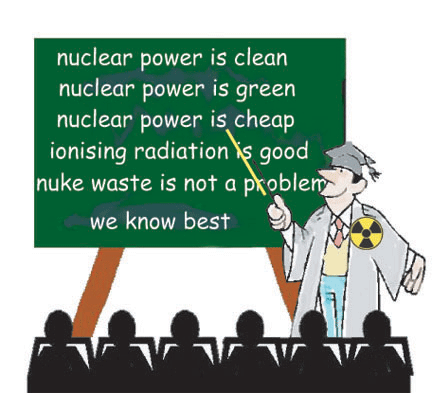 Teachers from two states go nuclear at educational summer institute, Augusta Chronicle By Mel Buckner
In each case, career opportunities were discussed……In addition, the evening programs included a panel discussion of local educational opportunities, led by Mindy Mets, the nuclear workforce initiative program manager for the Savannah River Site Community Reuse Organization, and a challenging presentation by Capt. Kevin Byrne, commanding officer of the Naval Nuclear Power Training Command at the Navy Nuclear Power School.
The institute included a series of workshop sessions over the three days to emphasize atomic and nuclear fundamentals; power generation fundamentals; nuclear technology applications; risk (real vs. perceived); and nuclear workforce opportunities ……
Lodging (if needed) and meals were provided at the University of South Carolina Aiken along with free educational resources and teacher guides for classroom presentations. In addition, each participant received two $25 gift cards to help cover travel expenses.
SSNI IS LED BY Citizens for Nuclear Technology Awareness, a local nonprofit organization whose mission is to provide education and information on nuclear subjects for the public. Other sponsors include the American Nuclear Society – Savannah River and Columbia, AREVA, Atkins, Georgia Power Co./Plant Vogtle, SCE&G, SRSCRO, SUNRISE Universities, USC Aiken and the Aiken Rotary Club.
(The writer – a retired program manager from the Savannah River National Laboratory – is a member of the Citizens for Nuclear Technology http://chronicle.augusta.com/opinion/opinion-columns/2016-07-03/teachers-two-states-go-nuclear-educational-summer-institute#
Scientific Committee on Oceanic Research reports on Fukushima and the oceans
Fukushima and the oceans: What do we know, five years on?, Science Daily June 30, 2016
- Source:
- Goldschmidt Conference
- Summary:
- A major international review of the state of the oceans five years after the Fukushima disaster shows that radiation levels are decreasing rapidly except in the harbor area close to the nuclear plant itself where ongoing releases remain a concern. At the same time, the review’s lead author expresses concern at the lack of ongoing support to continue the radiation assessment, which he says is vital to understand how the risks are changing.
- These are the conclusions of a major 5 year review, with multi-international authors who are all working together as part of a Scientific Committee on Oceanic Research (SCOR) Working Group. The report is being presented at the Goldschmidt geochemistry conference in Japan. The review paper is also published in Annual Review of Marine Science*. The main points made by the report are:…….
https://www.sciencedaily.com/releases/2016/06/160630214454.htm
1 This Month
Chernobyl: The Lost Tapes – A good documentary on Chernobyl on SBS available On Demand for the next 3 weeks– https://www.sbs.com.au/ondemand/tv-program/chernobyl-the-lost-tapes/2352741955560

of the week–London Campaign for Nuclear Disarmament

Tell the Ukrainian Government to Drop Prosecution of Peace Activist Yurii Sheliazhenko
To see nuclear-related stories in greater depth and intensity – go to https://nuclearinformation.wordpress.com
-
Archives
- April 2026 (126)
- March 2026 (251)
- February 2026 (268)
- January 2026 (308)
- December 2025 (358)
- November 2025 (359)
- October 2025 (376)
- September 2025 (257)
- August 2025 (319)
- July 2025 (230)
- June 2025 (348)
- May 2025 (261)
-
Categories
- 1
- 1 NUCLEAR ISSUES
- business and costs
- climate change
- culture and arts
- ENERGY
- environment
- health
- history
- indigenous issues
- Legal
- marketing of nuclear
- media
- opposition to nuclear
- PERSONAL STORIES
- politics
- politics international
- Religion and ethics
- safety
- secrets,lies and civil liberties
- spinbuster
- technology
- Uranium
- wastes
- weapons and war
- Women
- 2 WORLD
- ACTION
- AFRICA
- Atrocities
- AUSTRALIA
- Christina's notes
- Christina's themes
- culture and arts
- Events
- Fuk 2022
- Fuk 2023
- Fukushima 2017
- Fukushima 2018
- fukushima 2019
- Fukushima 2020
- Fukushima 2021
- general
- global warming
- Humour (God we need it)
- Nuclear
- RARE EARTHS
- Reference
- resources – print
- Resources -audiovicual
- Weekly Newsletter
- World
- World Nuclear
- YouTube
-
RSS
Entries RSS
Comments RSS
 nuclear-news