Hinkley Point nuclear station – not just a folly – but a massive folly
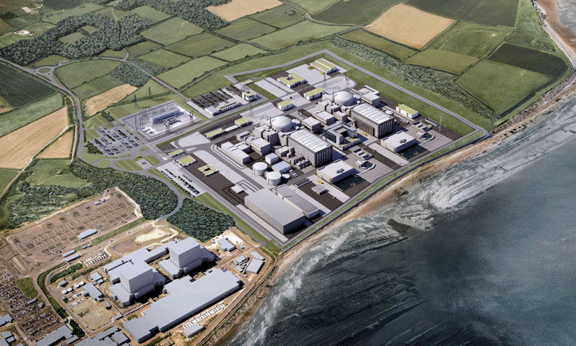 Why Hinkley Point is a nuclear folly of Titanic proportions https://www.newscientist.com/article/2099287-why-hinkley-point-is-a-nuclear-folly-of-titanic-proportions/ French utility company EDF is going ahead with plans for a massive new nuclear reactor in the UK, but there are many reasons to doubt it will ever be finished, says Michael Le Page
It’s also crucial for France, which largely owns EDF, the company that will build Hinkley. France needs the project to help cover the huge cost of revamping its ageing collection of nuclear plants, which currently supply three-quarters of the country’s electricity. And Hinkley matters to China, too, as one of its state-owned companies will be stumping up a third of the cost.
But despite today’s much-delayed decision by EDF to go ahead with the megaproject, its future still looks doubtful. There are huge financial, legal, technical and safety-related icebergs lurking in the seas ahead.
Behind schedule
One reason why is that the two reactors planned for Hinkley are based on a new design. The EPR design is supposed to be safer and more efficient, but it has proved so difficult to construct that not one has yet been completed.
EDF started building the first EPR, at Olkiluoto in Finland, in 2005. It was supposed to start up in 2009. Work on the second, at Flamanville in France, began in 2007 and was due to be finished in 2012. Another two EPRs are being built in Taishan, China. All four projects are years behind schedule and have cost billions more than expected.
There are also worries about the fact that a state-owned Chinese company will be supplying some of the parts and workers for the project. The UK’s intelligence agencies are said to be concerned that a “back door” could be built into the control systems, allowing China to shut down the plant if it wanted to.
Last but not least, there are various legal challenges pending. The Austrian government, for instance, is appealing against the European Commission’s decision to approve state aid for the project, saying it breaches European laws. Meanwhile, French authorities are investigating possible financial misreporting by EDF.
Even in the unlikely event that the Hinkley project dodges all these icebergs, there may not be a happy ending. Many analysts think it’s a bad deal for the UK, because it has had to promise to pay a very high price for Hinkley’s electricity.
The worst-case scenario is that the project sails on for many more years before finally sinking. That will be a disaster for everyone.
No comments yet.
1 This Month

of the week – Shut Down Drone Warfare!


Tell the Ukrainian Government to Drop Prosecution of Peace Activist Yurii Sheliazhenko

Petition to revoke the licensing of the Near Surface Nuclear Disposal Facility (NSDF) at Chalk River. https://www.ourcommons.ca/petitions/en/Petition/Details?Petition=e-7247
To see nuclear-related stories in greater depth and intensity – go to https://nuclearinformation.wordpress.com
-
Archives
- April 2026 (79)
- March 2026 (251)
- February 2026 (268)
- January 2026 (308)
- December 2025 (358)
- November 2025 (359)
- October 2025 (376)
- September 2025 (257)
- August 2025 (319)
- July 2025 (230)
- June 2025 (348)
- May 2025 (261)
-
Categories
- 1
- 1 NUCLEAR ISSUES
- business and costs
- climate change
- culture and arts
- ENERGY
- environment
- health
- history
- indigenous issues
- Legal
- marketing of nuclear
- media
- opposition to nuclear
- PERSONAL STORIES
- politics
- politics international
- Religion and ethics
- safety
- secrets,lies and civil liberties
- spinbuster
- technology
- Uranium
- wastes
- weapons and war
- Women
- 2 WORLD
- ACTION
- AFRICA
- Atrocities
- AUSTRALIA
- Christina's notes
- Christina's themes
- culture and arts
- Events
- Fuk 2022
- Fuk 2023
- Fukushima 2017
- Fukushima 2018
- fukushima 2019
- Fukushima 2020
- Fukushima 2021
- general
- global warming
- Humour (God we need it)
- Nuclear
- RARE EARTHS
- Reference
- resources – print
- Resources -audiovicual
- Weekly Newsletter
- World
- World Nuclear
- YouTube
-
RSS
Entries RSS
Comments RSS
 nuclear-news
Leave a comment