Cumbria demands huge investment to support Moorside nuclear project

 Huge investment needed to support Moorside nuclear project, say council, News and Star, 21 July 2016 CUMBRIA’S council leaders say any new nuclear facility built in the county must be accompanied by huge investment in the area’s key infrastructure – such as the road and rail network.
During a meeting at today’s Cumbria County Council cabinet meeting leader Stewart Young said that the authority needed the Government or NuGen – the firm behind the new Moorside development in west Cumbria – to stump up cash in advance so work can can begin…….
“The sheer scale of this nuclear project is unprecedented for Cumbria and in fact unprecedented for the UK. To ensure that everyone benefits we need a guarantee from Government or NuGen or both of extensive additional investment into services like the county’s infrastructure, such as roads, railways and port, as well as accommodation for the workforce, and the development of skills to ensure that as many jobs as possible are taken by Cumbrians.”
The call was made as part of the council’s formal response to the consultation into the Moorside project…… The formal consultation process ends on July 30. http://www.newsandstar.co.uk/news/latest/Huge-investment-needed-to-support-Moorside-nuclear-project-say-council-731df4b0-d076-4d29-86f7-2eea67a2e265-ds
New Zealand has been well served by its nuclear-free policy
 Nuclear-free has ‘served us well’ – Geoffrey Palmer, Radio New Zealand, 22 July 16 An architect of New Zealand’s once contentious anti-nuclear law says it remains the right approach for the country.
The law is in the spotlight as preparations begin for the first visit by an American warship since the landmark legislation was passed in 1987.
Under the law, the Prime Minister must make an assessment of whether the ship will breach New Zealand’s ban on nuclear weapons and nuclear power.
The US has not sent a naval ship since 1983, as it refuses to say whether its ships are nuclear-armed, as required by New Zealand’s nuclear-free law.
The deputy prime minister at the time the nuclear-free law was passed, Sir Geoffrey Palmer, told Morning Report the policy, and the law behind it, was sound…….http://www.radionz.co.nz/news/national/309192/nuclear-free-has-‘served-us-well’-geoffrey-palmer
Dirty uranium industry not a job creator for South Africa

 Uranium is the dirty underbelly of nuclear – scientist http://www.engineeringnews.co.za/article/uranium-is-the-dirty-underbelly-of-nuclear-scientist-2016-07-21 21ST JULY 2016 BY: NEWS24WIRE Anti nuclear sentiment tends to focus onnuclear waste or operational risks, but more focus should be on the “dirty underbelly” of uranium mining, according to a science adviser.
“Whenever people get excited about nuclear power stations, they kind of forget where the actual uranium comes from,”Dr Stefan Cramer, science adviser for environmentalist groupSafcei, told Fin24 in an interview recently.
“Nuclear is a fallacy, both economically and environmentally,” Cramer, who was born in Germany but not now lives in Graaff-Reinet, claimed.
“Uranium mining is the dirty underbelly of this whole nuclearcycle,” he said. “It’s where it all starts.”
“One must stop nuclear industries in (their) tracks because it leaves future generations with an immeasurable task and legacy,” he said. “The best point to start is at the source, where the whole cycle of nuclear technology begins, and that is at uranium mining.
“Uranium mining is very much the dirtiest part of the entire industry.”
Anti-uranium mining boost Cramer’s focus on anti-uranium mining was given a boost this month when Australian company Tasman Pacific Minerals Limited said it is downsizing its mining application in South Africa by almost 90%.
“Overall, the area covered by Tasman’s new and existingmining right and prospecting right applications in the Western and Eastern Cape will reduce by almost 300 000 ha to approximately 465 000 ha,” it said.
Tasman is punting job creation as necessitating the success of its new application. “Currently very few opportunities for additional economic development exist,” it said in a recent report.
“Tasman believes that uranium mining has a significant role to play in improving the economic outlook of the region, not only from an employment perspective, but also in the economic activity that is generated by associated businessactivities that extend beyond mining itself.”
“We desperately need jobs in the Karoo,” he said. “The Karoo is an area of high poverty, (with) very low employment opportunities. Any opportunity is usually highly welcome and it is to be welcomed because we need jobs desperately. Buturanium mining is a very poor process to create jobs.
“If we are really serious about job creation in the Karoo, there are other opportunities, which are much more valuable.
“Agriculture is still the main employment opportunity and needs to be protected and improved. Agri-tourism is a very new and very fast rising opportunity, but the best (opportunity) of all is renewable energy.”Renewable energy jobs boost
“South African already has 28 000 jobs in the renewable energy industry as compared to 2 600 in the nuclearindustry,” said Cramer. “Even the most ambitious job projections in the nuclear field would be up to 30 000 jobs if they whole country is run onnuclear energy. If we go into renewable energies, it’s an order of magnitude.
“The Department of Energy predicts up to 350 000 jobs inrenewable energy, so uranium mining is clear(ly) not a good strategy,” he said.
Cramer said nuclear is also a fallacy from a democratic point of view, “because it creates a veil of secrecy over this whole industry”. “That is clearly shown in our court case against the South African government for its failure to disclose the contents of an agreement with Russia,” he said.
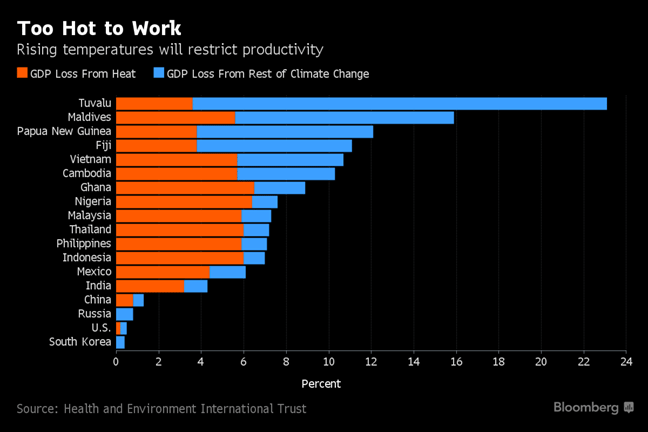
Climate change threatens economies, as workers hampered by increasing heat
Hotter Temperatures Threaten Southeast Asian Economies: Chart http://www.bloomberg.com/news/articles/2016-07-19/too-hot-to-work, Jessica Shankleman July 19, 2016 Rising global temperatures may cost global economies more than $2 trillion by 2030, restricting working hours in some of the poorest parts of the world, according to United Nations research published Tuesday. As many as 43 countries, especially those in Southeast Asia, will experience declines in their economies because of heat stress, says Tord Kjellstrom, a director at the Health and Environment International Trust, based in Nelson, New Zealand.“With heat stress, you cannot keep up the same intensity of work, and we’ll see reduced speed of work and more rest in labor-intensive industries,” he said.
Canada’s Federal NDP leader Tom Mulcair demands independent investigation in to nuclear unsafety allegations

 Nuclear Safety Warnings Demand Independent Review: Mulcair
Anonymous letter listing concerns about Canadian nuclear generating stations can’t be ignored, says NDP leader. By Jeremy J. Nuttall Today | TheTyee.ca Federal NDP leader Tom Mulcair is demanding an independent investigation into allegations of safety problems at nuclear power generating stations in Ontario.Mulcair criticized the Liberal government’s decision to allow the Canadian Nuclear Safety Commission (CNSC) to investigate itself in the wake of a scathing anonymous letter citing serious safety failures.
The letter was reportedly sent to commission president Michael Binder weeks ago and to media outlets this week.
It alleges CNSC management withheld information from commission panels holding licensing hearings for two nuclear plants in Ontario. The CNSCregulates the use of nuclear energy in Canada.
But Mulcair said the letter’s serious allegations should trigger an independent investigation by the government……http://thetyee.ca/News/2016/07/21/Canadian-Nuclear-Safety-Warnings/
New film “Atom and Peace—Ruiko, Nagasaki Prayer” questions Japan’s nuclear policy

 New documentary questions Japan’s use of nuclear energy, Japan Today, JUL. 18, 2016 TOKYO —
Documentary filmmaker Yoshitaka Nitta has made a movie based on a question he has asked himself since the nuclear meltdown at Tokyo Electric Power’s Fukushima Daiichi plant in March 2011.
The question is “Why does Japan insist on reactivating nuclear power plants despite the worst nuclear accident in its history?”
In the movie titled “Atom and Peace—Ruiko, Nagasaki Prayer,” Ruiko Matsunaga, a 24-year-old elementary school teacher in the city of Nagasaki in southwestern Japan, travels from Aomori to Fukushima Prefecture in northeastern Japan and then back to Nagasaki, visiting places where there is “peaceful use of nuclear energy.”
She hopes to find answers to how the Fukushima Daiichi accident occurred and why Japan, as the world’s only atomic-bombed country, is still eager to continue nuclear power generation.
Matsunaga, whose grandmother is a survivor of the 1945 atomic bombing of Nagasaki, “was the only person” who could play the leading role in the movie, said Nitta.
Through her trip, Matsunaga learns that Japan has plenty of plutonium, a radioactive chemical element used to produce the “Fat Man” atomic bomb detonated over Nagasaki……..http://www.japantoday.com/category/entertainment/view/new-documentary-questions-japans-use-of-nuclear-energy
Calgary, Canada succeeds brilliantly with wind-powered Light Rail Transport
 Calgary’s wind-powered LRT an incredibly successful system: Nenshi , Green Energy Futures July 6, 2015 “Every one of these three-car trains that goes by has a capacity of 600 people. That means it’s taking about 550 cars off the road. It makes a lot of sense,” says Calgary Mayor Naheed Nenshi. By David Dodge and Duncan Kinney
The CTrain in Calgary is one of the greatest examples of electrified transport in Canada.
It is overwhelmingly popular with residents, boasting an average weekday ridership of 325,000. It has kickstarted smarter, denser development around its stations. And, best of all, it and the City of Calgary’s operations are 100 per cent powered by renewable energy.
“It’s hugely important to me. I wish I could take it every day, but it’s an incredibly successful transit system,” says Calgary mayor Naheed Nenshi. “It has amongst the highest ridership of any LRT system anywhere — about 50 per cent of the people who travel downtown every day come downtown by public transit, and the majority of those use the CTrain system.”
But it’s when you compare Calgary to the other transit systems in Canada that it starts to get really interesting. The Pembina Institute has compiled some fascinating data, released in its Fast Cities report last year (disclosure: Green Energy Futures is presented by the Pembina Institute).
Calgary takes home the top spot when it comes to the amount of existing rapid transit lines per million residents; over the past ten years it has laid the most track out of any other city in the report. Continual investment in the system is an important factor that too many cities ignore.
City building
A full three-car CTrain carries 600 people. Not only does the CTrain take a lot of cars off the road, it also helps the city grow in a smarter, denser way………….
Powered by the wind
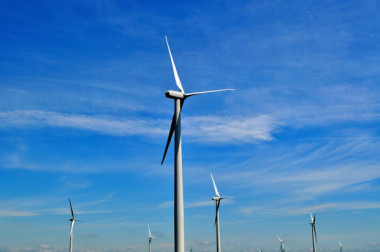
Perhaps the greatest coup of Calgary’s CTrain system is that it is powered by wind energy. In 2001, Calgary city council voted to purchase 21,000 megawatt-hours of wind power a year for 10 years. That’s the amount of electricity that the LRT uses in a year.
Now, the LRT does not run on electrons delivered straight from wind turbines — instead, it’s connected to the standard electricity grid. But while that grid is still dominated by natural gas and coal, Calgary’s 2001 investment meant 12 wind turbines were erected.
Then in 2012, Calgary went all-in on renewable energy, purchasing 100 per cent renewable power for all of the city’s operations. This investment meant two wind farms got built, totaling 144 megawatts of installed wind capacity.
While the CTrain is still 100 per cent powered by wind, the city’s other operations use a mix of renewable energies: wind, hydro, biomass and solar power. The power purchase agreement totals 450,000 megawatt-hours a year or the equivalent power demand of over 65,000 Calgary homes.
This is one of the killer apps of electrified rail transport: the ability to choose cleaner, greener options. By purchasing wind power, Calgary Transit reports they are saving 56,000 tonnes of carbon dioxide emissions per year.
Cities like Calgary are playing a leadership role without breaking the bank. While the City of Calgary wouldn’t disclose the terms of their power purchase agreement with ENMAX, wind is the cheapest source of electricity in Alberta. The 2013 average pool price for wind according the Alberta Electric System Operator was 5.5 cents per kilowatt-hour while coal was 7.7 cents per-kilowatt hour.
In December 2014 when Quebec issued requests for proposals to build 450 MW of wind power, the average price for accepted bids was 7.6 cents per kWh, including 1.3 cents per kwH transmission costs. Solar power purchase agreements are being signed for as low as 5.84 cents a kWh in Dubai and at 8 cents/kWh in Brazil.
The bottom line is Calgary’s LRT and city operations are running on 100 per cent renewable energy, making the city a leader in Canada. Doubly cool are the phenomenal ridership numbers Calgary has achieved for its LRT — something that is reducing congestion, bringing down emissions and building the clean energy economy of the future. http://www.greenenergyfutures.ca/episode/c-train-success-nenshi-calgary
Green State, Golden State: Clean Energy Policy Creates Good Jobs
 http://capitalandmain.com/latest-news/issues/labor-and-economy/green-state-golden-state-clean-energy-policy-makes-good-jobs-0719/ by Dean Kuipers July 19, 2016 California’s deserts are blooming with windmills and solar farms and, according to a new University of California, Berkeley report, these large-scale projects are creating top quality jobs. The Link Between Good Jobs and a Low Carbon Future, issued by the Don Vial Center on the Green Economy at Berkeley’s Labor Center, finds that despite the one-off nature of large, clean energy construction projects, these renewable-power enterprises are creating high-paying, long-lasting blue-collar jobs.
USA Dept of Energy funds Florida research into nuclear recycling
 Florida State receives #10 million for nuclear research center Florida State 24/7 JULY 21, 2016
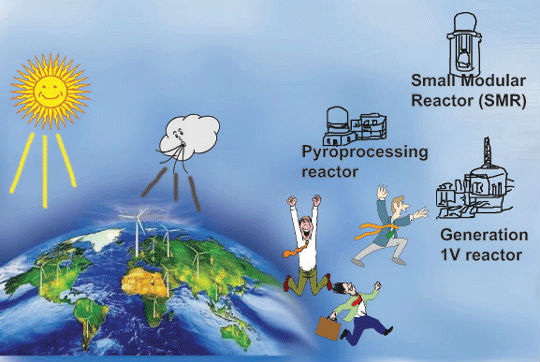
Kathleen Haughney Florida State University will receive $10 million from the U.S. Department of Energy to create a new Energy Frontier Research Center… The center will focus on developing technologies for recycling nuclear fuel and cleaning up Cold War-era weapon production sites. It will be led by Thomas Albrecht-Schmitt, the Gregory R. Choppin Professor of Chemistry at FSU……..Three other institutions will also host research centers. They are The Ohio State University, the University of South Carolina and DOE’s Pacific Northwest National Laboratory. http://news.fsu.edu/Top-Stories/Florida-State-receives-10M-for-nuclear-research-center
Developing world set to get 2 million new jobs with modern off-grid solar lighting
 Modern off-grid lighting could create 2 million new jobs in developing world, Eureka Alert, 20 July 16 Berkeley Lab study assesses employment impact of widespread conversion to solar-LED lighting in developing countries DOE/LAWRENCE BERKELEY NATIONAL LABORATORYMany households in impoverished regions around the world are starting to shift away from inefficient and polluting fuel-based lighting–such as candles, firewood, and kerosene lanterns–to solar-LED systems. While this trend has tremendous environmental benefits, a new study by Lawrence Berkeley National Laboratory (Berkeley Lab) has found that it spurs economic development as well, to the tune of 2 million potential new jobs.
Berkeley Lab researcher Evan Mills, who has been studying lighting in the developing world for more than two decades, has conducted the first global analysis of how the transition to solar-LED lighting will impact employment and job creation. His study was recently published in the journal Energy for Sustainable Development in a paper titled, “Job creation and energy savings through a transition to modern off-grid lighting.”
“People like to talk about making jobs with solar energy, but it’s rare that the flip side of the question is asked–how many people will lose jobs who are selling the fuels that solar will replace?,” said Mills. “We set out to quantify the net job creation. The good news is, we found that we will see many more jobs created than we lose.”
While there are about 274 million households worldwide that lack access to electricity, Mills’ study focuses on the “poorest of the poor,” or about 112 million households, largely in Africa and Asia, that cannot afford even a mini solar home system, which might power a fan, a few lights, a phone charger, and a small TV. Instead this group can afford only entry-level solar lighting.
In countries such as Mali, Niger, Sierra Leone, India, Indonesia, and Kenya, fuel-based lighting is not particularly “job-intensive.” Individual entrepreneurs sell lanterns, wicks, candles, fuel dippers, and kerosene in small quantities, often in local markets or on the roadside, but few jobs are created and many are part-time.
In all Mills found that fuel-based lighting today provides 150,000 jobs worldwide. Because there is very little data in this area, his analysis is based on estimating the employment intensity of specific markets and applying it to the broader non-electrified population. He also drew on field observations in several countries to validate his estimates.
He did a similar analysis for the emerging solar-LED industry and also collected data on employment rates for larger manufacturers and distributors representing the majority of global production of products quality assured by the World Bank’s Lighting Global initiative at the time. He found that every 1 million of these lanterns provides an estimated 17,000 jobs.
These values include employees of these companies based in developing countries but exclude upstream jobs in primary manufacturing by third parties such as those in factories in China. Assuming a three-year product life and a target of three lanterns per household, this corresponded to about 2 million jobs globally, more than compensating for the 150,000 jobs that would be lost in the fuel-based lighting market.
Furthermore Mills’ research found that the quality of the jobs would be much improved. “With fuel-based lighting a lot of these people are involved in the black market and smuggling kerosene over international borders, and child labor is often involved in selling the fuel,” he said. “Also these can be very unstable jobs due to acute shortages of kerosene and government subsidies going up and down. It’s a very poor quality of livelihood, and the commodity itself is toxic. These new solar jobs will be much better jobs–they’re legal, healthy, and more stable and regular.”
While there is some overlap in terms of skillsets required for the new jobs, retraining and education would be necessary. The new jobs span the gamut, from designing and manufacturing products to marketing and distributing them. “The challenge of re-employing some of these people is not trivial,” Mills said. “A lot of them aren’t literate. So there are some real human considerations to account for.”
In fact, a transition to modern lighting technologies could have immense benefits for the health and education of these populations. Mills, an energy analyst specializing in the energy efficiency of buildings and industry who also founded the Lumina Project, published a separate paper in the same journal recently that identified many of the risks of fuel-based lighting, such as child poisoning, slum fires, indoor air pollution, and lantern explosions leading to significant burn injuries.
Solar lanterns also provide far more and better light, allowing children to study in the evening and businesses to stay open later into the evening. “As long as people are using kerosene lanterns, candles, and other fuels for light, it’s actually reinforcing poverty because they’re spending so much on energy and getting so little in return. So many are stuck in that vicious circle,” he said.
Solar-LED lanterns and flashlights are gaining in popularity in the developing world thanks to being “a rugged, affordable, reliable, compact and very manufacturable technology and one that is effectively wireless,” Mills said.
In addition to job creation, the potential environmental benefits are also enormous. A study Mills published in Science in 2005 estimated global off-grid lighting energy expenditure at $38 billion per year. That corresponds to CO2 emissions of 190 million metric tons per year, or the equivalent of those from about 30 million typical American cars.
“All of this energy and pollution can potentially be saved with a conversion to solar-LED systems,” he said……..http://www.eurekalert.org/pub_releases/2016-07/dbnl-mol071916.php
The Sustainable Development Goals report 2016
 The Sustainable Development Goals report 2016 http://apo.org.au/resource/sustainable-development-goals-report-2016 Department of Economic and Social Affairs (United Nations)20 July 2016
This agenda is a road map for people and the planet that will build on the success of the Millennium Development Goals and ensure sustainable social and economic progress worldwide. It seeks not only to eradicate extreme poverty, but also to integrate and balance the three dimensions of sustainable development—economic, social and environmental—in a comprehensive global vision.
Russia marketing Nuclear Aircraft Carrier to India

 Russia Offers India Nuclear Aircraft Carrier Vivek Raghuvanshi, Defense July 11, 2016 NEW DELHI — Russia has offered its nuclear aircraft carrier, dubbed “Storm,” to India for purchase, a senior Indian Navy official said. The offer comes as India and the US discuss the transfer of technology for India’s future nuclear aircraft carrier, the INS Vishal.
A diplomat with the Russian Embassy confirmed that a Russian team visiting India last week made the offer.
Krylov State Research Center (KSRC), a Russian shipbuilding research and development institute, is designing the carrier, also known as Shtorm or Project 23000E…….http://www.defensenews.com/story/defense/naval/navy/2016/07/11/russia-india-nuclear-aircraft-carrier-storm/86937106/
Electricity system being reshaped by solar energy, batteries and electric cars
Will solar, batteries and electric cars re-shape the electricity system?, UBS, 20 July 16,
1 This Month

of the week – Shut Down Drone Warfare!


Tell the Ukrainian Government to Drop Prosecution of Peace Activist Yurii Sheliazhenko

Petition to revoke the licensing of the Near Surface Nuclear Disposal Facility (NSDF) at Chalk River. https://www.ourcommons.ca/petitions/en/Petition/Details?Petition=e-7247
To see nuclear-related stories in greater depth and intensity – go to https://nuclearinformation.wordpress.com
-
Archives
- April 2026 (91)
- March 2026 (251)
- February 2026 (268)
- January 2026 (308)
- December 2025 (358)
- November 2025 (359)
- October 2025 (376)
- September 2025 (257)
- August 2025 (319)
- July 2025 (230)
- June 2025 (348)
- May 2025 (261)
-
Categories
- 1
- 1 NUCLEAR ISSUES
- business and costs
- climate change
- culture and arts
- ENERGY
- environment
- health
- history
- indigenous issues
- Legal
- marketing of nuclear
- media
- opposition to nuclear
- PERSONAL STORIES
- politics
- politics international
- Religion and ethics
- safety
- secrets,lies and civil liberties
- spinbuster
- technology
- Uranium
- wastes
- weapons and war
- Women
- 2 WORLD
- ACTION
- AFRICA
- Atrocities
- AUSTRALIA
- Christina's notes
- Christina's themes
- culture and arts
- Events
- Fuk 2022
- Fuk 2023
- Fukushima 2017
- Fukushima 2018
- fukushima 2019
- Fukushima 2020
- Fukushima 2021
- general
- global warming
- Humour (God we need it)
- Nuclear
- RARE EARTHS
- Reference
- resources – print
- Resources -audiovicual
- Weekly Newsletter
- World
- World Nuclear
- YouTube
-
RSS
Entries RSS
Comments RSS
 nuclear-news