Calgary, Canada succeeds brilliantly with wind-powered Light Rail Transport
 Calgary’s wind-powered LRT an incredibly successful system: Nenshi , Green Energy Futures July 6, 2015 “Every one of these three-car trains that goes by has a capacity of 600 people. That means it’s taking about 550 cars off the road. It makes a lot of sense,” says Calgary Mayor Naheed Nenshi. By David Dodge and Duncan Kinney
The CTrain in Calgary is one of the greatest examples of electrified transport in Canada.
It is overwhelmingly popular with residents, boasting an average weekday ridership of 325,000. It has kickstarted smarter, denser development around its stations. And, best of all, it and the City of Calgary’s operations are 100 per cent powered by renewable energy.
“It’s hugely important to me. I wish I could take it every day, but it’s an incredibly successful transit system,” says Calgary mayor Naheed Nenshi. “It has amongst the highest ridership of any LRT system anywhere — about 50 per cent of the people who travel downtown every day come downtown by public transit, and the majority of those use the CTrain system.”
But it’s when you compare Calgary to the other transit systems in Canada that it starts to get really interesting. The Pembina Institute has compiled some fascinating data, released in its Fast Cities report last year (disclosure: Green Energy Futures is presented by the Pembina Institute).
Calgary takes home the top spot when it comes to the amount of existing rapid transit lines per million residents; over the past ten years it has laid the most track out of any other city in the report. Continual investment in the system is an important factor that too many cities ignore.
City building
A full three-car CTrain carries 600 people. Not only does the CTrain take a lot of cars off the road, it also helps the city grow in a smarter, denser way………….
Powered by the wind
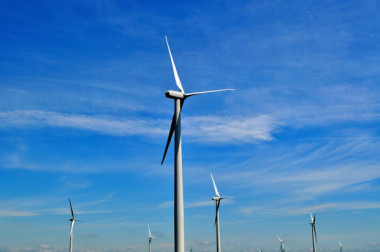
Perhaps the greatest coup of Calgary’s CTrain system is that it is powered by wind energy. In 2001, Calgary city council voted to purchase 21,000 megawatt-hours of wind power a year for 10 years. That’s the amount of electricity that the LRT uses in a year.
Now, the LRT does not run on electrons delivered straight from wind turbines — instead, it’s connected to the standard electricity grid. But while that grid is still dominated by natural gas and coal, Calgary’s 2001 investment meant 12 wind turbines were erected.
Then in 2012, Calgary went all-in on renewable energy, purchasing 100 per cent renewable power for all of the city’s operations. This investment meant two wind farms got built, totaling 144 megawatts of installed wind capacity.
While the CTrain is still 100 per cent powered by wind, the city’s other operations use a mix of renewable energies: wind, hydro, biomass and solar power. The power purchase agreement totals 450,000 megawatt-hours a year or the equivalent power demand of over 65,000 Calgary homes.
This is one of the killer apps of electrified rail transport: the ability to choose cleaner, greener options. By purchasing wind power, Calgary Transit reports they are saving 56,000 tonnes of carbon dioxide emissions per year.
Cities like Calgary are playing a leadership role without breaking the bank. While the City of Calgary wouldn’t disclose the terms of their power purchase agreement with ENMAX, wind is the cheapest source of electricity in Alberta. The 2013 average pool price for wind according the Alberta Electric System Operator was 5.5 cents per kilowatt-hour while coal was 7.7 cents per-kilowatt hour.
In December 2014 when Quebec issued requests for proposals to build 450 MW of wind power, the average price for accepted bids was 7.6 cents per kWh, including 1.3 cents per kwH transmission costs. Solar power purchase agreements are being signed for as low as 5.84 cents a kWh in Dubai and at 8 cents/kWh in Brazil.
The bottom line is Calgary’s LRT and city operations are running on 100 per cent renewable energy, making the city a leader in Canada. Doubly cool are the phenomenal ridership numbers Calgary has achieved for its LRT — something that is reducing congestion, bringing down emissions and building the clean energy economy of the future. http://www.greenenergyfutures.ca/episode/c-train-success-nenshi-calgary
No comments yet.
1 This Month

of the week – Shut Down Drone Warfare!


Tell the Ukrainian Government to Drop Prosecution of Peace Activist Yurii Sheliazhenko

Petition to revoke the licensing of the Near Surface Nuclear Disposal Facility (NSDF) at Chalk River. https://www.ourcommons.ca/petitions/en/Petition/Details?Petition=e-7247
To see nuclear-related stories in greater depth and intensity – go to https://nuclearinformation.wordpress.com
-
Archives
- March 2026 (244)
- February 2026 (268)
- January 2026 (308)
- December 2025 (358)
- November 2025 (359)
- October 2025 (376)
- September 2025 (257)
- August 2025 (319)
- July 2025 (230)
- June 2025 (348)
- May 2025 (261)
- April 2025 (305)
-
Categories
- 1
- 1 NUCLEAR ISSUES
- business and costs
- climate change
- culture and arts
- ENERGY
- environment
- health
- history
- indigenous issues
- Legal
- marketing of nuclear
- media
- opposition to nuclear
- PERSONAL STORIES
- politics
- politics international
- Religion and ethics
- safety
- secrets,lies and civil liberties
- spinbuster
- technology
- Uranium
- wastes
- weapons and war
- Women
- 2 WORLD
- ACTION
- AFRICA
- Atrocities
- AUSTRALIA
- Christina's notes
- Christina's themes
- culture and arts
- Events
- Fuk 2022
- Fuk 2023
- Fukushima 2017
- Fukushima 2018
- fukushima 2019
- Fukushima 2020
- Fukushima 2021
- general
- global warming
- Humour (God we need it)
- Nuclear
- RARE EARTHS
- Reference
- resources – print
- Resources -audiovicual
- Weekly Newsletter
- World
- World Nuclear
- YouTube
-
RSS
Entries RSS
Comments RSS
 nuclear-news
Leave a comment