UK Parliament prepares to deliberate on whether to ban the bomb
 The nuclear option. Parliament prepares to deliberate on whether to ban the bomb , The Economist 16 July 16 NINE countries are believed to have nuclear weapons. On July 18th Britain will decide whether it wants to remain in that club, when its MPs debate whether to renew the country’s Trident nuclear deterrent. Theresa May, the new prime minister, has said it would be “sheer madness” to give it up, and the vote is expected to pass easily. Perhaps 150 of Labour’s 230 MPs will vote in favour of the plan, rebelling against their leader, Jeremy Corbyn.
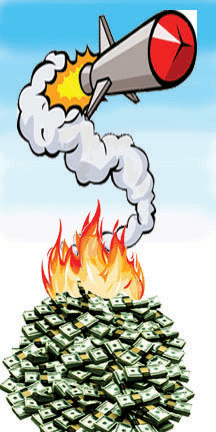 Trident’s detractors argue that a lot has changed since the programme was approved in 2007. For one thing money is tighter. Around one-quarter of defence spending on new equipment procurement will be on submarine and deterrent systems by 2021-22. There has also been a surge in support for independence in Scotland, where the submarines are based. It is unlikely that the government would choose to site the capability north of the border if the renewal process began again now, says William Walker of St Andrew’s University. The Scottish government opposes the plan; almost all of the 59 Scottish MPs at Westminster are expected to vote against it (though polls suggest that public opinion in Scotland is more mixed). If Scotland were to become independent—now more likely because of Brexit—Britain could well have to relocate its subs, at further expense.
1 Comment »
Leave a comment
1 This Month

of the week – Shut Down Drone Warfare!


Tell the Ukrainian Government to Drop Prosecution of Peace Activist Yurii Sheliazhenko

Petition to revoke the licensing of the Near Surface Nuclear Disposal Facility (NSDF) at Chalk River. https://www.ourcommons.ca/petitions/en/Petition/Details?Petition=e-7247
To see nuclear-related stories in greater depth and intensity – go to https://nuclearinformation.wordpress.com
-
Archives
- April 2026 (91)
- March 2026 (251)
- February 2026 (268)
- January 2026 (308)
- December 2025 (358)
- November 2025 (359)
- October 2025 (376)
- September 2025 (257)
- August 2025 (319)
- July 2025 (230)
- June 2025 (348)
- May 2025 (261)
-
Categories
- 1
- 1 NUCLEAR ISSUES
- business and costs
- climate change
- culture and arts
- ENERGY
- environment
- health
- history
- indigenous issues
- Legal
- marketing of nuclear
- media
- opposition to nuclear
- PERSONAL STORIES
- politics
- politics international
- Religion and ethics
- safety
- secrets,lies and civil liberties
- spinbuster
- technology
- Uranium
- wastes
- weapons and war
- Women
- 2 WORLD
- ACTION
- AFRICA
- Atrocities
- AUSTRALIA
- Christina's notes
- Christina's themes
- culture and arts
- Events
- Fuk 2022
- Fuk 2023
- Fukushima 2017
- Fukushima 2018
- fukushima 2019
- Fukushima 2020
- Fukushima 2021
- general
- global warming
- Humour (God we need it)
- Nuclear
- RARE EARTHS
- Reference
- resources – print
- Resources -audiovicual
- Weekly Newsletter
- World
- World Nuclear
- YouTube
-
RSS
Entries RSS
Comments RSS
 nuclear-news
yes. It takes money to make them. Kim Jong Un is starving his people to make them. People that want to use them on people need to ban them. People wanting to use them to kill people are as dumb as a beast.