Nuclear Information and Resources Service briefing on Radioactivity Levels
 The U.S. Environmental Protection Agency (EPA) has quietly proposed to raise the allowable levels of radioactivity in drinking water a nuclear incident to hundreds of times their current limits. If this guidance goes through, EPA’s action will allow people to drink water with concentrations of radioactivity at vastly higher levels.
Look no further than the current water crisis in Flint, Michigan to understand concern that the EPA will not act to protect public health in an emergency. In this case, the EPA is attempting to ensure that it would not have to act decisively to protect public health!
But there is still time to act.
Call in to the July 13 telebriefing to find out more.
You are invited to join us on WEDNESDAY JULY 13 for a national telebriefing: Dangerous Drinking Water, with presentations by leading experts and activists:
- Diane D’Arrigo, Radioactive Waste Project Director, Nuclear Information and Resource Service
- Daniel Hirsch, Director, Program on Environmental and Nuclear Policy, University of California Santa Cruz
- Emily Wurth, Water Program Director, Food and Water Watch
- Moderated by NIRS Executive Director, Tim Judson
The open and free event will be on the phone, starting at 8 pm eastern, 7 pm central, 6 pm mountain and 5 pm pacific. We will reserve the second half of the program for questions and discussion.
Register to attend the July 13 telebriefing.
The program will focus on EPA Guidance that massively increases the permitted levels of radioactivity in drinking water for years after any nuclear incident that requires consideration of “protective action,” ranging from a spill, leak or transport accident to a dirty bomb or nuclear meltdown—a nuclear accident of any kind, big or small. Allowable concentrations of radioactive elements allowed to come out of your tap would rise hundreds or even thousands of times above the current Maximum Concentration Levels allowed under the Safe Drinking Water Act regulations. Click here to review EPA’s proposal.
Nuclear Energy is Dirty in many dimensions, but first, and foremost because of its dangerous ionizing radiation. The EPA guidance, allowing us to drink highly radioactive water is a clever effort to bypass existing limits, which the law prevents from being weakened. It is yet another way to shift liability and cleanup costs to the public from industry and government in case of a “nuclear event.” For instance, for most radionuclides the Safe Drinking Water levels are based on no more than 4 millirems a year exposure from drinking water; the proposed water PAGs would allow 500 millirems a year with no notice, and no action to limit exposure to adults. This difference protects the government and industry from any liability from massively increased health consequences.
Although EPA for the first time ever admits that those under 15 years of age are at greater risk than adults the draft PAG only pays lip-service to considering a lower level which is still enormously higher than current water limits. This is in addition to rest of EPA PAGs, which allow even more exposure from air and food.
Call in to learn more about this federal guidance and how to help stop it.
Drones observed flying over troubled Savannah River Nuclear Site
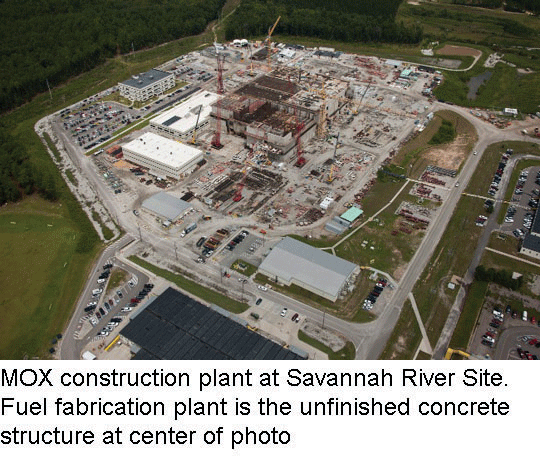 FBI investigating unidentified drones over S. Carolina nuclear site Rt.com 1 July 16 Federal law enforcement has begun a probe into reports of drones flying over the US Department of Energy’s Savannah River Site in South Carolina. Nuclear waste is treated at the site, and nuclear weapons materials are stored and processed there.
Several sightings of unmanned aerial vehicles, or drones, over the Savannah River Site (SRS) have been reported by site security in the month of June, the US Department of Energy announced Thursday.
Monte Volk, a spokesman for SRS, told The State it is yet unknown who is behind the flights or why they are occurring.
“The protective force at Savannah River Site (SRS) has confirmed several sightings of Unmanned Aerial Systems (UAS) flying in SRS airspace in June. SRS takes these reports very seriously and is coordinating with appropriate federal, state, and local authorities,” the Energy Department said in a statement.

There is no “no-fly zone” over SRS, Volk told WRDW, though there are some altitude guidelines enforced by the US Federal Aviation Administration (FAA), which has cautioned drone pilots about flying UAVs in airspace around nuclear facilities and other protected areas.
“Drones flying over any critical infrastructure, government facility, military base — with the environment we are living in today — would be a concern to law enforcement and homeland security officials,’’Mark Keel, chief of the South Carolina State Law Enforcement Division, told The State. Keel added that the drone reports “have got our attention.”
SRS covers 310 square miles of South Carolina’s Aiken, Barnwell, and Allendale counties near the Savannah River. ……..
A prominent activist and critic of the site told The State he had been interviewed by FBI agents about the drone flights. Tom Clements, of the non-profit group Savannah River Site Watch, said he has taken and published photographs of the site for years, but that those photographs were obtained using an airplane in full compliance with FAA rules.
South Carolina is currently suing the Department of Energy over its handling and construction of the Mixed Oxide Fuel Fabrication Facility, which was approved by Congress in 1998. The site has been part of a 2000 deal between the US and Russia in which both nations agreed to dispose of 34 tons of plutonium. Yet since that pledge, the mixed oxide facility’s costs have ballooned while delays have pushed its completion to a date unknown…….
Like operators of hobby drones, commercial drone pilots must keep their UAS within sight. Registered, security-cleared operators at least 16 years of age will be required to keep drones away from airspace where people are directly below, away from the underside of covered structures, and below 400 feet (122 meters) in altitude. Drones must also stay at least 400 feet away from a building or tower. https://www.rt.com/usa/349189-savannah-fbi-nuclear-drones/
Federal court considers South Carolina’s suit over Mixed Oxide Fuel nuclear fiasco
 Judge considers nuclear fuel dispute between S.C., Energy Dept. Savannah Now, By MEG KINNARD 1 July 16 COLUMBIA, S.C. — It’s now up to a federal judge to decide if South Carolina’s lawsuit against the federal government over an unfinished plutonium processing project should be dismissed, or if the state’s pursuit of millions of dollars in fees should move forward.
During a hearing in federal court in Columbia, attorney Randy Lowell said that the law is clear that the government owes South Carolina millions of dollars in fees and also must remove plutonium from the state because the processing plant wasn’t operational on time.
“All of this is a problem of their own creation,” Lowell, representing the state, said during a 90-minute hearing.
South Carolina in February sued the U.S. Department of Energy over the mixed oxide fuel project at the Savannah River Site, a sprawling former nuclear weapons plant along the South Carolina-Georgia border. The multi-billion-dollar project was intended to help the United States fulfill an agreement with Russia to dispose of at least 34 metric tons apiece of weapons-grade plutonium, an amount that’s enough for about 17,000 nuclear warheads.
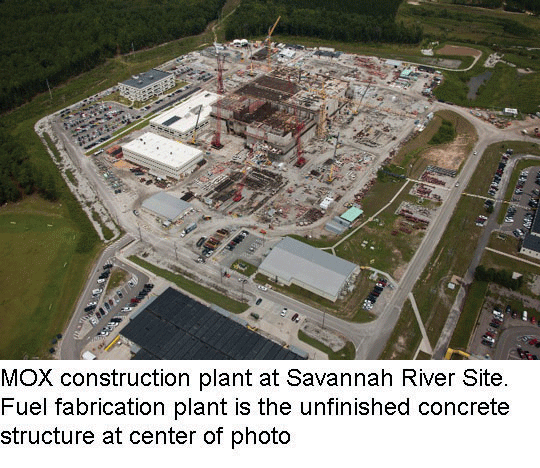
The plant is years behind schedule and billions over budget. Because the facility wasn’t operational by a Jan. 1, 2016, deadline, the federal government was supposed to remove 1 metric ton of plutonium from South Carolina or pay fines of $1 million a day — up to $100 million yearly — until either the facility meets production goals or the plutonium is taken elsewhere for storage or disposal.
Lowell argued that the government has given South Carolina repeated assurances that no plutonium would enter the state without a pathway out – like the production of mixed-oxide fuel, which would be sold to commercial power producers – thus keeping the state from being a permanent home for the materials.
But that hasn’t happened, Lowell said. He asserted that the government is in breach of the law governing the project.
“The whole purpose of the statute is to ensure that we are not the dumping ground,” he said.
Attorneys for the federal government argue that, while the mixed-oxide facility isn’t up and running, the Energy Department is already pursuing an alternate way to process the plutonium and send it out of state for permanent storage……..http://savannahnow.com/news/2016-06-30/judge-considers-nuclear-fuel-dispute-between-sc-energy-dept
Complications in who pays for costs of Germany’s nuclear phase-out
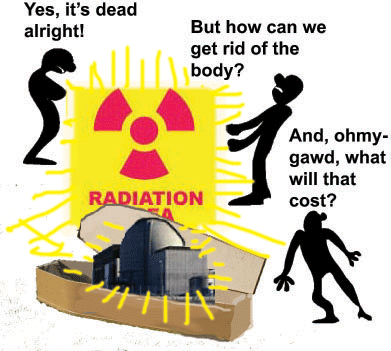 Who pays for Germany’s nuclear phase-out?,DW Hilke Fischer 1 July 16 Germany’s decision a few years ago to phase out nuclear power was an abrupt move. But it still remains unclear who foots the bill for shutting down the nation’s nuclear plants, as utilities seek damages from the state. Months after a Tsunami resulted in a nuclear disaster at the Fukushima Daiichi plant in Japan, Germany’s coalition government, led by Chancellor Angela Merkel, decided to phase out nuclear power in the country.
Immediately after Fukushima, eight of 17 functioning nuclear plants were shut down, and the government’s decision established a timeline of taking the remaining plants offline by 2022.
Five years later, it’s gradually becoming clear how much this hasty exit could cost. Feeling dispossessed by the move, major utilities have filed a raft of lawsuits claiming damage payments from the government amounting to around 20 billion euros ($22.3 billion).
An eagerly awaited ruling
Complying with the government’s nuclear moratorium, Germany’s biggest energy provider Eon had to shut down its power plants Isar 1 and Unterweser. The company has therefore sued both the federal government as well as the state governments of Bavaria and Lower Saxony, seeking damage payments to the tune of around 380 million euros. The state court of Hanover is expected to deliver its ruling on the case on Monday, July 4………..
the energy companies take issue not only with the moratorium. They – RWE, Eon and Vattenfall – have also lodged numerous cases at the constitutional court in Karlsruhe against the government’s entire policy mandating an accelerated exit from nuclear power……..
State responsible for disposal costs?
Lodging cases before the constitutional court is a pressure tactic, said Green Party politician Oliver Krischer in March. “It’s to obtain concessions over the financing of nuclear waste disposal,” he remarked, pointing to the nuclear commission the government had set up to advise it on how to allocate the costs of storage and disposal of nuclear waste as well as the decommissioning of the power stations.
At the end of April, the commission presented its recommendations: The companies have to bear the costs of decommissioning the nuclear power plants. Furthermore, Eon, RWE, Vattenfall and EnBW are to pay 23.3 billion euros into a fund to manage the storage and disposal of nuclear waste.
In return, the state is to take on all the residual financial risks associated with radioactive waste management. A number of scientists and economists argue that the costs would be much higher than the 23.3 billion euros, and that the taxpayers would be on the hook for those cost overruns.
Germany’s parliament is expected to vote on the recommendations after the summer break, and should it approve them, they would come into force at the end of the year. http://www.dw.com/en/who-pays-for-germanys-nuclear-phase-out/a-19372796
Japan’s Nuclear Regulation Authority (NRA) approves extending life of 2 reactors beyond 40 years

 Critics warn of ‘another tragedy’ as Japan re-embraces nuclear power, Rt.com kabunogakkou.com: 1 Jul, 2016 The decision by Japan’s Environment Ministry to allow the re-use of contaminated soil from the Fukushima disaster has come under fire amid a broader debate on nuclear power, with critics saying Tokyo needs to remember the devastating lessons of the past.
An Environment Ministry panel has approved the recycling of soil generated from Fukushima decontamination work despite a worrying estimate that it will take some 170 years for radioactivity concentrations in the contaminated soil to return to legal safety standards, Japan’s Mainichi newspaper reported.
Late last month Japan’s Nuclear Regulation Authority (NRA) approved Kansai Electric Power Co’s application to extend the life of two reactors beyond 40 years.
Kunihiko Shimazaki, who was a commissioner from 2012 to 2014,told Reuters that a powerful earthquake that killed 69 people in the south-western island of Kyushu in April further proved that the risk to some of Japan’s 42 operable nuclear reactors was being highly underestimated.
“I cannot stand by without doing anything. We may have another tragedy and, if that happens, it could not be something that was ‘beyond expectations,’” he warned.
When asked about the operating extensions of the reactors, a spokesman for the NRA referred Reuters to remarks by agency chairman Shunichi Tanaka, who stated: “It does not guarantee absolute safety but it means the reactors have cleared the safety standards.”
According to the World Nuclear Association, early reactors were designed for 30 or 40-year operating lives.
Back in 2012, a Japanese law regulating nuclear reactors was revised to establish the rule prohibiting reactors from being operated for over 40 years, the Japan Times reported. However, it allowed a one-off exceptional extension of up to 20 more years upon receiving safety clearance from the NRA. ……..https://www.rt.com/news/349168-fukushima-critics-nuclear-power/
World Bank backs solar power in 1 trillion dollars loan, tripling India’s renewable energy

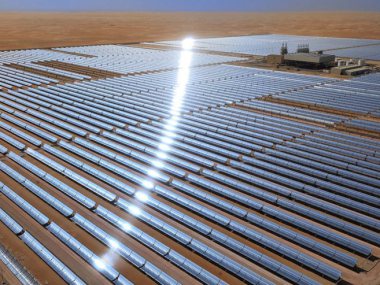 PM Modi lands World Bank’s record 1 trillion dollars loan for mega solar power project The World Bank has signed an agreement with India-led International Solar Alliance (ISA) to mobilise investments worth $1 trillion by 2030. IANS India Today, by Arpan RaiNew Delhi, June 30, 2016 The World Bank on Thursday signed an agreement with India-led International Solar Alliance (ISA) to mobilise investments worth $1 trillion by 2030 to help fund projects to increase solar energy use around the world.
The agreement, establishing the World Bank Group as a financial partner for 121-nation ISA, was signed here in the presence of visiting World Bank President Jim Yong Kim, Finance Minister Arun Jaitley and New and Renewable Energy Minister Piyush Goyal.
The ISA was launched at the Paris United Nations Climate Change Conference in November by Prime Minister Narendra Modi and French President Francois Hollande.
WHAT ALL DOES THE AGREEMENT INCLUDE?
As part of the agreement, the Bank will develop a roadmap to mobilise financing for development and deployment of affordable solar energy, and work with other multilateral development banks and financial institutions to develop financing instruments to support solar development.
On the occasion, the multilateral lender also announced that it planned to provide more than $1 billion to support India’s initiative to expand solar energy generation.
WHY IS THE MOVE A GRAND INVESTMENT FOR WORLD BANK?
The solar investments for India combined would be the Bank’s largest financing of solar energy projects for any country in the world to date, it said.
India’s plans to virtually triple the share of renewable energy by 2030 will both transform the country’s energy supply and have far-reaching global implications in the fight against climate change………http://indiatoday.intoday.in/story/pm-modi-lands-world-banks-record-1-trillion-dollars-loan-for-mega-solar-power-project/1/704572.html
US solar power market hits all-time high
 Here comes the sun: US solar power market hits all-time high, Guardian, Matt Weiser, 29 June 16
After a rocky start, the American solar market is taking off and growing faster than coal and natural gas power. What will it take to make it go truly mainstream?
Solar energy in the US has had a rocky existence. Ever since Ronald Reagan symbolically removed Jimmy Carter’s solar panels from the White House roof in 1986, federal policy has been unpredictable, such that manufacturers and consumers could never depend on reliable incentives to produce and install solar energy systems.
Remarkably, the US solar energy industry is now entering what may be its most prosperous decade ever, thanks to a new wave of federal and state policies and positive economics in the industry, both at home and abroad.
“I think it will actually be bigger than people are projecting,” says Jigar Shah, president and co-founder of Generate Capital, a clean energy investment firm based in San Francisco. “The solar industry is booming right now.”
The US solar industry expects to install 14.5 gigawatts of solar power in 2016, a 94% increase over the record 7.5 gigawatts last year, according to a new market report by GTM Research and the Solar Energy Industries Association. Revenues from solar installations also increased 21% from 2014 to more than $22bn in 2015.
For the first time, more solar systems came online than natural gas power plants – the top source of electricity in the US – in 2015, as measured in megawatts, said Justin Baca, vice president of markets and research at the Solar Energy Industries Association. This year, new solar is expected to surpass installations of all other sources, said the US Energy Information Administration.
The rise of solar energy use, especially by homes and businesses with panels on their roofs, is gradually transforming the electricity industry. For more than a century, power plant owners and utilities have controlled the energy delivery service, and some of them enjoy a monopoly.
“We were just a tiny little speck 10 years ago, and now we are really up there with the major established generating technologies,” said Baca. “It’s amazing.”
Sunny path
What’s behind all this? A federal tax credit has played a key role: it enables home and business owners to take off 30% of the price of their solar energy systems from their income taxes. Congress renewed the tax credit last December.
Another factor is cost. It is simply a lot cheaper to install solar these days, largely because cost of components have declined considerably. The wholesale price of a solar panel today is about $0.65 per watt, compared with $0.74 per watt a year ago and $4 per watt in 2008…….
The tariffs and increasing domestic demand have boosted manufacturing jobs in the US, which is now one of the top five nations for solar panel producers behind China, Singapore, Taiwan and Malaysia.
“Now the market’s so large you can actually sustain the large manufacturing plants and support the product locally,” said Shah.
One example is SolarCity, which is building a giant new solar panel factory in Buffalo, New York. The facility, expected to be in operation later this year, plans to employ 3,500 people. It will produce panels primarily for SolarCity’s own projects around the world……..https://www.theguardian.com/sustainable-business/2016/jun/28/solar-power-energy-us-utilities-environment-climate-change
Federal regulators declined to review a license application for high level nuclear waste dump
Federal regulators declined to review a license application submitted by Waste Control Specialists (WCS) for a high-level radioactive waste dump in Andrews County, records revealed.
WCS, a Dallas-based company with a nearly 15,000-acre site in western Andrews County, filed the application with plans to expand its existing low-level radioactive waste site.
The proposed facility would house spent fuel rods from nuclear reactors across the country for at least 40 years.
However, U.S. Nuclear Regulatory Commission (NRC) officials determined the company’s license application lacked “sufficient technical information” and safety-related details, according to a letter dated June 22 from the commission to WCS.
Company representatives did not immediately return calls for comment…….“The incomplete WCS license application reflects disregard for people around Texas who would be put at radioactive risk,” Smith said. “Andrews County should rescind their approval of this project and only reconsider it if and when WCS can prove they can handle this waste safely.” http://www.newswest9.com/story/32351938/paperwork-for-andrews-nuclear-waste-dump-missing-key-safety-security-details#.V3aIhr1ZZzQ.twitter
India and Pakistan communicate with each other on nuclear facilities
 Pakistan, India exchange information on nuclear facilities http://dailytimes.com.pk/islamabad/01-Jan-06/pakistan-india-exchange-information-on-nuclear-facilities ISLAMABAD: Pakistan and India on Sunday exchanged lists of their nuclear facilities on Sunday, a requirement every January 1 under an accord in which they promised not to attack each other’s nuclear installations.
“The governments of Pakistan and India today exchanged lists of their respective nuclear installations and facilities in accordance with Article II of the Agreement on Prohibition of Attacks Against Nuclear Installations and Facilities between Pakistan and India of December 31, 1988,” a Foreign Office statement said.
Zaheer A. Janjua, Director of the India Desk in Pakistan Ministry of Foreign Affairs handed over the list to an officer of the Indian High Commission in Islamabad at the Foreign Office at 11:00am PST, the statement said.
India handed over their list to Muhammad Khalid Jamali, First Secretary of the Pakistan High Commission at the Ministry of External Affairs in New Delhi at 11:30am IST, it added. The statement did not give any details of which installations and facilities are mentioned in the lists. The list usually includes civilian nuclear power plants and gives the exact location of each such installation.
Top foreign ministry officials from Pakistan, led by Foreign Secretary Riaz Muhammad Khan will meet Indian officials on January 17 and 18 in New Delhi for talks on Kashmir and other issues. Railway officials are also slated to meet in New Delhi on January 5 and 6 to discuss reopening a rail link between Munabao and Khokhrapar, which was terminated after a 1965 war between the two countries.
China trying to market nuclear reactors to Argentina
 China and Argentina reaffirm reactor agreement World Nuclear News, 01 July 2016 China and Argentina have signed a memorandum of understanding (MOU) reaffirming their plans to construct two new nuclear power reactors in the Latin American country with financing from Chinese banks. Construction of Argentina’s fourth reactor is to start early next year……..
More information needed on safety issues at Pilgrim Nuclear Power Station
 Nuclear safety expert seeks data about Pilgrim incident By Christine Legere The Cape Cod Times Jul. 1, 201 PLYMOUTH – A well-known nuclear safety expert is looking for more information from the Nuclear Regulatory Commission regarding a report that both emergency diesel generators at the Pilgrim Nuclear Power Station had been out of commission at the same time for a short period in April while the reactor was operating at full power.
David Lochbaum, director of the Nuclear Safety Program for the Union of Concerned Scientists, questions how long the plant had been running with no emergency generators, which provide a default power source to safely shut down the reactor, maintain safe shutdown conditions and operate all essential systems if primary and secondary power sources have failed……..
Meanwhile, Mary Lampert, a Duxbury resident and director of Pilgrim Watch, said she believed the situation occurred because of aging equipment and lack of vigilance.
“It’s the same old story: Entergy running the reactor on the cheap – generating not required backup power but trouble for us and themselves,” wrote Lampert in an email. ……http://www.enterprisenews.com/news/20160701/nuclear-safety-expert-seeks-data-about-pilgrim-incident
Fiji making its mark in renewable energy
Solar energy: Innovative start-up puts Fiji ahead on renewable energy, ABC News, 1 July 16 By Pacific economic and business reporter Jemima Garrett Fiji is making its mark as a leader in renewable energy thanks to an innovative start-up company focusing on supplying energy to the corporate sector.
Sunergise is the brain-child of entrepreneurs from Africa and the Pacific and has attracted investment interest from the World Bank as well as from Australia, New Zealand, North America and China……..
The installation of the first 700 photovoltaic cells at the marina was completed in 2012, just two days before Cyclone Evan hit, with winds gusting up to 270 kph.
Only one panel was damaged.
Sunergise has since completed two more installations at the Port of Denarau, creating the biggest marina-based solar plant in the world.
Australia ‘well behind’
In Australia, corporate solar is lagging behind residential investment and Sunergise is something advocacy group Solar Citizens would like to see more of.
“Australia leads the world in terms of residential roof-top solar,” Solar Citizen consumer campaigner Reece Turner said.
“Mums and dads have invested $8 billion of their own money in solar panels in just the last six or seven years. But we are well behind in the commercial space; comparatively we are probably 20th or 30th in the world in terms of commercial solar.
“That is where we are seeing some of the growth now but we really need to incentivise that uptake of commercial solar.”
We sell energy’
Sunergise’s business model is to focus on blue chip corporate clients and to own and operate the infrastructure they put on their roof.
“We don’t sell solar panels, we sell energy,” Sunergise chairman Bob Lyon said.
“We install the panels, the clients get an instant discount on their power, they don’t pay anything [for the infrastructure].”
Sunergise sells contracts that run for 10 or more years, with the client enjoying an initial saving of about 10 per cent and certainty on their power costs for the full term of the contract.
One of Fiji’s top hotels, the Tokoriki Island resort, uses Sunergise’s solar power technology and has cut its power bill by 50 per cent and silenced its expensive diesel generators.
The World Bank’s International Finance Corporation, its private sector arm, made its decision to take a 20 per cent stake in Sunergise based on the skills of its people………http://www.abc.net.au/news/2016-06-30/innovative-start-up-puts-fiji-ahead-on-renewable-energy/7557594
1 This Month


Tell the Ukrainian Government to Drop Prosecution of Peace Activist Yurii Sheliazhenko

Petition to revoke the licensing of the Near Surface Nuclear Disposal Facility (NSDF) at Chalk River. https://www.ourcommons.ca/petitions/en/Petition/Details?Petition=e-7247


of the week – STOP SMALL MODULAR REACTORS IN CANADA
To see nuclear-related stories in greater depth and intensity – go to https://nuclearinformation.wordpress.com
-
Archives
- March 2026 (204)
- February 2026 (268)
- January 2026 (308)
- December 2025 (358)
- November 2025 (359)
- October 2025 (376)
- September 2025 (258)
- August 2025 (319)
- July 2025 (230)
- June 2025 (348)
- May 2025 (261)
- April 2025 (305)
-
Categories
- 1
- 1 NUCLEAR ISSUES
- business and costs
- climate change
- culture and arts
- ENERGY
- environment
- health
- history
- indigenous issues
- Legal
- marketing of nuclear
- media
- opposition to nuclear
- PERSONAL STORIES
- politics
- politics international
- Religion and ethics
- safety
- secrets,lies and civil liberties
- spinbuster
- technology
- Uranium
- wastes
- weapons and war
- Women
- 2 WORLD
- ACTION
- AFRICA
- Atrocities
- AUSTRALIA
- Christina's notes
- Christina's themes
- culture and arts
- Events
- Fuk 2022
- Fuk 2023
- Fukushima 2017
- Fukushima 2018
- fukushima 2019
- Fukushima 2020
- Fukushima 2021
- general
- global warming
- Humour (God we need it)
- Nuclear
- RARE EARTHS
- Reference
- resources – print
- Resources -audiovicual
- Weekly Newsletter
- World
- World Nuclear
- YouTube
-
RSS
Entries RSS
Comments RSS
 nuclear-news