The nuclear power door is only just still open in Sweden
 Sweden’s deal leaves door to nuclear power open, but only just, Reuters STOCKHOLM, JUNE 23 | BY DANIEL DICKSON AND NERIJUS ADOMAITIS Sweden has agreed to cut taxes on nuclear power generators and allow for the construction of new reactors but policymakers have yet to work out how that fits with a commitment to using 100 percent renewable energy……..
Spokeswomen for the Energy Minister Ibrahim Baylan and for the Green Party, a junior member of the ruling coalition……….the target is formulated as electricity production… that means all production in Sweden is renewable,” Lise Nordin, Green Party energy policy spokeswoman and member of the parliament, told Reuters.
While the agreement allows power generators “in theory” to build new reactors, in reality they would be too costly, she added.
“The probability that new nuclear power will be built is zero,” Nordin said……..http://uk.reuters.com/article/sweden-nuclearpower-idUKL8N19E2VM
NUCLEAR-capable ballistic missiles for Russia – placed in Europe
Russia to deploy NUCLEAR-capable ballistic missiles in the heart of EUROPE, Express, UK 23 June 16 RUSSIA plans to station advanced nuclear-capable missiles deep inside Europe – putting vast swathes of the continent in the crosshairs of Moscow’s short-range ballistic missile programme. By TOM BATCHELOR, Jun 23, 2016 Kremlin insiders say the Russian enclave of Kaliningrad – on the Baltic Sea wedged between Poland and Lithuania – will host the Iskander missile – dubbed the Stone by Nato.
Crimea, which was annexed from the Ukraine in 2014, could also host a second Iskander missile base, Russian defence sources claim.
Russia has been accused of blatant acts of aggression in eastern Europe and the Baltics, with land grabs, military exercises and close fly-bys of its fighter jets.
The move is in defiance of a US-backed Nato missile shield that was erected in Romania last month, with a second planned for Poland in 2018.
With a range of roughly 300 miles, the Iskander missile could hit targets as far away as eastern Germany, the entire Baltic region and Poland, as well as parts of Sweden.
But experts say the targets it will cover can be struck by longer-range Russian missiles anyway.
Relations between Russia and the West have plunged to their lowest point since the Cold War in recent months.
Both sides have ramped up their defence spending, missile programmes and defensive shields as Europe enters what many observers believe is a new Cold War…….http://www.express.co.uk/news/world/682701/Russia-station-Iskander-nuclear-missiles-Kaliningrad-Cold-War-tensions
Safety issues at Taishan Nuclear Plant in China’s Guangdong

 Issues at Taishan Nuclear Plant in China’s Guangdong Spark Safety Fears Radio Free Asia, 23 June 16 Reported by Lam Kwok-lap for RFA’s Cantonese Service. Translated and written in English by Luisetta Mudie. Design flaws in a French-built nuclear reactor currently being tested at a power station on the southern coast of China have sparked safety concerns in neighboring Hong Kong, experts and local media reports said.
The U.S.$8.3 billion Taishan plant is among the first in the world to use European pressurised reactors (EPR) designed by French nuclear firm Areva, which recently sold a majority stake to energy giant Electricite de France (EDF).
Problems with the design of the reactors have emerged during testing, however, and were cited by EDF in a recent recommendation to the U.K. parliament that it postpone the Chinese-invested Hinkley Point nuclear plant, which had also planned to use EPR technology.
In a letter to U.K. lawmakers earlier this month, EDF said there may be “identical flaws” in the Taishan power plant, which lies just 160 km (100 miles) from the densely populated Pearl River Delta region, which includes Hong Kong.
Meanwhile, prolonged delays to an EPR reactor at Olkiluoto in Finland have resulted in multibillion-euro litigation between Areva and the Finnish energy group TVO. While Taishan has already postponed its scheduled opening by one year to 2018 after the discovery of too much carbon in the walls of the reactors, officials are still pushing for the plants to go ahead as planned, campaigners said in Hong Kong this week.
Last month, the concrete shells encasing the plant’s two pressure reactors were sealed, according to drone images gathered by Hong Kong’s crowd funded investigative news agency FactWire, which means that the EPR units can’t be removed or replaced now.
The amount of radioactive nuclear fuel stored at the Taishan plant is three times that of Japan’s Fukushima nuclear plant, campaigner Albert Lai told the agency.
50 million people
Lai fears that some 50 million people would be affected in the event of a large-scale nuclear leak, across a 7,000 square km area.
“There have been so many trust issues, that a lot of people now believe that quality control at this nuclear power plant is below standard,” engineer and sustainability campaigner Albert Lai, who convenes the Hong Kong think tank Professional Commons, told RFA on Thursday.
“What’s more, the problems are much more serious than we thought they were,” he said, citing a scandal over the falsification of parts forged at Areva’s Le Creusot facility that potentially put safety checks at risk………China General Nuclear has already posponed the opening of Taishan Unit 1 and Taishan Unit 2 to the first and second half of 2017 respectively, but FactWire reported, citing French engineers, that Unit 1 still required a large amount of tests, and the earliest it could start was 2018……..http://www.rfa.org/english/news/china/china-nuclear-06232016125814.html
Business analysts do not share the optimism of Toshiba’s new CEO, on nuclear power
 Toshiba’s new CEO sticks to nuclear target branded ambitious by analysts http://www.thefiscaltimes.com/latestnews/2016/06/23/Toshibas-new-CEO-sticks-nuclear-target-branded-ambitious-analysts Fiscal Times, 23 June 16, “Its achievable,” Satoshi Tsunakawa told reporters on Thursday, a day after assuming the top post, when asked about the company’s goal of building 45 nuclear power reactors globally by the business year ending March 2031….
Island states most at risk of global warming impact – Maldives want action
 Maldives urges rich countries to rapidly ratify Paris climate agreement
Environment and energy minister of small island state, one of the countries most at risk of global warming impacts, says ‘no time to waste’ on Paris deal, Guardian, Fiona Harvey, 21 June 16 Rich countries must ratify the climate change agreement reached in Paris last December, one of the world’s most at-risk nations has warned.
Thoriq Ibrahim, environment and energy minister of the Maldives, told the Guardian that there was “no time to waste”, in ratifying the agreement that was reached more than six months ago, and that it should be a matter of urgency for industrialised countries.
So far, almost the only countries to have passed the accord into law are the small islands most at risk from rising sea levels, and other smaller developing nations.
France became the first large industrialised nation to ratify the Paris agreementonly earlier this month, although a ceremony was held in New York in April at which countries were supposed to affirm their commitment to the international agreement…….https://www.theguardian.com/environment/2016/jun/21/maldives-urges-rich-countries-to-rapidly-ratify-paris-climate-agreement
Nestle’s new deal for powering its UK and Ireland operations with wind energy
 NEW RENEWABLE POWER SOURCE FOR NESTLE UK AND IRELAND OPERATIONS LONDON, The Climate Group, 22 June 16 Nestlé has signed a new deal to power around half of its UK and Ireland operations with wind from the Scottish Highlands.
An initial 15 year Power Partnership Agreement with Community Wind Power will see a brand new nine turbine wind farm open up in Dumfries and Galloway in the first half of 2017. It will produce approximately 125GWh of power per annum, meeting around 50% of Nestlés electricity demand in the UK and Ireland – equivalent to 30,000 homes.
Earlier this year, Nestlé UK & Ireland announced that all its grid supplied-electricity would come from renewable sources, in a deal with EDF Energy. This currently accounts for all of Nestlés electricity use in the UK and Ireland.
As a member of RE100, Nestlé is committed to transitioning its electricity use to 100% renewable electricity not just in the UK, but across its global operations. The latest available data shows that in 2015, 8.4% of Nestlés total electricity consumption was being sourced from renewable power. Today’s development is another positive step towards its global goal.
Dame Fiona Kendrick, Chairman & CEO of Nestlé UK & Ireland, said: “This is a newly commissioned wind farm, generating new energy, creating capacity that didn’t previously exist and capable of providing half of our electricity needs. It’s a proud moment for us and means we have reached another key milestone in our efforts to become a sustainable business.”…….http://www.theclimategroup.org/what-we-do/news-and-blogs/new-renewable-power-source-for-nestl-uk-and-ireland-operations/?platform=hootsuite
Diablo Canyon’s nuclear power plant leaves radioactive trash for a long time
 Nuclear plant closes, but it will not go away, Ventura County Star, 22 June 16, The announcement Tuesday of plans to close the Diablo Canyon nuclear power plant in 2025 was a historic moment in California.
It means the end of nuclear power generation in the state. The announcement by owners Pacific Gas & Electric was cheered by thousands who have fought since long before the plant went online in 1985 to end nuclear power production at the coastal facility at Avila Beach in San Luis Obispo County.
PG&E made the decision based, as best we can tell, for economic rather than environmental reasons. Although the majority of Americans now oppose the use of nuclear energy to provide electricity, the utility realized that there probably were going to be cheaper ways to provide power in the future than Diablo Canyon…….
there is one thing that will be left behind. They are the spent fuel rods, the most controversial, the most dangerous and the most difficult parts of a nuclear generating station.
At Diablo Canyon, the spent fuel rods are cooled in a special concrete pool for about five years. Then the rods are put in a helium-filled canister and set inside a 20-foot-tall concrete-filled steel storage cast that is cooled by natural air convection. The casks are bolted to a seven-and-one-half-foot thick concrete pad.
All of this is on the Diablo Canyon property, a short hike from the picturesque Avila Bay.
And there they will stay. The final responsibility for disposing of this high-level nuclear waste rests with the U.S. Department of Energy. And currently the federal government has no approved plan to dispose of any high-level nuclear fuel waste from any nuclear plant in the United States.
The nuclear rods are highly radioactive, enough to kill anyone exposed to them or contaminate local soil or groundwater, and will be in that state for thousands of years.
So until the federal government figures out how to safely get rid of our collective high-level nuclear waste — if it ever does — there will be a piece of Diablo Canyon plant, the most dangerous piece, creating minimal but potential risk for generations. http://www.vcstar.com/opinion/editorials/editorial-nuclear-plant-closes-but-it-will-not-go-away-35e17170-2354-07d3-e053-0100007fa1df-384027791.html
Potsdam Institute for Climate Impact Research says that renewables can deliver the Paris climate target
Explosive renewables development can deliver on Paris http://www.eurekalert.org/pub_releases/2016-06/pifc-erd062116.php POTSDAM INSTITUTE FOR CLIMATE IMPACT RESEARCH (PIK) While some criticize the Paris climate target as impracticable, a team of scholars argues that it is – on the contrary – a triumph of realism. First, and most importantly, adhering to the Paris target of keeping global warming well below 2 degrees Celsius is necessary in view of the massive risks that unchecked climate change would pose to society. A crucial type of threats, associated with the crossing of tipping points in the Earth system, is summarized in a landmark map for the first time. Second, implementing the Paris target is feasible through the controlled implosion of the fossil industry, instigated by a technological explosion related to renewable energy systems and other innovations. Third, the target is simple enough to create worldwide political momentum, the scientists say in their comment published in Nature Climate Change.
Necessity: tipping elements and global temperature
Based on the advances made by climate research as a whole over the past two decades, the scientists provide a defining diagram of tipping elements in the context of the global temperature evolution. “We illustrate that for the Earth system, half a degree really matters,” Winkelmann says. Warming of only 1.5 degrees above preindustrial levels will have major consequences, such as threatening the survival of coral reefs worldwide. But the difference to 2 degrees is substantial. In a 1.5-degree warmer world, for example, global sea-level rise could be limited to 1.5 meters by the year 2300, whereas at 2 degrees, 2-3 meters rise by 2300 have been projected, and the Greenland ice sheet may well pass its tipping point.
“Beyond 2 degrees, the course might be set for a long-term complete deglaciation of the Northern Hemisphere,” says Winkelmann. “This would result in sea-level rise that threatens the survival of many major coastal cities including New York, Mumbai and Tokyo. Hence the necessity of the Paris target.”
Feasibility: carbon pricing, divestment movement, wind and solar power
“While the latest IPCC assessment has shattered the infeasibility myth, showing that the 2 degrees guardrail can be respected at relatively low cost with the proper political resolve,” says co-author Stefan Rahmstorf, head of Earth System Analysis at PIK, “almost all IPCC scenarios assume so-called negative emissions – taking CO2 out of the atmosphere and storing it. That is a very long shot. However, the price decrease and the efficiency increase of wind and solar power have been beyond the most optimistic predictions.” A technical explosion of renewables would, once the new technologies reach a market penetration of 15-20 percent, lead to an implosion of the fossil industry, the scientists argue. Currently, India appears to be very serious about implementing its colossal renewables target – an example of self-amplifying developments that have the potential to tip the global market scales.
In addition, a strong climate agreement paves the way towards carbon pricing instruments that will be adopted in more and more countries, the authors say. Last but not least, issues of morality are going to interfere with economics – one case in point is the divestment campaign which aims at pulling assets out of fossil businesses. Already today, key financial market players like the German Allianz insurance, the French company AXA or the legendary US oil dynasty Rockefeller are moving in that direction.
Simplicity: negotiators can turn objectives into action
“Beyond necessity and feasibility, the 2 degrees C guardrail has a comparative advantage over competing targets that cannot be overrated in the world of ‘realpolitik’: it is easy to grasp and communicate,” says lead author Hans Joachim Schellnhuber, director of PIK. “In fact, the target strikes the optimal balance between concreteness and intelligibility. Now the world of climate action turns around one single number!” In the days and nights of the Paris negotiations, the 2 degrees concept – originating from a 1995 report by the German government advisory council for environmental issues (WBGU) – proved its worth since every national delegation could take a stance for the temperature limit of its choice. This would have been hard to imagine with the more complicated target suggestions made recently – ocean heat content, CO2 equivalent greenhouse gas atmospheric concentrations, or temperature change rate.
“The Paris agreement is a historic achievement and a genuine triumph of reason,” Schellnhuber concludes. “Now the pressure is on to implement that consensus in time, in order to avoid the looming humanitarian tragedy for good.”
###
Article: Schellnhuber, H.J., Rahmstorf, S., Winkelmann, R. (2016): Why the right climate target was agreed in Paris. Nature Climate Change
Weblink to the article once it is published: http://www.nature.com/nclimate/index.html
For further information please contact:
PIK press office
Phone: +49 331 288 25 07
E-Mail: press@pik-potsdam.de
Twitter: @PIK_Climate
June 23 Energy News

Opinion:
¶ “Can Renewables Replace Nuclear Power?” • Utility PG&E’s announcement that it would shutter California’s last nuclear plant and replace the power with energy efficiency and renewable energy was the result of a confluence of progressive state policies making it more feasible. [Scientific American]
 Diablo Canyon Nuclear Power Station, on the coast of California. Credit: Doc Searls/Flickr, CC BY-SA 2.0
Science and Technology:
¶ Solar Impulse 2 has landed in Spain, completing the Atlantic leg of its historic bid to circumnavigate the globe. The landing in Seville marked the end of the 15th stage of Solar Impulse’s route. Mission managers will now plot a route to Abu Dhabi where the venture began in March, 2015. [BBC]
World:
¶ Brazil’s Ministry of Mines and Energy approved six renewable energy plants, with a combined capacity of 165 MW, to join the national Incentive Regime for Infrastructure Development…
View original post 622 more words
Honeybees and Butterflies as Indicators of Radioactive Contamination; Impacts on Fruit Production

In “Honeybees as Monitors of Low Levels of Radioactivity” Simmons et. al.(1990) state that”it is known that honeybees can be used to detect radionuclides present in the environment. Their mobility and their ability to integrate all exposure pathways (i.e., water, air, vegetation, and soil) could expand and add another level of confidence to the present monitoring program.” (This study was for the US DOE at Hanford Nuclear Site) [1]
In “Radioactive Bees–Honey Bees as Indicators of Radionuclide Contamination“, Timothy K. Haarmann of Los Alamos National Lab says that his experiments at LANL “verify that honey bees are indeed good indicators of radionuclide contamination when it is present in the environment“. [2]
McGee and McGarry of the Radiological Protection Institute of Ireland inform us that “Bees forage intensively over about 7 km2 visiting thousands of plants daily in their search for pollen…
View original post 865 more words
Nobel Laureate H.J. Muller: Ionizing Radiation and (Lethal) Genetic Mutations Discoveries in the 1920s
“Hermann Joseph Muller (or H. J. Muller) (December 21, 1890 – April 5, 1967) was an American geneticist, educator, and Nobel laureate best known for his work on the physiological and genetic effects of radiation (X-ray mutagenesis) as well as his outspoken political beliefs.[2] Muller frequently warned of the long-term dangers of radioactive fallout from nuclear war and nuclear testing, helping to raise public awareness in this area.[3]
… At 16 he entered Columbia College. From his first semester he was interested in biology; he became an early convert of the Mendelian-chromosome theory of heredity — and the concept of genetic mutations and natural selection as the basis for evolution… Muller earned a B.A. degree in 1910.[5]
Muller remained at Columbia (the pre-eminent American zoology program at the time, thanks to E. B. Wilson and his students) for graduate school. He became interested in the Drosophila [fruit fly]
View original post 1,314 more words
In Defiance of Harmful Fuels — Is Tesla/Solar City the New Model For What an Energy Company Should Look Like?

GR.– CO2 continues to rise, a positive methane feedback loop may form, marine and terrestrial habitats are dying, and then there’s Elon Musk’s business enterprise with some good news. Power your home with your car? Read on:
 RobertScribbler.– “It could well be said that we are subsidizing our own destruction. Despite centuries of use, fossil fuels around the world today receive about 500 billion dollars annually in the form of economic incentives from Earth’s various governing bodies. With alternatives to fossil fuels becoming less costly and more widely available, and with the impacts of human-forced climate change growing dramatically worse with each passing year, such wasteful and harmful misuse of public monies is starting to look actively suicidal.
Fossil Fuel Funding for Global Catastrophe
“Given so much money going into the hands of what are already the wealthiest corporations in existence, one would expect that the practice of providing these…
View original post 128 more words
CO2’s Vertigo-Inducing Rate of Rise — In First 5 Months of 2016 Hothouse Gas Concentration Rocketed 3.7 Parts Per Million Above 2015
GR.– A recurring warning from climatologists is the possibility that melting permafrost will generate a positive feedback loop in global warming. Such an event would move the “Climate Emergency” into an extreme phase from which we could not recover without massive damage to Earth’s ecosystems and the current human civilizations. Prudence demands that we never dismiss such fears. We must try to prevent the event, plan contingency responses, and hope it never happens.
“Perhaps the most worrisome threat is that because the Arctic is warming so much faster than the globe as a whole, the permafrost — soil that remains frozen year-round — is thawing. As it does, organic matter which is trapped within can decay, and when it does it releases CO2 into the atmosphere, except those places where instead of releasing CO2 it releases CH4.” — Tamino.
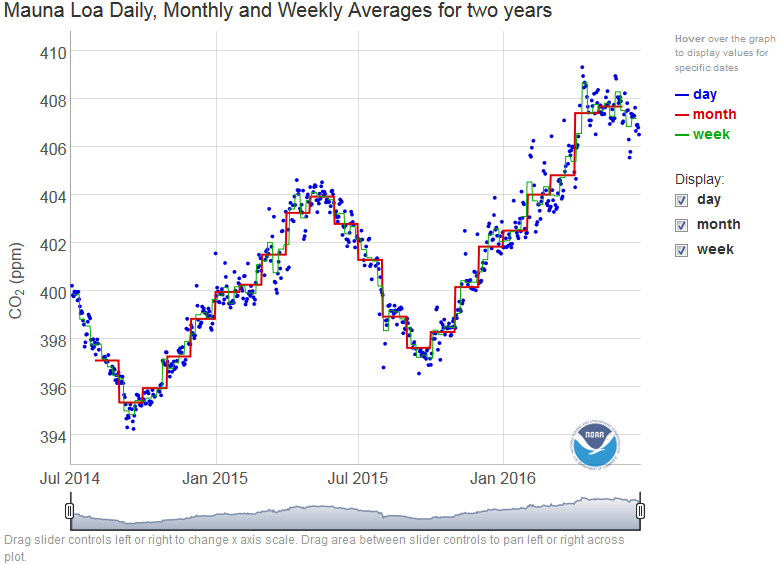 RobertScribbler.– “With the Northern Hemisphere Pole warming at a rate 2-3…
View original post 70 more words
Killing ourselves with technology

What do we do when technology spirals out of our control? Or, to put it more bluntly, when does humanity’s ability to build ever more dangerous weapons become a self-fulfilling prophesy?
Albert Einstein is said to have remarked that he didn’t know what weapons the third world war would be fought with, but the fourth would be waged with sticks and rocks. Even that classic of science fiction optimism, Star Trek, had humanity surviving a third world war. (Spock recounted the tolls of Earth’s three world wars in one episode.)
But we wouldn’t, would we? Or we might wish we didn’t. One story that has long lingered in my mind is an early Philip K. Dick story, “Second Variety,” published in 1953, a time when the cold war was looking decidedly hot. The story takes place in a post-apocalyptic France, in a world in which nuclear bombs…
View original post 890 more words
June 22 Energy News
Opinion:
¶ “The U.S. Nuclear Boom Has Turned Into a Dud” • Five years ago, we were supposed to be entering a nuclear renaissance. New nuclear plants were being planned and there were loan guarantee programs in place. Today, the nuclear industry in the US is dying. [Motley Fool]
 Vermont Yankee nuclear power plant. NRC photo. Public domain.
World:
¶ Warmer winters played an important role in the decline in EU greenhouse gas emissions. A report says CO2 emissions across the bloc dropped by almost 25% from 1990 to 2014. Renewable energy, a switch from coal to natural gas, and recession also contributed to the fall. [BBC]
¶ The University of Cambridge has blacklisted all investment in coal and tar sands companies following mounting pressure to divest from fossil fuels. The University currently has no coal or tar sands investments, and has “no expectation of having…
View original post 616 more words
1 This Month

of the week – Shut Down Drone Warfare!


Tell the Ukrainian Government to Drop Prosecution of Peace Activist Yurii Sheliazhenko

Petition to revoke the licensing of the Near Surface Nuclear Disposal Facility (NSDF) at Chalk River. https://www.ourcommons.ca/petitions/en/Petition/Details?Petition=e-7247
To see nuclear-related stories in greater depth and intensity – go to https://nuclearinformation.wordpress.com
-
Archives
- April 2026 (103)
- March 2026 (251)
- February 2026 (268)
- January 2026 (308)
- December 2025 (358)
- November 2025 (359)
- October 2025 (376)
- September 2025 (257)
- August 2025 (319)
- July 2025 (230)
- June 2025 (348)
- May 2025 (261)
-
Categories
- 1
- 1 NUCLEAR ISSUES
- business and costs
- climate change
- culture and arts
- ENERGY
- environment
- health
- history
- indigenous issues
- Legal
- marketing of nuclear
- media
- opposition to nuclear
- PERSONAL STORIES
- politics
- politics international
- Religion and ethics
- safety
- secrets,lies and civil liberties
- spinbuster
- technology
- Uranium
- wastes
- weapons and war
- Women
- 2 WORLD
- ACTION
- AFRICA
- Atrocities
- AUSTRALIA
- Christina's notes
- Christina's themes
- culture and arts
- Events
- Fuk 2022
- Fuk 2023
- Fukushima 2017
- Fukushima 2018
- fukushima 2019
- Fukushima 2020
- Fukushima 2021
- general
- global warming
- Humour (God we need it)
- Nuclear
- RARE EARTHS
- Reference
- resources – print
- Resources -audiovicual
- Weekly Newsletter
- World
- World Nuclear
- YouTube
-
RSS
Entries RSS
Comments RSS
 nuclear-news