Exelon wants license to operate nuclear plant for 80 years
Exelon Will Seek License to Run Nuclear Plant for 80 Years http://www.bloomberg.com/news/articles/2016-06-06/exelon-said-to-seek-license-to-run-nuclear-plant-for-80-years Mark Chediak Jonathan Crawford June 7, 2016
-
Exelon wants 20-year license extension for Peach Bottom site
-
Dominion said it will file similar request for Virginia plant
-
Exelon Corp. said it will seek to extend the operating life of a nuclear power plant in Pennsylvania by another 20 years, joining Dominion Resources Inc. in requesting permission to run atomic generators for as long as 80 years.
Exelon will ask federal regulators for approval to renew the licenses of the two reactors at its Peach Bottom facility, the Chicago-based power generator said Tuesday in a statement. An extension would help the state meet its carbon-reduction goals under the Obama administration’s Clean Power Plan, Chief Executive Officer Chris Crane said.
Should the commission approve Exelon’s request, the Peach Bottom nuclear station would be among the first U.S. reactors allowed to run beyond 60 years. Dominion said last year that it would seek approval to keep the Surry nuclear power plant in Virginia online until it’s 80 years old.
- The requests come at a pivotal time for the U.S. nuclear power industry as some operators including Exelon have announced plans to retire plants early because of financial losses. Competition from generators using cheap natural gas and renewable resources such as solar and wind have squeezed the profits of reactor owners, particularly those who sell their supply into wholesale power markets.
‘Renewal Program’
Exelon had issued a statement on Monday saying that Crane would join officials including Pennsylvania Public Utility Commission Chair Gladys Brown at the Peach Bottom station for an announcement on Tuesday “concerning the Station’s license renewal program.”
The two operating reactors at the Peach Bottom plant are licensed to operate through 2033 and 2034, according to Nuclear Regulatory Commission data. Exelon will seek federal permission for licenses that extend to 2053 and 2054, the company said. Exelon’s reactors received their original operating licenses in 1973 and 1974, according to the commission.
Europe and North America: aging nuclear reactors, components becoming obsolete
Escalating costs of nuclear power: too risky for Australia?, Independent Australia Climate News Network 7 June 2016, The nuclear industry worldwide faces an escalating battle to keep ageing reactors running as about a quarter of components and computer systems become obsolete. Paul Brown from Climate News Network reports.
LIFE EXTENSIONS to nuclear plants in Europe and North America are repeatedly being granted by safety regulators. But, according to nuclear plant owners, 25% of parts are now obsolete, so keeping the reactors going is becoming an increasing problem as components wear out
This is the background to the Nuclear Power Plant Optimisation Summit being held in Brussels Tuesday and Wednesday this week, when 150 of the world’s top nuclear executives will share experience on how to keep their stations open.
In theory, it makes economic sense to keep running a nuclear reactor well beyond its original design life, so long as it does not pose safety problems. With the capital cost of building the reactor written off decades earlier, profits can be substantial if the running costs can be kept low.
Life extensions In France, where 75% of electricity supply comes from 58 reactors, the government announced in February that it was prepared to raise the limit on the life of reactors from 40 to 50 years.
Also in February, two reactors in the UK that began generating in 1983 and are due to close in 2019 had their lives extended to 2024. Two others commissioned in 1988 will now work on until 2030. In all four cases, the owner can apply for further life extensions after that.
But nuclear power plants built across the world in the 1970s and 80s rely on computer technology and components now long out of production. Replacing worn-out parts is becoming a serious problem, causing an increasing number of unplanned and expensive shutdowns while components are updated.
Finding people with the expertise to operate obsolete equipment is a problem as experienced staff retire……
In Europe, there is little chance of replacing the obsolescent fleet with new plant. Perhaps the starkest example is France, with its 58 ageing reactors. It is building only one new replacement reactor.
This plant, at Flamanville in Normandy, should already be in operation, but is years late and three times over budget. Plans to build others have been shelved……https://independentaustralia.net/environment/environment-display/escalating-costs-of-nuclear-power-too-risky-for-australia,9079
Western societies not well prepared for nuclear evacuation crises
Westerners lack education on nuclear disaster risks, expert warns
Christopher Abbott says orderly evacuation seen during Japan’s Fukushima incident would not work as well in western societies, Guardian, Nicola Davis, 8 June 16, Western societies would not respond well to a Fukushima-style nuclear disaster due to a lack of public information, a leading disaster expert has warned.
Christopher Abbott said he firmly believed that the public ought to be better educated over the hazards and risks they may face.
Illustrating his point, he referred to the Fukushima disaster of 2011 in which 160,000 people were evacuated from the vicinity of the plant as experts attempted to tackle the emergency. The evacuation worked, said Abbott, because “the Japanese educate the public”.
“I just don’t see that it would have worked as successfully in western society,” he added. “[It’s] a very personal opinion but one that is backed up by Japanese colleagues.”…….http://www.theguardian.com/environment/2016/jun/07/westerners-lack-education-nuclear-disaster-risks-expert-warns
India and Japan – no progress yet on nuclear business co-operation deal
 India-Japan nuclear deal stuck on technical details, THE HINDU, KALLOL BHATTACHERJEE
The agreement misses Japan’s National Diet session
The India-Japan civil nuclear agreement is likely to have a long waiting period, probably more than a year, before it fructifies. This is because, the National Diet failed to take up the agreement in the summer legislative session which ended on June 1. Japanese diplomats further told The Hindu that even the “technical details” of the deal were yet to be finalised.
The civil nuclear agreement firmed up during the visit of Prime Minister Shinzo Abe in December 2015 needs the legislative approval as Japan wants to convince the political parties in the Diet that the “nuclear cooperation by Japan shall be carried out only for peaceful purposes”, Yasuhisa Kawamura, Press Secretary of Ministry of Foreign Affair of Japan told The Hindu.
- “The summer session of the Diet ended on June 1 and the nuclear agreement was not taken up for discussion. The next session of the Diet is in autumn,” Japanese ambassador to India Kenji Hiramatsu said on Tuesday in Delhi indicating that the agreement failed to make it to the Diet despite growing expectation that Japan would fast track the legislative approval for the same which came up after India concluded similar agreements with several major nuclear energy producing countries including the U.S.
Elaborating on the ambassador’s comments, Mr. Kawamura said “both Japan and India have been working on technical details of the Japan-India nuclear cooperation agreement, which have to be finalised as is mentioned in the memorandum which two Prime Ministers signed last December,” and added that the “schedule of submitting the Agreement to the Diet has not been yet decided”…….http://www.thehindu.com/news/national/indiajapan-nuclear-deal-stuck-on-technical-details/article8701794.ece
Ukraine sseking to renew deliveries of nuclear fuel from Russia
Ukraine’s Energoatom seeks to restart Russian nuclear fuel deliveries, Tass, June 07,
Energoatom is looking for alternative options of Russian nuclear fuel deliveries to Ukraine’s NPPs after the company’s financial accounts have been blocked KIEV, June 7. /TASS/. Energoatom, the operator of Ukrainian nuclear power plants, is looking for alternative options of Russian nuclear fuel deliveries to Ukraine’s NPPs after the company’s financial accounts have been blocked, Energoatom President Yuri Nedashkovsky said in reply to a TASS question on Tuesday.
“Our lawyers are working on possible alternative schemes of fuel deliveries,” he said in comments on the question about whether the company was considering the option of advance deliveries of Russian nuclear fuel with delayed payments for these supplies. The company head didn’t provide any further details, referring to the confidentiality of the information.
No breach of Russia contract with larger Westinghouse fuel load
The larger use of fuel from US Westinghouse Company at Ukrainian nuclear power plants does not breach Ukraine’s contractual obligations with Russia on fuel delivery by Russia’s TVEL Enterprise, President of Ukraine’s NPP operator Energoatom Yuri Nedashkovsky said on Tuesday.
According to the Energoatom president, the contractual obligation to load NPS with nuclear fuel of Russian assembly is relevant only if a nuclear fuel-producing facility is built in Ukraine jointly with Russia’s TVEL.
“The contract with Russia stipulates such a condition [on certain volumes of loading NPPs with Russian fuel assemblies] but only if a nuclear fuel factory is built,” the Energoatom head said.
A nuclear fuel plant that was planned for construction in partnership with Russia in the Kirovograd Region would have been the third source of fuel assembly fabrication for Ukrainian NPPs, Nedashkovsky said.
TVEL Fuel Company Vice-President Oleg Grigoryev earlier said Russia had not received any official notice from Ukraine on loading Westinghouse fuel into the reactors of the South Ukraine NPP. According to him, in case of receiving the notice, “measures of juridical nature will be taken as the load of the US nuclear fuel into Ukrainian reactors is a breach of the contract.”
Energoatom and Westinghouse have been cooperating since 2000 under the project of introducing US fuel at Ukrainian NPPs.
In April 2012, damages of US fuel cassettes were found at the third power unit of the South Ukraine NPP. A special inter-departmental commission found that the damage had been caused by design defects. In 2014, the Ukrainian leadership readdressed the issue of diversifying nuclear fuel deliveries and the contract with Westinghouse was extended to 2020.
Currently, Westinghouse fuel assemblies are loaded into the third power unit of the South Ukraine NPP. As Ukraine’s State Nuclear Regulation Inspection earlier told TASS, the department “has no principled claims to the operation of Westinghouse fuel at this power unit.”
Ukraine’s Energoatom seeks options for restart of Russian nuclear fuel deliveries…….http://tass.ru/en/economy/880576
Renewable power peaks in Western Europe squeezing out French nuclear power
France is surrounded by countries with a lot of solar and wind, with the exception of Switzerland. It thus seems that renewable power peaks in western Europe might be squeezing out French nuclear power.
French nuclear under pressure – from German renewables http://reneweconomy.com.au/2016/french-nuclear-pressure-german-renewables-27574 By Craig Morris on 7 June 2016 In late May, strikes reduced nuclear power production in France. Yet even more plants were offline a few weeks earlier without any strikes at all. German and European renewable electricity may have been one reason why France switched off so many nuclear plants that weekend. Craig Morris takes a look.
The news has been a bit difficult to comprehend. For instance, Reuters reported that labor union strikes on May 26 would affect the country’s “19 plants”. To be more precise, the country has 58 reactors in 19 locations. The difference in these numbers is important if we want to understand what it means that nine reactors were switched off that day because of the strike. Less than a sixth of the reactors were thus affected, not nearly half. Still, nuclear “must be designed to sidestep labor-management antagonisms,” wrote Mark Hertsgaard back in 1983. Strikes are relevant for nuclear safety.
On the other hand, 33 of France’s 58 reactors were offline or running at reduced output that day. Yet, the situation on Thursday (May 26) was not as grave as the one on Sunday (May 15) though it drew much less attention. The strikes on May 25 “only” brought nuclear power production down below 40 GW (and briefly below 37 GW, as shown in the chart below [on original] ).
In contrast, nuclear power production fell below 28 GW on Sunday (May 15) which may be an historic low (it is the low for the year). Note as well the time difference; the low on May 26 (workday) occurred in the middle of the night, when demand is low. But the low on Sunday (May 15) occurred in the afternoon.
There is an interesting correlation between the probably record peak share of renewable electricity in Germany at 3 PM that same day. As the chart below [on original] shows, wind and solar power collectively came in at around 35 GW – to serve demand only around 10 GW higher. All other power plants (hydro, biomass, coal, natural gas, and nuclear) were pushed down to 17 GW, more than half of which was for export.
That day, 34 of France’s 58 nuclear reactors were off-line or running at throttled output, a number that may be an historic record (if anyone can help us find that out, please use the comment box below). Eight of those 34 events were unplanned.
Note that all eight of those unplanned events in France began no later than May 14, the day before the new record in the share of renewable electricity in Germany. But as the chart above [on original] shows, renewables were already putting intense pressure on Germany’s power fleet that Saturday as well.
France is surrounded by countries with a lot of solar and wind, with the exception of Switzerland. It thus seems that renewable power peaks in western Europe might be squeezing out French nuclear power. If so, we will see how flexible the nuclear fleet can be. My bet is that France cannot afford to build up solar and wind any further unless it starts closing nuclear reactors. If neighboring countries continue to develop these two energy sources, the result could be more failures in France’s aging nuclear fleet.
Some of the other shutdowns deserve closer attention. On March 31, the nuclear plant Paluel 2 “just barely escaped catastrophe,” as Le Parisien put it (in French). That day, a 465-ton steam generator suspended above the reactor’s concrete pool (the facility was not in operation at the time) fell some 22 meters, causing an impact “comparable to an earthquake,” according to the French paper. It is unclear whether the reactor will ever go into operation again.
If it doesn’t, then the country’s oldest reactor, Fessenheim, technically might not need to be switched off. The current deal is that it will be shut down so that the new one in Flamanville can be turned on. Flamanville may never be completed, however, and Fessenheim is not doing so well itself. Block 1 was switched off in May when the potential for a leak was discovered. Overall, the reactor failed four times in May alone and was also switched off completely once for two days of scheduled maintenance.
France has put so many eggs in the nuclear basket that it cannot transition away from the technology. And because too many people concerned about carbon emissions fail to understand how incompatible nuclear is with wind & solar, France just may try to integrate the two. The result could be an accident that will change public opinion in the country forever, but it would be a high price to pay for the insight that the future is with wind & solar – and that nuclear is incompatible with them.
TVA’s Watts Bar-2 nuclear unit shuts soon after connecting to grid
Washington (Platts) William Freebairn –6 Jun 2016 Tennessee Valley Authority’s 1,150-MW Watts Bar-2 nuclear generating unit in Spring City, Tennessee, shut automatically Sunday, hours after it connected to the electricity grid for the first time Friday, TVA said Monday.
“Power ascension testing” will be repeated several times and the unit will be shut after producing power to test safety systems, officials have said. TVA said in a filing with the US Securities and Exchange Commission May 3 that it expects to declare commercial operation of the reactor, when testing is complete and steady-state operations are likely, sometime this summer. http://www.platts.com/latest-news/electric-power/washington/tvas-watts-bar-2-nuclear-unit-shuts-soon-after-21634906
To save the Great Barrier Reef ‘we need to start now, right now’ – video | Environment | The Guardian


GR: The video leaves us with a grim outlook. Human wastes running into the oceans coupled with global warming will soon destroy all the reefs. Do enough people care to force our governments to act? Probably not. Do you see any answers?
Josh Wall and Michael Slezak, theguardian.com: Jon Brodie from James Cook University says to give the Great Barrier Reef even a fighting chance to survive, Australia needs to spend $1bn a year for the next 10 years to improve water quality. If we don’t do that now, he says, we might need to just give up on the reef. ‘Climate change is happening much more quickly and much more severely than most scientists predicted’•
The Great Barrier Reef: a catastrophe laid bare – special report. Source: To save the Great Barrier Reef ‘we need to start now, right now’ – video | Environment | The Guardian
View original post 1 more word
Green Conservatives call for earlier UK coal power phase-out | Environment | The Guardian
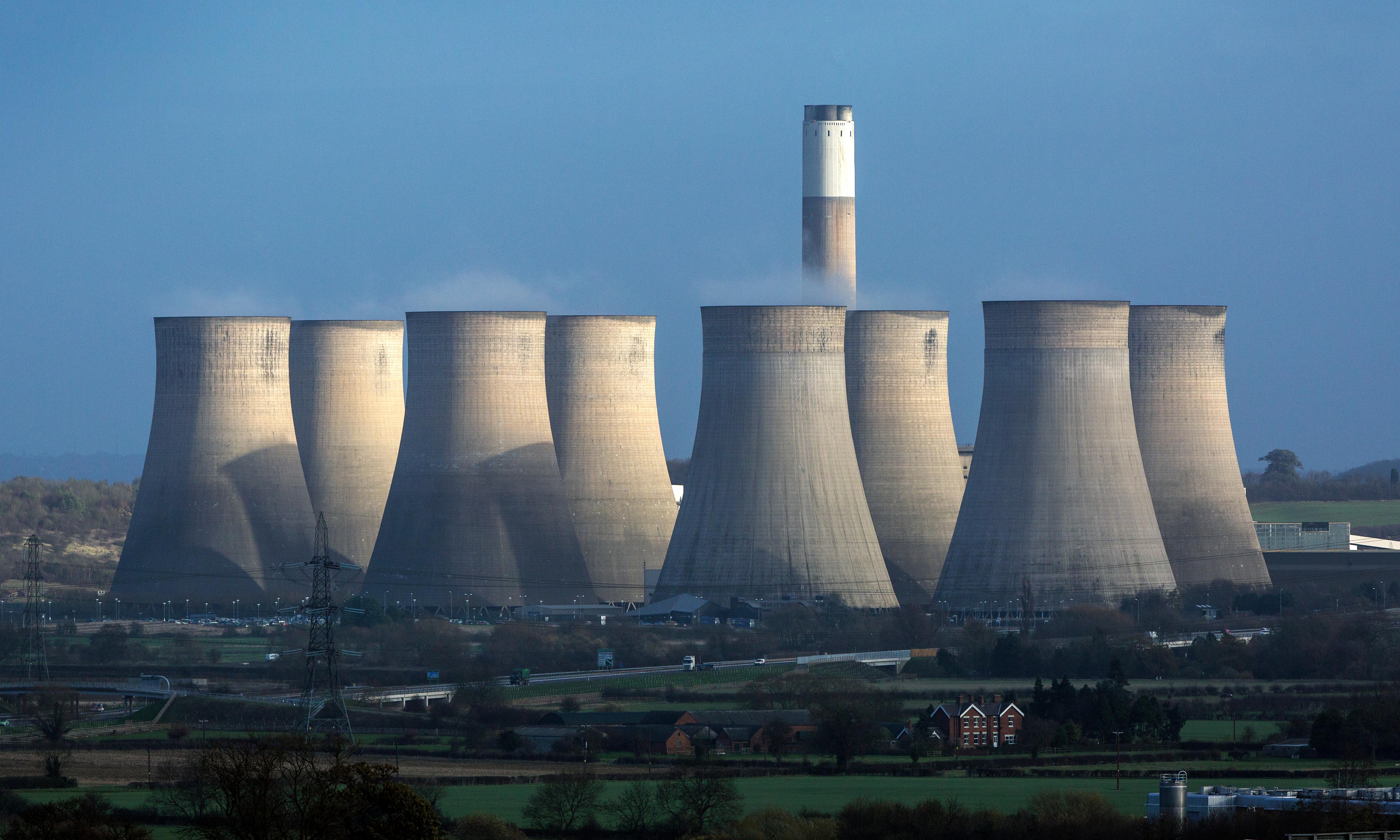 Damian Carrington: The UK should close all its coal-fired power stations two years earlier than the government’s pledge of 2025, according to green Conservatives including former energy minister Lord Greg Barker.
The move would not cause the lights to go out, would cut both carbon emissions and air pollution and would boost cleaner energy projects, according to a report from Bright Blue, a thinktank of Tory modernisers.
The report also concludes that if the troubled Hinkley C nuclear plant is cancelled it could be replaced by renewable energy. Source: Green Conservatives call for earlier UK coal power phase-out | Environment | The Guardian
Save
June 7 Energy News

Opinion:
¶ “French nuclear under pressure – from German renewables” • In late May, strikes reduced nuclear power production in France. Yet even more plants were offline a few weeks earlier without any strikes at all. This was partly because of renewable electricity from Germany. [RenewEconomy]
 Nuclear plant Paluel 2 “just barely escaped catastrophe,” Le Parisien said, on March 31. (Photo by Bodoklecksel, modified, CC BY-SA 3.0)
World:
¶ A 20% increase in wind and solar energy generation in 2015 has combined to deliver another annual increase in the amount of Australia’s electricity sourced from renewables, more than compensating for a drop in hydro production, a new report has found. [CleanTechnica]
¶ More detail has come on Solastor’s proposal for a “baseload” solar thermal and storage power plant in Port Augusta, South Australia. The ambitious 170-MW, $1.2 billion project could produce the lowest-price 24/7 solar power…
View original post 490 more words
Germany’s Attempt to Dump Nuclear Waste and Liability Upon America: SRS Citizen’s Board Objects

“Germany is a wealthy and stable first-world ally capable of safely and securely managing this SNF [Spent Nuclear Fuel] without US assistance.” (Citizens Advisory Bd, Savannah River Site)
Reuters reported (30 May 2016) that “The German cabinet plans to approve a draft law on August 3 that will require its utilities to pay billions of euros into a state fund to help cover the cost of nuclear storage,…” Germany’s major nuclear power companies include E.ON, RWE, EnBW and Vattenfall. The law will be debated and voted in German parliament in November. Reuters reported (1 June 2016) that while this 23.3 billion euros ($26 billion) is to “remove unwanted long-term liability for the storage of nuclear waste. The responsibility for dismantling and storing nuclear waste in the interim will remain with the utility companies.” (Emphasis our own).
Most of the 200…
View original post 1,736 more words
Here’s what the science really says about Fort McMurray and climate change | National Observer
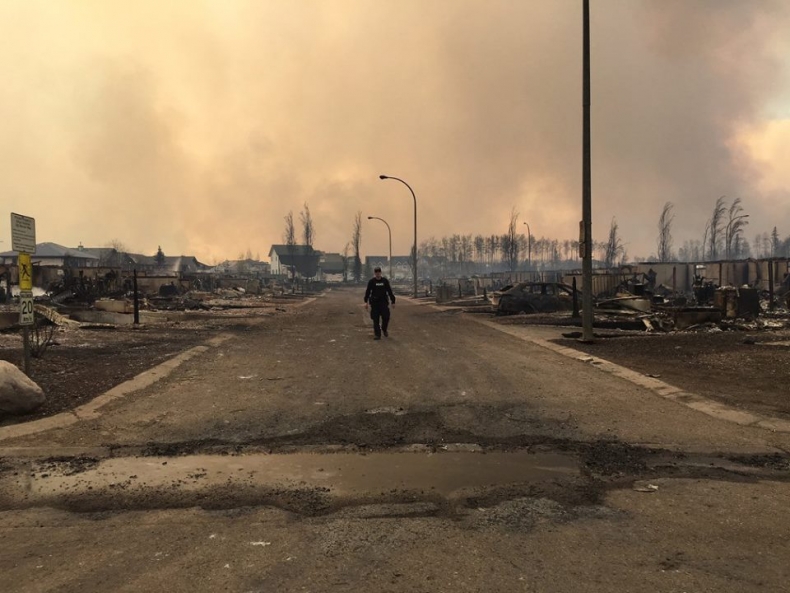
Climate Change Causing More Fires
Now Fort McMurray residents have begun the difficult journey home weeks after that terrifying day in May when an unprecedented inferno, fueled by unusually hot and dry spring weather, caused them to flee and led to the largest evacuation in Alberta’s history.
Those unusual weather conditions have been widely attributed to El Nino, a naturally-occurring phenomenon linked to warm ocean water that disrupts the weather.
But Flannigan, a professor of wildland fire from the University of Alberta, and many other climate change scientists agree that while the Fort McMurray fires cannot be directly linked to the carbon pollution produced by humans, Canadian wildfire activity of the past few years is well above average. And it’s connected to the warming climate.
In terms of the total areas destroyed by fires, there’s an unmistakable escalation, they say.They see these fires as vivid markers of dangers to come…
View original post 55 more words
Extent of Ocean Surface Above 86 Degrees (F) Hits New Record During May of 2016 | robertscribbler
Warming oceans reach new high temperature
Almost 10% of the ocean surfaces are above 85 degrees Fahrenheit. The chart below and this record indicate that the oceans are warming up. Read Scribbler’s analysis to learn just how terrible this really is.
Robert Scribbler: “Not only is a human-forced warming of the globe expected to increase average surface ocean and land temperatures, it is also expected to generate higher peak readings over larger and larger regions. Such was the case during May of 2016 as a massive expanse of the world ocean saw temperatures rocket to above 30 degrees Celsius (or 86 degrees Fahrenheit).
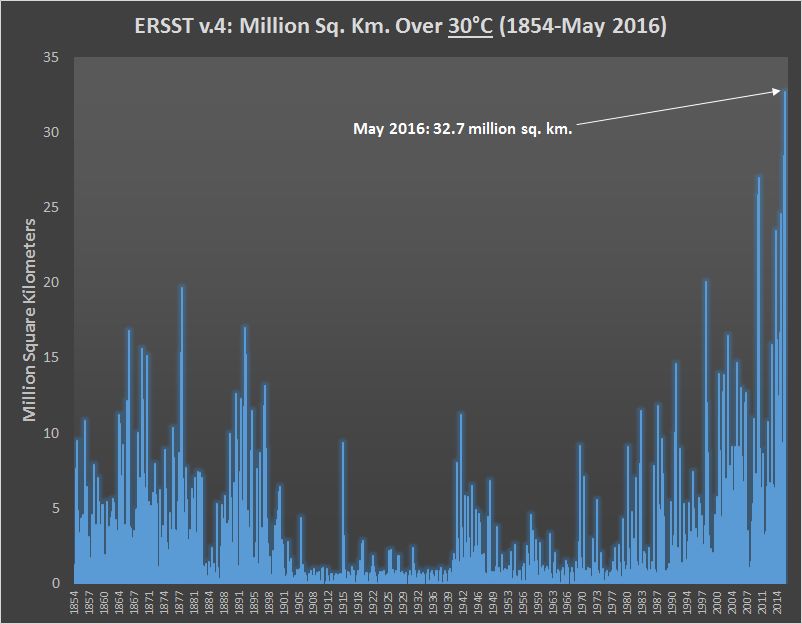
(A record hot global ocean has brewed up yet one more new extreme in the form of a 32.7 million square kilometer expanse of steaming hot waters above 86 degrees Fahrenheit or 30 degrees Celsius. Image source: Brian Brettschneider.)
“According to climatologist Brian Brettschneider, 32.7 million square…
View original post 94 more words
June 6 Energy News
Science and Technology:
¶ Using data from satellites, scientists at NASA, Environment and Climate Change Canada, and two universities have found 39 unreported and significant human-made sources of emission of toxic sulfur dioxide. Sulfur Dioxide is a known health hazard and acid rain contributor. [Maine News Online]
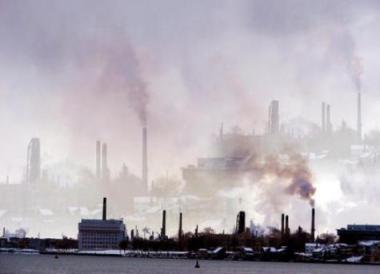 Scientists located 39 unreported sources of sulfur dioxide emissions.
World:
¶ RedT Energy plc will install a power storage system at a 1-MW wind farm on the Scottish Isle of Gigha. The 1.68-MW vanadium flow system was chosen for this remote location, which has limited grid connection, for their ability to balance variable renewable generation. [reNews]
¶ Global electric vehicle sales figures for the first quarter of 2016 were recently released by EV-Volumes, revealing that plug-in sales in 2016 to date totaled 180,500 units, including cars and light commercial vehicles. That is an increase year-on-year increase of roughly 42%…
View original post 369 more words
European Commission Nuclear Push? 90% of Uranium for European Reactors is Imported
From Greens-EFA:
“Leaked EU Commission Paper Foresees Major Expansion of Nuclear Power, 17.05.2016
A draft paper from the EU’s Sustainable Energy Technology Plan, which is being steered by the European Commission, was leaked today in the German media. The paper argues for the expansion of nuclear power and builds on an analysis on the future of nuclear power in Europe (the Community Nuclear Illustrative Programme – PINC) by the Commission last month (1).
Commenting on the paper, Greens/EFA co-president Rebecca Harms stated:
“This paper again highlights the EU Commission’s tendency to dress up the figures on nuclear power. The supporters of nuclear power want to do all within their means to secure massive financial support to keep the industry alive, despite the fact it is not able to stand on its own two feet. EU competition law and state aid rules should be set aside for nuclear power.
View original post 744 more words
1 This Month

Chernobyl: The Lost Tapes – A good documentary on Chernobyl on SBS available On Demand for the next 3 weeks– https://www.sbs.com.au/ondemand/tv-program/chernobyl-the-lost-tapes/2352741955560

of the week–London Campaign for Nuclear Disarmament

Tell the Ukrainian Government to Drop Prosecution of Peace Activist Yurii Sheliazhenko
To see nuclear-related stories in greater depth and intensity – go to https://nuclearinformation.wordpress.com
-
Archives
- April 2026 (173)
- March 2026 (251)
- February 2026 (268)
- January 2026 (308)
- December 2025 (358)
- November 2025 (359)
- October 2025 (376)
- September 2025 (257)
- August 2025 (319)
- July 2025 (230)
- June 2025 (348)
- May 2025 (261)
-
Categories
- 1
- 1 NUCLEAR ISSUES
- business and costs
- climate change
- culture and arts
- ENERGY
- environment
- health
- history
- indigenous issues
- Legal
- marketing of nuclear
- media
- opposition to nuclear
- PERSONAL STORIES
- politics
- politics international
- Religion and ethics
- safety
- secrets,lies and civil liberties
- spinbuster
- technology
- Uranium
- wastes
- weapons and war
- Women
- 2 WORLD
- ACTION
- AFRICA
- Atrocities
- AUSTRALIA
- Christina's notes
- Christina's themes
- culture and arts
- Events
- Fuk 2022
- Fuk 2023
- Fukushima 2017
- Fukushima 2018
- fukushima 2019
- Fukushima 2020
- Fukushima 2021
- general
- global warming
- Humour (God we need it)
- Nuclear
- RARE EARTHS
- Reference
- resources – print
- Resources -audiovicual
- Weekly Newsletter
- World
- World Nuclear
- YouTube
-
RSS
Entries RSS
Comments RSS
 nuclear-news