Nuclear marketers see India as a saviour of nuclear industry
U.S. President Barack Obama and Indian Prime Minister Narendra Modi agreed at a June 7 summit that U.S. nuclear reactor maker Westinghouse Electric, a subsidiary of Japan’s Toshiba, would build power plants in the South Asian nation. In a statement following their meeting in Washington, Modi and Obama said they welcomed the announcement by the Nuclear Power Corp. of India and Westinghouse that they would finalize a contract by June 2017. The two companies had said they would immediately begin the work of designing reactors and selecting locations.
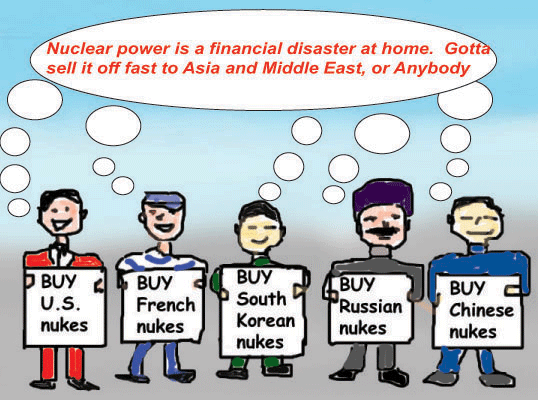
As the nation opens its market for nuclear plants, competition is likely to intensify between the U.S., France, Japan and other countries seeking a greater market share.
France reached an agreement early this year to start a development project in western India in 2017. Although a formal agreement has yet to be signed, the country will compete with the U.S. to become the first Western country in about 40 years to deliver a reactor to India. Japan also reached a broad agreement with India in late 2015……..http://asia.nikkei.com/magazine/20160616-POWER-PERFORMERS-of-the-Asia300/Business/Nuclear-power-plant-builders-see-new-opportunities-in-India
India paying high cost to save Westinghouse’s nuclear business
 The Cost of Modi’s US Visit: Offering Rs. 2.8 lakh crore to Westinghouse, News Click, Prabir Purkayastha, June 09, 2016
The 4th visit of Modi to the US has very little to show as achievements. No wonder, the headlines screamed about “the start of the preparatory work” on six nuclear reactors as a major achievement. Not content with this, the Westinghouse AP 1000 reactors were even hyped as 5th generation reactors, skipping two whole generations of reactors in between. The earlier AP 600 reactors are recognised as 2nd generation reactors, making the AP 1000 the 3rd generation, which is how they are known in the rest of the world – except to certain gentlemen in the Indian media.
The reality is that after 8 years of negotiations on the Westinghouse reactors, India has now shifted the location from  Mithivirdhi in Gujarat to Srikakulam in Andhra Pradesh. The negotiations for the deal with Westinghouse are still stuck, and only a new beginning is being sought with this new site. All that Westinghouse has agreed is that they will do some preliminary work for this new site — “start of the preparatory work”.
In today’s world, nuclear energy is a dying technology. Its costs are too high, its ability to build to schedule is non existent and it faces the challenge of renewables – wind and solar – the costs of which are dropping rapidly. The US, after a brief flirtation with nuclear energy – the so-called nuclear renaissance – has pretty much decided not to invest any further in this technology.
It is only China and India that can revive the dying nuclear industry of the US. Both Westinghouse and GE are without any further orders in the US and in the EU. So it is not the US showing its willingness to “give” us nuclear reactors to India that is the issue; it is India helping to revive a patient – the US nuclear industry – which has currently one foot already in the grave.
How much are we committing to pay to revive a dying Westinghouse? Continue reading
South Korea’s nuclear waste dilemma: will have to build waste dump
 South Korea looks to build used fuel store http://www.neimagazine.com/news/newssouth-korea-looks-to-build-used-fuel-store-4907688 30 May 2016 South Korea will select a site for an underground storage facility to permanently dispose used nuclear fuel, or high-level radioactive waste, by 2028 and complete the construction of the facility by 2053, according to the first roadmap for the project released by the Ministry of Trade, Industry and Energy on 25 May.
“A further delay in building the facility will put a drag on future generations, considering the saturation level of interim storage units located in the nuclear power complexes nationwide, ” Chae Hee-bong, the ministry’s energy policy director, told a press briefing.
Korea has 24 nuclear power units which produce more than 700t of used nuclear fuel annually. According to ministry data, the first used fuel storage unit to become full will be at the Wolsong NPP in Gyeongju, North Gyeongsang Province, in 2019.

Korea has no other choice than storage as it is strictly banned from reprocessing under a 1973 treaty with the USA. The government has been trying to find a site for the wastes since 1983, but has failed nine times because of local protests. The government said the country is running out of storage units.
To minimize public resistance in the course of a site selection, the ministry will adopt an open competition among geologically qualified sites. It will launch an independent committee to lead the site selection next year, following an approval by the National Assembly on the roadmap in the latter part of this year. The roadmap will be updated in five years embracing changing external conditions, the ministry added.
The ministry’s ‘road map’ is based on recommendations from the Public Engagement Commission, an independent advisory group set up in 2013. The ministry will hold a public hearing next month, followed by an inter-agency meeting chaired by the prime minister in July.
Park Dong-il, director of the nuclear power environment division at the ministry said: “It will take about 12 years to select the location and we will hear what they want to receive from the government and make deals during this period,” said. He added that the government will decide what kind of benefits or incentives to give to areas that want to build storage facilities.
According to the ministry, it will take the government about eight years to select the site and get feedback from local residents, and another four years to investigate the geological chracteristics of the site. The project was expected to cost some KRW53,000bn ($44.8bn) in 2013 but a government official said it is now looking at an estimated cost of KRW63,000bn.
Meanwhile, the Korean government opened its first low-and intermediate-level radioactive waste facility in Gyeongju, North Gyeongsang, last year. The government wanted to build a high-level facility there but faced opposition from residents.
Taiwan’s nuclear waste problem – sees overseas reprocessing as the answer
 Taiwan wants to send nuclear waste overseas for reprocessing, Japan Times, AFP-JIJI 16 June 16 TAIPEI – Taiwan has unveiled a plan to process nuclear waste overseas for the first time as it runs out of storage space at its power plants, sparking criticism from environmental groups.
The state-run Taiwan Power Co. on Tuesday began soliciting bids from overseas reprocessing companies for 1,200 used fuel rods from the island’s first and second nuclear plants.
The two plants, which currently store the spent fuel rods, were launched in 1978 and 1981 and will each be decommissioned once they have been operational for 40 years.
But Taipower has said it may be forced to shut down or decommission the plants earlier than scheduled, as they are reaching storage capacity for spent nuclear fuel.
Some environmental groups accused Taipower of seeking ways to keep the two plants in operation even though they are set to be decommissioned.
“We strongly protest the plan. It’s absurd to send the fuel rods abroad to be reprocessed since Taiwan is no longer building nuclear power plants,” said the National Nuclear Abolition Action Platform.
“It’s clear that Taipower is in a rush to ship the nuclear waste abroad because the first nuclear power plant will be shut down if it fails to do so, which will mean that its plan to push for extended operation of the plant will fall through.”
The government is under growing public pressure over its unpopular nuclear facilities as safety concerns have mounted since the Fukushima No. 1 nuclear disaster in 2011.
Like Japan, Taiwan regularly suffers earthquakes. In September 1999 a magnitude-7.6 quake killed around 2,400 people in the island’s deadliest natural disaster in recent history.
Last year the authorities were forced to seal off a new power plant due to open in 2015, pending a referendum on its future…….
Companies from England, France and Russia have expressed interest in bidding for the work, which is expected to cost $11.25 billion New Taiwan dollars ($356 million), local media reported. http://www.japantimes.co.jp/news/2015/02/18/asia-pacific/taiwan-wants-to-send-nuclear-waste-overseas-for-reprocessing/#.V2Mxz9J97Gj
Time that USA government backed its Iran nuclear deal and promoted investment


 The Obama Administration Needs to Double Down on the Iran Deal http://foreignpolicy.com/2016/06/16/the-obama-administration-needs-to-double-down-on-the-iran-deal/If Washington doesn’t move to help get banks and business into Iran, the nuclear deal will collapse. esident Barack Obama spent enormous political capital to cement an agreement with Iran that constrained its nuclear program for more than a decade. That agreement, however, is now at risk of unraveling.
The danger of the agreement collapsing, to the detriment of U.S. interests, is now evident. Under the nuclear accord, Iran agreed to constrain its nuclear program in return for economic reprieve from U.S. sanctions. While Iran has so far lived up to its nuclear-related obligations — addressing U.S. concerns over its nuclear program by reducing its number of operating centrifuges, reconfiguring its heavy-water reactor, and permitting an unprecedented inspections regime — the United States has struggled to fulfill its end of the nuclear bargain.
Hard-liners in Iran are touting the sanctions issue as an example of why the United States cannot be trusted.That message is having an effect: Recent pollingindicates that the Iranian people are growing increasingly skeptical that Washington is acting in good faith in meeting its commitments. Iranian moderates who support the accord, meanwhile, risk being undermined by this development. Absent a turn in Iran’s economic fortunes, the hopes and aspirations of the Iranian people will continue to be denied and their political engagement — as evidenced by recent parliamentary elections, in which Iranian hard-liners were dealt a significant defeat — stymied.
To its credit, the Obama administration is actively seeking to resolve concerns over the sanctions-lifting. A few weeks ago, Secretary of State John Kerry hosted a meeting of the British Bankers Association to encourage major European banks to re-engage their Iranian counterparts. High-level U.S. officials have likewise been touring the world, seeking to provide practical guidance on what the lifting of sanctions means and the scope of remaining U.S. sanctions. More public written guidance will soon be forthcoming.
But such guidance has been insufficient — and is likely to remain so. Following their meeting with Kerry, most of the banks in attendance stated publicly that they would not engage in Iran-related business for the foreseeable future, due to persistent U.S. sanctions risks. Without major European banks willing to re-engage Iran, financing will be unavailable for some of Iran’s bigger trade and investment opportunities.
The Obama administration needs a new game plan.Just as it expended political capital to secure the deal, it must expend the political capital to sustain it. Otherwise, the administration risks snatching defeat out of the jaws of victory and upending this historic diplomatic achievement.
Such additional steps come in two parts. First, the Obama administration will need to provide detailed written guidance to foreign banks and companies explaining what steps are required to ensure that they do not risk exposure to U.S. sanctions. Absent such guidance, non-U.S. banks and companies will continue to lack the confidence to engage in Iran-related dealings.
The Obama administration reportedly has been reluctant to provide the level of detail necessary to instill confidence in companies that they can do business in Iran. For instance, companies have long sought to understand the necessary level of due diligence to avoid exposure to U.S. sanctions — perhaps through a checklist of sorts. But U.S. officials, unwilling to act outside their comfort zone, have rejected calls to provide such detailed guidance, thus failing to address many firms’ primary concern.
Second, the Obama administration will need to take action to ease market entry into Iran. Banks have been hesitant to facilitate trade with Iran so long as Iran remains cut off from the U.S. financial system, and large foreign enterprises have been reluctant to pursue trade and investment opportunities in Iran so long as the U.S. primary trade embargo remains intact.
The administration can resolve these persistent concerns through a broader licensing scheme. For instance, the United States could re-authorize the U-turn license, which permitted U.S. dollar transactions involving Iran to be cleared through a U.S. bank, or license American banks to provide dollars to foreign financial institutions so that dollar-clearing can take place offshore. Similarly, the administration could take a hard look at the sense of maintaining a unilateral trade embargo with Iran while it is encouraging foreign parties to engage in trade with Iran. In lieu of those more dramatic steps, the administration could also license U.S. persons to facilitate certain transactions with Iran, particularly if those U.S. persons are employed in non-U.S. companies.
The politics of such action may not prove appetizing. Uber-hawks in Congress are bent on denying the Obama administration this diplomatic success and will try to block any action aimed at resolving sanctions concerns. But the sustainability of the nuclear accord is dependent on the Obama administration taking these steps. Absent such measures, the Iran deal threatens to unravel with the United States being the scapegoat, as Iran will continue to be denied the benefit of its bargain.
Passing off current problems with the lifting of sanctions to the next administration is not an option. Obama has made a big investment in limiting Iran’s nuclear program — the time is now to secure that investment.
US agencies and prosecutors influence Europe’s banks to impede Iran nuclear deal
Why our nuclear deal with Iran is turning to dust, The Independent, Robert Fisk @indyvoices 16 June 16
Many of Europe’s largest banks won’t do business with Iran for fear of breaching other US sanctions, which have nothing to do with the nuclear agreement – but a lot to do with US agencies and prosecutors.
The Middle East is littered with missed opportunities, lost chances and dreams turned to dust. The Iranian nuclear deal is now heading in the same direction. President Hassan Rohani, hero of the hour and Iran’s new Mr Good Guy in America, even obtained the support of Iran’s Supreme Leader, Ayatollah Ali Khamenei, when he signed off on the agreement with six world powers last year to reduce the country’s nuclear activities in return for an end to Western sanctions. But he’s beginning to look like a patsy.
And all of the old Iranian revolutionaries, the sons of martyrs and the war veterans and the Revolutionary Guard Corps and the managers of its billion-dollar conglomerates are turning out to have been right all along. The sanctions have been lifted – but they haven’t been lifted. Western investments are not, despite all the promises, pouring into Iran because banks – especially European banks – are too frightened of breaching the rest of America’s sanctions laws to do business with the Islamic Republic. Washington both giveth and taketh away; it’s a slogan that every Iranian president should learn.
Mohamed Khatami was the only real statesman the Middle East produced in half a century and he was elected president of Iran in 1997. He wanted a “civil society”, the nearest you can get to a secular nation ruled by Shiite democracy-necrology-government for and by the dead. But the United States treated Khatami with scorn – and so the crackpot Mahoud Ahmedinejad became the next president, a man with whose ravings America’s right-wing felt far more comfortable.
Hadn’t they said all along that Iran’s leaders were anti-Semitic nuclear crazies, even – this from the Israelis – worse than Hitler? Now Rohani, the man-America-could-do-business-with, may lose next year’s presidential election because he, too, forgot the slogan which, at its simplest, reads: don’t trust America.
Iran has not been reintegrated into the global financial system – and it’s not going to be – though the Chinese will be happy to do business. Khamenei’s supporters are now suggesting that the Supreme Leader – not the shrewd but naïve president – is the great hero of modern Iranian history (after Ayatollah Ruhollah Khomeini, of course). The banks, he says, fear the Americans who “have not acted on their promises and [only] removed the sanctions on paper”. Worse still, he’s right. “Khamenei’s life is the one you should be writing about,” one of his believers announced last week. “He is the saviour.” Yes, thanks to America.
For many of Europe’s largest banks won’t do business with Iran for fear of breaching other US sanctions, which have nothing to do with the nuclear agreement – but a lot to do with US agencies and prosecutors, hunting for evidence of Iranian money laundering, the financing of “terrorism” and monetary crime. The French BNP Paribas shelled out £6.3bn for its Iranian dealings a couple of years ago – over five years, along with StanChart and HSBC, the figure comes to a whopping £10.7bn.
So why should the UK’s Standard Chartered, Societe Generale, Credit Suisse or Deutsche Bank line up to pay more fines just because their governments want to do business in Tehran? Some American bankers – this from the Economist – won’t even hand over their business cards to Iranians. Now that’s what you call fear………
While Iran cannot break free of sanctions from which it thought it had been unshackled, its own paid militia in Lebanon – a nation which a Shiite prelate once described as “the lung through which Iran breathes” – is being caught up in the same financial net. So it’s not difficult for the Iranians to spot what they call in Persian the “dasisa” – and what the Hezbollah, in Arabic, refer to as the “muamara” – which means, quite simply: THE PLOT.
Decide for yourself if it’s true. But in Iran, the lifting of sanctions is a promise un-kept, the Revolutionary Guards are smiling and the nuclear deal is, surely, going downhill. A dream, in other words, fast turning into dust http://www.independent.co.uk/voices/why-our-nuclear-deal-with-iran-is-turning-to-dust-a7084981.html
Watts Bar-2 nuclear reactor – 43 years to build – shut down after 2 days
Nuclear fail: New reactor took 43 years to build, shut down after 2 days, REneweconomy, By Craig Morris on 16 June 2016 Renewables International
More than four decades after construction began, the Watts Bar-2 reactor was finally connected to the grid on 3 June 2016. However, two days later, while operating at 12.5 percent power, the reactor automatically shut down.
According to the U.S. Nuclear Regulatory Commission (NRC), the reactor tripped when a high pressure turbine valve failed to open. As of 8 June 2016, the reactor has not restarted and no restart schedule has been fixed yet, according to a spokesperson for plant owner the Tennessee Valley Authority (TVA)……….
TVA filed the construction license application for Watts Bar on 18 May 1971. On 18 September 1972, TVA applied for the exceptional authorization of certain site preparation activities, although it had not transmitted the final environmental impact statement and the construction license was still pending. TVA argued that startup of unit 1 by May 1977 “is vital in order to permit-TVA to meet its summer 1977 peak loads” and beyond:
“The present schedule for constructing the Watts Bar Nuclear Plant is predicated on beginning construction in October 1972. This schedule is extremely tight and failure to begin construction in October casts serious doubts on TVA’s ability to meet its load commitments in the 1977-78 period.”
TVA also insisted that cost of any delay be passed on to the ratepayer:
Fort Calhoun nuclear plant too expensive to run
 OPPD’s Fort Calhoun nuclear plant has become too expensive to run, company says, Omaha.com By Cole Epley / World-Herald staff writer
The nuclear plant at Fort Calhoun is simply too expensive to run when compared to other, cheaper forms of power, the Omaha Public Power District’s chief executive said Thursday. So it needs to shut down by the end of the year, he said.
OPPD President and Chief Executive Tim Burke told the utility’s board of directors that it no longer makes financial sense to continue operations at Fort Calhoun, which is the smallest nuclear power plant in the United States. The site for the plant was purchased in 1965.
The board will reconvene on June 16 to make a decision on Burke’s recommendation.
Closing the plant would mean lower overhead costs when it comes to complying with federal nuclear regulations and other expenses — including the $20 million a year OPPD pays an outside firm to run the plant. That firm, Exelon, has run Fort Calhoun since 2013 after OPPD was rapped hard by federal regulators for serious safety lapses; the plant was shut from mid-2011 until December 2013 as the utility dealt with Missouri River flooding and correcting violations of federal nuclear safety rules.
Shutting the plant permanently would move the utility away from relatively expensive-to-generate nuclear energy in an era of low-priced natural gas and an increasing reliance on wind power.
The recommendation to shut the plant comes with a guarantee, Burke said: Ratepayers won’t see a general rate increase until at least 2022 because of the savings from shuttering Fort Calhoun.
“You have to say enough is enough and curb the costs,” OPPD board member Tom Barrett said. “That’s the cold, hard facts of this business.”
The costs of nuclear generation put it at a disadvantage to wind and natural gas, according to the federal Energy Information Administration. The EIA in June of last year reported the total costs per megawatt-hour for a new nuclear plant to be about $95. In comparison, the cheapest natural gas-fired generation is about $75 or less per megawatt-hour and wind generation is about $74 per megawatt-hour…….
John Keeley, a spokesman for the Washington, D.C.-based Nuclear Energy Institute, an industry advocate, said the Fort Calhoun situation is an example of the vulnerability of similar nuclear plants to market conditions — mainly, the sources of energy that, at the moment, can produce electricity more cheaply, like natural gas and wind. (Five nuclear plants have closed in the past few years; two others are set to close.)…….
OPPD ratepayer Mark Welsch, who attended Thursday’s meeting, commended the utility’s management team and board for taking up the issue. Welsch is the head of the Omaha chapter of the advocacy group Nebraskans for Peace. He said the utility should be tilting toward renewable sources of energy, like wind.
“I’m very proud to be a customer-owner of OPPD right now,” he said. “The board is taking a hard look at a very hard potential decision it will have to make.”
If the board follows through on the recommendation, OPPD’s wind and renewable generation will make up 49 percent of its energy portfolio by 2020, up from 38 percent that is currently forecast.
OPPD’s relationship with renewables grew in 2014 when the utility approved a long-term generation plan that included the phase-out some of its coal-burning units, conversion of others to natural gas and the addition of 400 megawatts of wind power from a massive wind farm near O’Neill, Nebraska.
Under the plan presented Thursday, those plans would remain intact, but Burke said the most economically viable course is one that does not include nuclear power and effectively ends more than 40 years of nuclear generation…….
Decommissioning can take 10 years under a process known as Decon, under which a plant is dismantled and contaminated materials are either decontaminated or removed. In a deferred dismantling process known as Safstor, facilities are maintained for a period of up to 60 years and radioactivity decays to a safe level.
OPPD in its 2015 annual report estimated that the costs to decommission Fort Calhoun would be about $884 million. The utility has socked away about $373 million for those costs.
The board will take 30 days to consider management’s proposal, during which time it will field concerns and suggestions from stakeholders and ratepayers…………. Contact the writer: 402-444-1534, cole.epley@owh.com http://www.omaha.com/money/oppd-s-fort-calhoun-nuclear-plant-has-become-too-expensive/article_f8b86658-184e-11e6-b852-8f5144170b67.html
Russia’s powerful new nuclear icebreaker
Russia unveils ‘world’s biggest’ nuclear icebreaker, Yahoo News June 17, 2016, Moscow (AFP) – Russia on Thursday floated out a new nuclear-powered icebreaker, said to be the world’s biggest and most powerful, to be used for hauling liquefied natural gas from its Arctic terminal.
Arktika, ordered by Russia’s Rosatom state nuclear agency, was built at the Baltic Shipyard in Saint Petersburg, and will be ready to use by the end of next year.
“There are no icebreakers like it in the world,” said Rosatom chief Sergei Kiriyenko at the ceremony, according to a company statement. “The Arktika icebreaker presents truly new opportunities for our country.”…….It can cut through ice of up to 2.8 metres (nine feet) thick. https://au.news.yahoo.com/world/a/31854163/russia-unveils-worlds-biggest-nuclear-icebreaker/#page1
Entergy’s Pilgrim Nuclear Power Station decrepit facility with radioactive waste problem
 OF NUCLEAR INTEREST: Pilgrim’s nuclear waste dilemma http://plymouth.wickedlocal.com/news/20160616/of-nuclear-interest-pilgrims-nuclear-waste-dilemm Entergy’s Pilgrim Nuclear Power Station is a decrepit facility based on 1950s design. By Janet Azarovitz Jun. 16, 2016
Entergy’s Pilgrim Nuclear Power Station is a decrepit facility based on 1950s design. The design was acknowledged to be substandard by the time Pilgrim went online in December 1972. Its main design flaw is in the containment vessel, which is known to be incapable of “containing” the radiation if an accident in the reactor were to occur. The design also led to the construction of the “spent fuel pool” within the reactor building to store “spent” fuel rods, which are made of uranium and packaged in assemblies.
For the past 44 years and until Pilgrim shuts down in 2019, every 18 months one-third of Pilgrim’s fuel rods in the reactor core become spent. This means that they become too hot to control in the reactor and must be replaced. These spent rods must be kept in 40 feet of water in the spent fuel pool to shield radiation and be constantly cooled to prevent a fire that would release huge amounts of radioactivity.
Although Pilgrim’s spent fuel pool was originally designed to hold 880 assemblies, it now holds more than 3,000. Since there is no offsite national repository planned (i.e., Yucca Mountain was not approved), Pilgrim’s spent fuel pool is seriously over-crowded. There are currently discussions about centralized siting of nuclear waste by the U.S. Department of Energy, however it will be a long time before these discussions help those of us living in the shadow of Pilgrim. Even after Pilgrim shuts down in 2019, the pool will contain highly unstable radioactive fuel for many years.
America’s Hometown will be a hazardous waste dump for this nuclear fuel for many years to come. When the pool is finally emptied, the spent nuclear fuel will still be stored onsite. Entergy, the present owner of Pilgrim, has designed and constructed an “Independent Spent Fuel Storage Installation” (ISFSI) for the storage of spent fuel in “dry casks.” Three casks have been filled so far and approximately 100 casks will be needed to hold all of Pilgrim’s nuclear waste.
These dry casks are supposed to last 100 years, but we know that some don’t. Generally, scientists agree that dry cask storage is a safer system than wet pool storage, because electricity and pumping water are not required for cooling casks. Nor do casks require the critical, yet high-maintenance, boron panels that the densely packed pools need to prevent a nuclear reaction from occurring. For decades these panels have been known to deteriorate. A recent incident of “boron slippage” was reported last month at Pilgrim.
Unfortunately, no one, not the town of Plymouth, nor the U.S. Nuclear Regulatory Commission (NRC) reviewed the location of Entergy’s ISFSI. The facility is about 120 feet from Cape Cod Bay and only a few short feet higher than the outdated flood zone. There is currently a citizen lawsuit challenging the town of Plymouth Zoning Board of Appeals’ decision that allowed the construction of the ISFSI without review. The trial will occur this August, and if successful residents will have another opportunity to get real answers.
It is critically important that the problem of Pilgrim’s nuclear waste storage is addressed and its spent fuel is moved to dry casks as quickly as possible, and sited in a safe location away from flooding and extremists. It is essential that regulatory agencies deal with where this dangerous material will go and how it will get there, since leaving it by the ocean when the sea level is rising and storms are getting worse is clearly a recipe for disaster.
Janet Azarovitz is a Falmouth resident and a member of Cape Downwinders Cooperative, which works to protect the welfare of residents of the Cape and the Islands from nuclear-related risks. She is also a representative of the Pilgrim Legislative Advisory Coalition, which seeks to achieve passage of nuclear-related legislation. Cape Downwinders Cooperative works collaboratively with Cape Cod Bay Watch.
If India joins Nuclear Suppliers Group, the strategic India -Pakistan balance will be shaken – China
India’s entry into NSG will break India-Pakistan nuclear balance: Chinese media, Times of India, Jun 16, 2016
HIGHLIGHTS
- Chinese media said that India’s entry into NSG will ‘shake strategic balance in South Asia’
- New Delhi have inched closer to NSG membership after PM Modi gained backing from US.
- Major goal for India’s NSG ambition is to obtain an edge over Islamabad in nuclear capabilities
The US recognised New Delhi as a “major defence partner” during Modi’s recent visit, meaning that the White House has given India the treatment as a US military ally, it said.
The article said that over the years, the US has been “bending the rules” to back India’s nuclear projects……………..http://timesofindia.indiatimes.com/world/china/Indias-entry-into-NSG-will-break-India-Pakistan-nuclear-balance-Chinese-media/articleshow/52774701.cms
French company EDF manages to postpone closure of Fessenheim nuclear plant
French power company stalls nuclear plant closure http://www.dw.com/en/french-power-company-stalls-nuclear-plant-closure/a-19336521
The Fessenheim plant will not be closed until EDF is given a new assesment for damages compensation, the electric company has said. This pushes back plans to shut down the 40-year-old plant for at least a year. The fight over the plan to close France’s oldest operational nuclear power station took another turn on Thursday. The operators of the Fessenheim Nuclear Power Plant near the German and Swiss borders want a new assessment of the damages they will be awarded before they begin the process of shutting down the reactors.
The news came at the same time French nuclear watchdog ASH said one of Fessenheim’s reactors had to be shut down temporarily due to irregularities in a steam generator.
Opposition to Fessenheim began even before it was built in the 1970s, but has ramped up in recent years due to a number of minor safety breaches in the past decade. Leading the charge has been anti-nuclear power Germany, particularly the state of Baden-Württemberg, whose border lies a mere 1.5 kilometers (0.93 miles) from the reactors.
President Francois Hollande had promised to shut the plant by the end of 2016, but now EDF, France’s majority state-owned electrical company, wants a new appraisal of how much the government should pay it in damages for losses incurred as a result of the shut down. They say the 100 million euros ($114 million) offered by the government is far too little.
Observers say that a realistic timeline for the plant to go offline would be 2018, but to that end EDF has given no official date for its end of operations.
Bulgaria must pay Russia over cancelled nuclear project, says court.
Court orders Bulgaria to pay Russia over cancelled nuclear project: minister http://uk.reuters.com/article/uk-bulgaria-russia-arbitration-idUKKCN0Z213A , Jun 16, 2016
An arbitration court has ruled that Bulgarian state energy firm NEK should pay nearly 550 million euros (437.70 million pound) in compensation to Russia‘s Atomstroyexport for a cancelled nuclear power project, Bulgaria’s energy minister said on Thursday.
“NEK received the court’s decision late last night. It is still not handed down officially. In the next days, NEK will approach Atomstroyexport over the decision,” Energy Minister Temenuzhka Petkova told reporters.
Atomstroyexport had sought more than 1 billion euros at the Paris-based International Court of Arbitration against NEK over the cancellation of the Belene nuclear power plant it had been contracted to build.
NEK teamed up with Atomstroyexport to build two 1,000 megawatt reactors at Belene, on the Danube River at the border with Romania, in 2006.
Sofia abandoned the project in 2012, after it failed to attract investors for the 10 billion euros ($11 billion) scheme and also came under pressure from its Western allies about its energy dependence on Moscow.
Petkova said the court has ruled that NEK should cover the funds the Russian state company had spent to produce equipment for the project, but has rejected claims for additional works and damages from lost profits.
Bulgaria is currently extending the lifespan of its two 1,000 Soviet-made reactors at its Kozloduy nuclear power plant and is looking for an investor to build one more reactor at the same site.
USA’s Pro Nuclear Energy Secretary Moniz announces $82 Million for Nuclear Energy Research
 Feds Announce $82 Million for Nuclear Energy Research, Sci Tech Today, 16 June 16 US Energy Secretary Ernest Moniz has announced $82 million for nuclear energy projects in 28 states……The Idaho-based Snake River Alliance describes itself as Idaho’s nuclear watchdog and clean energy advocate.
“Nuclear waste is certainly a place where we want as much research as possible,” said Wendy Wilson, the group’s interim executive director, about Tuesday’s announcement. “If they put that much money into renewables that are here today, we could have really safe and clean energy.”
U.S. Court of Appeals rules nuclear waste can stay on indigenous land
Ruling will keep nuclear waste at Prairie Island indefinitely, Post Bulletin Brian Todd, btodd@postbulletin.com 16 June 16, WELCH — A ruling from the U.S. Court of Appeals for the District of Columbia Circuit will leave the spent nuclear fuel at the Prairie Island Nuclear Generating Plant right where it’s sitting for the foreseeable future.
The Court of Appeals on June 3 upheld a 2014 ruling that allows for the continued onsite storage of radioactive material, mostly spent nuclear fuel. The 2014 ruling is from a case brought by several states regarding the environmental impact, and potential health and safety concerns regarding on-site storage of radioactive materials.
Shelley Buck, Prairie Island Indian Community Tribal Council president, said the community’s worst fear is that the nuclear waste will remain on the tribe’s ancestral homeland forever.

“Our fears are much closer to reality because of this ruling,” Buck said.
Buck described the spent fuel as “some of the most dangerous and toxic substances known to mankind.” That nuclear waste, she said, is stored 600 yards from the homes of some of the community’s members.
“We are frustrated that the U.S. Court of Appeals has failed to consider the very real health and safety impacts of permanent on-site storage of highly radioactive nuclear waste,” she said…….http://www.postbulletin.com/news/local/ruling-will-keep-nuclear-waste-at-prairie-island-indefinitely/article_c2774613-7455-5c92-a87d-8bc0bd2d3339.html
1 This Month

of the week – Shut Down Drone Warfare!


Tell the Ukrainian Government to Drop Prosecution of Peace Activist Yurii Sheliazhenko

Petition to revoke the licensing of the Near Surface Nuclear Disposal Facility (NSDF) at Chalk River. https://www.ourcommons.ca/petitions/en/Petition/Details?Petition=e-7247
To see nuclear-related stories in greater depth and intensity – go to https://nuclearinformation.wordpress.com
-
Archives
- April 2026 (114)
- March 2026 (251)
- February 2026 (268)
- January 2026 (308)
- December 2025 (358)
- November 2025 (359)
- October 2025 (376)
- September 2025 (257)
- August 2025 (319)
- July 2025 (230)
- June 2025 (348)
- May 2025 (261)
-
Categories
- 1
- 1 NUCLEAR ISSUES
- business and costs
- climate change
- culture and arts
- ENERGY
- environment
- health
- history
- indigenous issues
- Legal
- marketing of nuclear
- media
- opposition to nuclear
- PERSONAL STORIES
- politics
- politics international
- Religion and ethics
- safety
- secrets,lies and civil liberties
- spinbuster
- technology
- Uranium
- wastes
- weapons and war
- Women
- 2 WORLD
- ACTION
- AFRICA
- Atrocities
- AUSTRALIA
- Christina's notes
- Christina's themes
- culture and arts
- Events
- Fuk 2022
- Fuk 2023
- Fukushima 2017
- Fukushima 2018
- fukushima 2019
- Fukushima 2020
- Fukushima 2021
- general
- global warming
- Humour (God we need it)
- Nuclear
- RARE EARTHS
- Reference
- resources – print
- Resources -audiovicual
- Weekly Newsletter
- World
- World Nuclear
- YouTube
-
RSS
Entries RSS
Comments RSS
 nuclear-news