South Carolina Electric and Gas Co slugging customers for costs of nuclear reactors that might never be built
 Power surge: Cost overruns at South Carolina nuclear plant growing part of SCE&G customer bills, Post and Courier David Wren Email @David_Wren_ 19 June 16 The state legislation allowing South Carolina Electric & Gas Co. to charge customers for two new reactors at its nuclear power plant years before they are completed has been compared to making payments on a new car without knowing the final price and before it leaves the assembly line.
The monthly payments continue to rise, but it’s not certain whether the customer making those payments will ever drive the car.
At least now, SCE&G’s customers have an idea how much the expansoin of the V.C. Summer Nuclear Station is costing them each month. The state’s Office of Regulatory Staff, which represents the public’s interest in utility issues, this month said SCE&G’s customers are paying an average of $23.16 each billing period — or 16.1 percent of their total bill — toward building the Midlands nuclear plant
And that’s likely to increase if the state Public Service Commission approves the company’s request to boost the project’s cost by another $852 million to $14 billion — more than $4 billion higher than original cost estimates.
SCE&G is using a state law called the Base Load Review Act to finance the nuclear project near Jenkinsville.
The law allows the utility to charge its 700,000 customers for construction as the project proceeds. ……
Critics like Frank Knapp, president and CEO of the state’s Small Business Chamber of Commerce, say the act “has turned into a blank check” for SCE&G.
The utility is allowed by state regulators to take up to 10.5 percent of the construction costs as profit. And Knapp says the pay-as-you-go method is unfair because some customers now paying for the project will leave the utility’s service area before it comes online……. http://www.postandcourier.com/20160618/160619424/power-surge-cost-overruns-at-south-carolina-nuclear-plant-growing-part-of-sceg-customer-bills
2 Workers Killed in Construction of Emirati Nuclear Plant
abc news, By THE ASSOCIATED PRESS DUBAI, United Arab Emirates — Jun 19, 2016 Two workers were killed and three others injured while building the first nuclear power plant in the United Arab Emirates, officials said Sunday.
The incident happened May 12 and was first reported this weekend by a state-owned newspaper in the UAE, a federation of seven sheikhdoms. It’s unclear why it took a month for authorities to acknowledge the fatalities……..http://abcnews.go.com/International/wireStory/workers-killed-construction-emirati-nuclear-plant-39969494
America does not need the new $30 billion Long-Range Standoff Weapon
The Air Force is set next year to accelerate the development of this new nuclear cruise missile. It would carry an upgraded W-80 nuclear warhead and be able to penetrate the world’s most advanced air-defense systems…….
There are three key questions that remain unanswered.
“hold at risk” using existing nuclear and conventional weapons and the platforms used to deliver them? We are aware of no such military necessity.Next, what role does the military intend this weapon to serve? The Pentagon says it would “provide the president with uniquely flexible options in an extreme crisis.” This suggests a lowering of the threshold for nuclear war, a perilous approach that would endanger not only America but allies that we are pledged to protect, like Japan and South Korea.
Finally, what is the weapon’s cost? The Defense Department and the National Nuclear Security Administration have yet to provide concrete estimates for the program, but the Federation of American Scientists hasreported that it could cost as much as $30 billion.
At a time when the Defense Department is set to modernize every leg of the nuclear triad, investing $30 billion in an unnecessary and dangerous new nuclear weapon is irresponsible………http://www.nytimes.com/2016/06/18/opinion/a-nuclear-weapon-that-america-doesnt-need.html?_r=0
Obama – disarmament talk, but his action is different
Obama’s nuclear deception, Japan Times, JUN 19, 2016
U.S. President Barack Obama deeply impressed the Japanese public with the speech he delivered in the world’s first atom-bombed city of Hiroshima on May 27. But on his home turf, he is clandestinely pushing a plan to modernize the U.S. nuclear arsenal. The plan, with its development cost estimated at $1 trillion over the next 30 years, is aimed at downsizing missiles capable of carrying nuclear warheads and improving their mobility with new delivery systems and platforms.
When does Obama expect to achieve a world without nuclear weapons, which he called for again in Hiroshima?….
He impressed the people of Japan to some extent while deftly avoiding using words like “remorse” or “apology.” Behind a glamorous diplomatic show, however, a major revolution occurring only once in decades is taking place in the U.S. nuclear weapons scheme, without being noticed by most Americans, let alone Japanese…….
Of the four categories of the development programs pursued by the Pentagon and the NNSA, the most controversial is modernization and downsizing of nuclear warheads, which constitutes the core of the whole scheme. In parallel with making warheads smaller, new models of platforms and nuclear weapons delivery systems will be introduced step by step in three fields: intercontinental ballistic missiles, submarine-launched ballistic missiles, and submarines and strategic bombers……….
“modernization and maintenance” programs will cost $1.8 billion annually from fiscal years 2021 to 2035. When expenses of the related facilities are added, the share of the nuclear weapons-related costs in the total defense budget is to rise from the present 3 percent to 7 percent. In other words, the Obama administration plans to make U.S. military forces far more dependent on nuclear arms than they are today.
Not only do these development programs run counter to Obama’s ideal of a world without nuclear weapons — downsizing the nuclear warheads will increase the chances of them being used, as stated on a PBS news program by James Cartwright, former vice chairman of the Joint Chiefs of Staff.
Regardless of what Washington says to justify its nuclear modernization programs, Russia and China have objected to it, saying that it poses a major threat to them. Indeed, when a mock test flight of the Model 12 warhead was conducted, Russia condemned the U.S. for “preparing a new weapon.”
It is certain that if the U.S. continues to pursue the modernization of its nuclear arsenal, China and Russia will take countermeasures. The possibility is rising day by day that these superpowers will confront each other with light and compact nuclear weapons in the not-so-distant future — despite Obama’s speech in Hiroshima. http://www.japantimes.co.jp/opinion/2016/06/19/commentary/japan-commentary/obamas-nuclear-deception/#.V2cWOdJ97Gh
The myth of carbon-free nuclear energy
http://www.latimes.com/opinion/readersreact/la-ol-le-nuclear-energy-carbon-footprint-20160617-snap-story.html Ron Rodarte, San Clemente How does one cheer nuclear as “clean” in the sense of carbon dioxide emissions when the entire process of mining uranium ore, processing the uranium into fuel pellets and loading the fuel frames into the reactor core are all carbon-intensive aspects of this power source?
Add the extreme dangers faced in ongoing climate change vis a vis flooding and loss of critical cooling water sources, the yet unresolved issues with radioactive spent fuel posing risks for thousands of years and the distinct possibility of a meltdown, and nuclear ought to be a no-go.
Nuclear is not safe, it is not carbon free, and it is the most expensive energy source on the market — and it is dangerous.
Nuclear Reactors at Risk in a Dozen Countries Due to Falsifications at Areva’s Creusot Forge Site-Suspected Anomalies in Areva Nuclear Parts

The US NRC had concerns over Areva testing and documentation at least as early as 2009, and the French Nuclear Safety Authority (ASN) was aware of these concerns: “July 2009 – French Regulator Autorité de Sûrete Nucléaire (ASN) observed NRC inspection at Creusot Forge, Le Creusot, France… Summary of Findings • 10 CFR Part 21 Program – NOV for failure to meet the requirements for implementing a procedure to evaluate deviations and failures to comply, and for imposing Part 21 in procurement documents • Control of Measuring and Test Equipment – Failure to require the calibration of the temperature measuring thermocouples for the temperature baths for the impact tests to conform to ASME Code, Section III, Subsection NB-2360…” ML092800118 https://web.archive.org/web/20160617220431/http://www.nrc.gov/docs/ML0928/ML092800118.pdf
(Greenpeace says that the French Safety Authority raised concerns to Areva as early as 2006.)
French State-Owned Areva at Le Creusot Steam Rolling Over International Nuclear Safety-the Environment
View original post 4,220 more words
IAEA Promotes the Role of Nuclear Technologies in Sustainable Development at European Development Days

GR.–Nuclear power generation creates extremely dangerous waste products that people must manage carefully for thousands of years. If the predictions of a great number of our scientists comes true and human civilization suffers major setbacks due to global warming, nuclear waste management might become impossible. Does it seem prudent to assume that we will always have the spare resources to deal with the wastes?
There are two other problems. Currently, there is great income disparity across people and nations. Everywhere, wealth is accumulating in the pockets a few people and leaving the pockets of most people. Nuclear power requires large investments. Investors expect to make profits, and this will add to the income disparity among people. The avarice that produces income disparity has been a disaster for Earth’s natural systems. Nuclear power generation will require water, land for power corridors, and great waste repositories. All of these will further…
View original post 216 more words
June 19 Energy News

Science and Technology:
¶ This past May was the warmest May month in a 137-year period, breaking global temperature records, according to a report published Thursday by the National Oceanic and Atmospheric Administration. Right now, 2016 is on pace to be the hottest year on record. [CNN]
 The planet could see 20 more hurricanes and tropical
storms each year by the end of the century.
World:
¶ India’s Ministry of New and Renewable Energy has come out with its most ambitious capacity addition target yet, for 16,600 MW of renewables added this fiscal year. During the current fiscal year, solar capacity is expected to reach its largest-ever capacity addition target of 12,000 MW. [CleanTechnica]
¶ India’s renewable energy targets will see massive amounts of capacity added quickly to the grid. The Indian government is looking at ways to minimize its impact on the existing grid. A…
View original post 486 more words
June 18 Energy News
Science and Technology:
¶ The Dead Sea, the salty lake located at the lowest point on Earth, is gradually shrinking under the heat of the Middle Eastern sun. It surface level is dropping by more than a meter (3.4 feet) per year. For those who live on its shores it’s an ongoing slow-motion crisis. [BBC]
 The ruins of the Naharayim hydro-electric power plant.
World:
¶ According to Solar Intelligence analyst Finlay Colville, the UK installed 1.553 GW of new solar PV capacity during the first quarter of 2016. The UK’s first quarter was the second highest quarter ever for the UK solar PV industry, as the first quarter of last year retains its record. [CleanTechnica]
¶ El Salvador will conduct an auction to deploy 170 MW of renewable electricity. This follows an award of 100 MW of PV projects in its previous auction, even though no…
View original post 640 more words
Indigenous people and the nuclear industry – theme for July 16
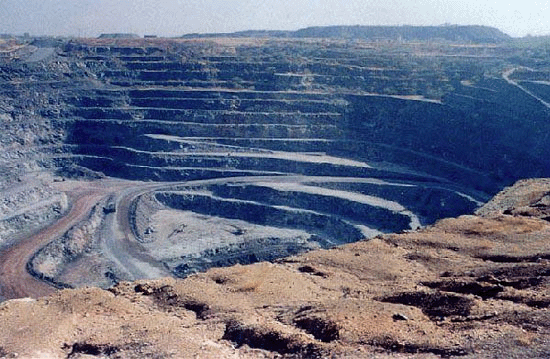 Indigenous people continue to bear the brunt of nuclear toxicity. It started with uranium mining – of course, on indigenous land in rural areas, in USA, Canada, Bulgaria, Australia, Germany , India, and of course to provide nuclear weapons material.
Then came the nuclear bomb tests – on remote rural indigenous lands and islands
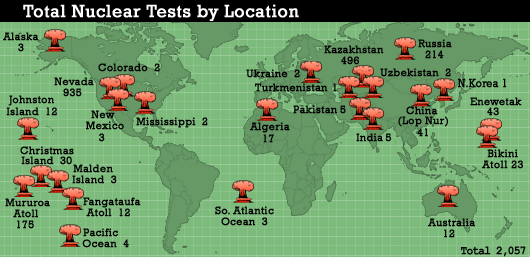
Indigenous peoples either stayed on their polluted lands, as uranium mining continued, or were removed from bomb tests sites, unable to return.
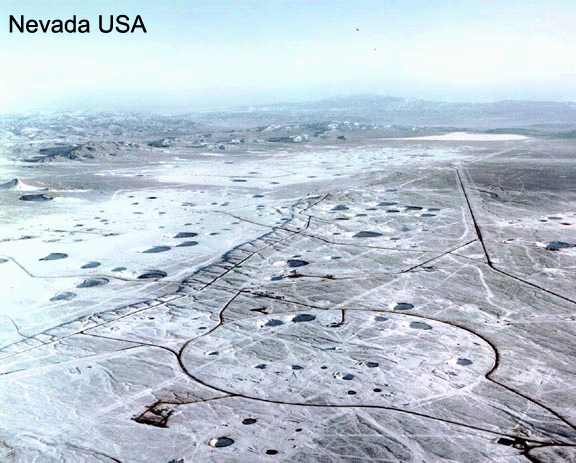

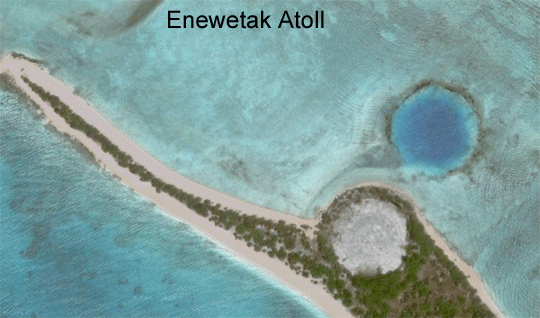

This Radioactive pollution remains today, from uranium mining in many countries – but always on or close to indigenous lands. The nuclear bomb test sites remain too radioactive for the indigenous people to return home.
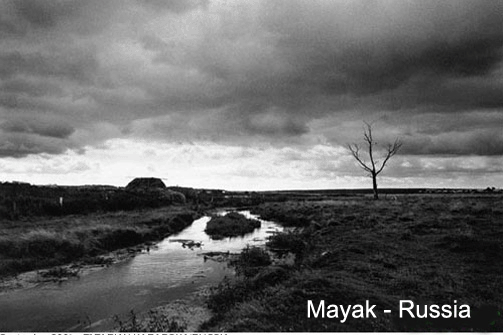
Uranium mining and milling, nuclear bomb tests and radioactive wastes ...
Russia is secretive about its nuclear wastes. They used to dump it in oceans, as did the French and others. Russia is notorious for its extremely polluted remote area at Mayak, where the rural people suffer the health legacy to this day
The “developed” world realises that something must be done with the growing amounts of radioactive trash.
Where to dump it? That’s a “developed society” no brainer – ON INDIGENOUS LAND, of course. There’s now a movement to export radioactive trash to remote rural areas, such as the Aboriginal lands of Australia
Next week we will look at the indigenous fight against the nuclear industry
USA nuclear plants going down like ninepins. Diablo next?
Closing Diablo would make California entirely nuke-free
Along with most nukes around the world, the only other remaining west coast reactor, WPPS2 on Washington’s Hanford military reservation, is also losing massive amounts of money.
Should California follow suit at Diablo, its conversion to a wholly green-powered economy would accelerate, likely leading Los Angeles to become the world’s first Solartopian megalopolis.
Ironically, with citizen action, a big push in that direction could now come from a state commission’s decision to enforce environmental protections signed into law by California’s most pro-nuke governor.
 Because they can’t evenly compete with renewable energy or gas, a tsunami of shut-downs has swept away a dozen U.S. reactors since October, 2012. Dozens more teeter at the brink, including two at Indian Point, just north of Manhattan, and Ohio’s rapidly crumbling Davis-Besse reactor near Toledo.
5 More U.S. Nukes to Close, Will Diablo Canyon Be Next? http://ecowatch.com/2016/06/17/diablo-canyon-meeting/ Harvey Wasserman | June 17, 2016 A rising tsunami of U.S. nuke shut-downs may soon include California’s infamous Diablo Canyon double reactors. But it depends on citizen action, including a statewide petition.

Five U.S. reactor closures have been announced within the past month. A green regulatory decision on California’s environmental standards could push the number to seven.
The focus is now on a critical June 28 California State Lands Commission meeting. Set for Sacramento, the hearing could help make the Golden State totally nuke free, ending the catastrophic radioactive and global warming impacts caused by these failing plants. A public simulcast of the Sacramento meeting is expected to gather a large crowd at the Morro Bay Community Center near the reactor site. The meeting starts at 10 a.m., but environmental groups will rally outside the community center starting at 9 a.m.
The three State Lands Commissioners will decide whether to require a legally-mandated Environmental Impact Report under the California Environmental Quality Act (CEQA). If ordered, a public scoping process will begin, allowing interested groups and individuals to weigh in on the environmental impacts of operation of two nuclear reactors on California’s fragile coastline. Continue reading
America’s unnecessary $1 trillion nuclear missile splurge
 America Already Has More Than Enough Nuclear Missiles. FP.com BY ADAM SMITH, JUNE 17, 2016But Republicans are pushing a $1 trillion nuclear modernization program, which would not only bankrupt the Pentagon but could spark a global nuclear arms race. This summer, Congress has been tying itself up in knots, trying to decide how to adequately fund U.S. national defense priorities, given the limits imposed by sequestration. But the difficult reality is that, however we choose to address immediate challenges, any rational attempt to plan for America’s future security must begin with a clear-eyed reassessment of the costs, trade-offs, and dangers of the trillion-dollar plan Washington is undertaking to modernize the U.S. nuclear weapons complex. That reassessment should include an effort to eliminate the new nuclear cruise missile.
The truth is that the United States can retain a credible nuclear deterrent with significantly fewer nuclear weapons and fewer delivery systems, at a fraction of the cost.
Instead, and with little debate, Congress has embarked on a plan to modernize all of these systems and increase these capabilities at an estimated total cost of $1 trillion over 30 years. This effort largely results fromdecisions made before the advent of the Budget Control Act and an ideological commitment to nuclear weapons by the Republican majority, which recently described them as our national security priority and “the foundation of all our defense efforts” in its security strategy. That plan means purchasing new nuclear weapons production facilities and labs, refurbishing warheads, land-based ballistic missiles, ballistic missile submarines, building new strategic bombers and nuclear-capable fighter aircraft, and, to top it all off, a new nuclear cruise missile.
These expenses will soon constitute a huge proportion of the U.S. defense budget: Yearly nuclear modernization costs will soon balloon and then more than double in the ensuing years, requiring at least $40 billion annually between 2024 and 2036, or nearly 10 percent of defense costs………
Now is the time for serious oversight and a realistic approach to these issues in order to stop an emerging arms race and avoid wasting billions of dollars we cannot afford. http://foreignpolicy.com/2016/06/17/nuclear-missiles-triad-congress-budget/
Alarm at the push to bail out Central New York nuclear plants
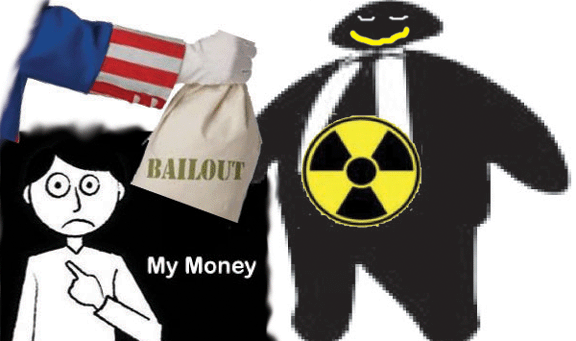 Critics sound alarm over rush to bail out Central New York nuclear plants, Syracuse.Com, By Tim Knauss | tknauss@syracuse.com , 17 June 16 SYRACUSE, N.Y. – The state’s frantic effort to save Upstate nuclear plants is drawing cheers from Oswego County. But it’s also raising alarms from critics who worry that key decisions about state energy policy are being rushed without enough public debate.
Exelon Corp.’s recent threat to close the Nine Mile 1 and Ginna nuclear reactors if it doesn’t get a subsidy from utility ratepayers by September has drawn barbed complaints from business, municipal and green energy advocates.
Critics point out that Exelon is asking the state Public Service Commission to determine how much of a subsidy the company’s nukes could get before the commission has even determined to what extent nuclear power should be subsidized.
Exelon “appears to be attempting an end run around the commission-established process,” wrote Albany attorney Michael Mager, who represents 60 large commercial and industrial utility customers in PSC rate proceedings. “The last thing that New York needs now is some ‘backroom deal.’ ”
Utility ratepayers could be on the hook for hundreds of millions in higher energy bills if the nuclear subsidies are approved – money that many renewable energy advocates would prefer to see spent on wind or solar power……..
A sudden focus on nuclear issues
The New York state energy plan, issued last year after much deliberation and 100,000 comments from the public, set an ambitious goal to make half of New York’s power from renewable energy by 2030. The plan barely mentioned nuclear power.
But hard times at Upstate’s nuclear plants – and hardball tactics by the owners – have suddenly forced Albany leaders to place a value on nuclear’s role in meeting the goals. Exelon’s recent ultimatum is the latest instance of brinksmanship during the past year from New York’s two nuclear operators.
Entergy Corp. last September threatened to close its 850-megawatt FitzPatrick plant in Scriba. After weeks of negotiations with Gov. Andrew Cuomo, punctuated by a war of words, Entergy made good on the threat and scheduled the shutdown for January 2017.
Now a similar warning has come from Exelon, the nation’s largest utility company, which owns the two-unit Nine Mile Point Nuclear Station near Oswego and the Ginna reactor in Wayne County.
Exelon has suggested in regulatory filings at the PSC that it is looking for a 12-year agreement that guarantees revenue of about $1 billion a year for its three Upstate reactors, an increase over what it makes now selling power in the wholesale market. The company did not estimate how much of a subsidy that would require…….
Based on current wholesale prices, two anti-nuclear groups estimated that subsidizing the two Nine Mile units and the Ginna plant would cost at least $190 million a year. In a filing with the PSC, the Alliance for a Green Economy and the Nuclear Information and Referral Service said their estimate was conservative……..http://www.syracuse.com/news/index.ssf/2016/06/critics_sound_alarm_over_rush_to_bail_out_central_new_york_nuclear_plants.html
Japan’s nuclear industry reels as court upholds injunction to halt reactors

 Japan court upholds injunction to halt reactors in blow to nuclear power industry, Reuters, TOKYO | BY OSAMU TSUKIMORI 17 June 16, A Japanese court on Friday upheld an order to keep two reactors at the Takahama nuclear plant closed, operator Kansai Electric Power said, leaving efforts to get a struggling nuclear industry up and running in limbo.
 , upholding a petition from residents living near the plant concerned about safety, keeps the legal battle center stage in a struggle by Prime Minister Shinzo Abe’s government to restore atomic power five years after the Fukushima disaster.
The Otsu District Court on March 9 ordered Kansai Electric, Japan’s second-biggest utility, to shut down the reactors in Fukui prefecture west of Tokyo, in the country’s first injunction to halt an operating nuclear plant.
The nuclear industry has only recently started to get reactors in a nuclear sector, which used to supply about a third of the country’s power, back online amid widespread public opposition after the melt downs at Fukushima in 2011.
Friday’s decision denied the utility’s attempt to temporarily halt the shutdown order……….
Amid mounting public scepticism over nuclear safety, local residents have lodged injunctions against nuclear plants across Japan…….http://www.reuters.com/article/us-japan-nuclear-court-idUSKCN0Z306R
Woes of France’s nuclear company AREVA, as it splits into three
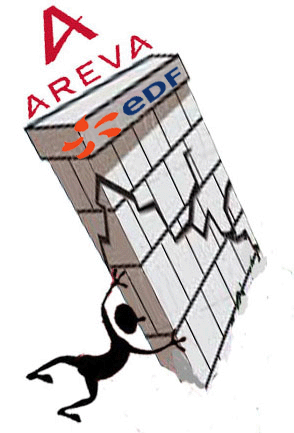
 French firm involved in Hinkley Point C unveils restructure plan Areva, a 10% equity participant in the Somerset scheme, reveals plans to split into three to stem losses and isolate Finnish project, Guardian, Terry Macalister, 16 June 16, Areva, one of the French companies at the heart of the controversial Hinkley Point C nuclear project, has unveiled plans to break itself up into three parts in a bid to stem huge losses.
The 87% state-owned atomic engineering and uranium mining company is hoping to raise €9bn (£7bn) from the government and from selling off assets after running up losses of €2bn last year.
Areva, a 10% equity participant in the £18bn planned new Hinkley scheme, is also using the split to isolate financial commitments to a hugely delayed project at Olkiluoto in Finland……
EDF, which is also part-owed by the French state, has its own massive debt problems and had refused to buy part of Areva, as ministers wanted, unless it could take the business without any financial commitments for the Olkiluoto 3 scheme.
Areva, which is providing the same European pressurised water reactor for Olkiluoto as is planned for Hinkley, is currently in a standoff over competing legal claims with the Finnish utility TVO relating to the project in Finland…….
A formal decision to go ahead with the investment at Hinkley has been put off until September amid internal opposition at EDF from unions and others about the wisdom of taking on such a major financial commitment……..https://www.theguardian.com/business/2016/jun/15/french-firm-involved-in-hinkley-point-c-unveils-restructure-plan
1 This Month

of the week – Shut Down Drone Warfare!


Tell the Ukrainian Government to Drop Prosecution of Peace Activist Yurii Sheliazhenko

Petition to revoke the licensing of the Near Surface Nuclear Disposal Facility (NSDF) at Chalk River. https://www.ourcommons.ca/petitions/en/Petition/Details?Petition=e-7247
To see nuclear-related stories in greater depth and intensity – go to https://nuclearinformation.wordpress.com
-
Archives
- April 2026 (114)
- March 2026 (251)
- February 2026 (268)
- January 2026 (308)
- December 2025 (358)
- November 2025 (359)
- October 2025 (376)
- September 2025 (257)
- August 2025 (319)
- July 2025 (230)
- June 2025 (348)
- May 2025 (261)
-
Categories
- 1
- 1 NUCLEAR ISSUES
- business and costs
- climate change
- culture and arts
- ENERGY
- environment
- health
- history
- indigenous issues
- Legal
- marketing of nuclear
- media
- opposition to nuclear
- PERSONAL STORIES
- politics
- politics international
- Religion and ethics
- safety
- secrets,lies and civil liberties
- spinbuster
- technology
- Uranium
- wastes
- weapons and war
- Women
- 2 WORLD
- ACTION
- AFRICA
- Atrocities
- AUSTRALIA
- Christina's notes
- Christina's themes
- culture and arts
- Events
- Fuk 2022
- Fuk 2023
- Fukushima 2017
- Fukushima 2018
- fukushima 2019
- Fukushima 2020
- Fukushima 2021
- general
- global warming
- Humour (God we need it)
- Nuclear
- RARE EARTHS
- Reference
- resources – print
- Resources -audiovicual
- Weekly Newsletter
- World
- World Nuclear
- YouTube
-
RSS
Entries RSS
Comments RSS
 nuclear-news