Russia’s nuclear marketing: the ambitions and the reality
 Russia’s nuclear energy expansion – a geopolitical footprint?, New Eastern Europe
 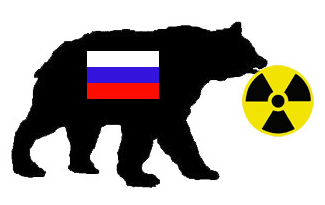 News, , 28 June 2016 “…….As the low oil and gas prices globally have squeezed Russia’s fossil fuel export revenues, an integral part of the country’s income, the nuclear industry has been looking for a worldwide expansion. Rosatom, Russia’s state-owned nuclear champion, has in the recent years set an ambitious course to deliver Russian nuclear power generating technology to both traditional partner countries as well as to new “developing“ economies…….
Nuclear ambitions
Over the past decade state-owned nuclear corporation Rosatom and its network of subsidiaries have made direct or indirect commitments to build nuclear power plants in a number of countries around the world. As stated by a Rosatom official in a recent interview, Russia has signed intergovernmental agreements for the possible construction of 36 nuclear reactors overseas and is holding “active and consistent” tendering negotiations about 21 others. It is apparent that Russia seems to be looking away from Europe and its traditional markets in search of new business opportunities for its nuclear industry.
During the Russia – ASEAN (Association of Southeast Asian Nations) summit held on 19 and 20 May in Sochi, Russia’s president Vladimir Putin said his country is ready to provide a Generation III nuclear reactor technology to countries in Southeast Asia. Another Rosatom official called forAfrica to invest in nuclear energy during an annual energy forum in Johannesburg in February 2016.
The reality
The overall expansion agenda seems really impressive, but in fact only some of the projects are in an active construction phase – such as those in Belarus, China, Finland, India, and Slovakia. The projects in Egypt, Hungary, Iran and Vietnam are also likely to get the go-ahead in the near future. As for the rest, the picture has not been so rosy.
Turkey’s Akkuyu project is becoming increasingly bogged down after the relationship between Moscow and Ankara embittered last November. Ukraine has denounced an agreement with Russia on the construction of two units at the Khmelnitsky site as the two countries have become increasingly hostile due to the looming Donbas and Crimea crises. China appears to have taken over the project for the expansion of the Atucha plant in Argentina. And nuclear development on the African continent (except for South Africa and Egypt) is nowhere closer to reality in the near future.
Looking back at Europe, both Finland’s Hanhikivi and Hungary’s Paks 2 nuclear new build projects have come under scrutiny of the authorities. In the Finnish case, the main condition set by Helsinki to allow the project was for 60 per cent of the ownership of Fennovoima, the company building Hanhikivi, to be held by investors from the EU. This meant Rosatom could only be a minority owner with its 34 per cent. As with Hungary, the European Commission (EC) has launched two procedures against the government in Budapest looking into the legality of the state aid and public procurement conditions around the Paks 2 project. The EC has expressed its doubts on whether the deal with Russia fully meets EU regulations and has been concluded on market terms. The EC said it would assess if a private investor would have financed the project on similar terms or whether Hungary’s investment constitutes state aid.
Economics and geopolitics
From an economic point of view, nuclear projects are specific with their high upfront capital costs. This fact often creates major hurdles for countries or companies looking to build nuclear capacities………
Apart from the initial investment, which is undoubtedly good business for Rosatom, even more attractive is the possibility for nuclear fuel supplies the Russian-designed reactors will be using over their operational lifetime. As this is on average 30-50 years, it is a brilliant opportunity for continued revenue over a very long period of time. ……
Forced to play by the common rules, Russia has to accommodate to open competition on EU terms. Therefore, it is looking for an ambitious expansion of its nuclear exports around the world, striving to “conquer” market shares as a first mover, while major nuclear industries in Europe and Japan are plagued by shrinking business opportunities, financial problems, and negative public opinions. The real contenders to Russia’s nuclear expansion in the short and medium term will become China and the US. It only remains to be seen where the business ends and geopolitics begins. http://www.neweasterneurope.eu/articles-and-commentary/2040-russia-s-nuclear-energy-expansion-a-geopolitical-footprint
No comments yet.
1 This Month

of the week – Shut Down Drone Warfare!


Tell the Ukrainian Government to Drop Prosecution of Peace Activist Yurii Sheliazhenko

Petition to revoke the licensing of the Near Surface Nuclear Disposal Facility (NSDF) at Chalk River. https://www.ourcommons.ca/petitions/en/Petition/Details?Petition=e-7247
To see nuclear-related stories in greater depth and intensity – go to https://nuclearinformation.wordpress.com
-
Archives
- April 2026 (68)
- March 2026 (251)
- February 2026 (268)
- January 2026 (308)
- December 2025 (358)
- November 2025 (359)
- October 2025 (376)
- September 2025 (257)
- August 2025 (319)
- July 2025 (230)
- June 2025 (348)
- May 2025 (261)
-
Categories
- 1
- 1 NUCLEAR ISSUES
- business and costs
- climate change
- culture and arts
- ENERGY
- environment
- health
- history
- indigenous issues
- Legal
- marketing of nuclear
- media
- opposition to nuclear
- PERSONAL STORIES
- politics
- politics international
- Religion and ethics
- safety
- secrets,lies and civil liberties
- spinbuster
- technology
- Uranium
- wastes
- weapons and war
- Women
- 2 WORLD
- ACTION
- AFRICA
- Atrocities
- AUSTRALIA
- Christina's notes
- Christina's themes
- culture and arts
- Events
- Fuk 2022
- Fuk 2023
- Fukushima 2017
- Fukushima 2018
- fukushima 2019
- Fukushima 2020
- Fukushima 2021
- general
- global warming
- Humour (God we need it)
- Nuclear
- RARE EARTHS
- Reference
- resources – print
- Resources -audiovicual
- Weekly Newsletter
- World
- World Nuclear
- YouTube
-
RSS
Entries RSS
Comments RSS
 nuclear-news
Leave a comment