June 24 Energy News

Opinion:
¶ “We’re all going solar, rooftop panels or not” • Solar power has gone beyond a rooftop revolution. Thanks to rapid cost reductions that even surprised experts, solar is on the verge of transforming Australia’s energy mix, whatever the outcome of the July 2 election. [The Australian Financial Review]
 Solar power is set to capture almost all the investment in new generation. Justin McManus
¶ “EDF should delay Hinkley Point decision following Brexit: union” • EDF’s unions have argued for months that the state-owned firm should delay its investment decision on the Hinkley Point. Now, the UK has voted to leave the EU, and UK politics have taken uncertainty to a new level. [The Fiscal Times]
Science and Technology:
¶ BMW announced battery packs from its i3 model can power your home, integrating seamlessly with solar panels to store energy for use at night, to…
View original post 662 more words
Exit from the European Union could make it easier for Britain to develop nuclear power
 A British vote to leave the European Union would force broad changes to the bloc’s energy policy, weakening its climate policy and removing a crucial Central European energy ally — but it could also give London far more freedom to pursue nuclear projects.
The U.K. is often an energy outlier in the EU, advocating nuclear power and shale gas sources shunned by others. And it tends to build alliances broadly aimed at keeping interference from Brussels to a minimum.
But both sides have a lot to lose.
A Brexit could undercut long-term climate policies in Brussels and London, and the EU would lose the U.K.’s pro-free market voice, which has historically helped tone down some more statist schemes coming from European capitals.
Here are the five ways that a Brexit would impact Europe’s energy and climate forecast:…….
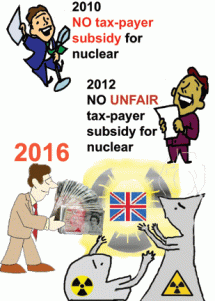 4. The freedom to subsidize — maybe
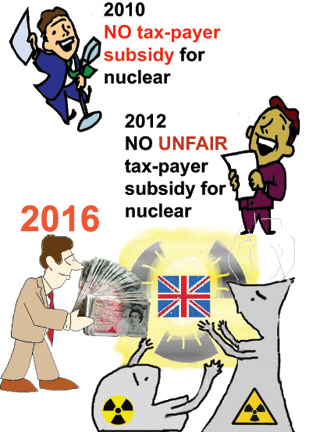
One area the European Commission tries to avoid is state aid, particularly for energy projects.
But even when the Commission gives a green light, there’s the danger that another EU country might try to interfere. That’s what happened with Hinkley Point. Brussels approved a state aid plan in 2014, but Austria, backed by Luxembourg,challenged the decision in the European Court of Justice eight months later…….
Environmental advocates worry it would give the U.K. room to continue rolling back support for renewables in favor of other fuels.
“One of the reasons why the government has had to have a more sensible policy on these issues is because state aid disciplines have stopped it from throwing money at gas-powered stations and fracking and nuclear,” said Nick Mabey, chief executive of the environmental analysis group E3G……..http://www.politico.eu/article/uk-brexit-renewable-energy-hinkley-nuclear-interconnectors-gas-climate-emissions-paris/
Every State can go Nuclear Free: California shows the way with a blue-green alliance
 California Is Going Nuclear-Free, Which Means Everyone Else Can, Too, Fast Coexist.com MICHAEL SHANK 06.21.16
A historic deal to replace the Diablo Canyon nuclear plant with renewable energy could be a model for the rest of the country. “……, a new historic agreement between a major American power company and environmental groups shows that another way is possible. America can, in fact, transition off nuclear in the short-term and replace it with renewable energy, efficiency and energy storage resources. It’s totally feasible. Take a look at the groundbreaking agreement:
First, the 100-plus year-old California-based power giant, Pacific Gas and Electric (PG&E), just agreed to shut down its two 30 year-old nuclear reactors in Diablo Canyon, letting the licenses expire in 2024 and 2025, respectively. This is a big deal, and it’ll make California, the world’s sixth largest economy, nuclear free.
This is no small thing. These two PG&E nuclear reactors, which spurred the start of the environmental organization Friends of the Earth, comprise roughly 20% of the annual electricity production in the company’s service territory and 10% of California’s annual production.
That’s a lot of power. And yet the transition off these kinds of plants is entirely doable and illustrative of switches that should happen across the U.S., including much older plants with long-expired licenses. Entergy’s Indian Point nuclear reactors north of New York City, for example, could be closed even sooner than Diablo Canyon and replaced with a portfolio of renewables, efficiency, and storage. Taking a cue from California, we should be replicating this everywhere.
Second, this agreement indicates that California is outpacing other states in how its utilities are redefining their future, as PG&E didn’t stop with the Diablo Canyon closure. They committed to ramping up their renewable energy portfolio over the next 15 years so that renewables will comprise the majority of their total retail power, at 55%, voluntarily exceeding California’s standards for 2030.
That’s also a big deal and heralds a new tide of utility leadership. PG&E sees the markets moving and wants to make the switch early. Utilities across the U.S., many of which are notoriously conservative in thinking and practice, are seeing the writing on the wall. And in the coming years, we’ll only see more of this switching as the economics are rapidly driving the conversion.
Senior EDF managers want Hinkley nuclear project to be postponed
 EDF Managers Tell UK MPs That Hinkley Point C Should Be Postponed http://www.nucnet.org/all-the-news/2016/06/20/edf-managers-tell-uk-mps-that-hinkley-point-c-should-be-postponed
Plans & Construction 20 Jun (NucNet): Senior managers at EDF have told British MPs that a final investment decision (FID) on the planned Hinkley Point C nuclear project should be delayed until problems including the reactor design and “multi-billion litigation” over the Olkiluoto-3 project in Finland have been resolved.
The letter from EDF managers to the UK parliament’s energy and climate change committee is a setback for the proposed £18bn (€23bn, $26bn) nuclear station in Somerset, England. The station is a flagship of the government’s energy policy and is intended to provide seven percent of Britain’s electricity from about 2025.
In April, the state-controlled French company said it was delaying the FID until September while it consulted with trade unions.
A letter dated 13 June and addressed to Angus MacNeil, the chairman of the committee, from the Fédération Nationale des Cadres Supérieurs de l’Énergie (FNCS) union, “advises to delay the FID until better upfront industrial visibility is evidenced”.
Outstanding problems highlighted by in the letter include:
– Areva NP, the designer of the European pressurised water reactor (EPR) planned for Hinkley Point, “is currently facing a difficult situation”.
– The French nuclear safety authority (ASN) may not approve operation of the Flamanville-3 EPR under construction in northwest France due to various anomalies with the reactor vessel bottom and the reactor vessel head.
– There may be “identical flaws” in an Areva EPR being built at Taishan-1 in China.
– Litigation between Areva and the Finnish energy group TVO over delays to the Olkiluoto-3 EPR remain unsettled.
– An EDF offer to purchase Areva expired on 31 March, leaving “governance uncertainties upon the implementation of the Hinkley Point C project”.
The letter says that on 25 May, ASN declared at an annual hearing in the French parliament that financial and economic challenges that both EDF and Areva are facing would be “time consuming”. The necessary reorganisations “would need long delays before a proper recovery happens” and ASN would prioritise regulatory oversight of the existing fleet rather than any new project.
According to the letter, ASN is concerned that while EDF is dedicating its efforts to new nuclear projects, the financing of safety improvements for the normal operation of the French nuclear fleet could be delayed or even given up.
The letter says “heavy evidence” still needs to be brought prior to further commitments, in order to make those commitments “gain robustness and reliability”.
On 7 June, three French workers unions sent a letter to energy minister Ségolène Royale asking for clarification about the “orientation” of the French nuclear industry.
Vincent de Rivaz, the chief executive officer of EDF’s UK subsidiary EDF Energy told MPs last month that he could not give a definite time for when the company will make the FID.
Mr de Rivaz was called to reappear before the committee after indicating at an appearance in March that the FID could be taken by early May. The committee asked him to explain why that had not happened.
The letter is online: http://bit.ly/1Uc8N0F
A model for nuclear plant closure: Diablo Canyon co-operative plan
 Diablo Canyon Nuclear Closure Plan: An Important Model, Natural Resources Defense Council, June 22, 2016 Matthew McKinzie Fourteen U.S. nuclear reactors have now been shut down or their owners have announced their closures since 2010, either because they were uneconomic in today’s electricity markets or had operational or environmental problems. The Joint Proposal announced yesterday for the two reactors at California’s Diablo Canyon Power Plant is historic, because it is the first time any utility owner has committed to a plan to replace retiring nuclear generation with 100 percent, zero-emissions, clean electricity-generating resources that are also lower cost. This shows that with careful planning, there is no need to substitute polluting fossil fuels for retiring nuclear generation –-an important model for the rest of the world.
The Diablo Joint Proposal signed by Pacific Gas & Electric (PG&E), Friends of the Earth, NRDC, labor and other environmental groups is further proof that our energy system is changing, and renewable energy and other resources can fill the gaps left from shuttering nuclear plants.
Energy efficiency, wind, and solar address climate change without nuclear energy’s burdens of highly radioactive waste, the need for physical and cyber security to guard against terrorist nuclear threats, the risk of radiation release in a major accident, and the nuclear weapons proliferation problem.
To see just how monumental the Joint Proposal for Diablo is, it’s important to take a look at what’s happening today in the nuclear industry. Since 2010, across Vermont, Massachusetts, New York, New Jersey, Florida, Illinois, Wisconsin, Nebraska and California, 14 nuclear reactors at 11 power plants totaling 11.9 gigawatts of electric capacity have either closed, or their owners have announced they will close.
Information on these closed or closing nuclear reactors is summarized in this table, and patterns are evident. Three of the reactors closed for primarily mechanical/safety reasons, whereas 11 reactors closed or will close primarily for market reasons. In other words, in today’s wholesale electricity markets (which largely do not reflect external costs imposed by carbon pollution), these reactors were unable to compete with other forms of electricity generation, including natural gas and wind, when utilities are procuring energy sources to help meet their customers’ needs……….
A carbon-free, renewable futureFortunately, both the United States and the world are making great strides forward on carbon-free energy efficiency and renewable energy, as well as technologies like demand response and battery storage. An October 2015 NRDC report “Tectonic Shift” describes how economic growth is now decoupled from energy usage, and that in fact energy usage is flat. California has adopted a requirement that half of its electricity come from renewable energy resources by 2030, and New York is about to adopt the same requirement. In 2015,in data compiled by AWEA, more than 30 percent of Iowa’s electricity came from wind power alone and three other states generated more than 20 percent of their electricity from wind power alone.
And the National Renewable Energy Laboratory has concluded that “renewable electricity generation from technologies that are commercially available today, in combination with a more flexible electric system, is more than adequate to supply 80 percent of total U.S. electricity generation in 2050 while meeting electricity demand on an hourly basis in every region of the country.”……
the Diablo Canyon proposal shows that given sufficient time to prepare, retiring nuclear capacity can transition smoothly to a mix of energy efficiency measures; clean, renewable resources; and energy storage without any role for fossil fuels – an outcome that can be optimal for the environment, the market, and the reliability of the electric grid.The Joint Proposal governing the shutdown of Diablo Canyon within nine years is exactly that – full replacement of retiring nuclear generating capacity with lower cost, zero-carbon resources. The proposal is a robust model of planned, orderly transition that takes into account sound energy policy, the values of jobs and community, the threat of climate change, and nuclear safety concerns. https://www.nrdc.org/experts/matthew-mckinzie/diablo-canyon-nuclear-closure-plan-important-model
Russia’s massive nuclear-powered icebreaker to seek oil reserves in Arctic
Arktika is just one icebreaker in a class known as Project 22220. The other two — Sibir, which was laid down in May 2015, and Ural — are also planned. If completed, Sibir will reportedly have the propulsion power of 110 MW, almost twice as powerful as Arktika. Both ships are part of a $1.2 billion contract that Baltic Shipyards signed in 2014 with Rosatom State Nuclear Energy Corp.
Why would Russia need nuclear-powered icebreakers in the first place? Obviously, for defense. Icebreakers can clear a path for military ships, allowing for increased mobility and range for the Russian naval fleet.
USA’s Department of Energy seeks “consent-based” #nuclear waste sites
 Nuclear waste, anyone? Feds look to willing states, The Orange County Register, June 22, 2016 By TERI SFORZA / STAFF WRITER Federal officials unleashed bubbles of hope in San Juan Capistrano on Wednesday – we’re developing a plan that can remove deadly nuclear waste from San Onofre earlier than we thought! – while others worked feverishly to pop them.
Speaking to a raucous audience at the San Juan Capistrano Community Center, John Kotek, the U.S. Department of Energy’s acting assistant secretary for nuclear energy, detailed the federal government’s new push for temporary nuclear waste storage in regions allegedly eager for the business.
Several such “consent-based” sites – currently envisioned in West Texas and New Mexico – could be up and running while the prickly question of finding a permanent home for the waste is hashed out……..
Some in Texas and New Mexico say they’ll never consent to importing our deadly castoffs, and they’re ready to do battle.
“Please be aware that many people in Texas and New Mexico are solidly opposed to having high-level radioactive waste stored in our region,” said Karen Hadden of the Sustainable Energy & Economic Development Coalition, a Texas-based nonprofit focusing on clean energy and public health, in a letter to San Onofre officials.
The DOE scheduled eight meetings about consent around the country, but none in Texas or New Mexico, the targeted region. … Dumping this dangerous waste on communities that are largely Hispanic and lack the resources to fight back, people who never had a say in the nuclear reactors to begin with or benefited from any electricity from them, would be an extreme example of environmental injustice.”
The Texas Democratic Party has gone on record opposing the import of nuclear waste, conjuring the stalemate at Yucca Mountain. The federal government spent $10 billion to put a permanent repository there, despite the opposition of Nevada residents. That effort is essentially dead……
 Former Nuclear Regulatory Commission Chairwoman Allison Macfarlane explained the tortured landscape: a Congress that only sees two, four and six years into the future, and is satisfied that the waste is safe where it is today, at 75 different sites across the nation; utilities that want to reduce costs, and thus aren’t eager to make changes; a Department of Energy that doesn’t have the legal authority to solve the problem entirely; and a Department of Justice that is paying billions to utilities from a judgment fund of taxpayer money, because the federal government promised the utilities it would permanently dispose of that waste in exchange for payments, but has failed utterly to do so……
It’s our ethical responsibility to not stick this problem to future generations, Macfarlane said to applause from the audience.
“I’m not hopeful new physics will be discovered to magic this stuff away. We have to grapple with it. It’s there.” http://www.ocregister.com/articles/waste-720291-nuclear-new.html
USA promotes a nuclear arms race in Asia, by Supporting India’s entry to Nuclear Suppliers Group
 Promoting a nuclear race?, Business Recorder June 23, 2016 IKRAM SEHGAL India clandestinely diverted nuclear fuel from the Canadian supplied civilian nuclear reactor in Tarapur for conducting its nuclear test in 1974. Created in 1974 as a direct result of the Indian subterfuge, the Nuclear Suppliers Group (NSG) was meant to prevent in future what India had done, being tasked with regulating nuclear commerce for civilian uses and preventing proliferation of nuclear weapons.
On the back of the US-India nuclear deal in 2008, the Bush Administration applied immense political pressure to exempt India from the NSG’s rules on civilian nuclear trade when it was under US sanctions for proliferation activities. This double standards waiver was engineered when Pakistani’s letter vehemently objecting to it was suddenly and surprisingly withdrawn in Vienna during NSG deliberations at the last minute on the express telephonic instructions from President Asif Zardari. This unparalleled “personal” initiative appeased the US and India but it destroyed the original concept of the NSG and cost Pakistan dearly. It “officially” allowed India to expand its arsenal massively by using imported fuel for civilian nuclear reactors and replenish stocks for weapon production. “Harvard’s Belfer Center” and US think tank “Arms Control Today” confirmed that this defeated the very purpose why the NSG was created in the first place.
What about nuclear balance in South Asia? In an article published by the International Committee of the Fourth International (ICFI), in September 2008 the writers correctly assessed that, “The action the NSG has been goaded into taking by the US has immense and incendiary strategic implications for South Asia, tilling the balance of power between India and its historic rival Pakistan sharply in India’s favour. It also rubbishes the basic principle of the nuclear regulatory regime the US championed earlier that States which pursue nuclear weapons will be “punished” by an embargo on all nuclear trade and those that adhere to the NPT will, in return, be assisted in developing civilian nuclear energy. And, as was foreshadowed in the events at the NSG meeting itself, it will intensify and complicate the ongoing and ever more explosive rivalry amongst the big powers for markets, raw materials, and geo-strategic advantage.”
A Senate hearing on 24 May saw US Senator Markey saying something extremely relevant, “Since 2008 when (we) also gave them an exemption, India has continued to produce fissile material for its nuclear weapons programme virtually un-checked. At that time Pakistan warned us that the deal would increase the chances of the nuclear arms race in South Asia”. Some countries, led by China and Turkey, are resisting this pressure on principle, arguing that if any exception to the rules is made, it should apply equally to both India and Pakistan. Since all 48 member NSG decisions are made by consensus, even one member can block a decision.
India has not honoured its limited commitments under the international non-proliferation regime that earned it the 2008 waiver, adhering to limited IAEA Additional Protocol as well as US laws (Hyde Act) for transparency in use of imported fissile material, agreeing to a moratorium on fissile material production for weapons use; signing and ratifying the CTBT and putting a cap on its nuclear weapons production. In the face of these obvious deficiencies, allowing India NSG membership will intensify the nuclear/strategic arms race in South Asia, undermine NSG’s credibility and will give India the legitimacy of a nuclear weapon state. Bent on using India as a counterweight to China, the US must realise the dangerous confrontation that will erupt in South Asia………http://www.brecorder.com/articles-a-letters/187/59532/
The nuclear power door is only just still open in Sweden
 Sweden’s deal leaves door to nuclear power open, but only just, Reuters STOCKHOLM, JUNE 23 | BY DANIEL DICKSON AND NERIJUS ADOMAITIS Sweden has agreed to cut taxes on nuclear power generators and allow for the construction of new reactors but policymakers have yet to work out how that fits with a commitment to using 100 percent renewable energy……..
Spokeswomen for the Energy Minister Ibrahim Baylan and for the Green Party, a junior member of the ruling coalition……….the target is formulated as electricity production… that means all production in Sweden is renewable,” Lise Nordin, Green Party energy policy spokeswoman and member of the parliament, told Reuters.
While the agreement allows power generators “in theory” to build new reactors, in reality they would be too costly, she added.
“The probability that new nuclear power will be built is zero,” Nordin said……..http://uk.reuters.com/article/sweden-nuclearpower-idUKL8N19E2VM
NUCLEAR-capable ballistic missiles for Russia – placed in Europe
Russia to deploy NUCLEAR-capable ballistic missiles in the heart of EUROPE, Express, UK 23 June 16 RUSSIA plans to station advanced nuclear-capable missiles deep inside Europe – putting vast swathes of the continent in the crosshairs of Moscow’s short-range ballistic missile programme. By TOM BATCHELOR, Jun 23, 2016 Kremlin insiders say the Russian enclave of Kaliningrad – on the Baltic Sea wedged between Poland and Lithuania – will host the Iskander missile – dubbed the Stone by Nato.
Crimea, which was annexed from the Ukraine in 2014, could also host a second Iskander missile base, Russian defence sources claim.
Russia has been accused of blatant acts of aggression in eastern Europe and the Baltics, with land grabs, military exercises and close fly-bys of its fighter jets.
The move is in defiance of a US-backed Nato missile shield that was erected in Romania last month, with a second planned for Poland in 2018.
With a range of roughly 300 miles, the Iskander missile could hit targets as far away as eastern Germany, the entire Baltic region and Poland, as well as parts of Sweden.
But experts say the targets it will cover can be struck by longer-range Russian missiles anyway.
Relations between Russia and the West have plunged to their lowest point since the Cold War in recent months.
Both sides have ramped up their defence spending, missile programmes and defensive shields as Europe enters what many observers believe is a new Cold War…….http://www.express.co.uk/news/world/682701/Russia-station-Iskander-nuclear-missiles-Kaliningrad-Cold-War-tensions
Safety issues at Taishan Nuclear Plant in China’s Guangdong

 Issues at Taishan Nuclear Plant in China’s Guangdong Spark Safety Fears Radio Free Asia, 23 June 16 Reported by Lam Kwok-lap for RFA’s Cantonese Service. Translated and written in English by Luisetta Mudie. Design flaws in a French-built nuclear reactor currently being tested at a power station on the southern coast of China have sparked safety concerns in neighboring Hong Kong, experts and local media reports said.
The U.S.$8.3 billion Taishan plant is among the first in the world to use European pressurised reactors (EPR) designed by French nuclear firm Areva, which recently sold a majority stake to energy giant Electricite de France (EDF).
Problems with the design of the reactors have emerged during testing, however, and were cited by EDF in a recent recommendation to the U.K. parliament that it postpone the Chinese-invested Hinkley Point nuclear plant, which had also planned to use EPR technology.
In a letter to U.K. lawmakers earlier this month, EDF said there may be “identical flaws” in the Taishan power plant, which lies just 160 km (100 miles) from the densely populated Pearl River Delta region, which includes Hong Kong.
Meanwhile, prolonged delays to an EPR reactor at Olkiluoto in Finland have resulted in multibillion-euro litigation between Areva and the Finnish energy group TVO. While Taishan has already postponed its scheduled opening by one year to 2018 after the discovery of too much carbon in the walls of the reactors, officials are still pushing for the plants to go ahead as planned, campaigners said in Hong Kong this week.
Last month, the concrete shells encasing the plant’s two pressure reactors were sealed, according to drone images gathered by Hong Kong’s crowd funded investigative news agency FactWire, which means that the EPR units can’t be removed or replaced now.
The amount of radioactive nuclear fuel stored at the Taishan plant is three times that of Japan’s Fukushima nuclear plant, campaigner Albert Lai told the agency.
50 million people
Lai fears that some 50 million people would be affected in the event of a large-scale nuclear leak, across a 7,000 square km area.
“There have been so many trust issues, that a lot of people now believe that quality control at this nuclear power plant is below standard,” engineer and sustainability campaigner Albert Lai, who convenes the Hong Kong think tank Professional Commons, told RFA on Thursday.
“What’s more, the problems are much more serious than we thought they were,” he said, citing a scandal over the falsification of parts forged at Areva’s Le Creusot facility that potentially put safety checks at risk………China General Nuclear has already posponed the opening of Taishan Unit 1 and Taishan Unit 2 to the first and second half of 2017 respectively, but FactWire reported, citing French engineers, that Unit 1 still required a large amount of tests, and the earliest it could start was 2018……..http://www.rfa.org/english/news/china/china-nuclear-06232016125814.html
Business analysts do not share the optimism of Toshiba’s new CEO, on nuclear power
 Toshiba’s new CEO sticks to nuclear target branded ambitious by analysts http://www.thefiscaltimes.com/latestnews/2016/06/23/Toshibas-new-CEO-sticks-nuclear-target-branded-ambitious-analysts Fiscal Times, 23 June 16, “Its achievable,” Satoshi Tsunakawa told reporters on Thursday, a day after assuming the top post, when asked about the company’s goal of building 45 nuclear power reactors globally by the business year ending March 2031….
Island states most at risk of global warming impact – Maldives want action
 Maldives urges rich countries to rapidly ratify Paris climate agreement
Environment and energy minister of small island state, one of the countries most at risk of global warming impacts, says ‘no time to waste’ on Paris deal, Guardian, Fiona Harvey, 21 June 16 Rich countries must ratify the climate change agreement reached in Paris last December, one of the world’s most at-risk nations has warned.
Thoriq Ibrahim, environment and energy minister of the Maldives, told the Guardian that there was “no time to waste”, in ratifying the agreement that was reached more than six months ago, and that it should be a matter of urgency for industrialised countries.
So far, almost the only countries to have passed the accord into law are the small islands most at risk from rising sea levels, and other smaller developing nations.
France became the first large industrialised nation to ratify the Paris agreementonly earlier this month, although a ceremony was held in New York in April at which countries were supposed to affirm their commitment to the international agreement…….https://www.theguardian.com/environment/2016/jun/21/maldives-urges-rich-countries-to-rapidly-ratify-paris-climate-agreement
Nestle’s new deal for powering its UK and Ireland operations with wind energy
 NEW RENEWABLE POWER SOURCE FOR NESTLE UK AND IRELAND OPERATIONS LONDON, The Climate Group, 22 June 16 Nestlé has signed a new deal to power around half of its UK and Ireland operations with wind from the Scottish Highlands.
An initial 15 year Power Partnership Agreement with Community Wind Power will see a brand new nine turbine wind farm open up in Dumfries and Galloway in the first half of 2017. It will produce approximately 125GWh of power per annum, meeting around 50% of Nestlés electricity demand in the UK and Ireland – equivalent to 30,000 homes.
Earlier this year, Nestlé UK & Ireland announced that all its grid supplied-electricity would come from renewable sources, in a deal with EDF Energy. This currently accounts for all of Nestlés electricity use in the UK and Ireland.
As a member of RE100, Nestlé is committed to transitioning its electricity use to 100% renewable electricity not just in the UK, but across its global operations. The latest available data shows that in 2015, 8.4% of Nestlés total electricity consumption was being sourced from renewable power. Today’s development is another positive step towards its global goal.
Dame Fiona Kendrick, Chairman & CEO of Nestlé UK & Ireland, said: “This is a newly commissioned wind farm, generating new energy, creating capacity that didn’t previously exist and capable of providing half of our electricity needs. It’s a proud moment for us and means we have reached another key milestone in our efforts to become a sustainable business.”…….http://www.theclimategroup.org/what-we-do/news-and-blogs/new-renewable-power-source-for-nestl-uk-and-ireland-operations/?platform=hootsuite
Diablo Canyon’s nuclear power plant leaves radioactive trash for a long time
 Nuclear plant closes, but it will not go away, Ventura County Star, 22 June 16, The announcement Tuesday of plans to close the Diablo Canyon nuclear power plant in 2025 was a historic moment in California.
It means the end of nuclear power generation in the state. The announcement by owners Pacific Gas & Electric was cheered by thousands who have fought since long before the plant went online in 1985 to end nuclear power production at the coastal facility at Avila Beach in San Luis Obispo County.
PG&E made the decision based, as best we can tell, for economic rather than environmental reasons. Although the majority of Americans now oppose the use of nuclear energy to provide electricity, the utility realized that there probably were going to be cheaper ways to provide power in the future than Diablo Canyon…….
there is one thing that will be left behind. They are the spent fuel rods, the most controversial, the most dangerous and the most difficult parts of a nuclear generating station.
At Diablo Canyon, the spent fuel rods are cooled in a special concrete pool for about five years. Then the rods are put in a helium-filled canister and set inside a 20-foot-tall concrete-filled steel storage cast that is cooled by natural air convection. The casks are bolted to a seven-and-one-half-foot thick concrete pad.
All of this is on the Diablo Canyon property, a short hike from the picturesque Avila Bay.
And there they will stay. The final responsibility for disposing of this high-level nuclear waste rests with the U.S. Department of Energy. And currently the federal government has no approved plan to dispose of any high-level nuclear fuel waste from any nuclear plant in the United States.
The nuclear rods are highly radioactive, enough to kill anyone exposed to them or contaminate local soil or groundwater, and will be in that state for thousands of years.
So until the federal government figures out how to safely get rid of our collective high-level nuclear waste — if it ever does — there will be a piece of Diablo Canyon plant, the most dangerous piece, creating minimal but potential risk for generations. http://www.vcstar.com/opinion/editorials/editorial-nuclear-plant-closes-but-it-will-not-go-away-35e17170-2354-07d3-e053-0100007fa1df-384027791.html
1 This Month

of the week – Shut Down Drone Warfare!


Tell the Ukrainian Government to Drop Prosecution of Peace Activist Yurii Sheliazhenko

Petition to revoke the licensing of the Near Surface Nuclear Disposal Facility (NSDF) at Chalk River. https://www.ourcommons.ca/petitions/en/Petition/Details?Petition=e-7247
To see nuclear-related stories in greater depth and intensity – go to https://nuclearinformation.wordpress.com
-
Archives
- April 2026 (91)
- March 2026 (251)
- February 2026 (268)
- January 2026 (308)
- December 2025 (358)
- November 2025 (359)
- October 2025 (376)
- September 2025 (257)
- August 2025 (319)
- July 2025 (230)
- June 2025 (348)
- May 2025 (261)
-
Categories
- 1
- 1 NUCLEAR ISSUES
- business and costs
- climate change
- culture and arts
- ENERGY
- environment
- health
- history
- indigenous issues
- Legal
- marketing of nuclear
- media
- opposition to nuclear
- PERSONAL STORIES
- politics
- politics international
- Religion and ethics
- safety
- secrets,lies and civil liberties
- spinbuster
- technology
- Uranium
- wastes
- weapons and war
- Women
- 2 WORLD
- ACTION
- AFRICA
- Atrocities
- AUSTRALIA
- Christina's notes
- Christina's themes
- culture and arts
- Events
- Fuk 2022
- Fuk 2023
- Fukushima 2017
- Fukushima 2018
- fukushima 2019
- Fukushima 2020
- Fukushima 2021
- general
- global warming
- Humour (God we need it)
- Nuclear
- RARE EARTHS
- Reference
- resources – print
- Resources -audiovicual
- Weekly Newsletter
- World
- World Nuclear
- YouTube
-
RSS
Entries RSS
Comments RSS
 nuclear-news