India paying high cost to save Westinghouse’s nuclear business
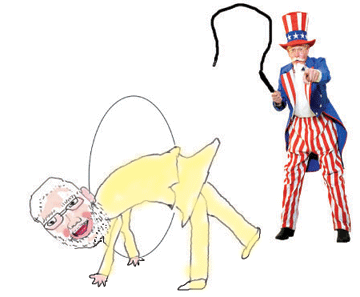 The Cost of Modi’s US Visit: Offering Rs. 2.8 lakh crore to Westinghouse, News Click, Prabir Purkayastha, June 09, 2016
The 4th visit of Modi to the US has very little to show as achievements. No wonder, the headlines screamed about “the start of the preparatory work” on six nuclear reactors as a major achievement. Not content with this, the Westinghouse AP 1000 reactors were even hyped as 5th generation reactors, skipping two whole generations of reactors in between. The earlier AP 600 reactors are recognised as 2nd generation reactors, making the AP 1000 the 3rd generation, which is how they are known in the rest of the world – except to certain gentlemen in the Indian media.
The reality is that after 8 years of negotiations on the Westinghouse reactors, India has now shifted the location from  Mithivirdhi in Gujarat to Srikakulam in Andhra Pradesh. The negotiations for the deal with Westinghouse are still stuck, and only a new beginning is being sought with this new site. All that Westinghouse has agreed is that they will do some preliminary work for this new site — “start of the preparatory work”.
In today’s world, nuclear energy is a dying technology. Its costs are too high, its ability to build to schedule is non existent and it faces the challenge of renewables – wind and solar – the costs of which are dropping rapidly. The US, after a brief flirtation with nuclear energy – the so-called nuclear renaissance – has pretty much decided not to invest any further in this technology.
It is only China and India that can revive the dying nuclear industry of the US. Both Westinghouse and GE are without any further orders in the US and in the EU. So it is not the US showing its willingness to “give” us nuclear reactors to India that is the issue; it is India helping to revive a patient – the US nuclear industry – which has currently one foot already in the grave.
How much are we committing to pay to revive a dying Westinghouse? Though no cost figures have been disclosed – very similar to how India is negotiating with Areva for Jaitapur – the bill for the six Westinghouse reactors is estimated to be in the region of a whopping Rs. 2.8 lakh crore! The cost of such nuclear power would be about Rs. 12-14 per unit (KWh), or about three to four times that from coal fired plants, and far higher than the wind and solar costs.
As a part of the India US nuclear deal signed almost a decade ago, India had offered both GE and Westinghouse one site each for setting up six units of 1,000 MW. Srikakulam was offered as a site to GE-Hitachi, which they had turned down. Westinghouse was offered the Mithivirdhi site. Facing protests of the local people and various environmental objections, Nuclear Power Corporation Limited (NPCL) decided to abandon its Mithivirdhi plans, and instead offered the Srikakulam site to Westinghouse. The Modi Obama statement on the six nuclear plants is therefore simply a continuation of the India US Nuclear agreement reached during Manmohan Singh’s time. All that both sides have achieved after 8 long years, is simply coming back to square one.
At least during Manmohan Singh’s time, there was a talk of a nuclear renaissance and the renewal of nuclear energy industry after a long hiatus. After Fukushima, nuclear energy worldwide has gone out of reckoning in most countries, with only India, China, and Russia still pursuing their nuclear energy plans. For India, more than nuclear energy, it is paying back the US for its “support” for entry into the nuclear club. While India has got access to nuclear fuel, the rest of the promise – dual use technology, technology, fuel reprocessing, membership of NSG etc. — has not materialised.
Eight years is a long time and much radiation has flown into the sea from Fukushima meanwhile. The US has virtually stopped all further nuclear plants; the French after its two costly EPR’s – one in Olkiluoto, Finland and the other in Flamanville, – has stopped all further expansion of its nuclear fleet. The UK is still considering installing EPR’s and Westinghouse reactors to replace nuclear plants that they are closing, while Germany is switching to renewables and shutting down its nuclear fleet.
The primary driver in all this is that the 3rd generation reactors have all proven to be much too complex and difficult to construct. It is the huge cost and time over runs, the same issue that led to abandoning the nuclear plans in the 80’s that still is dogging the nuclear industry today. Fukushima has made us more aware of the danger of a meltdown following the loss of all power to the reactors. But the underlying issues is same: the costs and time involved in making nuclear power safe, mount the more we learn about the issues.
Let us examine more closely the Westinghouse reactors that we are buying and see whether it makes any sense for us today. The Westinghouse AP 1000 reactors have come up against very similar problems that have dogged the French Areva EPR designs. Just as the EPR’s have shown huge cost and time over runs, so have the AP 1000’s in the US and in China, where plants are under construction……….
What is the cost of the AP 1000’s? Without taking the delays into account, the cost of the two units of the Vogtle plant in 2009 was approximately $14 billion or about Rs. 94,000 thousand crore (at today’s exchange rates). Assuming these same price will hold good even after 7 years and without taking into account the cost and time overruns, this works out to an astronomical Rs. 2.8 lakh crore (Rs. 2,80,000 crore) for six units in Srikakulam! This translates to Rs. 42 crore per MW or about 7 times the cost of coal fired plants. Before people claim that these are over estimates, let us also remember that these are very similar to the Areva EPR prices for Jaitapur, which is why negotiations have dragged on for more than 7 years between NPCL and Areva.
What do these capital costs per MW translate in terms of cost per unit of electricity(KWh)? Roughly, a capital cost of Rs. 42 crore per MW would mean that a unit of electricity would cost – at a very conservative estimate – about Rs. 12-14 as against the current cost of Rs. 3-4 for coal fired plants. The latest renewable figures in India shows that wind is cheaper than coal and solar is about Rs. 4.00 to Rs. 6.00 per unit. In other words, nuclear power with imported reactors, is two to three times more expensive to that from renewables.
The reasons for the spiralling costs in nuclear energy have been many. I will single out the two most important ones. One is that as nuclear accidents have happened, they made us much more aware of the inherent complexity of handling a controlled burn of potentially explosive, nuclear fissile material. If any critical system fails, it can lead to loss of controls and therefore the possibility of reactor melt down. This is what we saw in Chernobyl and Fukushima. The second is that with costs rising, the nuclear industry decided to scale up the size of the units to bring down the costs per unit of electricity produced. However, such an economy of scale also adds to the complexity; the reactors of 1,100 MW (AP 1000) and 1,600 MW (EPR) size means that these reactors are much more complex. This has lead to the difficulty of manufacturing, as also constructing such complex plants. This is the key reason why the nuclear industry has repeatedly failed to meet its project schedules. What killed the nuclear industry in the US was not the Three Mile Island disaster, but consistently failing to meet its cost and projected time targets.
There is another factor we need to take into account. If we pack more units together, the magnitude of a nuclear accident increases. The reason we still do so is reducing costs, and the difficulty of finding suitable sites. With 6 units of 1,100 MW (Srikakulam), or 1,600 MW (Jaitapur), packed together, an accident would have catastrophic consequences for a much larger area than the smaller units NPCL has been installing in India till now.
Nuclear technology is the only technology I know in which the costs have consistently risen with time. All others, after a relatively short time, led to a significant lowering of costs. Not so with nuclear energy. Today, we should switch to renewables if we want to phase out coal. Nuclear energy is no longer the answer, either in economic terms or as a clean energy source. http://newsclick.in/india/cost-modis-us-visit-offering-rs-28-lakh-crore-westinghouse
No comments yet.
1 This Month

of the week – Shut Down Drone Warfare!


Tell the Ukrainian Government to Drop Prosecution of Peace Activist Yurii Sheliazhenko

Petition to revoke the licensing of the Near Surface Nuclear Disposal Facility (NSDF) at Chalk River. https://www.ourcommons.ca/petitions/en/Petition/Details?Petition=e-7247
To see nuclear-related stories in greater depth and intensity – go to https://nuclearinformation.wordpress.com
-
Archives
- March 2026 (244)
- February 2026 (268)
- January 2026 (308)
- December 2025 (358)
- November 2025 (359)
- October 2025 (376)
- September 2025 (257)
- August 2025 (319)
- July 2025 (230)
- June 2025 (348)
- May 2025 (261)
- April 2025 (305)
-
Categories
- 1
- 1 NUCLEAR ISSUES
- business and costs
- climate change
- culture and arts
- ENERGY
- environment
- health
- history
- indigenous issues
- Legal
- marketing of nuclear
- media
- opposition to nuclear
- PERSONAL STORIES
- politics
- politics international
- Religion and ethics
- safety
- secrets,lies and civil liberties
- spinbuster
- technology
- Uranium
- wastes
- weapons and war
- Women
- 2 WORLD
- ACTION
- AFRICA
- Atrocities
- AUSTRALIA
- Christina's notes
- Christina's themes
- culture and arts
- Events
- Fuk 2022
- Fuk 2023
- Fukushima 2017
- Fukushima 2018
- fukushima 2019
- Fukushima 2020
- Fukushima 2021
- general
- global warming
- Humour (God we need it)
- Nuclear
- RARE EARTHS
- Reference
- resources – print
- Resources -audiovicual
- Weekly Newsletter
- World
- World Nuclear
- YouTube
-
RSS
Entries RSS
Comments RSS
 nuclear-news
Leave a comment