Scientists, city leaders, local community warn against burial of nuclear waste near San Onofre State Beach.

 Local Leaders, Scientists Sounding Alarm Over Possible Nuclear Disaster In Southland http://losangeles.cbslocal.com/2016/06/08/local-leaders-scientists-sounding-alarm-over-planned-nuclear-waste-dumping-in-san-onofre-state-beach/ June 8, 2016 LAGUNA BEACH (CBSLA.com) — A standing-room-only public forum was held Wednesday night to warn the community about Southern California Edison’s plans to bury radioactive waste near San Onofre State Beach.
If nothing is done, the utility will be allowed to bury 2,000 tons of high-level nuclear waste in canister less than an inch thick 100 feet from the beach, according to the newly formed Secure Nuclear Waste Coalition, made up of scientists, city leaders and people who live near the San Onofre nuclear plant.
“Each canister contains a Chernobyl’s worth of radiation, and there’s 50 of them. And they want to put 100 more without dealing with the fact that ocean air is going to cause them to crack and potentially and even explode,” Donna Gilmore said.
The California Coastal Commission approved the beachfront nuclear waste burial on October 6, 2015.
The group told those living within the 50-mile evacuation zone from San Diego to Long Beach that even though the San Onofre nuclear- generating station has been shut down, the real danger still lies in the still highly radioactive spent nuclear fuel that will remain on site for years.
“They have been called rightfully so – bombs in our backyard,” warned Rita Conn of the coalition.
Edison has maintained the shuttered nuclear power plant and the spent fuel rods stored there are safe. But some fear Southern California is one earthquake, one tsunami or one terrorist attack away from a nuclear disaster.
“Whether it’s mother nature, human error or terrorism, anything could close down the 7th largest economy of the United States for the next 10,000 years,” Laguna Beach resident Marni Magda said.
“If we don’t do anything about it, people are just going to have their heads in the sand and heaven forbid, something terrible happens,” Donna Tiab warned.
A call to Southern California Edison for comment Wednesday night was not returned.
Rockland County Lawmakers Want Shutdown of Dangerous Indian Point Nuclear Station
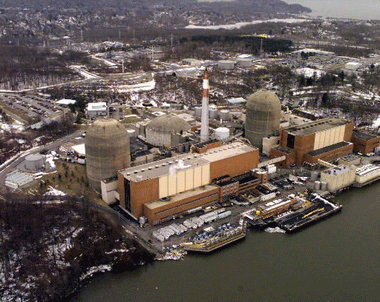 VOICE OF THE LEGISLATIVE MAJORITY: Shut Down Indian Point
http://www.rocklandtimes.com/2016/06/09/voice-of-the-legislative-majority-shut-down-indian-point/June 9th, 2016 By Legislator Alden H. Wolfe (D- Montebello) Chairman, Rockland County Legislature
From the moment the Indian Point nuclear power plants went on line, safety issues began to emerge. Malfunctions and faulty parts caused the plants to be closed, and later restarted. As the Hudson Valley population grew and the problems at Indian Point increased, the reality of the potential for a catastrophic disaster became clearer and clearer.
Sadly, the Indian Point facility continues to suffer more failures than ever before. In the last year alone, there have been seven plant shutdowns. At this point, there is undoubtedly only one solution: Indian Point must be shut down immediately.
This week, I stood with other governmental and environmental leaders in Westchester to call for the shutdown of the plant, and to raise awareness about continuing dangerous conditions that exists in the plant.
One of the critical components of a nuclear plant is its cooling capability. Carefully laid metal plates channel cooling water through the reactor at a rate of 250,000 gallons per minute. The water flows through the core of the plant, cooling it and preventing a nuclear meltdown. The plates need to be arranged in such a way to control the amount and speed of the water that flows in the plant. Any deviation from those parameters could create a devastating meltdown endangering hundreds of thousands of lives.
The plates are kept in place by bolts known as “baffle-former assembly bolts.” The Indian Point Unit 2 nuclear reactor has 832 of these bolts, and each one is essential to keeping the metal plates secure. Nationally, roughly 1 – 3 percent of bolts at the average nuclear power plant are broken or missing. At Indian Point, that number is an astounding 27 percent.
Two hundred and twenty seven of the 832 bolts that are the difference between life and death are broken or missing at Indian Point. According to the Nuclear Regulatory Commission, that is “the largest seen to date at a U.S. reactor.” Shockingly, these failures occurred under the watchful eye of the NRC, which now declares the reactor safe to restart once the bolts are replaced. What other critical safety component will be the next to fail at this aging plant?
As if the threat of loss of life weren’t enough, last month it was estimated that in the event of a nuclear meltdown, it would take 1.5 million workers and as much as $1 trillion – with a T – to decontaminate the affected areas.
Indian Point is a powder keg. Every minute it operates is another risk to all of us, and it is a risk we should no longer allow. The Legislature will continue to work with those committed to closing Indian Point to put an end to this unnecessary gamble with our lives.
Britain was secretly upgrading Trident nuclear arsenal prior to Parliamentary consent
MoD admits it’s worried about security at Trident nuclear weapons base, Rt.com 9 Jun, 2016 Britain’s Trident nuclear weapons program has suffered a skills shortage for the last 10 years, posing a threat to nuclear safety, a Ministry of Defence (MoD) report says.
The latest annual report from the MoD’s internal watchdog, the Defence Nuclear Safety Regulator (DNSR), says staff shortages are a “key strategic issue” which requires attention to ensure continued “safe delivery” of the nuclear weapons program…….
On Tuesday, it was revealed by the Nuclear Information Service that Britain was secretly upgrading its arsenal of Trident nuclear weapons and developing an entirely new warhead.
Controversially, parliament is yet to consent to its renewal. https://www.rt.com/uk/345975-trident-nuclear-security-concern/
USA: “NewNuclear” lobbyists want changed regulations and more tax-payer funding
Advanced Nuclear Reactor Framework Needed, Industry Says, Bloomberg BNA From Energy and Climate Report By Rebecca Kern June 8 — The Nuclear Regulatory Commission needs to develop a regulatory framework specifically for advanced nuclear reactors and review applications for them efficiently, vendors that are developing the next-generation nuclear reactors told the agency.

The current regulatory process for all 100 operating nuclear reactors in the U.S. is meant for light water reactor technology. Companies developing advanced non-light reactors say the current framework doesn’t apply to their technologies, which are cooled by substances other than water—such as sodium, gas, molten salt and lead…….
Jennifer Uhle, director of NRC’s Office of New Reactors, told Bloomberg BNA June 8 that the NRC can review non-light water reactors under its current light water reactor framework, but it is considering developing a new non-light water reactor framework that would be more efficient. So far the agency hasn’t received any applications for these types of reactors.
The most mature advanced non-light water technologies—sodium-cooled and gas-cooled reactors—are still at least 15 years away from the commercial market, John Kelly, DOE’s deputy assistant secretary for nuclear reactor technologies, told Bloomberg BNA June 8. Other advanced non-light water technologies, such as molten salt reactors, are at least 20 years away from the market, Kelly said.
Need for More DOE Funding
DOE is providing funding for these reactor designs. DOE awarded X-energy and Southern Company Services competitive advanced non-light water grants in January for X-energy’s pebble bed high temperature gas-cooled and Southern’s molten-chloride fast reactor designs.
“DOE funding for industry is definitely needed, alongside funding for test facilities,” Rita Baranwal, director of technology development at Westinghouse Electric Co., said at the workshop.
Additionally, the industry and government need to work together more closely to encourage innovation in advanced reactor designs, Baranwal said. She commended the work DOE has done to establish the Gateway for Accelerated Innovation in Nuclear (GAIN) initiative, which aims to provide the nuclear industry with access to technical, regulatory and financial support to speed the commercialization of new advanced nuclear reactor designs…….
To contact the reporter on this story: Rebecca Kern in Washington atrkern@bna.com
To contact the editor responsible for this story: Larry Pearl atlpearl@bna.com http://www.bna.com/advanced-nuclear-reactor-n57982073849/
Alarm sounded on Southern California Edison’s plan for nuclear waste burial near beach
Local Leaders, Scientists Sounding Alarm Over Possible Nuclear Disaster In Southland http://losangeles.cbslocal.com/2016/06/08/local-leaders-scientists-sounding-alarm-over-planned-nuclear-waste-dumping-in-san-onofre-state-beach/ June 8, 2016 LAGUNA BEACH (CBSLA.com) — A standing-room-only public forum was held Wednesday night to warn the community about Southern California Edison’s plans to bury radioactive waste near San Onofre State Beach.
If nothing is done, the utility will be allowed to bury 2,000 tons of high-level nuclear waste in canister less than an inch thick 100 feet from the beach, according to the newly formed Secure Nuclear Waste Coalition, made up of scientists, city leaders and people who live near the San Onofre nuclear plant.
“Each canister contains a Chernobyl’s worth of radiation, and there’s 50 of them. And they want to put 100 more without dealing with the fact that ocean air is going to cause them to crack and potentially and even explode,” Donna Gilmore said.
The California Coastal Commission approved the beachfront nuclear waste burial on October 6, 2015.
The group told those living within the 50-mile evacuation zone from San Diego to Long Beach that even though the San Onofre nuclear- generating station has been shut down, the real danger still lies in the still highly radioactive spent nuclear fuel that will remain on site for years.
“They have been called rightfully so – bombs in our backyard,” warned Rita Conn of the coalition.
Edison has maintained the shuttered nuclear power plant and the spent fuel rods stored there are safe. But some fear Southern California is one earthquake, one tsunami or one terrorist attack away from a nuclear disaster.
“Whether it’s mother nature, human error or terrorism, anything could close down the 7th largest economy of the United States for the next 10,000 years,” Laguna Beach resident Marni Magda said.
“If we don’t do anything about it, people are just going to have their heads in the sand and heaven forbid, something terrible happens,” Donna Tiab warned.
A call to Southern California Edison for comment Wednesday night was not returned.
Strong protest call for shutdown of Indian Point nuclear station
Protesters call for shutdown of Indian Point, lohud Thomas C. Zambito, The Journal News June 9, 2016 Judy Allen listened as a federal safety official detailed the Nuclear Regulatory Commission’s conclusion that Indian Point could shut down in time if a gas pipeline under construction nearby ruptured.
And she wasn’t buying it.
“You no longer have any credibility,” Allen, of Putnam Valley, told a panel of NRC officials who gathered in Tarrytown on Wednesday to deliver their annual assessment of Indian Point’s safety record.
“You have become a lapdog for (Indian Point owner) Entergy,” she added. “Putting a 42-inch gas pipeline next to Indian Point is pure insanity. I wish I had enough money in my piggybank to sue you.”
There was little common ground to be found Wednesday night when competing sides in the debate over Indian Point’s future stepped up to the microphone at the DoubleTree Hotel and weighed in on the NRC’s decision to give the nuclear power plant a passing grade in its annual safety assessment…….
decision by federal safety regulators to approve a plan by Spectra Energy to expand a natural gas pipeline that runs north from Pennsylvania to New England, touching several communities bordering Indian Point.
The decision has led to regular protests in the towns along the pipeline route. Last month, two protesters were arrested after they locked themselves inside an environmentally-friendly shipping container positioned outside a construction site in Peekskill……..
The hearing comes at a critical time for Indian Point.
On Monday, Gov. Andrew Cuomo renewed his call for the plant’s shutdown.
“Indian Point is the nuclear power plant that is the closest to the most densely populated area on the globe,” Cuomo told reporters in Poughkeepsie on Monday. “It has had a series of mishaps. We know we can find replacement power. Why you would allow Indian Point to continue to operate defies common sense, planning and basic sanity.”
Cuomo is pushing the state Public Service Commission to get behind a clean-energy plan that would force the state to rely on renewables like solar and wind power for 50 percent of its electricity over the next 15 years.
Cuomo is also pushing a slate of financial incentives for three upstate nuclear power plants struggling to make money in an economically-depressed part of the state. But the incentives wouldn’t apply to Indian Point…….http://www.lohud.com/story/tech/science/environment/2016/06/08/protesters-call-shutdown-indian-point/85613178/
USA Senate race, and assault weapons for nuclear guards
Nuclear power and assault weapons collide in Calif. Senate race http://www.washingtonexaminer.com/nuclear-power-assault-weapons-collide-in-calif.-senate-race/article/2593457 By JOHN SICILIANO • 6/9/16 What do nuclear power plants, a 2016 Senate race and assault weapons have in common? A lot, actually.
The Nuclear Regulatory Commission, the federal watchdog overseeing all things nuclear, was forced to step in Wednesday to issue a special exemption for guards to wield assault weapons to keep nuclear power plants secure, after the Democratic nominee in the 2016 California Senate race apparently got in the way.
The Los Angeles Times reports that the commission stepped in after California Attorney General Kamala Harris refused to extend the assault weapons exemption when taking over from her predecessor.
Harris is running for the open California spot in the U.S. Senate, taking over from environmental stalwart Sen. Barbara Boxer, who is retiring at the end of the year.
The plants affected by the order would include two in California owned by Southern California Edison, one of which has been closed and the other the last operating plant in the Golden State. The commission also allowed special weapons to be used at plants in New York.
“The lack of a written exemption from the current California Attorney General prevents the licensee’s security personnel from having access to firearms and devices needed to implement the licensee’s protective strategy at [the power plants], since firearms dealers are not willing to honor the [previous AG’s] 2004 exemption letter,” the Nuclear Regulatory Commission stated in its order.
The assault weapons exemption is required to protect the closed plant, specifically because of all the radioactive waste being stored there. The waste cannot be moved because of a lack of a centralized nuclear waste repository.
The Times said a spokesman for Harris did not immediately respond to questions about why the attorney general was unwilling to extend the 2004 firearms exemption.
Harris won the California primary on Tuesday, beating out her Democratic challengers. Boxer, who Harris would replace if she wins in the November general election, is the top Democrat on the Environment and Public Works Commmittee that oversees the NRC and the nuclear power plant fleet.
Boxer has been opposed to keeping nuclear power plants open in the wake of the 2011 disaster in Fukushima, Japan, and succeeded in shutting down the San Onofre power plant in her state
Iran nuclear deal points to a better nuclear order
 The Iran Deal’s Building Blocks of a Better Nuclear Order, Carnegie Endowment For International Peace, GEORGE PERKOVICH June 9, 2016 The U.S. debate over the Iran nuclear deal focused primarily on whether the agreement’s terms were sufficient to prevent Iran from acquiring nuclear weapons, whether Iran would cheat, and whether Iran would use gains from sanctions relief to fund aggression against its neighbors and Israel. Practically no attention was paid in the media or in Congress to the possibility that the nuclear agreement, known as the Joint Comprehensive Plan of Action (JCPOA), could provide opportunities to strengthen the global nonproliferation regime. Of course, the potential to build on the agreement depends on its being successfully implemented; the deal’s collapse would create an international crisis that would subsume efforts to adopt its salutary provisions elsewhere.
It will take considerable time and patient give-and-take bargaining to persuade Russia and other influential players in nuclear diplomacy to build on the JCPOA, but there is no need to rush. Beyond the Republic of Korea, there are no other states on the near horizon that have the capability and intention to initiate a new fuel-cycle program.
The JCPOA innovatively fills in each of these lacunae in the NPT. While it does not settle or fully address these complex issues, it offers potentially important building blocks for doing so. For example, the JCPOA, in practice, establishes that the NPT does not a priori deny states the “right” to acquire and utilize capabilities to produce fissile materials for peaceful purposes. Critics have identified this as a major shortcoming. The agreement makes it easier for other states to insist that they, too, should be allowed to enrich uranium, which many observers fear could exacerbate proliferation risks. But the JCPOA also defines conditions, as well as monitoring and verification mechanisms, that would significantly bolster international confidence that a state’s fuel-cycle activities are exclusively peaceful.
Despite “cooler” La Nina, 2016 likely to be hottest year on record
Scientists: 2016 likely to be hottest year on record despite looming La Niña Skeptical Science 7 June 2016 This is a re-post from Carbon Brief by Roz Pidcock The phenomenon known as El Niño, which combined with human-caused warming to supercharge global temperature in 2015/16 and brought chaotic weather worldwide, is officially on its way out. But stepping quickly into El Niño’s shoes is its cooler counterpart,La Niña.
Carbon Brief has been speaking to climate scientists about what it all means. Despite La Niña’s propensity to drag down global temperature, so exceptional is the warming we’ve seen so far this year that 2016 is still likely to top the charts as the hottest year on record.
But we should expect 2017 to be cooler than 2016, as the world begins to feel the full force of La Niña, scientists say.
El Niño is over
The El Niño that left such a mark on weather, crop yields and water supplies in 2015/16 is firmly on its way out. Australia’s Bureau of Meteorology this week became the first of the world’s major weather organisations to officially declare it dead.
The high sea surface temperatures that have characterised the equatorial eastern Pacific Ocean are waning and relative calm is on its way to being restored, say scientists……
While the record-topping El Niño may be fading fast, hot on its heels is its cooler counterpart, known as La Niña.
During La Niña, a change in the trade winds mean more heat is absorbed from theatmosphere into the ocean than usual. In El Niño years, the reverse happens and moreheat enters the atmosphere from the ocean instead. This major reshuffling of heat means both El Niño and La Niña tend to have big – but opposite – effects on global surface temperature……..
A record hot start to 2016
So far in 2016, global temperatures have been exceptionally high.
With February, March and April all breaking monthly temperature records by the biggest margins ever recorded, 2016 is looking like a sensible bet for the warmest year on record.
Earlier this month, Dr Gavin Schmidt, director of the NASA Goddard Institute for Space Science, put the chance of 2016 topping the temperature rankings at more than 99%.
Will the coming La Niña alter that picture?……..
‘A done deal’
Such is the warming seen so far this year that 2016 is likely to retain the top spot, whether or not a La Niña develops, says Cobb. She tells Carbon Brief:
“It’s likely a done deal, for two reasons.”
One, is that La Niña tends to have a smaller influence on global temperature than her warmer brother. A large event still wouldn’t be enough to redress the balance, Cobb says:
“Even a strong La Niña event later this year will likely not compensate for the warm months we’ve had early in 2016 associated with an exceptionally strong El Niño event.”
Two, is that La Niña typically doesn’t reach a peak until winter, or early the following year. This means the biggest impact on global temperature is likely to come in 2017, not in 2016.
That means that, while La Niña will reduce some of the warmth in the latter part of 2016, it is likely that 2016 will stay in top spot. Scaife predicts:
“There continues to be a high chance that 2016 will be a nominal third record year in a row.”……….http://www.skepticalscience.com/2016-likely-record-hot-despite-la-nina.html
Nuclear industry’s next “renaissance” getting ever more unlikely
 As more costly nuclear power plants face closure, industry’s rebound only gets tougher, Tampa Bay Times Robert Trigaux, Times Business Columnist, June 8, 2016 The more the nuclear power industry mopes over its once bright future the more that vision darkens. The latest marketing pitch aimed at reviving a clearly overpriced nuke business is to claim that nuclear power is America’s best new friend in the battle against climate change. Close those polluting coal power plants, nuclear proponents say. Build more nukes instead and enjoy round-the-clock electricity — carbon free.
It’s a smart message. Except for one thing: It doesn’t work. Nukes, as they are now designed and financed, cannot compete with cheap natural gas alternatives.
Some attempts to build nuclear plants have been abandoned — as Duke Energy Florida customers saw with the proposed Levy County nuclear plant north of Tampa Bay. Other plants — Southern Co.’s Vogtle nuclear plant in Georgia or the V.C. Summer plant in South Carolina — are behind schedule and billions over budget.
Consider five examples of why the U.S. nuclear power business is losing ground:
1. The V.C. Summer project so far has cost $1.5 billion more than originally estimated. As Duke Energy Florida ratepayers can empathize, South Carolina law allows utilities to charge customers more for cost overruns.
2. Exelon, a major Chicago-based power provider, said this month it plans to shut two money-losing nuclear plants in Illinois after failing to win a bailout in the state’s legislature.
3. Marvin Fertel, president of the Nuclear Energy Institute, the industry’s trade association, warned last month that another 15 to 20 nuclear plants are at risk of a premature shutdown in the next decade due to bad economics.
“Over the last several years, companies have shut down — or announced plans to shut down — eight nuclear reactors … about 6,300 megawatts of capacity … 6,000 direct jobs and at least that many indirect jobs … almost 10 percent of the Clean Power Plan’s 2030 carbon reduction goal,” Fertel told an audience at the U.S. Department of Energy’s Nuclear Summit on May 19.
4. In California, the Diablo Canyon plant near San Luis Obispo is the only nuke facility left in the state. Pacific Gas & Electric may seek permission to extend its operating license past 2024. But opponents want the plant to follow the fate of the San Onofre Nuclear Generating Station, shuttered in early 2012.
5. In May, CEO Tim Burke of the Omaha Public Power District urged his board to close its Fort Calhoun Nuclear Generating Station in Nebraska by year end. It is too expensive to operate, he said.
At this rate, there soon won’t be many U.S. nuclear plants left to worry about. Only 99 nuclear reactors are currently in use….http://www.tampabay.com/news/business/energy/as-more-costly-nuclear-power-plants-face-closure-industrys-rebound-only/2280720
What If Global Warming Emptied India?
Climate change poses significant threats to the populous nation
By Gayathri Vaidyanathan, ClimateWire on June 9, 2016 “……..A warming of 2 degrees Celsius would cause 34 percent of the world’s population to migrate more than 300 miles, to places on the fringes of the tropics where the temperatures are milder. Dramatic population declines might occur in Mexico, Central America, Africa and India. The results were published today in Scientific Reports……..http://www.scientificamerican.com/article/what-if-global-warming-emptied-india/
1 This Month


18 March Webinar @ 1 PM EST: An Assessment of SMR Projects: The Case of Canada
register for the zoom:
https://us02web.zoom.us/webinar/register/WN_o8BIIOUvQ2ONJR1nta65DQ#/registration


of the week – STOP SMALL MODULAR REACTORS IN CANADA
To see nuclear-related stories in greater depth and intensity – go to https://nuclearinformation.wordpress.com
-
Archives
- March 2026 (146)
- February 2026 (268)
- January 2026 (308)
- December 2025 (358)
- November 2025 (359)
- October 2025 (376)
- September 2025 (258)
- August 2025 (319)
- July 2025 (230)
- June 2025 (348)
- May 2025 (261)
- April 2025 (305)
-
Categories
- 1
- 1 NUCLEAR ISSUES
- business and costs
- climate change
- culture and arts
- ENERGY
- environment
- health
- history
- indigenous issues
- Legal
- marketing of nuclear
- media
- opposition to nuclear
- PERSONAL STORIES
- politics
- politics international
- Religion and ethics
- safety
- secrets,lies and civil liberties
- spinbuster
- technology
- Uranium
- wastes
- weapons and war
- Women
- 2 WORLD
- ACTION
- AFRICA
- Atrocities
- AUSTRALIA
- Christina's notes
- Christina's themes
- culture and arts
- Events
- Fuk 2022
- Fuk 2023
- Fukushima 2017
- Fukushima 2018
- fukushima 2019
- Fukushima 2020
- Fukushima 2021
- general
- global warming
- Humour (God we need it)
- Nuclear
- RARE EARTHS
- Reference
- resources – print
- Resources -audiovicual
- Weekly Newsletter
- World
- World Nuclear
- YouTube
-
RSS
Entries RSS
Comments RSS
 nuclear-news