Gloabl nuclear industry problems shown up in Illinois political battle over government subsidy
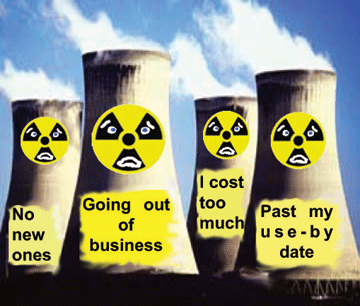 Illinois Power Plant Closings Reveal Worldwide Nuclear Issues, Clean Technica June 9th, 2016 by Sandy Dechert The many-sided battle over nuclear power continues with a clear break over politics in Illinois. The company and the government are dancing around the issues currently, with the industry essentially taking the position that government (read: the people) should subsidize the waning years of nuclear installations, or else. That state’s legislature adjourned its spring session last week without extending subsidies for nuclear power (the Next Generation Energy Plan advocated by the nuclear industry).
In return, Exelon Corporation—the nation’s largest nuclear power supplier—announced that it would have to close two of the state’s best-performing plants. It has said that the Clinton Power Station will close next June, and the Quad Cities Generating Station will close a year later. Despite their high scores, they have apparently lost $800 million over the past seven years. Exit papers are in preparation.
Joe Dominguez, executive vice president for governmental and regulatory affairs and public policy at Exelon, describes his company’s bottom line:
“We think that the costs of new nuclear right now are not competitive with other zero-carbon technologies, renewables, and storage that we see in the marketplace…. Right now we just don’t have any plans on the board to build any new reactors.”
Renewables broke all world records in 2015, say the United Nations Environment Programme and Bloomberg New Energy Finance. Also, renewables (excluding large hydro) accounted for more than half of new power generation capacity for the first time last year.Including large hydro, renewables’ share of all global electricity generation rose to more than 20%.
The human cost of closing the two Illinois plants includes 4,200 direct and indirect jobs and over $1.2 billion in economic activity annually. An earlier state report that Exelon quotes estimates that wholesale energy costs would rise in the region by $439 million to $645 million annually because of the plant closures. Exelon claims consumers will have to pay about $0.25 monthly to sustain the plants. Critics charge it will hike electric bills by about $3.00. Exelon has its eye on three other American closures, and Entergy is considering two at last report.
Industry-Wide Issues
Although this squabble has plagued Illinois for years, it brings up some nuclear issues that impact on the larger energy scene, both nationally and worldwide. These include not only competition from renewable energy but also unique financial factors, extension of design limits for the plants, decreasing reliability as reactors age, stability of the power grid, inadequate measures for disposal of radioactive waste. For all of these, potential near-term usefulness in slowing climate change—by limiting carbon releases associated with other forms of electric power generation—should be a major consideration……….
No commercial plants have been built in this country during the past 20 years. Eight have remained “under construction” during this time. These are mostly in the South, which still retains a protective regulatory environment. Only two are already scheduled to come online. In 2015, TVA Bellefonte ceased construction.
And decommissioning involves even greater expenses in the short term than keeping unprofitable plants afloat. Some of this huge expense (including the vital component of all project management, which the NRC’s Office of Nuclear Material Safety and Safeguards carries out) involves using more public funds…………..https://cleantechnica.com/2016/06/09/illinois-power-plant-closings-reveal-worldwide-nuclear-issues/
1 Comment »
Leave a comment
1 This Month

of the week – Shut Down Drone Warfare!


Tell the Ukrainian Government to Drop Prosecution of Peace Activist Yurii Sheliazhenko

Petition to revoke the licensing of the Near Surface Nuclear Disposal Facility (NSDF) at Chalk River. https://www.ourcommons.ca/petitions/en/Petition/Details?Petition=e-7247
To see nuclear-related stories in greater depth and intensity – go to https://nuclearinformation.wordpress.com
-
Archives
- April 2026 (68)
- March 2026 (251)
- February 2026 (268)
- January 2026 (308)
- December 2025 (358)
- November 2025 (359)
- October 2025 (376)
- September 2025 (257)
- August 2025 (319)
- July 2025 (230)
- June 2025 (348)
- May 2025 (261)
-
Categories
- 1
- 1 NUCLEAR ISSUES
- business and costs
- climate change
- culture and arts
- ENERGY
- environment
- health
- history
- indigenous issues
- Legal
- marketing of nuclear
- media
- opposition to nuclear
- PERSONAL STORIES
- politics
- politics international
- Religion and ethics
- safety
- secrets,lies and civil liberties
- spinbuster
- technology
- Uranium
- wastes
- weapons and war
- Women
- 2 WORLD
- ACTION
- AFRICA
- Atrocities
- AUSTRALIA
- Christina's notes
- Christina's themes
- culture and arts
- Events
- Fuk 2022
- Fuk 2023
- Fukushima 2017
- Fukushima 2018
- fukushima 2019
- Fukushima 2020
- Fukushima 2021
- general
- global warming
- Humour (God we need it)
- Nuclear
- RARE EARTHS
- Reference
- resources – print
- Resources -audiovicual
- Weekly Newsletter
- World
- World Nuclear
- YouTube
-
RSS
Entries RSS
Comments RSS
 nuclear-news
Union of Concerned Scientists’ analysis shows Illinois will be okay regarding energy supply and enegy costs if Exelon shuts down some of their nuclear power facilities and the state moves forward with renewables.
http://blog.ucsusa.org/steve-clemmer/new-analysis-illinois-clean-energy-policies?utm_source=feedburner&utm_medium=feed&utm_campaign=Feed%3A+TheEquationSteveClemmer+%28The+Equation+