Global danger in transporting nuclear wastes by plane
 Whether it is transported by sea, or even by air, there is real concern over the potential for an accident or a malicious attack that would put the public at risk.
How many nuclear weapons could be made if such material got into the wrong hands? Why risk global nuclear security by transporting this waste across the Atlantic by air?
We call for this deal to be cancelled forthwith. The waste should be stored on-site at Dounreay and not moved over 6,000 miles away.
UK-US air transports of high enriched uranium: global security at risk for commercial gain, Ecologist Ernie Galsworthy / NFLA 3rd May 2016 Planned air transports of high-enriched uranium from Dounreay in Scotland to the US state of Tennessee would risk of accident or a terrorist seizure of weapon-usable nuclear material. The motive for the transport appears to be purely commercial – and would thus put the public at needless risk for the sake of a cut-price nuclear waste / fuel deal between US and UK authorities.
There has been a recent flurry of media reports suggesting that a proposed transport of radioactive materials from the Caithness Dounreay site to the United States could be sent by plane. Continue reading
Continuing nuclear waste leak at Hanford
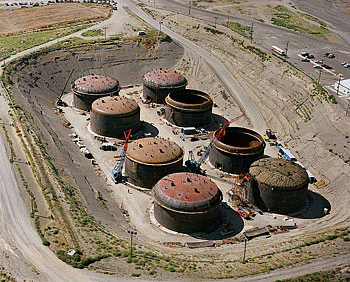 Nuclear Waste Leak Continues at ‘America’s Fukushima“ https://weather.com/news/news/nuclear-waste-leak-continues
The government has requested help from private contractors to construct a new, permanent facility that will have the capacity to hold the waste. However, the project to cover up “America’s Fukushima” will cost an estimated $100 billion and take at least 50 years to complete, according to Newsweek. 33 Left Ill by Radioactive Fumes By Andrew MacFarlane weather.com May 4 2016 A nuclear waste leak at the Hanford Site in Washington state that rapidly intensified last month has left 33 workers ill from possible exposure to chemical vapors, while others scramble to pump the remaining waste out of the storage facility.
Back in 2011, a leak was found on the inner hull of one of the site’s 28 double-wall storage tanks. The previous leak posed an insignificant threat, but workers came across an even larger leak in recent weeks while attempting to clear the inner hull of its remaining waste.
The number of those who have been reported ill as a result of the leak climbed into the 30s after six workers sought medical evaluation Monday, suspecting exposure to radioactive fumes left them unwell, according to the Tri-City Herald. A majority of the affected have been cleared to return to work, but voice a fear of suffering from long-term or neurological sickness.
Crews at the United States Department of Energy’s storage site in Hanford were alerted by leak detection alarms the morning of April 17, and after lowering a camera into the affected area, the staff found 8.4 inches of radioactive and chemically toxic waste had poured between the inner and outer walls of the tank, KING 5 reported.
This is catastrophic,” former site employee Mike Geffre said soon after the leak was found. “This is probably the biggest event to ever happen in tank farm history. The double-shell tanks were supposed to be the saviors of all saviors.”
However, a State Representative in Seattle argued that the of the 56 million gallons of radioactive chemicals stored at the Hanford site, two-thirds of the total substance is radioactive waste being held in unfit tanks made sometime between 1940 and 1970.
The tanks “were not supposed to last more than 10 to 20 years, 20 years was a dream in the first place,” Gerry Pollet told RT.com. “Some of them didn’t last twenty years and we had a small explosion in the 1950s where hot waste boiled, created a steam explosion under the tank, and we were lucky we didn’t have half of Eastern Washington permanently evacuated.”
The large puncture causing the devastating leak is thought to have occurred while the three-week long pumping was taking place. An estimated 20,000 gallons of waste remain in the 800,000-gallon AY-102 tank, Q13 FOX reports.To make matters worse, a second double-shelled tank has been reported with a leak. AY-101, a tank very similar to AY-102, has had “higher-than-expected radioactivity readings” from the tank’s continuous air monitor, according to a recent KING 5 report. The new leak is an unsettling find, considering the 45-year-old AY-101 was built with thicker steel and with advanced construction methods.
“Simply put, Hanford is nearly out of double-shell tank space,” said Hanford Challenge executive director Tom Carpenter. “[There] is no other realistic option but to begin building new tanks immediately.”
Nuclear Regulatory Commission to re-analyse costs of potential impact of severe accident At Indian Point
 NRC reverses decision on Indian Point accident analysis, Westfair By Ryan Deffenbaugh May 5, 2016 Federal regulators used the wrong data to analyze the potential impact of a severe accident at Indian Point Energy Center and will have to redo the study, a panel of commissioners with the Nuclear Regulatory Commission ruled Wednesday.
The commission reversed an earlier administrative ruling and found that the NRC analysis of the costs of a severe accident at the Buchanan nuclear facility relied on incorrect data, in violation of the National Environmental Policy Act. The decision directs NRC staff to redo its analysis using other sources of data.
“While typically we decline to second-guess the [Atomic Safety and Licensing Board] on its fact-specific conclusions, here the decision contains obvious material factual errors and could be misleading, warranting clarification,” NRC officials wrote in the decision.
The NRC study was challenged by New York Attorney Eric Schneiderman, who said it systematically undercounted the costs and impacts associated with severe reactor accidents at Indian Point.
His office put out a statement Wednesday applauding the ruling.
“The commissioners’ decision requires the NRC staff to do what should have been done years ago: provide an accurate account of cost-effective upgrades at this aging nuclear plant that can prevent or minimize severe accidents,” Schneiderman said. “While some might prefer to treat severe accidents as impossibilities, the millions of people who live and work near Indian Point deserve nothing less than a full and fair assessment of the plant upgrades needed to protect them against such accidents.”……..
The federal licenses for both Indian Point’s reactors have expired and Entergy has applied for a 20-year renewal from the NRC. Gov. Andrew Cuomo has fought against the renewal, arguing that Indian Point’s location in a densely populated area makes it unsafe. He reiterated that view in a statement following the NRC’s decision Wednesday.
“Clearly, this facility poses too great a risk to the millions of people who live and work nearby,” Cuomo said. “We will work closely with NRC staff and continue to monitor Indian Point’s daily operations to ensure that a proper analysis is done regarding any unacceptable dangers to ensure that the public is protected at all times.”http://westfaironline.com/79195/nrc-reverses-decision-on-indian-point-accident-analysis/
Former Electricite de France SA Chief Financial Officer says he quit because of financial risks of Hinkley nuclear project


 Ex-EDF CFO Quit Over Financial Risks From U.K. Nuclear Project, Bloomberg, Francois De Beaupuy FrancoisDeBeaup
-
Piquemal says French utility needs to strengthen balance sheet
-
EDF can’t afford significant downgrade in rating: Piquemal
Former Electricite de France SA Chief Financial Officer Thomas Piquemal said he quit two months ago to highlight the risks of proceeding with the 18 billion-pound ($26 billion) Hinkley Point nuclear power project without additional financing.
The timetable pushed by EDF Chairman and Chief Executive Officer Jean-Bernard Levy for an investment decision on the U.K. project meant there wouldn’t have been time to strengthen the utility’s balance sheet, Piquemal told a hearing at the National Assembly in Paris. That would have left the company reliant on its 85 percent shareholder, the French state, providing funding and threatened EDF with the same fate as troubled nuclear-reactor builder Areva SA, he said.
“A new nuclear project is an extra risk for a company,” Piquemal said in his first public statement since quitting. “I didn’t want to approve a decision that could leave EDF in Areva’s situation one day.”……
Financial Strain
Speculation has mounted over the future of Hinkley Point since Piquemal resigned amid concerns the project would put EDF under too much financial strain, while labor unions have called for a three-year delay until similar nuclear plants built by the company start operating in France and China…….
EDF has held off on making a final investment decision even after forming a partnership with China General Nuclear Power Corp. and securing guaranteed power prices from the U.K. government at almost three times the current market rate for 35 years.Rating companies will probably downgrade EDF because large nuclear projects such as Hinkley Point will increase its risk profile, the ex-CFO said. While EDF had no financing problems at the end of 2015, it can’t afford a “significant” downgrade that would push its hybrid debt into the “junk” category because it would complicate a potential refinancing from 2020, Piquemal said. http://www.bloomberg.com/news/articles/2016-05-04/ex-edf-cfo-quit-over-financial-risks-from-u-k-nuclear-project
Sanders and Clinton split on future of Indian Point nuclear station
 New York nuclear plant’s future further divides Sanders and Clinton Sanders says Indian Point facility is ‘a catastrophe waiting to happen’, but former New York senator says he’s late to the issue and site simply needs more oversight, Guardian, Alan Yuhas 8 Apr 16, The Indian Point Energy Center, a controversial and ageing nuclear plant near New York City, has split the Democratic presidential candidates .
As campaigning continued before the New York primary on 19 April, Bernie Sanders called the facility “a catastrophe waiting to happen”. Hillary Clinton said only that it needed more oversight.
A senior member of the Union of Concerned Scientists told the Guardian “the whole New York metropolitan area is potentially imperiled by an accident at Indian Point”.
Last week, the company that runs Indian Point revealed that 227 bolts holding the interior of a nuclear reactor at the site have “degraded” or gone missing. In February, the plant reported that a radioactive material, tritium, had leaked into groundwater.
The plant, about 40 miles north of midtown Manhattan on the eastern bank of the Hudson river, has a 40-year history of accidents, fires and complaints. Governor Andrew Cuomo ordered an investigation into February’s “unacceptable” leak. He has called for the plant to close.
“In my view, we cannot sit idly by and hope that the unthinkable will never happen,” Sanders said in a statement. “It makes no sense to me to continue to operate a decaying nuclear reactor within 25 miles of New York City where nearly 10 million people live.”
The Vermont senator elaborated on his stance, calling for the US to phase out nuclear plants along with more polluting resources such as fossil fuels.
“Nuclear power is and always has been a dangerous idea because there is no good way to store nuclear waste,” he said…….
The disagreement between Sanders and Clinton mirrors their stances on fracking for natural gas. The senator has called for a ban, citinggrowing evidence that drilling causes earthquakes. The former secretary of state has called for intense regulation of the industry.
“I want the federal government to regulate much more toughly than we have in the past,” she said on Monday.
In 2014 Cuomo signed a law that banned fracking in New York. http://www.theguardian.com/environment/2016/apr/07/bernie-sanders-hillary-clinton-indian-point-nuclear-plant
UK nuclear parts made at French plant in fakery probe
Telegraph Emily Gosden, energy editor 4 MAY 2016 Parts of the Sizewell B nuclear power station in Suffolk were made at a French plant being investigated over possible fake manufacturing records, EDF Energy has confirmed.
Mr Piquemal said he had sought a three-year delay to Hinkley as he was not prepared to “bet 60 to 70pc of [EDF’S] equity on a technology that has not yet proven that it can work and which takes 10 years to build”.
He said the proposed reactor technology involved “major construction risk”.
EDF has already postponed a decision on the £18bn Hinkley project until September as it consults with unions on a plan to shore up its balance sheet, but the problems at the Le Creusot plant have raised further doubts about the project and as well as nuclear safety at existing plants………http://www.telegraph.co.uk/business/2016/05/04/uk-nuclear-parts-made-at-french-plant-in-fakery-probe/
Climate change is taking its toll on water supplies, and especially – on children
As Global Temperatures Rise, Children Must Be Central Climate Change Debates
Rising temperatures, rising sea levels and the increasing likelihood of extreme weather will all alter children’s lives and the lives of their own children. And yet, children are largely left out of discussions about appropriate responses to climate change, according to a journal released by Princeton University and the Brookings Institution.
Forecasts suggest that by 2050, the world could see 200 million environmental migrants, many of whom would be children. For this reason and others, children should be central to such climate change debates. They–as well as future generations–have a much larger stake in the outcome than current generations, authors argue in the latest volume of Future of Children.
https://www.sciencedaily.com/releases/2016/05/160504121330.htm
The biggest threat of climate change is in the water, or lack of it: World Bank
A lack of water will knock down food production and economic growth in China, India, the Middle East, Africa and large population areas, a new report says.
http://www.smh.com.au/world/the-biggest-threat-of-climate-change-is-in-the-water-or-lack-of-it-world-bank-20160504-golptd.html
Month after month, global average temperatures reach record heights
 April joins parade of record global temperatures, making it 12 months in a row,SMH, May 3, 2016 Peter Hannam Environment Editor, The Sydney Morning Herald
It’s the sort of anniversary you don’t want to celebrate.
Early reports indicate that April was another record hot month – by some margin – making it 12 months in a row that have set new high marks for heat.
Eric Holthaus, a US-based meteorologist took to Twitter with an estimate that sea and land-surface temperatures would again top 1 degree compared with the average for 1951-80 period used by NASA.
The previous biggest anomaly for April was recorded in 2010 at 0.83 degrees, implying that last month was easily the warmest ever registered for the month.
If confirmed by major meteorological agencies within coming weeks, the April figures would continue the remarkably warm start to 2016, with each month among a handful over the most abnormally hot months in more than 130 years of global figures.
Australia is also exceptionally warm. During the first four months of 2016, average mean temperatures were 1.28 degrees above the 1961-90 period used by the Bureau of Meteorology for its benchmark.
The previous record to this point of the year was 1.16 degrees in 2005, Blair Trewin, senior bureau climatologist, told Fairfax Media……….http://www.smh.com.au/environment/climate-change/april-joins-parade-of-record-global-temperatures-making-it-12-months-in-a-row-20160502-gokkg2.html
What do we know about North Korea’s nuclear program?
 North Korea’s nuclear program: What do we know? Euan McKirdy, CNN 5 May 16 Despite international condemnation, North Korea has ramped up its quest to become a nuclear power, with weapons tests a very visible sign of leader Kim Jong Un’s ambitions. This year alone has seen at least eight signs of either nuclear tests or delivery methods. Some analysts believe the regime may be gearing up for another nuclear test — its fifth.
Cameco cuts back on mining uranium, as market stays slumped
 Cameco scales back uranium production, WNN, 22 Apr 16, Cameco is suspending production at the Rabbit Lake uranium mine in northern Saskatchewan, curtailing production at its US uranium operations, and reducing production at McArthur River/Key Lake in response to market conditions, the company announced yesterday.
Work to transition the underground Rabbit Lake mine to care and maintenance will begin immediately and is expected to be completed by the end of August. Production at the US in situ leach operations cannot cease immediately because of the nature of the technology, and will instead decrease over time as head grades decline. The development of new wellfields will be deferred.
“Unfortunately, continued depressed market conditions do not support the operating and capital costs needed to sustain production at Rabbit Lake and the US operations,” CEO Tim Gitzel said. “These measures will allow us to continue delivering value to Cameco’s many stakeholders and support the long-term health of our company. We will provide assistance to those affected by these decisions,” he said……
The company will also reduce 2016 production at the McArthur River/Key Lake operation in Saskatchewan to 19 million pounds U3O8 (7308 tU), down from 20 million pounds (7693 tU), in response to a currently oversupplied uranium market…….http://www.world-nuclear-news.org/UF-Cameco-scales-back-uranium-production-2204167.html
Respiratory diseases, radioactive fumes – concerns in St Louis County, USA
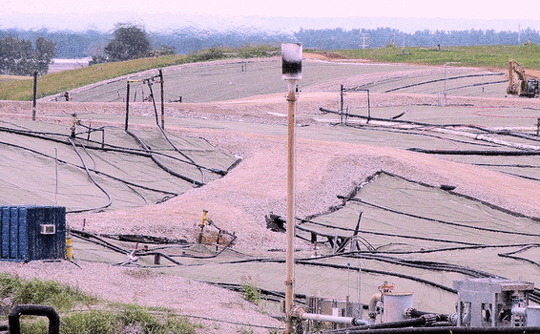 AIR POLLUTION, ATOMIC RISKS GROW AS TOXIC DUMP SMOLDER , URBAN NEWS SERVICE, Part 2 of a 2 part series. For part 1 visit “Near Ferguson, Ghosts of Hiroshima Haunt Fuming Landfill“.
BRIDGETON, Missouri – They can’t breathe.
Residents of this community near Ferguson — site of 2014’s police-involved shooting death of teenager Michael Brown — have complained for years about lung troubles caused by toxic fumes tied to radioactive waste linked to the atomic bombs that flattened Hiroshima and Nagasaki.
Missouri’s Department of Health and Senior Services will release a study in June to gauge these concerns. Many here call this step positive, small and too late; a slow-moving, subterranean landfill fire that began in 2010, could boost the site’s toxic-gas emissions.
Some locals have been diagnosed with cancer, which they connect to nuclear waste illegally dumped at the West Lake Landfill by the Cotter Corporation in 1973. This radioactive refuse is from World War II’s top-secret Manhattan Project.
Thanks to these conditions, residents who seek government-assisted relocation feel abandoned. Lengthy fights over who ultimately should control the site have slowed cleanup efforts……..
The Centers for Disease Control and Prevention is reportedly investigating the issue following a September 2014 study by Missouri’s health department. It found that, between 1996 and 2011, the ZIP codes around the landfill included statistically significant, higher incidences of leukemia plus cancers of the colon, prostate, kidney, bladder and brain.
“[The] recent study by St. Louis County is actually the first time that a government entity has asked people if they feel ill,” said Laura Barrett, executive director for the Center for Health, Environment and Justice…….
A 1988 Nuclear Regulatory Commission study revealed that its inspectors discovered in 1974 that the Cotter Corporation — which agreed to buy the atomic refuse from the federal government and dispose of it — mixed this waste with 39,000 tons of topsoil. Cotter illegally covered the West Lake Landfill with this irradiated earth in 1973, according to the nuclear agency’s report.
“It’s not in barrels. Some of it’s mixed in the soil and the garbage,” said Chapman. “Some of it’s just lying on the surface for over 40 years, and none of us knew about this.”……https://urbannewsservice.com/investigations/air-pollution-atomic-risks-grow-toxic-dump-smolder/
Leaked TTIP documents cast doubt on EU-US trade deal
Greenpeace says internal documents show US attempts to lower or circumvent EU protection for environment and public health, Guardian, Arthur Neslen , 2 May 16, Talks for a free trade deal between Europe and the US face a serious impasse with “irreconcilable” differences in some areas, according to leaked negotiating texts.
The two sides are also at odds over US demands that would require the EU to break promises it has made on environmental protection.
President Obama said last week he was confident a deal could be reached. But the leaked negotiating drafts and internal positions, which were obtained byGreenpeace and seen by the Guardian, paint a very different picture………
Jorgo Riss, the director of Greenpeace EU, said: “These leaked documents give us an unparalleled look at the scope of US demands to lower or circumvent EU protections for environment and public health as part of TTIP. The EU position is very bad, and the US position is terrible. The prospect of a TTIP compromising within that range is an awful one. The way is being cleared for a race to the bottom in environmental, consumer protection and public health standards.”
US proposals include an obligation on the EU to inform its industries of any planned regulations in advance, and to allow them the same input into EU regulatory processes as European firms.
American firms could influence the content of EU laws at several points along the regulatory line, including through a plethora of proposed technical working groups and committees.
“Before the EU could even pass a regulation, it would have to go through a gruelling impact assessment process in which the bloc would have to show interested US parties that no voluntary measures, or less exacting regulatory ones, were possible,” Riss said……. https://www.theguardian.com/business/2016/may/01/leaked-ttip-documents-cast-doubt-on-eu-us-trade-deal
USA’s Energy Det program ‘Orange Button’ will bring down costs of solar power
Department of Energy Program Aims to Bump Solar Costs Even Lower A clean energy initiative goes beyond declining hardware costs to address the remaining barriers to embracing solar over fossil fuels. Inside Climate News BY DAVID J. UNGER MAY 2, 2016 While the solar industry trumpets the rapidly declining costs of solar panels—which have paved the way for solar energy capacity in the U.S. to GROW NEARLY TWENTY-FOLD SINCE 2008—those numbers don’t account for all the costs involved in the transition to clean energy. That is why a new government initiative aims to slash the overall price tag by better managing the reams of data associated with financing, building and operating solar installations.
The U.S. Department of Energy’s (DOE) Orange Button, a $4 million program launched earlier this month, seeks to streamline what experts say can be a costly, complicated and time-consuming path to bringing more solar panels online. By developing an easily downloadable, standardized set of data about individual solar installations, the DOE hopes to lower the bureaucratic barriers—as well as the excessive costs—that discourage investors, utilities and consumers from embracing solar.
Orange Button is part of the DOE’s SunShot Initiative, which launched in 2011 with the goal of making solar energy cost competitive with coal, natural gas and other traditional sources of electricity such as nuclear and hydroelectric power. If SunShot reaches its goal of reducing utility solar costs to $1 per watt by 2020, it will enable solar-generated power to expand from less than 2 percent of the nation’s electricity generation portfolio to roughly 14 percent by 2030 and 27 percent by 2050, according to the program’s vision study.
Similar programs have already been launched in other industries. The DOE’sGreen Button was launched in 2012, allowing utility customers to download standardized, consumer-friendly data about their energy usage. The Department of Health and Human Services’ Blue Button program offers people help accessing and transferring their health records.
Part of the challenge for solar is a lack of information. Compared to housing and other well-established markets, solar is relatively new, so banks, utilities, solar companies and other constituencies do not have a standardized set of metrics to share. The U.S. energy market has 18,000 jurisdictions and 3,000 utilities in regulated and unregulated markets, so navigating its idiosyncrasies costs time and money, said Elaine Ulrich, program manager at the DOE.
“When you look at the cost of financing for these solar projects, it’s artificially high,” Ulrich told InsideClimate News. “Solar is a long-term asset that has pretty well-known characteristics, but it’s treated as a higher-risk asset because there isn’t sufficient data available to help folks in the financial industry to know how to assess the risk of [a] portfolio of assets.”…….http://insideclimatenews.org/news/02052016/department-energy-program-aims-bump-solar-costs-even-lower
Parents near nuclear plant concerned about evacuation plans
I-TEAM: WAKE COUNTY PARENTS QUESTION SECRETIVE NUCLEAR EVACUATION PLAN abc Eyewitness News, By Jon Camp, 5 May 16, NEW HILL, N.C. (WTVD) —
That’s what parents living near the Harris Nuclear Plant want to know about their children’s schools. 23 schools are less than 10 miles from the Shearon Harris nuclear powerplant. If those schools had to evacuate, where would the kids go? The school system knows, but the parents don’t, and they asked the I-Team to get answers, tonight at 5:30
Robke lives in one of the many neighborhoods within the 10-mile Emergency Planning Zone around the Harris plant. It’s located in New Hill, N.C. about 20 miles south of Raleigh. Like her neighbors, Robke has never been told by the school system what the plan would be if anything were to go wrong at the nuclear facility.
That’s because in Wake County the plans are secret. A spokesperson for the school system emailed the reasoning:
“Apex Friendship High School does have an evacuation plan in place to respond to an emergency situation at Shearon Harris Power Plant. Wake County government oversees the emergency planning and response for those situations. Our part of the emergency response plan is outlined in the Wake County Public School System- Emergency Operations Plan. Since it contains sensitive safety information, it is not a public record. FEMA has reviewed and approved our emergency response plans.”
State law expressly prohibits schools from making emergency plans public. It’s spelled out in North Carolina’s educational statutes. Still, some parents say that’s little comfort.
Robke’s neighbor, Chris Young remembers getting potassium iodide pills from the school system and county about 15 years ago and says she can’t remember hearing from the schools since.
“What’s going to happen if something happens during a school day?” Young wanted to know. “What are the parents supposed to do? What are their kids supposed to do? The school system should be providing the parents with some kind of information.”
There are 23 schools from four districts in the 10-mile Emergency Planning Zone around the nuclear plant. The EPZ represents the area folks are most at risk of plume exposure in a disaster. The risk zone for ingestion exposure goes out to 50 miles.
Claim that dragonfly wings can track radiation
Dragonfly wings can track radiation doses after a nuclear mishap, New Scientist, By Bas den Hond, 5 May 16, Humble insects may be called as witnesses to the next nuclear accident. Shining UV light on their wings reveals how much radiation they have absorbed.
Staff at nuclear plants carry dosimeters, instruments that take real-time measurements of radioactive exposure, usually expressed in grays (Gy). Civilians in the surrounding areas probably won’t have these devices. In the event of an accidental release of radioactive material, this leaves a gap in the data on its dispersal and resulting radioactivity doses, making it hard to estimate health effects by location.
Part of the solution is to investigate how radiation alters materials in the body or in personal property – for example, nails or the glass of a mobile phone. And if no one is present close to a radiation leak, insects may do the job, says Nikolaos Kazakis of the Athena Research Centre in Xanthi, Greece.
“Insects are everywhere,” he says. Their short lives give them an advantage over phones: “They live only a few weeks, so you don’t have to make corrections for natural radiation when you want to measure the accidental dose.”
1 This Month
Chernobyl: The Lost Tapes – A good documentary on Chernobyl on SBS available On Demand for the next 3 weeks– https://www.sbs.com.au/ondemand/tv-program/chernobyl-the-lost-tapes/2352741955560

of the week–London Campaign for Nuclear Disarmament

Tell the Ukrainian Government to Drop Prosecution of Peace Activist Yurii Sheliazhenko
To see nuclear-related stories in greater depth and intensity – go to https://nuclearinformation.wordpress.com
-
Archives
- April 2026 (152)
- March 2026 (251)
- February 2026 (268)
- January 2026 (308)
- December 2025 (358)
- November 2025 (359)
- October 2025 (376)
- September 2025 (257)
- August 2025 (319)
- July 2025 (230)
- June 2025 (348)
- May 2025 (261)
-
Categories
- 1
- 1 NUCLEAR ISSUES
- business and costs
- climate change
- culture and arts
- ENERGY
- environment
- health
- history
- indigenous issues
- Legal
- marketing of nuclear
- media
- opposition to nuclear
- PERSONAL STORIES
- politics
- politics international
- Religion and ethics
- safety
- secrets,lies and civil liberties
- spinbuster
- technology
- Uranium
- wastes
- weapons and war
- Women
- 2 WORLD
- ACTION
- AFRICA
- Atrocities
- AUSTRALIA
- Christina's notes
- Christina's themes
- culture and arts
- Events
- Fuk 2022
- Fuk 2023
- Fukushima 2017
- Fukushima 2018
- fukushima 2019
- Fukushima 2020
- Fukushima 2021
- general
- global warming
- Humour (God we need it)
- Nuclear
- RARE EARTHS
- Reference
- resources – print
- Resources -audiovicual
- Weekly Newsletter
- World
- World Nuclear
- YouTube
-
RSS
Entries RSS
Comments RSS
 nuclear-news