Research suggests link between cellphones and brain cancer
“Game-Changing” Study Links Cellphone Radiation to Cancer An increased incidence of brain and heart tumors was seen in rats. Mother Jones, MAY 27, 2016 It’s the moment we’ve all been dreading. Initial findings from a massive federal study, released on Thursday, suggest that radio-frequency (RF) radiation, the type emitted by cellphones, can cause cancer.
The findings from a $25 million study, conducted over two and a half years by the National Toxicology Program (NTP), showed that male rats exposed to two types of RF radiation were significantly more likely than unexposed rats to develop a type of brain cancer called a glioma, and also had a higher chance of developing the rare, malignant form of tumor known as a schwannoma of the heart. The effect was not seen in females.
he radiation level the rats received was “not very different” from what humans are exposed to when they use cellphones, said Chris Portier, a former associate director of the NTP who commissioned the study.
As the intensity of the radiation increased, so did the incidence of cancer in the rats. (The highest radiation level was five to seven times as strong as what humans typically receive while using a phone.) Although ionizing radiation, which includes gamma rays and X-rays, is widely accepted as a carcinogen, the wireless industry has long noted that there is no known mechanism by which RF radiation causes cancer. The researchers wrote that the results “appear to support” the conclusion that RF radiation may indeed be carcinogenic.
The findings should be a wake-up call for the scientific establishment, according to Portier, who is now a contributing scientist at the Environmental Defense Fund. “I think this is a game changer,” he said. “We seriously have to look at this issue again in considerable detail.”
“The NTP does the best animal bioassays in the word,” Portier added. “Their reputation is stellar. So if they are telling us this was positive in this study, that’s a concern.”…….
The NTP first decided to investigate the carcinogenicity of cellphone radiation in 2001, partly in response to epidemiological studies showing a correlation between gliomas and cellphone use. Some of the studies even showed that the cancers were ipsilateral—meaning they tended to appear on the same side of the head where users held their phones. But other epidemiological studies haven’t found links between cancer and cellphones…….
Only the test results for rats have been released so far. Female rats didn’t experience significantly higher than normal cancer rates. However, among male rats that received the highest radiation exposures, 2 percent to 3 percent contracted gliomas and 6 percent to 7 percent percent developed schwannoma tumors in their hearts, depending on the type of radiation used. None of the male rats in the control groups developed those cancers……..
The authors of the NTP study did not say how their results might translate into cancer risk for humans. But “given the extremely large number of people who use wireless communication devices,” they wrote, “even a very small increase in the incidence of disease resulting from exposure to RFR resulting from those devices could have broad implications for public health.”……http://www.motherjones.com/environment/2016/05/federal-study-links-cell-phone-radiation-cancer
Sad loss of a man of integrity, Michael Mariotte
Michael Mariotte, a Leading Antinuclear Activist, Dies at 63, NYT, By SAM ROBERTS MAY 23, 2016 Michael Mariotte, a leading national opponent of nuclear power and an advocate for alternative, sustainable sources of energy, died on May 16 at his home in Kensington, Md. He was 63.
The cause was pancreatic cancer, his wife, Tetyana Murza, said.
As executive director and president of the Nuclear Information and Resource Service in Takoma Park, Md., for three decades, Mr. Mariotte was at the forefront of two successful landmark efforts: to prevent the repeal of a federal ban on interstate shipment of radioactive waste, and to bar the construction of new nuclear plants in Maryland and Louisiana.
He also organized antinuclear campaigns in Eastern Europe after the fatal power plant catastrophe in 1986 at Chernobyl, in what was then the Ukrainian Soviet Socialist Republic. And his information service acted as a clearinghouse for groups that opposed nuclear power, both in the United States and overseas.
In 2014, Mr. Mariotte (pronounced like the hotel chain) received a lifetime achievement award from Ralph Nader, the consumer advocate, on behalf of a dozen environmental groups, including Friends of the Earth, Greenpeace, Public Citizen and the Sierra Club.
He had earlier been a co-founder of an alternative weekly newspaper in the nation’s capital, which became Washington City Paper, as well as a drummer in a punk-rock band……
He joined the Nuclear Information and Resource Service in 1985, became executive director the next year and began publishing a newsletter called Groundswell, now known as Nuclear Monitor. The organization mobilized antinuclear groups, testified before Congress and enlisted celebrity endorsements.
Notably, it helped defeat a proposed reactor in Calvert Cliffs, Md.; a uranium processing plant in Louisiana; and legislation that would have lifted curbs on the transportation of radioactive waste. Mr. Mariotte said the measure had posed the threat of a “mobile Chernobyl.”
He resigned as executive director at the end of 2013 because of his illness. He was subsequently named president and ran the organization’s website, its GreenWorld blog and other programs.
Mr. Mariotte remained convinced that nuclear power would become obsolete and be replaced by clean, renewable energy sources and greater energy efficiency.
“It is no longer a question of whether these 21st-century technologies can replace nuclear power and fossil fuels,” he said when he stepped down as executive director of the information service. “The question is when. http://www.nytimes.com/2016/05/24/us/michael-mariotte-a-leading-antinuclear-activist-dies-at-63.html?_r=0
Climate change: Australia covered up the truth on its damaged World Heritage sites

 Australia covered up UN climate change fears for Tasmania forests and Kakadu
Fears about damage to the Great Barrier Reef were removed from UN report along with concern about a threat to the environment in two other heritage sites, Guardian, Michael Slezak, 29 May 16, A draft UN report on climate change, which was scrubbed of all reference to Australia over fears it could deter visitors to the Great Barrier Reef, also outlined possible threats to the Tasmania wilderness and Kakadu.
 The draft report contained a chapter on the Great Barrier Reef, which described climate change as “the biggest long-term threat to the [reef] today, and to its ecosystems services, biodiversity, heritage values and tourism economy”.
It concluded that “without a comprehensive response more in keeping with the scale of the threat, the [reef]’s extraordinary biodiversity and natural beauty may lose its world heritage values”.
But before it was scrubbed, the report had two other key sections on Australian world heritage sites, and the threats they face from climate change.
One of those sections was on the Tasmanian wilderness…….the censored section of the Unesco report on Tasmania is clear about the “dire” nature of the threat.
It said: “A 2013 assessment of climate threats identified the same habitats as at high risk from greater fire frequency and drier conditions, with likely catastrophic implications for fauna. These dire predictions appeared to be playing out in January 2016, when tens of thousands of hectares of forest burned, sparked by lightning strikes that came in a month when temperatures were 2C above average and in the wake of the driest two-year period ever recorded for the region.”
 The deleted section on Kakadu national park contained similarly dire warnings.
It described the important natural and cultural values of Kakadu, which has been inhabited by Aboriginal people for 50,000 years.
“The thousands of rock art sites in the park are at risk from damage by more extreme rainfall events, while sea level rise is happening at twice the global average along the northern Australian coast,” the draft report said.
It warned that fresh-water wetlands were at risk from sea level rise, as they are likely to be inundated with salt water. “Climate change threatens Aboriginal traditional use by altering the ecosystems of the vast wetlands of Kakadu and raising temperatures to a level likely to lead to more intense fire regimes,” the report said.
The final version of the report entitled “World heritage and tourism in a changing climate” was published last week by Unesco, United Nationsenvironment programme and the Union of Concerned Scientists, with all references to Australia removed.
The lead author of the report, Adam Markham, told Guardian Australia: “I was shocked when I read in the Guardian the reasons the Australian government gave for why they had pressured Unesco to drop the Australian sites.” http://www.theguardian.com/environment/2016/may/29/australia-covered-up-un-climate-change-fears-for-tasmania-forests-and-kakadu
The world’s dire situation due to the nuclear disasters and nuclear pollution
 Extremely Cautionary Catastrophes: Fukushima And Chernobyl, By Robert Snefjella, 28 May, 2016, Countercurrents.org With phenomenal ingenuity and extreme folly, technically-advanced humanity has managed to conceive and implement a technology that has done much harm to life, and will do much greater harm to life, and that even threatens our extinction. Whether suddenly through nuclear war, or through a pernicious slow motion assault on life’s wondrous, intricate, amazing inner workings and accurate reproductive capabilities, nuclear technology is inherently, inescapably, anti-life. Given that the rest of the marvels of creation – that which has so far survived us – is also along for the ride, it’s not just about us. One might wonder, if the rest of creation were capable of hope, if it would be clinging to the fading hope that humanity at this late hour would transform itself into a species characterized by a decisively dominant strain of sane, careful, sensible behavior, or, if it would be hoping for our demise, the sooner the better, come what may. If we are to extricate ourselves from the trap into which we have placed ourselves, it will take much more ingenuity, and much reduced folly.
This piece is an incomplete overview of our situation, intended to boost general understanding of these subjects. Some reflections on essential reforms close out the piece.
“[In 1936] … [Fatu Hiva’s ocean pools and shorelines] literally teemed with life.”
From the book Fatu-Hiva, By Thor Heyerdahl. (He lived on the Polynesian Island of Fatu-Hiva in 1936)
“[In 2015] … everything [flora and fauna] is missing!” [along the shorelines and in the tidal pools of British Columbia]
Dana Durnford’s words, after his 15000 mile odyssey along the west coast of Canada in 2014 and 2015
The unprecedented mass mortality of much life in the North Pacific Ocean in recent years has been given inadequate coverage by corporate mass media, and has not gained widespread public awareness.
In local media close to the ‘situation’, there have been many reports of unusual numbers of deaths, of strange diseases, of mass disappearances of life forms. And sometimes these reports appear in national and international media. But such reports are typically brief, sporadic, disconnected from each other, and often narrowly focused.
Poorly represented has been the scale and breadth of the devastation: But then, no one knows just how many whales and sea lions and walrus and sardines and sea stars and mussels and sea urchins and sea birds, and countless other creatures large and small, have in recent years died, starved, disappeared, ‘melted away’ in the water, rotted on the shores. And we mustn’t forget humans’ industrial scale ocean ‘harvest’.
But when one puts together the many reports, the scale of the disaster over recent years is pretty mind-boggling. Kelly Ann Thomas has compiled one such list. [1]
A few examples from my own notes:……..http://www.countercurrents.org/snefjella280516.htm
Up to 20 USA uneconomic nuclear stations soon to close
 Economics Point Toward Closure for Up To 20 U.S. Nukes, The Energy Mix, May 24, 2016 A leading nuclear industry lobby group in the United States says its members aren’t being paid enough for their power, threatening the shutdown of 15 to 20 generating stations in the country………
Speaking at a U.S. Department of Energy summit last week, Marvin Fertel, president and CEO of the Nuclear Energy Institute, said more than a dozen plants face possible early closure because they are uneconomic at today’s market wholesale power rates……..
Earlier this month, the Omaha Public Power District proposed closing its 478-MW Fort Calhoun nuclear plant, the smallest in the U.S., and the Tennessee Valley Authority gave up on its unfinished Bellefonte nuclear station in Alabama and put it up for sale. Last month, Moody’s Investor Services reported that low natural gas prices threatened widespread nuclear and coal plant closures.
Those closures may bring owners less financial relief than they anticipate. As expensive as nuclear power plants are to build, safely shutting them down will also cost hundreds of billions, potentially trillions of dollars, Climate News Network reported last month. http://smartershift.com/energymix/2016/05/24/economics-point-toward-closure-for-up-to-20-u-s-nukes/
Fossil fuel subsidies to end by 2025- G7 nations pledge
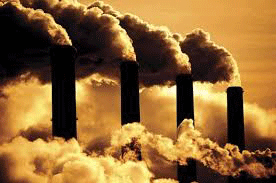 G7 nations pledge to end fossil fuel subsidies by 2025 http://www.theguardian.com/environment/2016/may/27/g7-nations-pledge-to-end-fossil-fuel-subsidies-by-2025
Leaders of the UK, US, Canada, France, Germany, Italy, Japan and the EU urge all countries to join them in eliminating support for coal, oil and gas in a decade, Guardian, Karl Mathiesen 29 May 16, The G7 nations have for the first time set a deadline for the ending most fossil fuel subsidies, saying government support for coal, oil and gas should end by 2025.
The leaders of the UK, US, Canada, France, Germany, Italy, Japan and the European Union encouraged all countries to join them in eliminating “inefficient fossil fuel subsidies” within a decade.
“Given the fact that energy production and use account for around two-thirds of global greenhouse gas emissions, we recognise the crucial role that the energy sector has to play in combatting climate change,” said the leaders’ declaration,issued at the end their summit in Japan. The pledge first entered into G7 (then known as G8) declarations in 2009 but has until now lacked a firm timeline.
Shelagh Whitley, a research fellow at the Overseas Development Institute, called it an “historic day” but said 2020 was a more appropriate date if governments were serious about their commitments to the global climate deal agreed in Paris in December.
Across the G7, subsidies are already falling, assisted by falling commodity prices. A notableexception is the UK, which increased subsidies by opening up new tax breaks for North Sea oil producers. Japan has been criticised for funding new coal projects, both at home and abroad.
“We already see [some in] the G7 going in the wrong direction since Paris. Just because they are saying this [about fossil fuel subsidies], it’s not afait accompli,” said Whitley. Canada also recently extended some subsidies for natural gas.
The G7 joins the leaders of the Organisation for Economic Co-operation and Development (OECD)and the World Bank, who have previously called for an end to assistance for fossil fuel projects.
The statement did not define precisely what the G7 consider to be a subsidy. The word “inefficient” in the G7 text indicates subsidies that distort energy markets. The OECD estimates that this type of support for fossil fuels within its member states is $160-200bn (£109-136bn) each year.
But when the cost of damage from pollution and climate change is factored in, the International Monetary Fund has estimated that support increases to a staggering $5.3tn a year, or $10m per minute. This is more than the total global spend on human health.
The OECD approach to measuring subsidies is likely to be the yardstick applied by the G7. The US and China recently asked the OECD to oversee a peer review of each other’s subsidy programme.
Whitley said another significant change from the G7 was the excision of a past phrase that focused on subsidies for the “consumption” of fuels. She said this meant the G7 could target subsidies for exploration as well, not just the end use.
Role of Antarctic melt in world’s weather
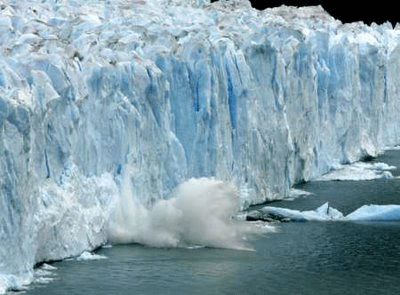 ICE MELT CONTROLS WORLD WEATHER Radio Ecoshock 29 May 16 More on super storms, ice melt & James Hansen, from climate expert Dr. David Archer & the late anti-nuclear activist Michael Mariotte. New Antarctic melt science w. Dr. Tony Worby & Dr. David Etheridge – some surprises in role of Antarctic ice in world weather.
Download or listen to this Radio Ecoshock show in Ecoshock 160525 Lo-Fi (14 MB) or Ecoshock 160525 CD Quality (56 MB)
Welcome to a third program where we look into claims Earth will experience rapidly rising seas and super storms in the coming decades…….
I have trouble with James Hansen’s promotion of nuclear power as a solution for climate change. In Hansen’s book “Storms of My Grandchildren” he advocates for Generation Four nuclear reactors, new designs that are allegedly safer. But now he’s gone a step further, teaming up in an unlikely alliance with Michael Schellenberger of the Breaththrough Institute, to push for Illinois to keep old and dangerous reactors running – and get a public subsidy for them.
Two of these are the GE Mark I reactors that blew up in Fukushima, due to bad design (the fuel rods come up from the bottom, through seals that let reactor fuel leak out of containment). Hansen is on the board of an industry-friendly group in Illinois, all funded by the Chicago billonaire family, the Pritzkers. Strange company.
I talk with the long-time head of the Nuclear Information and Resource Service (NIRS) Michael Mariotte about “how low will they go”. In the few days since I recorded that interview, I am sad to report that Michael passed away May 23rd from pancreatic cancer. This was his last interview. Michael was true to his cause literally to the end.
Then we get some surprises in new science on Antarctica, from two Australian experts, Tony Worby and David Etheridge. We’ve all be focused on major changes in the Arctic, which is conveniently closer to most of us – but it’s the South Pole which may determine the future of the world – through sea levels, and sea ice several times greater than Australia. That ice melt may determine the coming weather, even in the next decades.
 You can listen to this show on Soundcloud right now!…….http://www.ecoshock.org/2016/05/ice-melt-controls-world-weather.html
USA Department of Energy wants to delay Southy Carolina MOX hearings

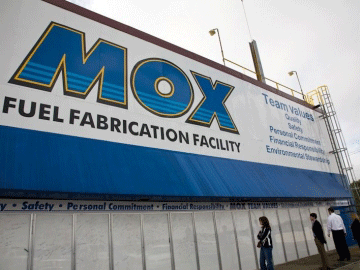
Judge J. Michelle Childs scheduled a hearing for June 30 in Columbia, but the Energy Department’s lawyers say there’s too much to do before then. Besides, they want her to rule first on their motion to dismiss the case altogether.
South Carolina filed suit in February asking for the $100 million in penalties that a federal law assesses the agency for not removing 2 metric tons of plutonium from Savannah River Site. The law was to ensure construction remained on schedule for the mixed-oxide fuel plant on the site, but the builders are still late……..
Construction on the MOX facility is behind schedule and about $8 billion over budget, by some critics’ estimates. The Obama administration says that’s why it wants to shut the program down and use a different method of disposing of 34 metric tons of plutonium…….http://chronicle.augusta.com/news/metro/2016-05-26/federal-government-wants-delay-mox-court-hearing?v=1464299788
Let’s not forget the nuclear corruption in South Africa

 Zuma, the Guptas and South Africa’s R1 trillion nuclear plans, Business Tech By The Conversation May 29, 2016 South Africa is facing a critical decision that could see it investing about R1 trillion – or US$60 billion to $70 billion – in a fleet of new nuclear power stations……
What should be an economic decision has now been clouded by controversy, with political pressure to push through the nuclear build and the increasingly apparent rewards it would bring to politically linked individuals.
The nuclear expansion programme needs to be considered exceptionally carefully given that the required financial commitment is roughly equal to the total South African annual tax revenue. Loan repayments could place a devastating long-term burden on the public and on the economy as a whole….
The government-driven Integrated Resource Plan aims to increase total capacity from 42,000MW (peak demand of 39,000MW) to 85,000MW (peak demand of 68,000MW) in 2030. A key component of this plan is the construction of facilities to produce 9,600MW of nuclear power. However, this aspect of the plan has been challenged.
The biggest concern is that nuclear power is too expensive for the country. The debate gained momentum when the 2013 update to the 2010-2030 electricity plan found that electricity demand is growing slower than originally anticipated. Peak demand in 2030 is now expected to range between 52,000 MW and 61,000 MW. There is consequently widespread belief that new nuclear power stations can be delayed considerably.
South Africa’s energy generation options
South Africa has had remarkable success with speedy, cost-effective installation ofrenewable energy power plants. In addition to this, technologies for harvesting South Africa’s plentiful wind and solar energy resources are rapidly becoming cheaper, raising the question of whether the country should not invest more in these options rather than in going nuclear……
Zuma and the Russians
The nuclear debate gained a political dimension when President Jacob Zuma and his Russian counterpart, Vladimir Putin, started to develop an unusually close relationship. It culminated in an announcement that the Russian nuclear developer, Rosatom, had been awarded the potentially highly lucrative contract to build the new reactors. The agreement was laterdenied.
Rosatom was considered the preferred contender, with other bidders only there to lend the process legitimacy, according to some observers. The lack of transparency surrounding the process, coupled with a history of corruption in South African mega-projects like the arms deal, has made the whole scheme seem suspicious to the broader public.
A thickening plot
A crucial thread in this saga involves the Shiva uranium mine, about 30km north-west of Pretoria, the country’s executive capital. It originally belonged to a company called Uranium One, a subsidiary of Russia’s Rosatom. It was sold in 2010 to Oakbay Resources, a company controlled by members of the politically connected Gupta family and the president’s son, in a deal that greatly surprised economists.
The mine was deemed unprofitable and thus unattractive to other mining companies. But it was still considered worth a whole lot more than the R270 million paid by Oakbay.
The mine would, however, become highly profitable if it became the uranium supplier to the new nuclear power stations. Oakbay and its associates therefore have a very strong incentive for this nuclear build to happen.
It is here that the nuclear build drama feeds into the recent major controversy surrounding alleged state capture, meaning a corrupt system where state officials owe their allegiance to politically connected oligarchs rather than the public interest. This was highlighted by the shock dismissal of Finance Minister Nhanhla Nene, a reported nuclear build sceptic, but also by subsequent allegations of ministerial positions being offered to people by members of the Gupta family.
Political, legal and civil opposition
The nuclear build’s association with the Zuma faction in the ruling African National Congress (ANC) will be a political hot potato for decades to come. The whole scandal also offers potential opportunity to opposition parties……..
A negative nuclear outlook
Building these plants is a risky business proposition, especially for Rosatom, which is implicated in the developing scandal. The recent political mood swing against state capture and a likely credit rating downgrade add to the risk.
Rosatom has suggested a nuclear build financing option that effectively amounts to it providing a loan. It is, however, conceivable that a future government may not honour debt repayments if there is a view that the construction deal was secured irregularly……..
By Hartmut Winkler, Professor of Physics, University of Johannesburg
This article was first published by The Conversation – read the original here http://businesstech.co.za/news/government/124993/zuma-the-guptas-and-south-africas-r1-trillion-nuclear-plans/
Florida consumers still being slugged unfairly for Turkey Point delayed nuclear expansion

 Consumers deserve ‘pause’ in FPL’s nuclear plant recovery costs, Miami Herald, 29 May 16
FPL’s plans to expand its nuclear energy plant at Turkey Point are on hold for four years
However, the utility’s plan to still charge customers for “recovery costs” has caused a stir
FPL should also pause charging its Florida customers — it’s only fair
Given a string of setbacks regarding FPL’s plans to expand the nuclear energy plant at Turkey Point, the recent disclosure that it plans to delay construction for up to four years is a victory for common sense and for critics who worry about the project’s impact on safety and the environment.
What doesn’t make sense is the utility’s desire to charge consumers for costs related to the project, particularly when the delay raises the prospect that it may not go forward at all.
FPL says the recovery costs will decrease during the delay, but remain necessary as part of the licensing procedure and the need to learn from other nuclear energy projects around the country that have also experienced unforeseen delays.
The company wants to charge customers $22 million in 2017 — on top of $281 million it has already recovered for planning and licensing costs — even though the utility said in anApril 27 filing with the state’s Public Service Commission that it wants to maintain its “current state” without going forward on the construction phase until 2020.
On top of that, the utility also wants the PSC to waive the requirement that it file a feasibility report that essentially states that the project it applied for nearly a decade ago is still viable.
That drew a volley of challenges from consumers groups, the Office of Public Counsel (which represents the public in rate cases) and others. A brief filed by the city of Miami said feasibility studies are required to assure the public that such projects are prudent. “If a project is no longer feasible or practical, then the costs incurred are not prudent,” wrote city of Miami attorney Victoria Mendez.
FPL’s decision followed several developments that cast doubt on the wisdom of the proposed expansion. Among them:
▪ Reports dating back to 2014 that water in the canals designed to cool reactors were running too high, requiring waivers from nuclear regulators to operate the canals at higher-than-normal temperatures. If the existing nuclear plant is causing problems, wouldn’t an expansion make matters worse?
▪ In February, A Tallahassee judge ordered state environmental regulators and FPL to clean up the utility’s cooling canals at Turkey Point after blaming the system for polluting South Florida’s groundwater.
▪ In March, this newspaper reported that a study released by Miami-Dade County Mayor Carlos Gimenez found that a tracer element of nuclear power plant spillages had been detected in Biscayne Bay at levels up to 215 times higher than normal in ocean water……..http://www.miamiherald.com/opinion/editorials/article80438112.html
‘Nuclear energy has no sustainable, democratic future in Japan’,
‘Nuclear energy has no sustainable, democratic future in Japan’, DW, 29 May 16 Despite the majority of Japanese opposing a restart of the nation’s nuclear reactors, the government continues to press for a full resumption of nuclear power. Energy expert Tetsunari Iida tells DW the reasons behind it. “…….Tokyo plans to increase nuclear power as a share of the country’s energy profile to between 20 and 22 percent by 2030.
However, public opposition to nuclear energy remains steadfast, as the disaster continues to loom in the Japanese psyche and many harbor safety concerns in the earthquake-prone country.
Kansai Electric Power Co. announced on January 28 plans to restart the nation’s third nuclear reactor, after it cleared new post-Fukushima safety regulations.
In a DW interview, sustainable energy policy expert Tetsunari Iida says the nuclear lobby in Japan has not only economic interests, but also a strong conviction in the conservative energy policy concept, which gives nuclear power a major role in the energy policy mix.
DW: Why has the government decided to restart some of the reactors despite protests from the population?
Tetsunari Iida: There is a strong belief among certain sections in Japan that nuclear power is one of the most important components of the energy mix. This is an old-fashioned and conservative energy policy concept shared by those at the center of Japan’s energy policy circle, such as the ruling Liberal Democratic Party (LDP) and the country’s industry association Keidanren.
For them, the resumption of nuclear power generation is of utmost importance. That is why Japan’s government has been strongly urged to restart the nuclear reactors.
Is the conservative government of PM Abe not taking the concerns of the population seriously?
No, I do not believe PM Abe takes the concerns of the population seriously. I am of the view that Abe still believes nuclear energy is safe, cheap and stable, even after the Fukushima disaster.
According to nuclear energy opponents, many Japanese are afraid of the potential consequences of restarting the nuclear reactors, and demand a change in energy policy. So why isn’t there much more public resistance to the government’s plans?
The majority of people in Japan have been against the Abe government’s plans to restart the nuclear reactors. This opposition, however, is not necessarily having an impact on the people’s political affiliations and their voting tendencies……….
Of course, renewable energy is really helpful to achieve energy independence. But the benefits are not solely limited to securing energy independence, as renewables also help to mitigate climate change, create jobs and boost economic growth.
Speaking in ecological and economic terms, which renewable energy sources are best suited for an industrialized nation such as Japan?
From resource potential point of view, wind and solar power are the best suited for Japan…….
Japan can afford to completely give up nuclear power. In fact, sticking to nuclear represents an old-fashioned economy, whereas renewable energy is a symbol of a new industrial revolution……. http://www.dw.com/en/nuclear-energy-has-no-sustainable-democratic-future-in-japan/a-19011468
Consumers keep footing the bill for nuclear project
Post and Courier, BY TERESA ARNOLD May 29 2016 Did you know that South Carolina law allows utility companies to charge consumers more for cost overruns on big projects like building a nuclear power plant?
It sounds shocking, but the Office of Regulatory Staff (ORS) just published a report showing that SCE&G’s V.C. Summer project has cost $1.5 billion more than originally estimated.
And guess who is footing the bill? South Carolina consumers, many of whom live on modest incomes and cannot afford these additional costs.
AARP South Carolina continues to raise concerns about the cost overruns that have resulted during the current SCE&G capital improvement projects. The most serious questions we raised about the state regulations that allow SCE&G to charge consumers for cost overruns remain unanswered.
AARP South Carolina asked the Office of Regulatory Services to answer the following questions:
1) Is there less incentive for a utility like SCE&G, operating under current state law, to prevent “risk shifting,” since the monetary risk or cost overruns are being borne by consumers, rather than the traditional method that expects the utility to bear that risk? The analysis ORS commissioned does not answer this question.
2) ORS has acknowledged that the current state law governing utility capital improvements, in this case — V.C. Summer nuclear plants — prevents refunds or rebates to the consumer, if a project goes bad. But are there any actions that ORS could take under the law to ensure that cost overruns are not borne by captive consumers? Or does state law prevent ORS from taking action to protect consumers from cost overruns?
3) Is there any other provision in current law that would allow SCE&G to provide voluntary rebates or future rate increase offsets to consumers?……….http://www.postandcourier.com/20160529/160529294/consumers-keep-footing-the-bill-for-nuclear-project
Wind power and solar replacing diesel on Galapagos
Wind turbines on Galapagos replace millions of liters of diesel since 2007, meet 30 percent of energy needs World’s top utilities hand over project keys, chart path for Ecuador’s famously biodiverse archipelago to meet 70 percent of fast-rising energy needs with renewables, Eureka Alert, 29 May 16.
GLOBAL SUSTAINABLE ELECTRICITY PARTNERSHIP A global renewable energy project on the Galapagos Islands — one of Earth’s most fragile and important ecological treasures — has helped avoid many tanker loads worth of risky diesel fuel imports since 2007, reduced the archipelago’s greenhouse gas emissions and preserved critically endangered species.
Now, after eight successful years, the project’s new operators are pursuing an ambitious expansion that would multiply the benefits of renewable energy for this remote, precious archipelago with a growing appetite for electricity.
A performance summary and recommendations for the expansion are contained in a new report by the Global Sustainable Electricity Partnership (GSEP), a not-for-profit association of 11 of the world’s foremost electricity firms, which led and financed the $10 million project.
The project’s three 51-metre-tall wind turbines and two sets of solar panels have supplied, on average, 30% of the electricity consumed on San Cristóbal, the archipelago’s second-largest island in size and population, since it went into operation in October 2007.
During that time, it has displaced 8.7 million litres (2.3 million gallons) of diesel fuel and avoided 21,000 tonnes of carbon dioxide emissions, the GSEP report states. The achievements have led to awards from Power Engineering Magazine, World Energy Forum, and Energy Globe.
The proposed expansion could boost the renewable energy share to 70 per cent, en route to a hoped-for elimination of fossil fuels, the report states. It could also be a template for energy development elsewhere in the Galapagos chain — where renewable sources now account for 20% of electricity production — and elsewhere around the world……..http://www.eurekalert.org/pub_releases/2016-05/tca-wto052016.php
Indian company exits nuclear project, switches to wind energy
Nalco pulls out of JV with NPCIL for nuclear power plant in Gujarat Business Standard, Dillip Satapathy | Bhubaneswar May 30, 2016 Aluminium major Nalco has decided to drop its plan to foray into nuclear energy generation. The company had signed a memorandum of understanding (MoU) with Nuclear Power Corporation of India Ltd (NPCIL) in 2012 to set up two units of Kakrapara Atomic Power Station in Gujarat with capacities of 700 Mw each. The cost of the project was estimated at Rs 12,000 crore…….
We have decided to pull out of the JV with NPCILfollowing change in technology of the project. Initially, it was decided to build the plant with indigenous technology. But later, it was decided to use foreign technology. The foreign technology will not only be more expensive, the gestation period of the project will also be more and we are not in a mood to wait that long with so much of investment exposure,” said Nalco Chairman and Managing Director Tapan Kumar Chand……..
Notwithstanding its unsuccessful bid to foray into nuclear energy, Nalco has identified renewable energy as its next focus area. “We have set up wind mills in Andhra Pradesh (50.4 Mw) and Jaisalmer, Rajasthan (47.6 Mw). We plan to set up more wind power mills in Rajasthan and Maharashtra (50 Mw each) and a 20 Mw solar power plant in Madhya Pradesh. We are also in the processing of installing a 14-Mw wind power mill at Damanjodi,” said Chand. http://www.business-standard.com/article/companies/nalco-pulls-out-of-jv-with-npcil-for-nuclear-power-plant-in-gujarat-116052900518_1.html
Police: Lost Couple Cuts Chain to Enter Nuclear Plant Property
The Blaze, May. 29, 2016 Carly Hoilman — A couple who got lost in Pennsylvania while driving to New York entered the property of a nuclear plant by cutting a chain at a gate, apparently in a quest to get back on the right road, authorities said.
The Chesapeake, Virginia, couple were driving from Baltimore on Friday night when they got onto an access road at the Peach Bottom Atomic Power Station, owned by Exelon. The driver told police he didn’t see two “no trespassing” signs when he cut the chain on the gate, the York Daily Record reported…….
Police initially said, after consulting with security staff, that the man and woman appeared to have made it to “a highly security sensitive area where radioactive material is transferred from the main power plant. If the couple had gone inside a nearby outbuilding, the plant would have been placed on lockdown and there was a “possibility of lethal force being used,” authorities said in court documents…….
But Merkel said Saturday that the couple hadn’t made it to any areas where radioactive materials are transferred or stored and didn’t make it past security officers who constantly monitor all sides of the plant. She said the couple was “very cooperative” and waited until police arrived……..http://www.theblaze.com/stories/2016/05/29/police-lost-couple-cuts-chain-to-enter-nuclear-plant-property/
-
Archives
- February 2026 (211)
- January 2026 (308)
- December 2025 (358)
- November 2025 (359)
- October 2025 (376)
- September 2025 (258)
- August 2025 (319)
- July 2025 (230)
- June 2025 (348)
- May 2025 (261)
- April 2025 (305)
- March 2025 (319)
-
Categories
- 1
- 1 NUCLEAR ISSUES
- business and costs
- climate change
- culture and arts
- ENERGY
- environment
- health
- history
- indigenous issues
- Legal
- marketing of nuclear
- media
- opposition to nuclear
- PERSONAL STORIES
- politics
- politics international
- Religion and ethics
- safety
- secrets,lies and civil liberties
- spinbuster
- technology
- Uranium
- wastes
- weapons and war
- Women
- 2 WORLD
- ACTION
- AFRICA
- Atrocities
- AUSTRALIA
- Christina's notes
- Christina's themes
- culture and arts
- Events
- Fuk 2022
- Fuk 2023
- Fukushima 2017
- Fukushima 2018
- fukushima 2019
- Fukushima 2020
- Fukushima 2021
- general
- global warming
- Humour (God we need it)
- Nuclear
- RARE EARTHS
- Reference
- resources – print
- Resources -audiovicual
- Weekly Newsletter
- World
- World Nuclear
- YouTube
-
RSS
Entries RSS
Comments RSS
 nuclear-news