Big doubts about Bill Gates’ enthusiastic claims for nuclear power
Nuclear Power: Part of the Alternative Energy ‘Solution’? Differing views voiced by Microsoft founder Bill Gates and Stanford energy expert Yale Climate Connections, Mark Z. Jacobson, May 16, 2016 By Peter Sinclair
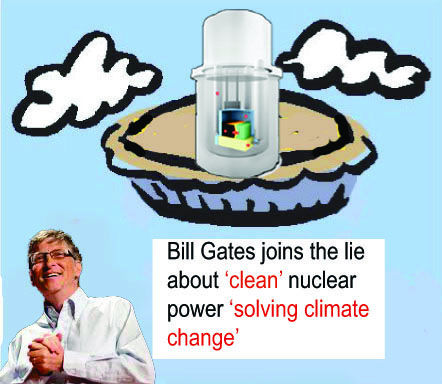 “………..“If everything goes perfectly,” Gates has told a Wall Street Journal conference, a demonstration fourth-generation design could be in place by 2022. “If everything continues to go perfectly,” that design could be replicated and built in many countries around the world by 2028.
“Big Ifs,” some might say, and a moderator suggested as much in response to Gates’ point.
In this month’s “This is Not Cool” video, Stanford University engineering professor Mark Z. Jacobson expresses reservations. His research looks at energy technologies in hand and not those he says “might be available 20, 30 years from now.” That research – as explained in an earlier related video – involves wind, solar, and water power.
To reach global carbon dioxide emissions targets, Jacobson says, 80 percent of the world’s energy infrastructure needs to be converted by 2030 and 100 percent by 2050.
Jacobson says exiting nuclear power may be cleaner than natural gas, but it is nine to 25 times more polluting per kilowatt hour generated than wind power in terms of carbon and air pollution. In addition, about 40 percent of that difference results from a need to continuously mine and refine uranium during the life time of the nuclear power plant. He says the “sole purpose” of two coal-fired power plants in the U.S. now is to refine uranium for nuclear energy and weapons.
While Gates expresses optimism about fourth-generation nuclear power technology and safety, Jacobson counters that 1.5 percent of all nuclear reactors built worldwide “have melted down seriously. So there’s a catastrophic risk problem.” A world wanting to go fully nuclear – and currently having 400 850-megawatt nuclear reactors – would need 16,000 850-megawatt reactors.
Jacobson points to relative costs as the key determinant. Unsubsidized current costs are about 12.5 cents per kilowatt hour; for wind 3.2 to 5 cents per kilowatt hour; for thin film solar 5 to 6 cents per kilowatt hour; and for utility-scale crystalline solar 5.2 to nearly 7 cents per kilowatt hour. Big differences, he says. http://www.yaleclimateconnections.org/2016/05/nuclear-power-part-of-the-alternative-energy-solution/Nuclear
International Atomic Energy Agency keen to teach kids how great is the nuclear industry
IAEA Invites Students to Learn Nuclear Science Through Play. IAEA, By Laura Gil, IAEA Office of Public Information and Communication, 12 May 16, Teachers have reached almost 10 000 students in four Asian countries through a guidebook designed to bring nuclear science and technology closer to young adults. The compendium, which is being tested by the IAEA and education experts from several countries, collects unique teaching strategies and materials to introduce science and technology in education systems.
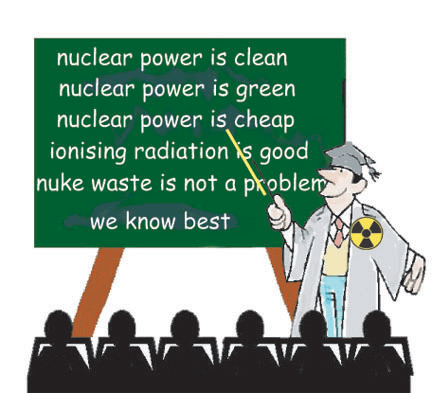
By generating interest in science among young generations, the compendium aims at contributing to the sustainability of the nuclear industry and related technologies in the future. With populations growing, applications of nuclear technology rapidly expanding, and active nuclear scientists ageing, a new generation of professionals will soon need to step up……
In preparation for the curriculum, experts collected ideas from, for example, Japan, where teachers often organize field trips for students; India, where education centres convoke essay contests all across the country to create an interest in the student community; Israel, where the government has built a nuclear science park and museum; and Australia, where school children are invited to an exhibition centre in the Australian Nuclear Science and Technology Organisation already from an early age. https://www.iaea.org/newscenter/news/iaea-invites-students-to-learn-nuclear-science-through-play
World Bank warns on the growing dangers of climate change
 Climate change puts 1.3bn people and $158tn at risk, says World Bank https://www.theguardian.com/business/2016/may/16/climate-change-puts-13bn-people-and-158tn-at-risk-says-world-bank Guardian, Larry Elliott, Economics editor,
Organisation urges better city planning and defensive measures to defend against rapid rise in climate change-linked disasters The global community is badly prepared for a rapid increase in climate change-related natural disasters that by 2050 will put 1.3 billion people at risk, according to the World Bank.
Urging better planning of cities before it was too late, a report published on Monday from a Bank-run body that focuses on disaster mitigation, said assets worth $158tn – double the total annual output of the global economy – would be in jeopardy by 2050 without preventative action.
The Global Facility for Disaster Reduction and Recovery said total damages from disasters had ballooned in recent decades but warned that worse could be in store as a result of a combination of global warming, an expanding population and the vulnerability of people crammed into slums in low-lying, fast-growing cities that are already overcrowded.
“With climate change and rising numbers of people in urban areas rapidly driving up future risks, there’s a real danger the world is woefully unprepared for what lies ahead,” said John Roome, the World Bank Group’s senior director for climate change.
“Unless we change our approach to future planning for cities and coastal areas that takes into account potential disasters, we run the real risk of locking in decisions that will lead to drastic increases in future losses.”
The facility’s report cited case studies showing that densely populated coastal cities are sinking at a time when sea levels are rising. It added that the annual cost of natural disasters in 136 coastal cities could increase from $6bn in 2010 to $1tn in 2070.
The report said that the number of deaths and the monetary losses from natural disasters varied from year to year, but the upward trend was pronounced.
Total annual damage – averaged over a 10-year period – had risen tenfold from 1976–1985 to 2005–2014, from $14bn to more than $140bn. The average number of people affected each year had risen over the same period from around 60 million people to more than 170 million.
Although developed countries have been responsible for the bulk of historic global emissions, poorer countries are more vulnerable to the impact of climate change and they demanded financial help from the west as part of last December’s breakthrough global deal to reduce emissions.
Oxfam this week called on rich countries to make good on the pledges made at the Paris conference to provide the funding to help developing countries adapt to the effects of global warming.
“Climate change is a brutal reality confronting millions of the world’s most vulnerable people. Their need for financial support to adapt to climate extremes is urgent and rising,” Oxfam said in its Unfinished Business report.
“International support for adaptation falls well short of what is needed. Latest estimates indicate that only 16% of international climate finance is currently dedicated to adaptation – a mere $4bn–$6bn per year of which is public finance.”
According to the the facility, disaster risk is affected by three factors. It said these were: hazard – the frequency of potentially dangerous naturally occurring events, such as earthquakes or tropical cyclones; exposure – the size of the population and the economic assets located in hazard-prone areas; and vulnerability – the susceptibility of the exposed elements to the natural hazard.
The World Bank-run body said the population was expected to rise by at least 40% in 14 of the 20 most populated cities in the world between 2015 and 2030, with some cities growing by 10 million people in that period. “Many of the largest cities are located in deltas and are highly prone to floods and other hazards, and as these cities grow, an ever greater number of people and more assets are at risk of disaster.”
Francis Ghesquiere, head of the secretariat at the The Global Facility for Disaster Reduction and Recovery, said: “By promoting policies that reduce risk and avoiding actions to drive up risk, we can positively influence the risk environment of the future. The drivers of future risk are within the control of decision makers today. They must seize the moment.”
Cultural genocide – nuclear waste dumping in Australia: Take a stand!
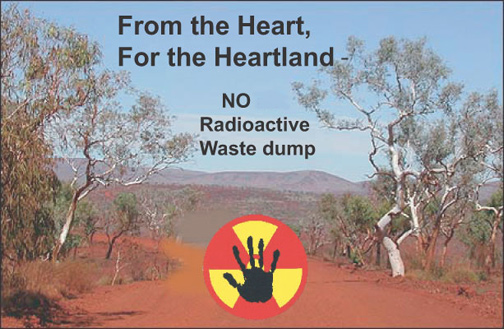 Stop Australia From Committing “Cultural Genocide” and Environmental Injustice http://www.truth-out.org/news/item/36006-stop-australia-from-committing-cultural-genocide-and-environmental-injustice, 14 May 2016 By Jessica Ramos, Care2 | Report Australia is about to make a horrible mistake. The country has (at least, tentatively) earmarked the location of its first nuclear dumping site next to an aboriginal cultural site. And the aboriginal community is speaking out — calling the proposed site “cultural genocide.” Australia is on the path to repeating the United States’ past mistakes and environmental injustices.
Can You Put a Price on Cultural Genocide and Death? Yes, Apparently
The traditional lands at the center of the controversy belong to the Adnyamathanha, also known as the “rock people,” from Flinders Ranges, South Australia. In 2009, the Federal Court of Australia recognized the Adnyamathanha’s native rights over 16,000 square miles of territory. But a nuclear dumping site of low- and intermediate-level nuclear waste (e.g. from medical procedures) endangers their territory and legal rights.
As reported in The Guardian, Wallerberdina Station (a cattle station) near Barndioota — less than 500km north of Adelaide in the Flinders Ranges — was originally one of six sites selected for the proposed nuclear dump last year, but now it’s the only location under consideration after a “four-month consultation process.” I’m not sure who was consulted, but it doesn’t appear to be the Adnyamathanha.
“This is our land, we have been here forever and we will always be here and we are totally opposed to this dump,” says Vince Coulthard, the Adnyamathanha Traditional Lands Association (ATLA) chief executive, to The Guardian. Apart from calling the move “cultural genocide,” Coulthard adds that the community has been mostly excluded from the decision-making process.
Important Adnyamathanha cultural sites near the proposed dumping site need to be taken into consideration. Hookina Creek, a women’s place and registered heritage site, is one of these sites. When Regina McKenzi, an Adnyamathanha woman, learned about the proposed dumping area coming to her ancestral lands, she told The Guardian that she felt like she was “getting news of a death.”
But, hey, the Adnyamathanha will be compensated for, so that’s something — right? As reported in The Guardian, Josh Frydenberg MP, the Minister for Resources, Energy and Northern Australia, explains that the Adnyamathanha community will receive $2m for local projects and $10m if the Wallerberdina Station is ultimately selected. Frydenberg adds that consulting the aboriginal community is the next wave of the process — even though it should’ve been a priority since the process’ inception, in my humble opinion.
National Treasures, Not Nuclear Dumping Sites
If you’re from the United States, then this whole ordeal should sound somewhat familiar. When I wrote about the massive mine spill caused by the EPA near the Navajo Nation last year, it was hard not to reflect on the ways indigenous communities experience environmental injustice. The Navajo Nation is probably the most infamous and prominent example with its long history of uranium mining that caused high rates of cancers and lung disease in the community.
But this form of injustice isn’t limited to one tribe. According to the Scientific American, “[n]ative tribes across the American West have been and continue to be subjected to significant amounts of radioactive and otherwise hazardous waste as a result of living near nuclear test sites, uranium mines, power plants and toxic waste dumps.”
Environmental injustice just doesn’t compromise the physical health of the locals. It also compromises the environment, and, ultimately, the cultural health. To this day, many indigenous identities are intricately tied to ancestral lands. By polluting sacred, ancestral and/or historical sites, these companies and governments are also polluting ancestral memories and robbing future generations of their ancestral identities. Millions of dollars can never compensate for these past and future losses.
Cultures, languages, traditions and stories that have survived centuries of colonization are national treasures — not nuclear dumping sites.
Take Action!
The final decision for the nuclear dumping site will occur in a year, please act now by signing and sharing this petition urging Australian leaders not to dump nuclear waste near Adnyamathanha territory.
Strategy paper on nuclear energy prepared by European Union
European Union to publish strategy paper on nuclear energy http://www.dw.com/en/european-union-to-publish-strategy-paper-on-nuclear-energy/a-19262144 Ahead of a meeting of the EU’s energy commissioners, a report obtained by German media has revealed plans for the future of nuclear power in Europe. The plans run contrary to German policy.
Citing a strategy paper from the EU on Tuesday, “Spiegel Online” reported that the European Union plans to defend its technological dominance in the nuclear sector.
According to the document, the European Union’s 28 member states should strengthen cooperation on researching, developing, financing and constructing innovative reactors.
The paper is reportedly the basis for the European Commission’s future nuclear policy and is expected to be passed by the European commissioner for energy union on Wednesday. The report would then be presented to the European Parliament.
“Spiegel” reported that the European Union plans to advance the minireactors with the hope that such technology should be in use no later than 2030.
German nuclear phaseout
The plans contradict policy in Germany, which currently intends to end the domestic use of nuclear power by 2022. As an alternative to nuclear energy, Berlin has pushed to increase renewable energy, such as wind and solar power. But a decision to shut down nuclear power following the 2011 Fukushima nuclear disaster in Japan has also left Germany reliant on dirty and readily available coal to produce power.
The task of safely decommissioning and dismantling nuclear power stations also promises to be expensive and controversial, and will take many years. Though the government and nuclear industry are keen to get on with dismantling and removing reactors soon after they are shut down, the nongovernmental organization International Physicians for the Prevention of Nuclear War (IPPNW) has voiced concerns about the potential associated health risks.
The IPPNW’s preferred solution would require heavily contaminated elements such as spent fuel rods to be removed immediately, while less-contaminated buildings and equipment would be left in situ indefinitely.
Representatives at E.ON – Germany’s largest electricity utility and the owner of 11 nuclear stations – told DW that fencing off sites was neither more nor less safe than dismantling them. The utility argued instead that dismantling is a better solution in terms of the labor market consequences.
“IPPNW’s option would mean that 300-400 people who work at a nuclear site would abruptly lose their jobs,” an E.ON spokesperson said.
Obama shuns Open Ended Working Group on Taking Forward Multilateral Nuclear Disarmament Negotiations.
 Obama goes to Hiroshima, but stiffs nuclear talks in Geneva The upcoming visit may be a first, but if Obama is serious about disarmament, he will not shut the door on discussions with non-nuclear weapon states, Open Canada.org BY: PAUL MEYER MAY 17, 2016 After some extended internal debate, the White House has announced that U.S. President Barack Obama will visit Hiroshima on May 27 after a G7 summit meeting in Japan, making him the first sitting American president to pay such a visit to the city synonymous with atomic devastation.
Although his Secretary of State John Kerry had paid such a visit in April and several U.S. ambassadors had previously attended commemorative ceremonies in Hiroshima, the political significance of a presidential visit would be of an entirely different order of magnitude. Hence the concern of his advisors as to how such a visit would play in the American political scene and their haste to proclaim that Obama will not offer any ‘apology’ for the actions of his predecessor some 70 years ago……
Far from advancing his nuclear disarmament-related goals — including the ratification of the Comprehensive (Nuclear) Test Ban Treaty, initiation of a fissile material production ban, further reduction of strategic nuclear forces, and diminishing the saliency of nuclear weapons in national strategy — Obama has committed to an unprecedented modernization of these nuclear forces that is estimated to cost more than USD$350 billion over the next decade.
He has also endorsed the perverse Cold War practice of maintaining nuclear-tipped inter-continental ballistic missiles (ICBMs) on high alert status with all the attendant risks that such a posture represents. His singular accomplishment in hosting the first and last of a series of four Nuclear Security Summits was an underwhelming lowest common denominator process that excluded from discussion the very subjects that he had raised in the Prague speech as requiring attention that would “transcend Cold War thinking.”
With all this evidence of a yawning gap between aims and achievements on the nuclear agenda, one would think that the Obama administration would be eager to find opportunities to enhance relations with non-nuclear weapon states and repair its image as an active supporter of nuclear disarmament. An opportunity to do so is currently present in Geneva in the form of the Open Ended Working Group on Taking Forward Multilateral Nuclear Disarmament Negotiations.
This group was constituted last fall by a widely supported resolution of the UN General Assembly and has just completed two weeks of deliberations after an earlier week of discussions in February. After a few more days of meetings in August the group is slated to submit a report to the 71th session of the General Assembly this fall.
As its title suggests, the objective of the group is to try and identify effective measures to make progress on nuclear disarmament issues that have been neglected for years in multilateral forums. Instead of engaging with the non-nuclear weapon states, the U.S. and the other nuclear-armed states have chosen to boycott these meetings. Given that the Open Ended Working Group was a duly constituted multilateral body operating under UN General Assembly auspices, this rejection to participate is insulting to the others attending (which include Canada, Japan and the rest of the U.S.’s allies) and to the principles of multilateral cooperation in general. Given the support freely offered by the non-nuclear weapon states to so many of the international security initiatives championed by the U.S., it is grating to see the cavalier fashion in which the U.S. and its nuclear weapon posse is stiffing the Geneva process. One can imagine the consternation in Washington if Prime Minister Justin Trudeau or the other invited leaders of the non-nuclear weapon states had said they would not attend Obama’s Nuclear Security Summit this March until such time as the U.S. agreed to participate in the Geneva proceedings.
Perhaps it is time for non-nuclear weapon states to become more insistent that their priority agenda gets some respect from the members of the nuclear weapons club…….https://www.opencanada.org/features/obama-goes-hiroshima-stiffs-nuclear-talks-geneva/
Former AREVA CEO ‘Atomic Anne’ Lauvergeon under a cloud at Rio Tinto
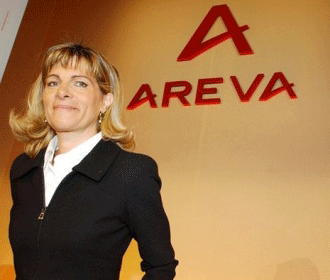 The future of Rio Tinto director ‘Atomic Anne’ Lauvergeon is under a cloud, The Age, May 16, 2016 Peter Ker Resources reporter The future of Rio Tinto director Anne Lauvergeon is under a cloud after French prosecutors starting investigating her conduct while chief executive of energy giant Areva almost a decade ago.
French prosectors spent Friday questioning Ms Lauvergeon over whether she deliberately filed misleading accounts for Areva in 2007.
The investigations centre on Areva’s disastrous takeover of London listed company Uramin in 2007, and the disclosure of multi-billion dollar impairments several years later.
London newspaper the Financial Times reported over the weekend that French prosecutors had confirmed that Ms Lauvergeon was being investigated for “publication of inaccurate accounts” during her time at Areva.
The 56-year-old Ms Lauvergeon, who is known as “Atomic Anne” in France, has served as a non-executive director of Rio since 2014.
The weekend’s revelations come barely two months after French prosecutors launched a separate investigation into alleged insider trading by Olivier Fric, who is Ms Lauvergeon’s partner.
The prosecutors are investigating whether Mr Fric used privileged information to profit from the Uramin deal. Mr Fric’s lawyers have reportedly denied the allegations.
The controversy surrounding Ms Lauvergeon and Mr Fric was known when the Rio board endorsed Ms Lauvergeon for re-election in March……..
Ms Lauvergeon’s continuing work at Rio while the French investigations go ahead is at odds with the approach taken by ASX chief executive Elmer Funke Kupper, who has stood down while the Australian Federal Police conduct anti-bribery investigations into his time spent working for Tabcorp. http://www.theage.com.au/business/mining-and-resources/the-future-of-rio-tinto-director-atomic-anne-lauvergeon-is-under-a-cloud-20160515-govnv7.html
Uranium industry finally acknowledging its dire situation
Uranium on the rocks http://onlineopinion.com.au/view.asp?article=18236&page=0

| By Jim Green , 17 May 2016 Indicative of the uranium industry’s worldwide malaise, mining giant Cameco recently announced the suspension of production at Rabbit Lake and reduced production at McArthur River/Key Lake in Canada. Cameco is also curtailing production at its two U.S. uranium mines. About 500 jobs will be lost at Rabbit Lake and 85 at the U.S. mines. A Cameco statement said that “with today’s oversupplied market and uncertainty as to how long these market conditions will persist, we need to focus our resources on our lowest cost assets and maintain a strong balance sheet.”Christopher Ecclestone, mining strategist at Hallgarten & Company, offered this glum assessment of the uranium market: “The long-held theory during the prolonged mining sector slump was that Uranium as an energy metal could potentially break away irrespective of the rest of the metals space. How true they were, but not in the way they intended, for just as the mining space has broken out of its swoon the Uranium price has not only been left behind but has gone into reverse. This is truly dismaying for the trigger for a uranium rebound was supposed to be the Japanese nuclear restart and yet it has had zero effect and indeed maybe has somehow (though the logic escapes us) resulted in a lower price.”Ecclestone adds that uranium has “made fools and liars of many in recent years, including ourselves” and that “uranium bulls know how Moses felt when he was destined to wander forty years in the desert and never get to see the Promised Land.” He states that uranium exploration “is for the birds” because “the market won’t fund it and investors won’t give credit for whatever you find”.
The Minerals Council of Australia launched a pro-uranium social media campaign last month. The twitter hashtag #untappedpotential was soon trending but – as an AAP piece noted – contributors were overwhelmingly critical. No doubt the Minerals Council anticipated the negative publicity but what it didn’t anticipate is the uranium price falling to an 11-year low. Mining.com noted in an April 20 article that the current low price hasn’t been seen since May 2005. The current price, under US26/lb, is well under half the price just before the 2011 Fukushima disaster, and under one-fifth of the 2007 peak of a bubble. Mining.com quotes a Haywood Securities research note which points out that the spot uranium price “saw three years of back-to-back double-digit percentage losses from 2011-13, but none worse than what we’ve seen thus far in 2016, and at no point since Fukushima, did the average weekly spot price dip below $28 a pound.” Haywood Securities notes that an over-supplied market continues to inflate global inventories. Mining.comnotes that five years after the Fukushima disaster, only two of Japan’s nuclear reactors are back online (and yet another permanent reactor closure was announced on May 15), and that in other developed markets nuclear power is also in retreat. The last reactor start-up in the U.S. was 20 years ago. The French Parliament legislated last year to reduce the country’s reliance on nuclear power by one-third. Germany is phasing out nuclear power, as are several other countries. The European Commission recently released a report predicting that the EU’s nuclear power retreat ‒ down 14% over the past decade ‒ will continue. China is a growth market but has amassed a “staggering” stockpile of yellowcake according to Macquarie Bank. India’s nuclear power program is in a “deep freeze” according to the Hindustan Times (unfortunately the same cannot be said about its nuclear weapons program), while India’s energy minister Piyush Goyal said on April 20 that India is not in a “tearing hurry” to expand nuclear power since there are unresolved questions about cost, safety and liability waivers sought by foreign companies. A decision on two planned reactors in the UK could be announced in the near future and the cost – A$48 billion for the two reactors – goes a long way to explaining nuclear power’s worldwide stagnation. If the project proceeds, the industry will be hoping it doesn’t go three times over budget and lag 5-9 years behind schedule, as reactor projects in France and Finland have. Even if all of Japan’s 42 reactors are included in the count, the number of power reactors operating worldwide is the same now as it was a decade ago. And there is little likelihood that nuclear power will break out of its long stagnation in the foreseeable future, with the ageing of the global reactor fleet a growing problem for the industry. As former World Nuclear Association executive Steve Kidd noted earlier this year: “The future is likely to repeat the experience of 2015 when 10 new reactors came into operation worldwide but 8 shut down. So as things stand, the industry is essentially running to stand still.” Australia’s uranium industry is also struggling just to stand still. The industry accounts for just 0.2 percent of national export revenue and less than 0.01 percent of all jobs in Australia. Those underwhelming figures are likely to become even less whelming with the end of mining and the winding down of processing at the Ranger mine in the NT. |
Adolf Hitler’s secret NUCLEAR BOMBS found – claims engineer
Peter Lohr, 70, says he’s found five metallic objects in Nazi tunnels
Using radar and 3D he claims he can prove two are atom bombsBy SARA MALM FOR MAILONLINE, 18 May 2016 A pensioner claims he has found Adolf Hitler’s secret atom bombs inside tunnels dug by the Nazis underneath a mountain valley in central Germany.
Peter Lohr, 70, claims to have found five large metal objects in a cave in the Jonas Valley in Thuringia state, of which at least two are ‘atomic bombs’.
Mr Lohr is certain that the objects are weapons of mass destruction manufactured by the Nazis towards the end of the Second World War.
‘The metal’s been lying there for 71 years. At some point it will decay and then we will have a second Chernobyl on our hands’ he said.
The centre of the Jonas Valley was a scene of secret military construction towards the end of the Second World War, with thousands of concentration camp prisoners forced to dig tunnels under the mountains.
It is not known what purpose the tunnels were meant to have as it was never completed.
The tunnel system stretches for miles underneath the mountain, with thousands of caves, bunkers and storerooms, and it is believed that it was intended to be the Alamo of the Third Reich leadership.
The Jonas Valley was liberated by American troops in April 1945, and US authorities have since classified all 1945 documents relating to Ohrdruf for a minimum of 100 years.
This is not the first time rumours of a Nazi nuclear bomb has surfaced.
Last year, a documentary called The Search for Hitler’s Atom Bomb,’ quotes sealed records from Russia and America said to prove the Nazis were close to creating a weapon of mass destruction.
The programme quoted interrogation reports of Nazi scientists, eyewitness account and the records left behind by researchers, many of which were shipped to America after the war.
United Arab Emirates sets up firm to operate first nuclear power plants
UAE sets up firm to operate first nuclear power plants, Arabian Business, 17 May 16, By Staff writer The Emirates Nuclear Energy Corporation (ENEC) has announced the formation of a new subsidiary called Nawah Energy Company to operate and maintain the UAE’s first nuclear reactors at Barakah.
The ENEC board of directors have mandated ENEC management to proceed with the formation of the operating company and to ensure the transfer and provision of all required resources to form the operating subsidiary, a statement said.
“The formation of Nawah as ENEC’s subsidiary operating company will bring greater focus towards the safe and quality delivery of Units 1-4 at Barakah,” the statement said.
It added that Nawah’s mission will be to “safely and reliably generate electricity from nuclear energy”, and aims to become a globally recognized nuclear utility in the safe operation of nuclear energy plants…….http://www.arabianbusiness.com/uae-sets-up-firm-operate-first-nuclear-power-plants-632003.html#.VzuUJjV97Gg
Global solar power industry expanding at fast rate
Experts at industry summit say solar power expanding faster than ever CCTV America, May 11, 2016 [Good Graphs] Last week, the U.S. marked its one millionth solar panel installation, 40 years after solar energy was first developed. Analysts say it’ll only take two years to install another one million.
“By 2020, we’ll be generating enough electricity to power 20 million homes. So we are at the place where solar takes off,” Rhone Resch, president and chief executive of the Solar Energy Industry Association said……..
Noam Chomsky on the twin threats: Climate Change and Nuclear Proliferation
Noam Chomsky: Climate Change and Nuclear Proliferation Pose Worst Threat Ever Faced by Humans, EcoWatch Democracy Now! | May 16, 2016 President Obama has just passed a little-noticed milestone, according to The New York Times: Obama has now been at war longer than any president in U.S. history—longer than George W. Bush, Franklin D. Roosevelt and Abraham Lincoln. Obama has taken military action in at least seven countries: Iraq, Afghanistan, Libya, Syria, Pakistan, Yemen and Somalia.
Just last month, President Obama announced the deployment of 250 more Special Operations troops to Syria in a move that nearly doubles the official U.S. presence in the country. As war spreads across the globe, a record 60 million people were driven from their homes last year. Experts warn the refugee crisis may also worsen due to the impacts of global warming. Over the weekend, the National Aeronautics and Space Administration (NASA) released data showing 2016 is on pace to be by far the hottest year ever, breaking the 2015 record. Meanwhile, manyfear a new nuclear arms race has quietly begun, as the U.S., Russia and China race to build arsenals of smaller nuclear weapons.
These multiple crises come as voters in the U.S. prepare to elect a new president. We speak with one of the world’s preeminent intellectuals, Noam Chomsky, institute professor emeritus at Massachusetts Institute of Technology, where he has taught for more than 50 years. His latest book is titled Who Rules the World?…….
Noam Chomsky“………The nuclear threat is the threat of—on the Russian border, which happens to be the invasion route through which Russia was virtually destroyed twice last century by Germany alone—well, Germany as part of a hostile military alliance—on that border, both sides are acting as if a war is thinkable. The U.S. has just sharply increased; it quadrupled military expenses on its side. The Russians are doing something similar. There are constant near collisions, jets coming close to colliding with one another. A Russian jet a couple months ago virtually hit a Danish commercial airliner. U.S. troops are carrying out maneuvers virtually on the Russian border. That threat is escalating and very serious. William Perry, a respected nuclear specialist, a former defense secretary, recently estimated that the threat is higher than it was during the 1980s. There are also confrontations near the Chinese around China, South China Sea and so on. That’s one major threat.
The other is what you just described. The threat of global warming is very serious. Every time one reads a science journal, there’s an even more alarming discovery. Virtually all the ice masses are melting. The Arctic ice mass, which was assumed to be pretty stable, is actually melting very fast, much more than was thought. The glaciers are melting. There’s severedroughts. Right now already, about 300 million people in India are on the edge of starvation from drought, which has been going on for years. The groundwater is depleted as the Himalayan glaciers melt, as they’re doing. It will undermine the water supply for huge areas in South Asia. If people think there’s a migration crisis now, they haven’t seen anything. The sea level is rising. Chances are it could rise three to six feet, maybe more, by the end of the century—some estimate even sooner. It will have a devastating effect, not just on coastal cities, but on coastal plains, like, say, Bangladesh, where hundreds of millions of people will be severely threatened. I mean, this is a—we’re already killing other species at the level of the so-called fifth extinction. ….”http://ecowatch.com/2016/05/16/noam-chomsky-climate-change/
Four Workers Accused of “Willfully” Hiding Info Re Emergency Cooling Tank Leaking into Reactor Control Room: Another Big Easy Nuclear Reactor Day for the US NRC

Palisades: another “Big Easy” Nuclear Reactor owned by New Orleans’ Entergy.
Emergency cooling water on top of the nuclear reactor control room gushing 90 gallons per day of radioactive water with 3 drops per minute dripping into the control room and even onto the control panels; radioactive water discharged to the environment… This was after the previous 2011 leak was repaired. Why was it radioactive if it’s emergency borated water? “On May 18, 2011, Condition Report (CR) PLP–2011–02491 was initiated when leakage from the ceiling in the Palisades main control room was identified following heavy rains in the area. Chemistry analysis of this leakage revealed several radioactive isotopes including Cobalt–58, a short-lived isotope found in the primary coolant…”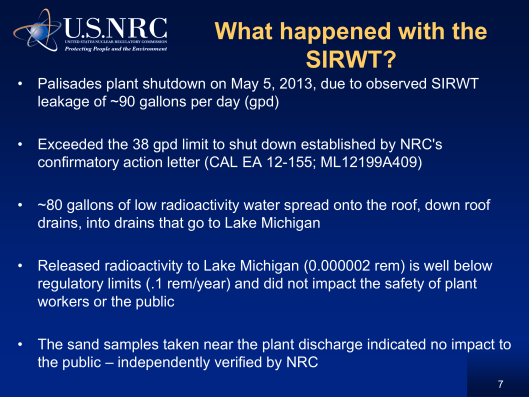
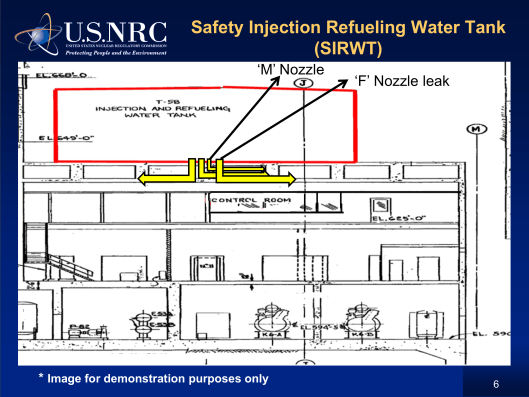
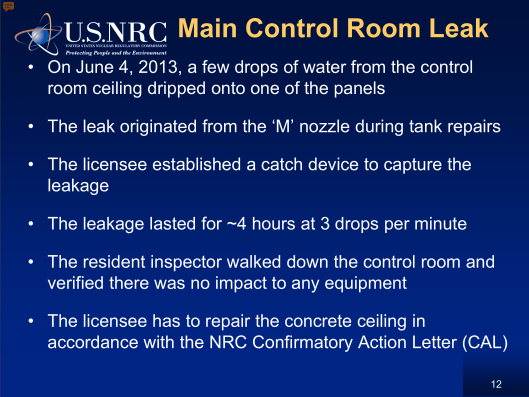
Palisades Nuclear Reactor will be 45 years old at the end of this year and is located on the Great Lakes (in Michigan). The major “news” coming out of the…
View original post 2,590 more words
May 17 Energy News

Science and Technology:
¶ Earth experienced the warmest April on record, keeping 2016 on track to be the hottest year yet and by the biggest margin ever. New data released by NASA put this April’s land and sea temperatures at 1.11 degrees Celsius warmer than average April temperatures between 1951 to 1980. [CNN]
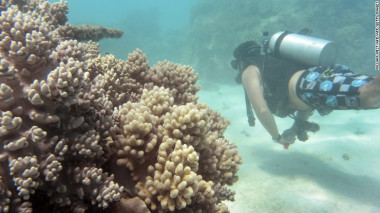 Coral bleaching, Great Barrier Reef
¶ The Ford Motor Company announced that it will use foam and plastic parts sourced from reclaimed carbon dioxide. Ford plans to transition its seating and underhood foam and plastic parts to materials made with reclaimed carbon dioxide, following a test period. [CleanTechnica]
World:
¶ Around 12,000 people have been urged to leave Canada’s oil sands camps near the fire-hit town of Fort McMurray as a resurgent wildfire heads towards them. The vast fire now covers 930 square miles. It had moved away from the city but recently…
View original post 714 more words
NASA — World Just Had Seven Months Straight of Record-Shattering Global Heat

It’s not just that we’re seeing record global heat. It’s that 2016’s jump in global temperatures may be the biggest single-year spike ever recorded. It’s that the world may never again see annual temperatures below 1 C above preindustrial averages. And it’s that this high level of heat, and a related spiking of atmospheric greenhouse gasses due to fossil fuel emissions, is now enough to begin inflicting serious harm upon both the natural world and human civilization.
Seven Straight Months of Record Heat
Last month was the hottest April in the global climate record. Not only was it the hottest such month ever recorded — it smashed the previous record by the largest margin ever recorded. And this April has now become the seventh month in a row in an unbroken chain of record global heat.

(When graphed, this is what the hottest April on record looks like when…
View original post 1,397 more words
1 This Month

of the week – Shut Down Drone Warfare!


Tell the Ukrainian Government to Drop Prosecution of Peace Activist Yurii Sheliazhenko

Petition to revoke the licensing of the Near Surface Nuclear Disposal Facility (NSDF) at Chalk River. https://www.ourcommons.ca/petitions/en/Petition/Details?Petition=e-7247
To see nuclear-related stories in greater depth and intensity – go to https://nuclearinformation.wordpress.com
-
Archives
- April 2026 (114)
- March 2026 (251)
- February 2026 (268)
- January 2026 (308)
- December 2025 (358)
- November 2025 (359)
- October 2025 (376)
- September 2025 (257)
- August 2025 (319)
- July 2025 (230)
- June 2025 (348)
- May 2025 (261)
-
Categories
- 1
- 1 NUCLEAR ISSUES
- business and costs
- climate change
- culture and arts
- ENERGY
- environment
- health
- history
- indigenous issues
- Legal
- marketing of nuclear
- media
- opposition to nuclear
- PERSONAL STORIES
- politics
- politics international
- Religion and ethics
- safety
- secrets,lies and civil liberties
- spinbuster
- technology
- Uranium
- wastes
- weapons and war
- Women
- 2 WORLD
- ACTION
- AFRICA
- Atrocities
- AUSTRALIA
- Christina's notes
- Christina's themes
- culture and arts
- Events
- Fuk 2022
- Fuk 2023
- Fukushima 2017
- Fukushima 2018
- fukushima 2019
- Fukushima 2020
- Fukushima 2021
- general
- global warming
- Humour (God we need it)
- Nuclear
- RARE EARTHS
- Reference
- resources – print
- Resources -audiovicual
- Weekly Newsletter
- World
- World Nuclear
- YouTube
-
RSS
Entries RSS
Comments RSS
 nuclear-news