May 20 Energy News

World:
¶ While Australian network operators are usually keen to underline the importance of the grid, a survey by Western Power of regional consumers has shown that an overwhelming majority, four out of five, are either very keen or are open to the idea of cutting the line altogether. [RenewEconomy]
 Most customers want to leave the grid.
¶ The latest inventory of national greenhouse gas emissions, released by the government, indicates that Australian emissions increased 1% over the 2015 calendar year, growing to 3% above 2000 levels, and forecast to be above of Australia’s target of -5% on 2000 levels by 2020. [CleanTechnica]
¶ According to a new report from GlobalData, China was responsible for nearly half of all new wind installations globally during 2015. Only a few weeks ago, GlobalData predicted China’s installed wind capacity would triple by 2030, reaching 495 GW, up from 149…
View original post 602 more words
Climate and Nuclear News This Week
 CLIMATE CHANGE. NASA – World Just Had Seven Months Straight of Record-Shattering Global Heat. World Bank warns on the growing dangers of climate change. Climate change exacerbates wildfires – Canada’s tragedy. Women head UN climate change body/
Noam Chomsky on the twin threats: Climate Change and Nuclear Proliferation.
NUCLEAR Uranium industry finally acknowledging its dire situation. International Atomic Energy Agency keen to teach kids how great is the nuclear industry.
USA.
- True costs of nuclear-generated electricity hidden for decades.
- ‘Generation IV’ nuclear companies desperate for tax-payers’ money.
- USA House and Senate committees approve bills favouring “new nuclear” companies.
- America’s Nuclear Regulatory Commission set to exempt nuclear corporations from safety costs and liabilities.
- Former Prime Minister Koizumi backs U.S. sailors suing over Fukushima radiation.
- Fears that South Carolina is to become a nuclear waste import hub.
- Protestors demand shut-down of radiation leaky Florida Nuclear Station.
- Growing opposition in both Canada and USA to nuclear waste dumping near the Great Lakes.
FRANCE. Sparks flew at Electricite de France’s AGM: EDF has €37 billion of debt. EDF hoping to extend life of nuclear reactors, postpone decommisson costs. Credibility of nuclear corporation EDF taking a beating over Hinkley Nuclear project shemozzle. French prosecutors launch probe into Tokyo’s 2020 Olympic bid.
UK. How Margaret Thatcher’s nuclear dream has turned into UK’s Hinkley nightmare. Genetic damage in children of nuclear test veterans: an investigation begins. Former AREVA CEO ‘Atomic Anne’ Lauvergeon under a cloud at Rio Tinto. Greens Urge Ireland to Insist on Hinkley Nuclear Power Consultation Following UNESC Ruling.
JAPAN. Japanese cities say ‘no’ to nuke restart. Mayor blasts nuclear power to students visiting from Taiwan. FUKUSHIMA: No one knows where the Fukushima nuclear reactor melted cores are. Tepco to put some Fukushima decommissioning work on hold during G-7 summit. School to close in Fukushima as too few children able to attend.
RUSSIA plans for Africa to be its nuclear colony, starting with south Africa. Russia joins the throng desperate to sell nuclear radioactive trash to Britain.
CANADA. Indigenous residents of Yellowknif, Canada, send Terrestrial Energy nuclear salesmen packing.
CHINA. Chinese nuclear companies planning to carve up nuclear exports between each other.
ARMENIA. Nuclear danger in Armenia.
INDIA. to sell nuclear reactors to Bangladesh (But what if Bangladesh is under water before long?)
PAKISTAN wants to join the Nuclear Suppliers Group.
GERMANY Adolf Hitler’s secret NUCLEAR BOMBS found – claims engineer
100% renewable energy powers Portugal for four days. Revolutionary solar power: London Borough’s solar panels over marketplace. Berkely Lab finds that Solar Power brings Environmental and Public Health Benefits.
New York’s proposed Clean Energy Standard a financial gift to the nuclear industry
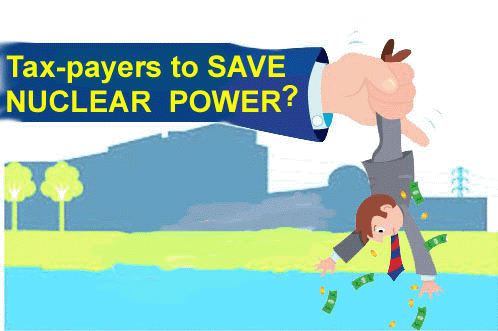 A gift to the nuclear power industry, The River Reporter May 18, 2016 — State officials are in the midst of a round of meetings regarding the state’s proposed Clean Energy Standard (CES), which will determine how much renewable electricity will be distributed to customers by utilities in years to come. The proposed plan calls for the state to generate 80% of electricity from renewable power by 2050, which is certainly a laudable goal.
Incredibly, however, the proposed CES mandates that rate-payers keep the state’s four nuclear power plants alive by paying higher-than-market prices for the expensive electricity produced by the plants.
As Jessica Azulay, program director of Alliance for a Green Economy, wrote in a memo, “The proposed Clean Energy Standard also includes a gift to nuclear corporations operating in Upstate New York. Due to low electricity prices, declining demand, competition from wind power, and rising nuclear costs, New York’s four upstate reactors have been struggling economically. Two are on the verge of closure unless they receive a financial lifeline. Tucked into the ‘Clean Energy Standard’ is that lifeline. In addition to requiring that utilities and ESCOs [Energy Supply Companies] purchase renewable energy, the policy would mandate that utilities buy 4.6% of the electricity they deliver in 2017 from nuclear reactors ‘facing financial difficulty.’ By 2020, utilities would be required to buy 15.7% of electricity from unprofitable nuclear plants.”….
while proponents call nuclear power a form of clean energy because it doesn’t release any carbon into the air while electricity is being generated, the process of collecting uranium to power the nuclear plants could hardly be considered clean.
Again, according to Azulay, the mining of uranium is largely unregulated and there are over 15,000 abandoned uranium mines in this country that have not been cleaned up. She says, “After mining, uranium is processed into uranium dioxide ore at a mill; milling generates vast amounts of radioactive and toxic tailings that are deposited on the ground or in open ponds. The fuel is then enriched in an energy-intensive process. By the time fuel is delivered to a reactor for use, approximately 25,000 pounds of mining waste (rock, mill tailings, and depleted uranium) have been generated for each pound of nuclear fuel.”
Nuclear power plants are not the answer to present or future energy needs, and New York State taxpayers should not be asked to pay for those that become unprofitable. Comments regarding the CES are due by June 6, and a sample comment and submission instructions can be found at www.allianceforagreeneconomy.org/nukes-are-not-clean. http://www.riverreporter.com/editorial/4302/2016/05/18/gift-nuclear-power-industry
‘Generation IV’ nuclear companies desperate for tax-payers’ money
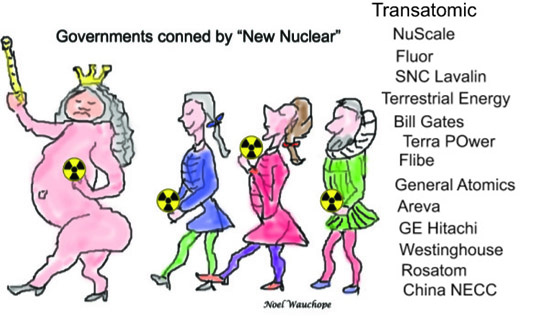

 Nuclear Firms: More Federal Money for Advanced Reactors. Bloomberg BNA, By Rebecca Kern May 17 — Nuclear companies said in a Senate hearing that continued support from Congress is needed to further develop and commercialize advanced nuclear reactors, several of which are getting some Department of Energy funding.
“Successful completion of the DOE cost-share program depends on sustained congressional support and continued appropriations,” John Hopkins, chairman and chief executive officer of NuScale Power LLC, an advanced nuclear reactor company, said at a May 17 Senate Energy and Natural Resources hearing on advanced reactors. “We appreciate your past support and we ask that you continue to prioritize small modular reactor programs in a tight budgetary environment.”……
NuScale has been receiving cost-share grants from the DOE since 2013 and expects to submit its first-of-a-kind small modular reactor licensing application to the Nuclear Regulatory Commission by the end of 2016, Hopkins said……
John Gilleland, chief technical officer of TerraPower LLC—a nuclear design company developing a generation-four reactor—also said there is a need for more government funding….
TerraPower is working with the China National Nuclear Corporation, an economic corporation overseen by the Chinese government, to develop a 1,200 megawatt electric liquid sodium-cooled fast reactor that uses depleted uranium as fuel in the metallic form. They hope it will be commercially deployable in the 2020-2030 time frame, Gilleland told Bloomberg BNA May 17.
Support for Advanced Nuclear Bills
Jacob DeWitte, co-founder and chief executive officer of Oklo, an advanced reactor start-up company, lauded the work done by the committee to pass the Energy Policy Modernization Act (S. 2012) in late April (76 ECR, 4/20/16). The bill included language from a bill sponsored by Sen. Mike Crapo (R-Idaho) that would establish a National Nuclear Innovation Center between the Energy Department and the NRC to establish capabilities for the private sector to test and demonstrate advanced reactor concepts.
He also supported S. 2795 introduced by Sen. James Inhofe (R-Okla.) that would promote the development of advanced nuclear technologies, which is being marked-up by the Senate Environment and Public Works committee this week…..
Also, Rep. Bob Latta (R-Ohio) has introduced H.R. 4979 which would direct DOE and the NRC to work together on an advanced nuclear reactor framework. This bill will be marked up by the House Energy and Commerce committee this week (92 ECR, 5/12/16)……
To contact the reporter on this story: Rebecca Kern in Washington atrkern@bna.com
To contact the editor responsible for this story: Larry Pearl atlpearl@bna.com http://www.bna.com/nuclear-firms-federal-n57982072580/
Russia plans for Africa to be its nuclear colony, starting with south Africa

 How Russia Is Expanding Its Vast Nuclear Empire Into Africa, AFK Insider By Dana Sanchez May 19, 2016, Russia’s government-owned nuclear agency Rosatom hopes to use South Africa as a springboard into the rest Africa as it seeks to expand its influence on the continent by building nuclear power plants.
Rosatom plans to sign framework cooperation agreements with Kenya, Uganda and Zambia, adding to those already made with South Africa, Nigeria and Ghana, Reuters reported.
Right now, South Africa may be the best prospect. Nigeria looks less likely as its economy contracts in the global oil price plunge.
“Given the extremely bad economic situation in Nigeria today, it might take a bit longer. But the government and the new president are still determined to go nuclear,” said Viktor Polikarpov, Rosatom’s vice-president of sub-Saharan Africa.
South Africa in 2015 approved a plan to develop up to 600 megawatts of nuclear capacity by 2030 as part of a bigger plan to build 9,600 megawatts of nuclear power at up to nine new nuclear reactors……
Environmental activist group Greenpeace warned the ANC in 2015 to abandon nuclear build plans or face massive resistance, NuclearNews reported.
“The ANC needs to know that if it does go for the nuclear option as part of the (energy) mix, then they are on a collision course with the broader spectrum of the South African civil society,” said Greenpeace Director Kumi Naidoo said on Monday that the ANC should “take nuclear off the table.
Russia has competition to do the nuclear build from China, France and South Korea, Reuters reported. It’s already planning to seek more deals across the region that range from building power plants to supplying reactor fuel.
“What we are targeting is to build South Africa as a nuclear cluster of nuclear industries so that we can use our partners and our partnership for our expansion into Africa,” Polikarpov said in an interview Tuesday in Cape Town.
Rosatom can offer financing options, Polikarpov said, according to Bloomberg. These include a contract with a state-export credit offered to the government of South Africa, a buyer-owner operator agreement, a public-private partnership, or a combination of them…….
The allure of the turnkey nuclear power plant, built, owned and operated by Rosatom, allows governments across the world to embrace such projects. But for Russia they are much more than a major economic export. They are another geopolitical tool, allowing the Kremlin to tie up strategic governments into long-term cooperation. http://afkinsider.com/126032/how-russia-is-expanding-its-vast-nuclear-empire-into-africa/
Revolutionary solar power: London Borough’s solar panels over marketplace
 London borough installs 6,000 solar panels over marketplace http://www.theguardian.com/environment/2016/may/19/london-borough-installs-6000-solar-panels-on-market £2m scheme by Hounslow council on Western International Market will be biggest solar scheme by any local authority, and use batteries to store energy. A London council is unveiling a vast installation of 6,000 solar panels on a wholesale market rooftop, which it says is the largest such array put up by a local authority.
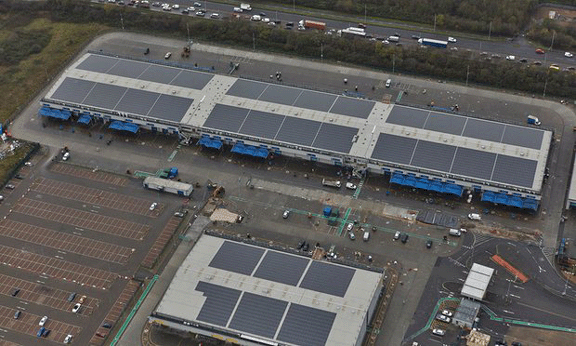
The London Borough of Hounslow says its £2m investment in solar, which has been installed on the roof of Western International Market, is also the first by a council to adopt battery storage to maximise the power from the panels.
The 1.73 megawatt (MW) array of 6,069 panels and four 60kW lithium batteries system now generates half the site’s required electricity.
The site is west London’s largest wholesale market for fresh produce and flowers, and uses around 3.5 megawatt hours (MWh) of electricity to provide climate controlled facilities to around 80 wholesalers and buyers – the equivalent of 1,750 homes a year.
Hounslow council, which owns the market near Heathrow Airport, says the solar system will contribute 2% of its carbon reduction target, cutting emissions by more than 780 tonnes a year.
It will also save £148,000 in energy costs which, along with £100,000 in generation tariff payments and £7,000 in export tariffs, means that the council expects to be £255,000 better off in the first year of operation.
Charles Pipe, energy manager at Hounslow, said: “From the very beginning, this project has been about reducing our carbon footprint and making an investment for the future. “But we have achieved so much more than that. Not only can we expect to see immediate savings on our electricity bills, but we are expecting to see a return on this investment in about five years.”
LG Electronics, one of Hounslow’s partners in the scheme, said it was the company’s largest solar panel installation in Europe and would deliver significant costs savings to the borough.
LG Solar’s UK senior solar sales manager Bob Mills said: “What’s more, the project has set the wheels in motion for further investment and research into the potential of battery storage, which is set to revolutionise the solar industry.
Climate change exacerbates wildfires – Canada’s tragedy
 As Alberta wildfire rages, thousands who fled must wait weeks to go home
The more than 88,000 Fort McMurray residents evacuated during the wildfire must wait until June to begin a phased re-entry plan, says Alberta premier, Guardian, Ashifa Kassam , 19 May 16, The wildfire in northern Alberta continues to rage out of control, growing to more than 423,000 hectares as officials said it would be at least another two weeks before the tens of thousands of evacuated Fort McMurray residents would be allowed to return to the city.
Relief – in the form of cooler weather and slight precipitation – may be on the way for fire crews, Rachel Notley, the Alberta premier, said on Wednesday. “So of course we’re all crossing our fingers that that happens.”
While the fire had expanded by 68,000 hectares in the past day, making it more than six times the size of Toronto, much of the fire’s growth has been confined to remote forested areas.
Earlier this week, shifting winds forced the evacuation of 8,000 non-essential staff from more than a dozen camps and sites north of Fort McMurray. Hours later, the fire consumed an oil sands camp belonging to Horizon North Logistics, and authorities warned the fire was fast approaching the Syncrude and Suncor Energyfacilities in the area.
On Wednesday the government said firefighters had been able to hold off the fire from the oil sands facilities. “We were very successful in some of the areas there to the north, so the fire hasn’t encroached as far as we had first feared,” said Chad Morrison, Alberta’s manager of wildfire prevention. “It was very unfortunate that we lost one lodge and that’s obviously due to the extreme fire behaviour.”
In early May, the fire transformed from one that was largely in controlto a raging wildfire that breached the city of Fort McMurray. Amid heavy smoke and flames that licked city streets, more than 88,000 residents were ordered evacuated.
The Alberta premier said that residents would be able to return to the city beginning 1 June, in a phased re-entry plan that would see residents in the least-damaged areas be allowed in first. By 4 June, residents of neighbourhoods like Beacon Hill, where the fire destroyed an estimated 70% of homes, will be allowed to return.
The dates are tentative, stressed Notley, and contingent on the fire’s behaviour in the coming weeks. “This is our best guess,” she said. “If conditions change as they did just this week, the voluntary re-entry may begin later than 1 June.”…….
Speaking in Ottawa on Wednesday, Don Forgeron, the chief executive of the Insurance Bureau of Canada said the fire will likely be the costliest natural disaster in Canadian history, estimating that the cost to insurers would land somewhere between C$3 billion and C$9 billion.
The world, he said, was now in a new era in which disasters such as fires and floods were happening more often. He pointed to a recent report by Canada’s parliamentary budget officer predicting that disasters linked to climate change could cost the government an average of C$902m a year over the next five years. “Climate change … has moved from future threat to present danger,” Forgeron said. http://www.theguardian.com/world/2016/may/18/alberta-wildfires-fort-mcmurray-residents-must-wait-to-return-canada
One of the world’s oldest nuclear plants helped build the Jewish state’s secret nuclear arsenal
A textile factory with a differenceOne of the world’s oldest nuclear plants helped build the Jewish state’s secret nuclear arsenal

WITH its cupola dully glinting in the sun across kilometres of an exclusion zone in the Negev Desert, the nuclear reactor near the Israeli town of Dimona has for decades been the subject of intense speculation. Its bland official name, the Centre for Nuclear Research, belies a martial purpose. Foreign intelligence services, atomic scientists and a former Israeli employee claim that it is the source of fissile material used to make Israel’s nuclear weapons.
The country’s atomic secrets have always been closely guarded, so little is known about the plant at Dimona. However, officials at the Israel Atomic Energy Commission (IAEC) admitted at a scientific conference last month that the reactor is showing its age. An ultrasound inspection of the aluminium core found 1,537 small defects and cracks, they said. The lifetime of such a reactor is usually around 40 years. At 53, Dimona is one of the world’s oldest operating nuclear plants.
The reactor, which was supplied by France, was switched on 15 years after the establishment of the state of Israel. The embattled country’s first prime minister, David Ben-Gurion, insisted that Israel needed a nuclear deterrent. The programme was spearheaded by his assistant, Shimon Peres, and the main components were first activated in 1963. The government claimed that Dimona was a “textile plant”.
Many of the ancillary systems in the reactor have been renewed or replaced, but the core itself cannot be swapped out. The flaws that have been detected are closely monitored and there is no serious suggestion that the reactor is unsafe. Yet in most other countries it would have been deactivated long ago. Safety concerns will only increase with time.
Israel has never used its reactors for generating electricity. Along with the United States, France, Russia and China, it is one of the few countries believed to have acquired the nuclear “triad”. It can deliver nuclear weapons as bombs dropped from an aircraft, as warheads on a land-launched missile (since the 1970s) and on missiles fired from submarines.
The third leg of the triad is thought to have been added in 1999, when Israel received the first of six planned submarines. These were built and largely paid for by Germany. If, as reported, they can launch nuclear-tipped cruise missiles, this would give Israel a “second-strike” capability, allowing it to retaliate even if an enemy were to destroy its air bases and missile silos in a nuclear “first strike”. In January Prime Minister Binyamin Netanyahu said: “Our submarine fleet will act as a deterrent to our enemies who want to destroy us.”
Dimona’s defenders say it has both symbolic value (as a reminder that Israel will defend itself fiercely) and practical uses, too. It is a source of materials needed to maintain nuclear warheads, such as tritium (which decays, but could theoretically be produced or procured by other means). It is also the centre of a “secret kingdom” of scientists whose capabilities the government is loath to give up.
For nearly six decades, Israel’s policy of “nuclear opacity” has served it well. Its Arab neighbours are convinced it is a nuclear power, but Israel clings to the ambiguous formulation that it “will not be the first to introduce nuclear weapons to the region”, neither acknowledging nor denying its capabilities. With powerful neighbours still openly advocating its destruction, the Jewish state will keep its doomsday weapons. But its ageing reactor? Perhaps not.
USA House and Senate committees approve bills favouring “new nuclear” companies
 environmental groups raised concerns with H.R. 4979 in a May 17 letter to the House Energy and Commerce Committee, saying changes to the NRC’s licensing framework could lead to safety concerns.
 Ed Lyman, a senior scientist at the Union of Concerned Scientists, said he had concerns with requiring the Energy Department to split the costs of advanced reactor development, because this ultimately would be borne by taxpayers.
House, Senate Panels OK Advanced Nuclear Reactor Bills Bloomberg BNA, By Rebecca Kern May 18 — House and Senate committees approved two bills May 18 that would create a new licensing framework at the Nuclear Regulatory Commission for the review of advanced reactors.
During separate hearings, the House Energy and Commerce Committee favorably reported out the Advanced Nuclear Technology Development Act (H.R. 4979), and the Senate Environment and Public Works Committee approved the Nuclear Energy Innovation and Modernization Act (S. 2795)………
NuScale Power LLC will be the first company to submit a licensing application to the NRC by year-end for its advanced small modular reactor that is 50 megawatts and can be transported by rail, truck or barge (95 ECR, 5/17/16).
The bills will next go to the House and Senate floors, although no schedules for votes have been announced.
Dan Schneider, the Energy and Commerce’s press secretary, told Bloomberg BNA May 18 that the committee members look forward to working with the co-sponsors of S. 2795 once the House passes H.R. 4979 to work out differences between the bills.
Environmentalists Cite Concerns
Egypt goes into $25 billion nuclear debt to Russia
 Egypt gets $25 billion loan from Russia for nuclear plant http://www.theprovince.com/business/egypt+gets+billion+loan+from+russia+nuclear+plant/11930248/story.html BY THE ASSOCIATED PRESS MAY 19, 2016 CAIRO – Egypt has announced a $25 billion loan from Russia for the building of a nuclear power plant.
Thursday’s announcement came in a decree by President Abdel-Fattah el-Sissi. The Russian loan will cover 85 per cent of the expenses of the plant’s construction.
Egypt, which will cover the other 15 per cent, is to repay the loan over a 22-year period, starting in 2029, with a 3 per cent annual interest rate.
Egypt and Russia agreed in February 2015 to build the plant together and signed a memorandum of understanding on the project. But the relations between the two nations were badly impacted after the horrific Russian passenger plane crash in Sinai last October, when all 224 people on board were killed.
Egypt’s economy has plummeted amid a slump in the tourism sector.
Berkely Lab finds that Solar Power brings Environmental and Public Health Benefits
 New Berkeley Lab Study Tallies Environmental and Public Health Benefits of Solar Power, Berkely Lab, Jon Weiner 510-486-4014 • MAY 18, 2016 Berkeley, CA — Solar power could deliver $400 billion in environmental and public health benefits throughout the United States by 2050, according to a study from the U.S. Department of Energy (DOE)’s Lawrence Berkeley National Laboratory (Berkeley Lab) and National Renewable Energy Laboratory (NREL).
“We find that a U.S. electric system in which solar plays a major role—supplying 14% of demand in 2030, and 27% in 2050—would result in enduring environmental and health benefits. Moreover, we find that the existing fleet of solar plants is already offering a down-payment towards those benefits, and that there are sizable regional differences in the benefits,” said Ryan Wiser of Berkeley Lab’s Energy Technologies Area.
The total monetary value of the greenhouse-gas and air pollution benefits of the high-penetration solar scenario exceeds $400 billion in present-value terms under central assumptions. Focusing on the existing end-of-2014 fleet of solar power projects, recent annual benefits equal more than $1.5 billion under central assumptions.
The report, The Environmental and Public Health Benefits of Achieving High Penetrations of Solar Energy in the United States, may be downloaded here. The report is part of a series of papers published as part of the U.S. Department of Energy’s On the Path to SunShot study. The DOE launched the SunShot Initiative in 2011, with the goal of driving down the cost of solar energy so that it was cost-competitive with other forms of electricity by the end of the decade. The new reports take stock of the progress already made, and highlight various barriers and opportunities that remain to achieving SunShot-level cost reductions. The full set of reports, including two others involving Berkeley Lab, can be found here…..http://newscenter.lbl.gov/2016/05/18/berkeley-lab-study-tallies-benefits-solar-power/
Confronting nuclear proponents on the real costs of “new nuclear” – US Senate hearing
Hearing on new reactors turns into colloquy on subsidies Hannah Northey, E&E reporter E&E Daily: Wednesday, May 18, 2016 A Senate hearing focused on the challenges of building the nation’s next-generation nuclear fleet yesterday quickly pivoted to concerns about cost and competition from cheap natural gas, with senators needling each other over energy subsidies…….
senators on the panel repeatedly turned back to the question of cost and whether the developers could make their projects compete financially.
Sen. Martin Heinrich (D-N.M.) said he was having a hard time reconciling the closure of nuclear power plants, including units in Illinois that had lost hundreds of millions of dollars in past years, with the industry’s push for new reactor designs. Heinrich asked witnesses what cost per kilowatt-hour they were targeting to ensure the advanced technologies would be competitive in the marketplace…….
Independent Sen. Angus King of Maine also questioned the industry’s math, noting that it could cost $7 million per megawatt to build an advanced reactor, whereas the costs for wind and natural gas are substantially lower……
The senator went on to ask Kuczynski whether a “level playing field” also meant scrapping federal support for the nuclear industry in the form of the Price-Anderson Act — a 1957 law that created a $12 billion pot of money to cover injuries and property damage during accidents.
When Kuczynski said the industry doesn’t view the law as a subsidy, King was quick to respond.
“It walks like a duck, it talks like duck, it’s a duck. It’s a subsidy,” King said. “If you had to buy that insurance, it would cost you a fortune, is that not correct?” http://www.eenews.net/stories/1060037434
Women head UN climate change body
 With women at the top, UN climate body has chance for real change Women now hold six of the most influential positions at global climate talks, but can they make a difference on the ground? Climate Home reports, Guardian, Ed King, 18 May 16 Whisper it quietly, but a gender revolution is taking place at the global climate change negotiations.
As of 17 May, the six most influential positions within the UN process are all held by women, a significant increase on last year’s total of two.
Outgoing UN climate chief Christiana Figueres has held her role for six years, but it’s the steady arrival of other women in top jobs that is a sign of change.
France environment minister Ségolène Royal is now president of the talks, aided by two UN “climate champions”: Moroccan minister Hakima El Haite and Paris Agreement architect Laurence Tubiana.
This week, Saudi Arabian diplomat Sarah Baashan and New Zealand’s former climate ambassador Jo Tyndall completed the team, taking charge as co-chairs of the UN talks……
Veteran climate justice campaigner and former Ireland president Mary Robinson described the appointment of Bashaan and Tyndall as a “significant step” towards gender balance at the talks…….http://www.theguardian.com/environment/2016/may/18/with-women-at-top-un-climate-body-has-chance-real-change
Chinese nuclear companies planning to carve up nuclear exports between each other
 China’s CGN to Avoid Competing Abroad Against Nuclear Partner http://www.bloomberg.com/news/articles/2016-05-19/china-s-cgn-to-avoid-competing-abroad-against-nuclear-partner Aibing Guo Stephen Stapczynski sstapczynski
-
China General Nuclear Power Corp. to focus on European markets
-
Nuclear companies formed a JV to export co-developed reactor
-
China General Nuclear Power Corp. said it won’t compete with China National Nuclear Corp. for customers in the same overseas markets as the two companies aim to increase exports of their co-developed nuclear reactor.
China General Nuclear Power will target customers in Europe and avoid markets where CNNC is active, such as South America, according to Huang Xiaofei, spokesman for China General Nuclear Power. CNNC didn’t respond to requests for comment. While the companies have merged their nuclear technologies into the Hualong One reactor, the country’s main export model, they separately market the design overseas, Huang said.
The companies build similar, but not identical, versions of the Hualong One and will maintain much of their own supply chains, according to the World Nuclear Association.They also established a joint-venture in March to integrate the technology.
CGN and Electricite de France SA signed an accord in October to build three reactors in the U.K., including the Hinkley Point plant in southwest England and a Chinese-developed reactor at Bradwell. CGN has also signed a memorandum of understanding with the Kenyan government in September to possibly build a Hualong One reactor, while CNNC has its own projects in Argentina and Pakistan. -
Taishan
Separately, two Areva SA-designed nuclear reactors in Taishan are on track to start commercial operation in China in the first half of 2017, according to Huang. The cost overrun for the reactors, known as an EPR, was caused by labor costs and loan interest and were within a reasonable range, he said. The company also plans to deliver its first small modular reactor, which can be used offshore, by 2020, he said
The country plans to export about 30 nuclear units by 2030, CNNC chairman Sun Qin said in March, according to China Daily.
Republican U.S. Sen. Lamar Alexander opposes wind power
 Pro-Nuclear GOP Senator Urges Tennessee to Reject Wind Farm, abc news,By ERIK SCHELZIG, ASSOCIATED PRESS NASHVILLE, Tenn. — May 19, 2016, Republican U.S. Sen. Lamar Alexander is urging his fellow Tennesseans to oppose what he calls an “unsightly” wind farm near the Cumberland Mountain State Park.
The longtime supporter of nuclear power argued on the Senate floor this week that the 23 wind turbines Apex Clean Energy wants to install are “massive” and would spoil the “natural beauty of our state.”
“We should not allow anyone to destroy the environment in the name of saving it,” said Alexander, arguing that wind energy is being fueled by “billions in wasteful taxpayer subsidies” to out-of-state companies.
Apex countered that the $130 million project will emit no pollution and create no hazardous waste as it provides a safe energy alternative near wildlife and natural areas…….
The wind farm near Crossville, about 100 miles east of Nashville, is projected to power 20,000 homes. It is located on a privately-owned 1,800-acre site behind a limestone quarry, though the turbines would be visible from Interstate 40.
“This project will help bring about cleaner, healthier air, reduce pollution, and create economic growth and jobs in Cumberland County,” Chandler said……http://abcnews.go.com/US/wireStory/pro-nuclear-gop-senator-urges-tennessee-reject-wind-39229291
1 This Month

of the week – Shut Down Drone Warfare!


Tell the Ukrainian Government to Drop Prosecution of Peace Activist Yurii Sheliazhenko

Petition to revoke the licensing of the Near Surface Nuclear Disposal Facility (NSDF) at Chalk River. https://www.ourcommons.ca/petitions/en/Petition/Details?Petition=e-7247
To see nuclear-related stories in greater depth and intensity – go to https://nuclearinformation.wordpress.com
-
Archives
- April 2026 (114)
- March 2026 (251)
- February 2026 (268)
- January 2026 (308)
- December 2025 (358)
- November 2025 (359)
- October 2025 (376)
- September 2025 (257)
- August 2025 (319)
- July 2025 (230)
- June 2025 (348)
- May 2025 (261)
-
Categories
- 1
- 1 NUCLEAR ISSUES
- business and costs
- climate change
- culture and arts
- ENERGY
- environment
- health
- history
- indigenous issues
- Legal
- marketing of nuclear
- media
- opposition to nuclear
- PERSONAL STORIES
- politics
- politics international
- Religion and ethics
- safety
- secrets,lies and civil liberties
- spinbuster
- technology
- Uranium
- wastes
- weapons and war
- Women
- 2 WORLD
- ACTION
- AFRICA
- Atrocities
- AUSTRALIA
- Christina's notes
- Christina's themes
- culture and arts
- Events
- Fuk 2022
- Fuk 2023
- Fukushima 2017
- Fukushima 2018
- fukushima 2019
- Fukushima 2020
- Fukushima 2021
- general
- global warming
- Humour (God we need it)
- Nuclear
- RARE EARTHS
- Reference
- resources – print
- Resources -audiovicual
- Weekly Newsletter
- World
- World Nuclear
- YouTube
-
RSS
Entries RSS
Comments RSS
 nuclear-news