Climate change: Australia covered up the truth on its damaged World Heritage sites

 Australia covered up UN climate change fears for Tasmania forests and Kakadu
Fears about damage to the Great Barrier Reef were removed from UN report along with concern about a threat to the environment in two other heritage sites, Guardian, Michael Slezak, 29 May 16, A draft UN report on climate change, which was scrubbed of all reference to Australia over fears it could deter visitors to the Great Barrier Reef, also outlined possible threats to the Tasmania wilderness and Kakadu.
 The draft report contained a chapter on the Great Barrier Reef, which described climate change as “the biggest long-term threat to the [reef] today, and to its ecosystems services, biodiversity, heritage values and tourism economy”.
It concluded that “without a comprehensive response more in keeping with the scale of the threat, the [reef]’s extraordinary biodiversity and natural beauty may lose its world heritage values”.
But before it was scrubbed, the report had two other key sections on Australian world heritage sites, and the threats they face from climate change.
One of those sections was on the Tasmanian wilderness…….the censored section of the Unesco report on Tasmania is clear about the “dire” nature of the threat.
It said: “A 2013 assessment of climate threats identified the same habitats as at high risk from greater fire frequency and drier conditions, with likely catastrophic implications for fauna. These dire predictions appeared to be playing out in January 2016, when tens of thousands of hectares of forest burned, sparked by lightning strikes that came in a month when temperatures were 2C above average and in the wake of the driest two-year period ever recorded for the region.”
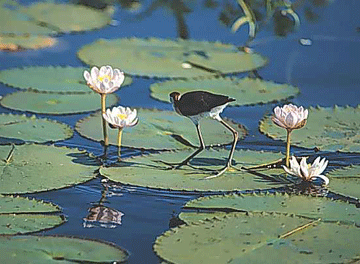 The deleted section on Kakadu national park contained similarly dire warnings.
It described the important natural and cultural values of Kakadu, which has been inhabited by Aboriginal people for 50,000 years.
“The thousands of rock art sites in the park are at risk from damage by more extreme rainfall events, while sea level rise is happening at twice the global average along the northern Australian coast,” the draft report said.
It warned that fresh-water wetlands were at risk from sea level rise, as they are likely to be inundated with salt water. “Climate change threatens Aboriginal traditional use by altering the ecosystems of the vast wetlands of Kakadu and raising temperatures to a level likely to lead to more intense fire regimes,” the report said.
The final version of the report entitled “World heritage and tourism in a changing climate” was published last week by Unesco, United Nationsenvironment programme and the Union of Concerned Scientists, with all references to Australia removed.
The lead author of the report, Adam Markham, told Guardian Australia: “I was shocked when I read in the Guardian the reasons the Australian government gave for why they had pressured Unesco to drop the Australian sites.” http://www.theguardian.com/environment/2016/may/29/australia-covered-up-un-climate-change-fears-for-tasmania-forests-and-kakadu
No comments yet.
1 This Month

of the week – Shut Down Drone Warfare!


Tell the Ukrainian Government to Drop Prosecution of Peace Activist Yurii Sheliazhenko

Petition to revoke the licensing of the Near Surface Nuclear Disposal Facility (NSDF) at Chalk River. https://www.ourcommons.ca/petitions/en/Petition/Details?Petition=e-7247
To see nuclear-related stories in greater depth and intensity – go to https://nuclearinformation.wordpress.com
-
Archives
- April 2026 (91)
- March 2026 (251)
- February 2026 (268)
- January 2026 (308)
- December 2025 (358)
- November 2025 (359)
- October 2025 (376)
- September 2025 (257)
- August 2025 (319)
- July 2025 (230)
- June 2025 (348)
- May 2025 (261)
-
Categories
- 1
- 1 NUCLEAR ISSUES
- business and costs
- climate change
- culture and arts
- ENERGY
- environment
- health
- history
- indigenous issues
- Legal
- marketing of nuclear
- media
- opposition to nuclear
- PERSONAL STORIES
- politics
- politics international
- Religion and ethics
- safety
- secrets,lies and civil liberties
- spinbuster
- technology
- Uranium
- wastes
- weapons and war
- Women
- 2 WORLD
- ACTION
- AFRICA
- Atrocities
- AUSTRALIA
- Christina's notes
- Christina's themes
- culture and arts
- Events
- Fuk 2022
- Fuk 2023
- Fukushima 2017
- Fukushima 2018
- fukushima 2019
- Fukushima 2020
- Fukushima 2021
- general
- global warming
- Humour (God we need it)
- Nuclear
- RARE EARTHS
- Reference
- resources – print
- Resources -audiovicual
- Weekly Newsletter
- World
- World Nuclear
- YouTube
-
RSS
Entries RSS
Comments RSS
 nuclear-news
Leave a comment