Boston Edison Company, now known as NSTAR Electric Company sues US Dept of Energy
DOE Sued for $40M Over Nuclear Waste Storage, Courthouse News Service By LORRAINE BAILEY CN), 19 May 16 — Blaming the government for not settling on a nuclear-waste storage scheme, a nuclear energy company has filed a federal complaint to recover $40 million.
The Nuclear Waste Policy Act of 1982 required the U.S. Department of Energy to accept and dispose of spent nuclear fuel and high-level radioactive waste by Jan. 31, 1998, in return for fees paid by owners of such waste.
It also effectively made it mandatory for nuclear utilities to enter into contracts for such disposal.
When the Department of Energy failed to meet the 1998 deadline, however, utilities began to incur substantial costs for storage and management of the waste accumulating at reactor sites.
By 2006, the U.S. Court of Federal Claims had found that the Department of Energy partially breached its contractual obligations to Yankee Atomic Electric Co., Connecticut Yankee Atomic Power Co., and Maine Yankee Atomic Power Co., all of which are now decommissioned, to the tune of $235 million
It sued the U.S. in the Court of Federal Claims Wednesday over its continued obligation to pay for highly reactive waste storage.
Boston Edison says it paid Entergy $40.3 million to cover the cost to store spent nuclear fuel through 2012, the expected decommissioning date for the plant.
That fuel would have been disposed of by the government had it kept its pledge.
But now, Entergy has stated that operations at Pilgrim will continue through 2019, and there is still no government plan for a permanent repository for high level nuclear waste.
Most nuclear power plants continue to keep their reactor waste on-site in steel and concrete casks……. The Department of Energy has expressed the urgency need to find a permanent repository, but the Congress has taken no action since abandoning the Yucca Mountain project.
Boston Energy seeks damages for breach of contract, and breach of the covenant of good faith. http://www.courthousenews.com/2016/05/19/doe-sued-for-40m-over-nuclear-waste-storage.htm
Russia to build Bushehr Nuclear Plant in Iran

 ‘A Partner We Can Trust’: Iran Chooses Russia to Build Bushehr Nuke Plant Russia’s State Atomic Energy Corporation, Rosatom, will start work on Iran’s Bushehr-2 nuclear power plant by the end of this year after the construction site preparations are completed……
Russia runs pro nuclear workshop in Vietnam
 Workshop promotes nuclear power A workshop to enhance the understanding of nuclear power among people and media alike was held on May 19 in Hanoi. The event, part of activities of the “2016 Nuclear Science Day in Hanoi ,” was jointly organised by Russia ‘s State Nuclear Energy Corporation (ROSATOM), the Vietnam Atomic Energy Agency under the Ministry of Science and Technology, the Information Center on Nuclear Energy (ICONE) and the Hanoi University of Technology.
Speaking at the event, Andrey Stankevich from ROSATOM Vietnam attached significance to publicity work to promote the development of nuclear energy…….
Communication work is crucial to raise public awareness of the development of the nuclear sector and get people’s approval of nuclear power, said Deputy Director of the Agency Nguyen Thi Thu Trang
According to the representative from ROSATOM Asia, the press and media need to be a reliable source of basic information on radiation, nuclear science and the safety of nuclear power plants.
They should also promote the benefits of the sector in terms of socio-economic development, health care, agriculture and industry.
Numerous activities will also take place during the “2016 Nuclear Science Day in Hanoi” programme, which runs until May 20, including a lecture by a professor from the Russia National Research Nuclear University (MEPhI) and an awards presentation for the recent Physics Olympiad winners. http://english.vietnamnet.vn/fms/science-it/156747/workshop-promotes-nuclear-power.html
Russia looks to nuclear colonise Africa
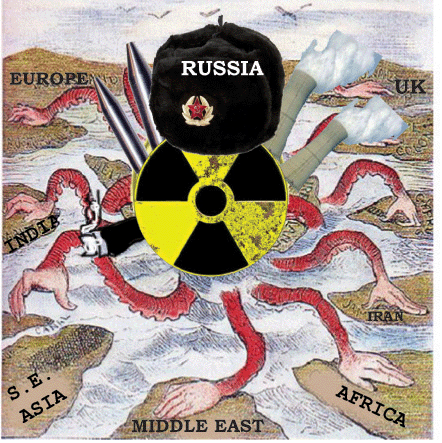 Russia’s Rosatom seeks cooperation agreements for African nuclear expansion By Wendell Roelf CAPE TOWN (Reuters) 20 May 16, – Russia’s state nuclear agency Rosatom plans to sign cooperation agreements with Kenya, Uganda and Zambia to lay the groundwork for an expanded presence in Sub-Saharan Africa beyond its planned bid to build nuclear power plants in South Africa.
Rosatom has voiced confidence in its ability to see off competition from China, France and South Korea in a planned South African tender to build a 9,600 megawatts (MW) nuclear power fleet in the continent’s most industrialised country. It sees scope, however, for more deals across the region, from the building of plants to supplying reactor fuel……
Victor Polikarpov, Rosatom’s regional vice-president for Sub-Saharan Africa, said on Thursday.
“We want South Africa to become our springboard for the rest of Africa. We want to create a nuclear cluster, a group of companies here that can operate with us in Africa.”
President Jacob Zuma’s government was checking the financial and commercial impact of its nuclear ambitions before it issues a tender.
South Africa’s 1,800 MW Koeberg station near Cape Town is the continent’s only commercial nuclear power plant at present, though Rosatom is building a nuclear plant in Egypt that is expected to be completed by 2022.
Meanwhile, South Africa’s nuclear energy corporation Necsa is being encouraged by government to revive nuclear enrichment and conversion facilities to reduce dependence on imported reactor fuels……
Rosatom’s Polikarpov, however, said it might not be viable for South Africa to restart enrichment facilities dismantled before white minority rule ended in 1994.
“Another solution is just to have fuel supplied from Russia. We can guarantee supply of fuel non-stop for the duration of operation of all power plants,” he said.
Nigeria, however, looks a more distant prospect as its economy contracts amid the global plunge in oil prices.
“Given the extremely bad economic situation in Nigeria today, it might take a bit longer. But the government and the new president are still determined to go nuclear,” Polikarpov said.
(Editing by James Macharia and David Goodman) http://af.reuters.com/article/investingNews/idAFKCN0YA1CH
Exelon nuclear corporation pressing for tax-payer funding at State and Federal level, USA
 Exelon presses for help at state, federal levels, E & E, Jeffrey Tomich, E&E reporter EnergyWire: Friday, May 20, 2016 The nation’s largest nuclear operator put on the full-court press yesterday in Washington, D.C., and Springfield, Ill., for policies to keep some its struggling plants afloat amid increasing competition from wind energy and a glut of cheap shale gas that’s depressing energy prices.
The case for helping preserve Exelon Corp.’s endangered nuclear plants — the Clinton and Quad Cities plants in Illinois and the R.E. Ginna and Nine Mile Point plants in New York — isn’t new.
Chicago-based Exelon has threatened for more than two years to shut money-losing plants in an effort to prod state lawmakers to act. In New York, Democratic Gov. Andrew Cuomo’s administration has come to the rescue with an evolving plan to help existing plants survive the downturn in energy markets (EnergyWire, March 18). In Illinois, Exelon is proposing a similar remedy, but it remains to be seen if the General Assembly will come to the rescue.
Earlier this month, Exelon’s chief executive, Chris Crane, said he has authority from the board to shut the “distressed assets” if lawmakers don’t approve a proposal requiring up to $290 million a year in subsidies from Illinois consumers to keep them profitable.
The company offered a revamped proposal on May 5 and gave the Legislature until the end of the month to pass it (EnergyWire, May 6). If not, the 1,087-megawatt Clinton plant would be closed when its obligation to run ends a year from now, Crane said. The Quad Cities plant is required to run an extra year, but unless the bill passes or the plant clears this year’s PJM Interconnection capacity auction for 2018-19, it, too, will be shut down.
If Exelon’s nuclear proposal isn’t complex and controversial enough, it is woven into a sweeping, 316-page energy bill that would rewrite Illinois energy policy……
Exelon said the two plants have lost a combined $800 million over the last six years, and they are projected to lose another $500 million over the next five years.
“We are unable to sustain those type of economic losses any longer,” Tim Hanley, the company’s senior vice president of nuclear projects, told the committee……
Exelon’s claims were challenged, however, by consumer groups including AARP and by the Illinois attorney general, as well as by Illinois industrial energy users and downtown Chicago building owners. The same groups opposed the nuclear proposal a year ago.
Cara Hendrickson, an assistant attorney general, told committee members the measure was nothing more than “another nuclear bailout, dressed up differently.” …..http://www.eenews.net/stories/1060037598 Twitter: @jefftomich Email: jtomich@eenews.net
USA Energy secretary Ernest Moniz keen to get tax-payer funding for Exelon nuclear power
 Fifteen to 20 nuclear units in US ‘at risk’ of shutdown: industry official Washington (Platts)–19 May 2016 Some 15 to 20 nuclear power units in the US are “at risk” of being shut over the next five to 10 years due to economic challenges such as low power prices, competition from natural gas-fired generation and subsidized renewables, a nuclear industry official said Thursday.
Marvin Fertel, president and CEO of the Nuclear Energy Institute, did not name any of the reactors considered to be most at risk in his remarks at a US Department of Energy summit on the future of nuclear power. He did say that small, single-unit nuclear power plants are the most economically challenged.
Two such plants, Dominion’s Kewaunee in Wisconsin and Entergy’s Vermont Yankee, have closed for economic reasons since 2013. Entergy’s FitzPatrick in New York and Pilgrim in Massachusetts are scheduled to be shut in 2017 and 2019, respectively, due to such factors, the company has said. The Omaha Public Power District said last week it is recommending to the district’s board of directors that its Fort Calhoun plant in Nebraska be shut because other generating options are less costly…….
Fertel noted that Exelon’s two-unit Quad Cities nuclear plant in Illinois, which the company has said is losing money and will be shut in the next few years without further legislative and market support, “……
Secretary of Energy Ernest Moniz, who spoke immediately before Fertel at the summit, agreed in his remarks that continued operation of some operating nuclear power plants is at risk.
Moniz said that DOE’s Quadrennial Energy Review currently underway is assessing the future of the existing nuclear fleet in a subcommittee chaired by former deputy secretary of defense John Deutch, and is considering how nuclear plant operators might be compensated for the various benefits of their generation. Those issues will be “at the heart of the analysis work going on right now in developing this QER,” he said.
“I’m expecting an excellent report” from the subcommittee on what can be done to sustain operation of existing nuclear units, Moniz said. “This question of valuation [of nuclear generation] is one that is absolutely central. It’s one that we’re certainly paying attention to.”……. http://www.platts.com/latest-news/electric-power/washington/fifteen-to-20-nuclear-units-in-us-at-risk-of-21497100
Illinois General Assembly split on the idea of bailing out Exelon’s financially distressed nuclear station
Bill to help Clinton nuclear plant on back burner Bloomington Pantograph Dan Petrella dan.petrella@lee.net SPRINGFIELD, 20 May 16 — It remains unclear whether the Illinois General Assembly will act before the scheduled end of its spring session on legislation that Exelon Corp. says is essential to the future of its financially struggling nuclear power plants in Clinton and near the Quad Cities.
Near the end of a committee hearing Thursday that lasted more than three hours, Democratic Sen. Mattie Hunter of Chicago, chairwoman of the Senate Energy and Public Utilities Committee, said the measure won’t be coming to the Senate floor for a vote anytime soon.
Exelon has said that it will shut down the Clinton Power Station next year “if adequate legislation is not passed that properly values nuclear power for its economic, environmental and reliability benefits during the spring Illinois legislative session scheduled to end May 31.”…….
“It appears our committee is split,” Hunter said. “I don’t know if we even have enough votes to get it passed anyway.”…..
Exelon’s proposal also faces stiff opposition from groups like AARP Illinois, the Illinois Public Interest Research Group and the Illinois attorney general’s office. Opponents say a shift in the way customers are charged could result in wide month-to-month variations in power bills. http://www.pantagraph.com/news/state-and-regional/bill-to-help-clinton-nuclear-plant-on-back-burner/article_4f2fcbbf-84bd-52a5-a2e0-991c7e7fda74.html
Solar power for making fresh water
To Make Fresh Water without Warming the Planet, Countries Eye Solar Power https://www.technologyreview.com/s/601419/to-make-fresh-water-without-warming-the-planet-countries-eye-solar-power/ 20 may 16
In drought-ridden California, a $1 billion plant at Carlsbad, north of San Diego, will produce 54 million gallons of fresh water a day. The giant Sorek plant in Israel can crank out more than 160 million gallons a day (see “Megascale Desalination” and “Desalination Out of Desperation”). But these plants are a devil’s bargain; they use power from plants that, in most cases, emit greenhouse gases, ultimately worsening the problem of drought. Saudi Arabia, for instance, uses around 300,000 barrels of oil every day to desalinate seawater, providing some 60 percent of its fresh water supply. That’s not sustainable. Finding a way to produce fresh water without burning fossil fuels is critical not just for the desert countries of the Middle East but for a growing number of places around the world.
While the new solar-powered desalination plant in Dubai is quite small, next year a much larger one, at Al Khafji City in Saudi Arabia, is scheduled to come online. The Al Khafji plant will produce nearly 16 million gallons of fresh water a day, enough to supply the local population. The Spanish solar company Abengoa, which is building the plant along with the state-owned Saudi company Advanced Water Technology, calls it “the world’s first large-scale desalination plant to be powered by solar energy.”
Unfortunately, solar-powered desalination is expensive: as much as three times the cost of water from grid-powered plants, according to a World Bank report. Desalination plants need to run 24 hours a day, requiring expensive battery packs to supplement solar power when the sun’s not shining. Thanks to increased efficiency and the falling price of solar power, costs are expected to fall rapidly: from more than $50 per 1,000 gallons today, in the Middle East, to half of that by midcentury. But that’s still likely too much to make solar-powered desalination economically viable without government subsidies, even in places such as the Middle East that are optimal for solar power.
Another reason it’s so expensive is that big solar arrays need a lot of space. That means, though, that solar-powered desalination could be more economical in small settings. For example, in California’s drought-ridden Central Valley, the Water Technology Research Center at UCLA is building several solar-powered facilities that will desalinate brackish agricultural wastewater for towns that lack sufficient supplies of clean water. These facilities “are small enough for solar energy usage,” says UCLA professor Yoram Cohen, who heads the project. “You couldn’t do this in Carlsbad because real estate is too expensive.”
Advanced technologies could alter the equation as well. The Al Maktoum and Al Khafji plants simply substitute solar power for grid power in plants that use reverse osmosis, which pushes salt water through polymer membranes that trap salt ions while allowing water molecules to pass through. That’s an energy-intensive process. Plants that use heat generated by concentrated solar power arrays to distill seawater into fresh water could be comparable in cost and output to some grid-powered plants, according to the World Bank analysis.
Russia ‘s nuclear colonial ambitions
Getting Power by Providing Power By Matthew Cottee and Hassan Elbahtimy 19 May 16, A few years ago, the Middle East’s nuclear energy prospects were in decline. Political instability made long-term investments in civil nuclear infrastructure risky. For one, Egypt was in the last stages of considering reactor bids when the popular uprising began in 2011. These plans were soon shelved by subsequent transitional governments. And the 2011 Fukushima Daichii meltdown in Japan had shaken public confidence across the world in the safety of nuclear power and raised questions about the industry’s future. But now, at least in the Middle East, it appears that nuclear power is back in style. In April, Russian state nuclear firm Rosatom announced that it had opened an office in Dubai, the United Arab Emirates. The office will help oversee the company’s many nuclear power projects in Egypt, Iran, Jordan, and Turkey. It is also hoped that Russian regional presence would open up new opportunities for its nuclear industry in the region.
Germany Just Got Almost All of Its Power From Renewable Energy
Jessica Shankleman Jess_Shankleman, 16 May 16, Bloomberag,
-
Wind, solar, biomass and hydro met demand on Sunday afternoon
-
Angela Merkel’s Energiewende is squeezing coal and gas margins
-
Clean power supplied almost all of Germany’s power demand for the first time on Sunday, marking a milestone for Chancellor Angela Merkel’s “Energiewende” policy to boost renewables while phasing out nuclear and fossil fuels.
Solar and wind power peaked at 2 p.m. local time on Sunday, allowing renewables to supply 45.5 gigawatts as demand was 45.8 gigawatts, according to provisional data by Agora Energiewende, a research institute in Berlin. Power prices turned negative during several 15-minute periods yesterday, dropping as low as minus 50 euros ($57) a megawatt-hour, according to data from Epex Spot.
- Countries around Europe are building increasing amounts of renewable capacity in order to reduce their carbon emissions and boost supply security. Last year Denmark’s wind farms supplied 140 percent of demand, while the U.K. had no coal-fired power stations meeting electricity demand for about four hours on May 10 as a result of plant breakdowns.
“Events like this highlight that eventually we may need to start curtailing because of market-wide oversupply,” said Monne Depraetere, an analyst for Bloomberg New Energy Finance. “In the long-run, that may provide a case to build technologies that can manage this oversupply — for example more interconnectors or energy storage.”…….http://www.bloomberg.com/news/articles/2016-05-16/germany-just-got-almost-all-of-its-power-from-renewable-energy
Australian university team sets new world record set for converting sunlight to electricity
New world record set for converting sunlight to electricity http://www.gizmag.com/solar-cell-electricity-efficiency-world-record-unsw/43384/ Eric Mack May 17, 2016 An Australian team has set a new record for squeezing as much electricity as possible out of direct, unfocused sunlight via a new solar cell configuration. Engineers at the University of New South Wales (UNSW) achieved 34.5 percent sunlight-to-electricity conversion efficiency, a new mark that also comes closer than ever to the theoretical limits of such a system.
UNSW’s Dr. Mark Keevers and Professor Martin Green set the record with a 28 centimeter-square (4.3 sq in), four-junction mini-module embedded in a prism. This new configuration allows the sun’s rays to be split into four bands so that a higher amount of energy can be extracted from each beam.
The same team reached an even higher level of efficiency a few years back using mirrored concentrators that were able to convert 40 percent of incoming sunlight to electricity. However, this new record is the highest level achieved without the use of concentrators.
“What’s remarkable is that this level of efficiency had not been expected for many years,” said Green, citing a German study that set a goal of 35 percent efficiency to be reached by 2050.
The team does not expect that its record-breaking cell configuration will find its way on to home or office rooftops anytime soon, as they are more costly to manufacture. The group is working to reduce the complexity to make them cheaper to produce and sees a future for them on solar towers that make use of concentrating mirrors.
Meanwhile, efficiency gains are also being made in the development of organic solar cells that are cheaper and more flexible. There’s still a long way to go though, as the most recent record for organic photovoltaics set in February was 13.2 percent efficiency. Source: University of New South Wales
India rejects China contention for entry into nuclear suppliers group
Live Mint, 20 May 16
India cites example of France to contend that it needn’t sign nuclear non-proliferation treaty to get membership of nuclear suppliers group. New Delhi: India on Friday rejected China’s contention that it must sign the Nuclear Non-Proliferation Treaty (NPT) to get membership of the Nuclear Suppliers Group (NSG), citing the example of France, which was part of the NSG without being a signatory to the NPT.
India’s comments followed China’s reported blocking of India’s entry to the NSG earlier this month on grounds that it had not signed the NPT…..
Last week, Chinese foreign ministry spokesman Lu Kang had said all the multilateral non-proliferation export control regime including the NSG have regarded NPT as an important standard for the expansion of the NSG.
“Apart from India, a lot of other countries expressed their willingness to join. Then it raised the question to the international community—shall non-NPT members also become part of NSG?” he said, adding, “China’s position is not directed against any specific country but applies to all the non-NPT members.”…..http://www.livemint.com/Politics/3A2dMOnJXti1RaSmoPa7LO/India-rejects-China-contention-for-entry-into-nuclear-suppli.html
1 This Month

of the week – Shut Down Drone Warfare!


Tell the Ukrainian Government to Drop Prosecution of Peace Activist Yurii Sheliazhenko

Petition to revoke the licensing of the Near Surface Nuclear Disposal Facility (NSDF) at Chalk River. https://www.ourcommons.ca/petitions/en/Petition/Details?Petition=e-7247
To see nuclear-related stories in greater depth and intensity – go to https://nuclearinformation.wordpress.com
-
Archives
- April 2026 (68)
- March 2026 (251)
- February 2026 (268)
- January 2026 (308)
- December 2025 (358)
- November 2025 (359)
- October 2025 (376)
- September 2025 (257)
- August 2025 (319)
- July 2025 (230)
- June 2025 (348)
- May 2025 (261)
-
Categories
- 1
- 1 NUCLEAR ISSUES
- business and costs
- climate change
- culture and arts
- ENERGY
- environment
- health
- history
- indigenous issues
- Legal
- marketing of nuclear
- media
- opposition to nuclear
- PERSONAL STORIES
- politics
- politics international
- Religion and ethics
- safety
- secrets,lies and civil liberties
- spinbuster
- technology
- Uranium
- wastes
- weapons and war
- Women
- 2 WORLD
- ACTION
- AFRICA
- Atrocities
- AUSTRALIA
- Christina's notes
- Christina's themes
- culture and arts
- Events
- Fuk 2022
- Fuk 2023
- Fukushima 2017
- Fukushima 2018
- fukushima 2019
- Fukushima 2020
- Fukushima 2021
- general
- global warming
- Humour (God we need it)
- Nuclear
- RARE EARTHS
- Reference
- resources – print
- Resources -audiovicual
- Weekly Newsletter
- World
- World Nuclear
- YouTube
-
RSS
Entries RSS
Comments RSS
 nuclear-news