Former AREVA CEO ‘Atomic Anne’ Lauvergeon under a cloud at Rio Tinto
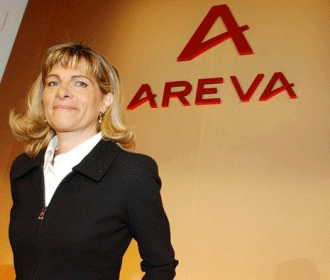 The future of Rio Tinto director ‘Atomic Anne’ Lauvergeon is under a cloud, The Age, May 16, 2016 Peter Ker Resources reporter The future of Rio Tinto director Anne Lauvergeon is under a cloud after French prosecutors starting investigating her conduct while chief executive of energy giant Areva almost a decade ago.
French prosectors spent Friday questioning Ms Lauvergeon over whether she deliberately filed misleading accounts for Areva in 2007.
The investigations centre on Areva’s disastrous takeover of London listed company Uramin in 2007, and the disclosure of multi-billion dollar impairments several years later.
London newspaper the Financial Times reported over the weekend that French prosecutors had confirmed that Ms Lauvergeon was being investigated for “publication of inaccurate accounts” during her time at Areva.
The 56-year-old Ms Lauvergeon, who is known as “Atomic Anne” in France, has served as a non-executive director of Rio since 2014.
The weekend’s revelations come barely two months after French prosecutors launched a separate investigation into alleged insider trading by Olivier Fric, who is Ms Lauvergeon’s partner.
The prosecutors are investigating whether Mr Fric used privileged information to profit from the Uramin deal. Mr Fric’s lawyers have reportedly denied the allegations.
The controversy surrounding Ms Lauvergeon and Mr Fric was known when the Rio board endorsed Ms Lauvergeon for re-election in March……..
Ms Lauvergeon’s continuing work at Rio while the French investigations go ahead is at odds with the approach taken by ASX chief executive Elmer Funke Kupper, who has stood down while the Australian Federal Police conduct anti-bribery investigations into his time spent working for Tabcorp. http://www.theage.com.au/business/mining-and-resources/the-future-of-rio-tinto-director-atomic-anne-lauvergeon-is-under-a-cloud-20160515-govnv7.html
Uranium industry finally acknowledging its dire situation
Uranium on the rocks http://onlineopinion.com.au/view.asp?article=18236&page=0

| By Jim Green , 17 May 2016 Indicative of the uranium industry’s worldwide malaise, mining giant Cameco recently announced the suspension of production at Rabbit Lake and reduced production at McArthur River/Key Lake in Canada. Cameco is also curtailing production at its two U.S. uranium mines. About 500 jobs will be lost at Rabbit Lake and 85 at the U.S. mines. A Cameco statement said that “with today’s oversupplied market and uncertainty as to how long these market conditions will persist, we need to focus our resources on our lowest cost assets and maintain a strong balance sheet.”Christopher Ecclestone, mining strategist at Hallgarten & Company, offered this glum assessment of the uranium market: “The long-held theory during the prolonged mining sector slump was that Uranium as an energy metal could potentially break away irrespective of the rest of the metals space. How true they were, but not in the way they intended, for just as the mining space has broken out of its swoon the Uranium price has not only been left behind but has gone into reverse. This is truly dismaying for the trigger for a uranium rebound was supposed to be the Japanese nuclear restart and yet it has had zero effect and indeed maybe has somehow (though the logic escapes us) resulted in a lower price.”Ecclestone adds that uranium has “made fools and liars of many in recent years, including ourselves” and that “uranium bulls know how Moses felt when he was destined to wander forty years in the desert and never get to see the Promised Land.” He states that uranium exploration “is for the birds” because “the market won’t fund it and investors won’t give credit for whatever you find”.
The Minerals Council of Australia launched a pro-uranium social media campaign last month. The twitter hashtag #untappedpotential was soon trending but – as an AAP piece noted – contributors were overwhelmingly critical. No doubt the Minerals Council anticipated the negative publicity but what it didn’t anticipate is the uranium price falling to an 11-year low. Mining.com noted in an April 20 article that the current low price hasn’t been seen since May 2005. The current price, under US26/lb, is well under half the price just before the 2011 Fukushima disaster, and under one-fifth of the 2007 peak of a bubble. Mining.com quotes a Haywood Securities research note which points out that the spot uranium price “saw three years of back-to-back double-digit percentage losses from 2011-13, but none worse than what we’ve seen thus far in 2016, and at no point since Fukushima, did the average weekly spot price dip below $28 a pound.” Haywood Securities notes that an over-supplied market continues to inflate global inventories. Mining.comnotes that five years after the Fukushima disaster, only two of Japan’s nuclear reactors are back online (and yet another permanent reactor closure was announced on May 15), and that in other developed markets nuclear power is also in retreat. The last reactor start-up in the U.S. was 20 years ago. The French Parliament legislated last year to reduce the country’s reliance on nuclear power by one-third. Germany is phasing out nuclear power, as are several other countries. The European Commission recently released a report predicting that the EU’s nuclear power retreat ‒ down 14% over the past decade ‒ will continue. China is a growth market but has amassed a “staggering” stockpile of yellowcake according to Macquarie Bank. India’s nuclear power program is in a “deep freeze” according to the Hindustan Times (unfortunately the same cannot be said about its nuclear weapons program), while India’s energy minister Piyush Goyal said on April 20 that India is not in a “tearing hurry” to expand nuclear power since there are unresolved questions about cost, safety and liability waivers sought by foreign companies. A decision on two planned reactors in the UK could be announced in the near future and the cost – A$48 billion for the two reactors – goes a long way to explaining nuclear power’s worldwide stagnation. If the project proceeds, the industry will be hoping it doesn’t go three times over budget and lag 5-9 years behind schedule, as reactor projects in France and Finland have. Even if all of Japan’s 42 reactors are included in the count, the number of power reactors operating worldwide is the same now as it was a decade ago. And there is little likelihood that nuclear power will break out of its long stagnation in the foreseeable future, with the ageing of the global reactor fleet a growing problem for the industry. As former World Nuclear Association executive Steve Kidd noted earlier this year: “The future is likely to repeat the experience of 2015 when 10 new reactors came into operation worldwide but 8 shut down. So as things stand, the industry is essentially running to stand still.” Australia’s uranium industry is also struggling just to stand still. The industry accounts for just 0.2 percent of national export revenue and less than 0.01 percent of all jobs in Australia. Those underwhelming figures are likely to become even less whelming with the end of mining and the winding down of processing at the Ranger mine in the NT. |
Adolf Hitler’s secret NUCLEAR BOMBS found – claims engineer
Peter Lohr, 70, says he’s found five metallic objects in Nazi tunnels
Using radar and 3D he claims he can prove two are atom bombsBy SARA MALM FOR MAILONLINE, 18 May 2016 A pensioner claims he has found Adolf Hitler’s secret atom bombs inside tunnels dug by the Nazis underneath a mountain valley in central Germany.
Peter Lohr, 70, claims to have found five large metal objects in a cave in the Jonas Valley in Thuringia state, of which at least two are ‘atomic bombs’.
Mr Lohr is certain that the objects are weapons of mass destruction manufactured by the Nazis towards the end of the Second World War.
‘The metal’s been lying there for 71 years. At some point it will decay and then we will have a second Chernobyl on our hands’ he said.
The centre of the Jonas Valley was a scene of secret military construction towards the end of the Second World War, with thousands of concentration camp prisoners forced to dig tunnels under the mountains.
It is not known what purpose the tunnels were meant to have as it was never completed.
The tunnel system stretches for miles underneath the mountain, with thousands of caves, bunkers and storerooms, and it is believed that it was intended to be the Alamo of the Third Reich leadership.
The Jonas Valley was liberated by American troops in April 1945, and US authorities have since classified all 1945 documents relating to Ohrdruf for a minimum of 100 years.
This is not the first time rumours of a Nazi nuclear bomb has surfaced.
Last year, a documentary called The Search for Hitler’s Atom Bomb,’ quotes sealed records from Russia and America said to prove the Nazis were close to creating a weapon of mass destruction.
The programme quoted interrogation reports of Nazi scientists, eyewitness account and the records left behind by researchers, many of which were shipped to America after the war.
United Arab Emirates sets up firm to operate first nuclear power plants
UAE sets up firm to operate first nuclear power plants, Arabian Business, 17 May 16, By Staff writer The Emirates Nuclear Energy Corporation (ENEC) has announced the formation of a new subsidiary called Nawah Energy Company to operate and maintain the UAE’s first nuclear reactors at Barakah.
The ENEC board of directors have mandated ENEC management to proceed with the formation of the operating company and to ensure the transfer and provision of all required resources to form the operating subsidiary, a statement said.
“The formation of Nawah as ENEC’s subsidiary operating company will bring greater focus towards the safe and quality delivery of Units 1-4 at Barakah,” the statement said.
It added that Nawah’s mission will be to “safely and reliably generate electricity from nuclear energy”, and aims to become a globally recognized nuclear utility in the safe operation of nuclear energy plants…….http://www.arabianbusiness.com/uae-sets-up-firm-operate-first-nuclear-power-plants-632003.html#.VzuUJjV97Gg
Global solar power industry expanding at fast rate
Experts at industry summit say solar power expanding faster than ever CCTV America, May 11, 2016 [Good Graphs] Last week, the U.S. marked its one millionth solar panel installation, 40 years after solar energy was first developed. Analysts say it’ll only take two years to install another one million.
“By 2020, we’ll be generating enough electricity to power 20 million homes. So we are at the place where solar takes off,” Rhone Resch, president and chief executive of the Solar Energy Industry Association said……..
Noam Chomsky on the twin threats: Climate Change and Nuclear Proliferation
Noam Chomsky: Climate Change and Nuclear Proliferation Pose Worst Threat Ever Faced by Humans, EcoWatch Democracy Now! | May 16, 2016 President Obama has just passed a little-noticed milestone, according to The New York Times: Obama has now been at war longer than any president in U.S. history—longer than George W. Bush, Franklin D. Roosevelt and Abraham Lincoln. Obama has taken military action in at least seven countries: Iraq, Afghanistan, Libya, Syria, Pakistan, Yemen and Somalia.
Just last month, President Obama announced the deployment of 250 more Special Operations troops to Syria in a move that nearly doubles the official U.S. presence in the country. As war spreads across the globe, a record 60 million people were driven from their homes last year. Experts warn the refugee crisis may also worsen due to the impacts of global warming. Over the weekend, the National Aeronautics and Space Administration (NASA) released data showing 2016 is on pace to be by far the hottest year ever, breaking the 2015 record. Meanwhile, manyfear a new nuclear arms race has quietly begun, as the U.S., Russia and China race to build arsenals of smaller nuclear weapons.
These multiple crises come as voters in the U.S. prepare to elect a new president. We speak with one of the world’s preeminent intellectuals, Noam Chomsky, institute professor emeritus at Massachusetts Institute of Technology, where he has taught for more than 50 years. His latest book is titled Who Rules the World?…….
Noam Chomsky“………The nuclear threat is the threat of—on the Russian border, which happens to be the invasion route through which Russia was virtually destroyed twice last century by Germany alone—well, Germany as part of a hostile military alliance—on that border, both sides are acting as if a war is thinkable. The U.S. has just sharply increased; it quadrupled military expenses on its side. The Russians are doing something similar. There are constant near collisions, jets coming close to colliding with one another. A Russian jet a couple months ago virtually hit a Danish commercial airliner. U.S. troops are carrying out maneuvers virtually on the Russian border. That threat is escalating and very serious. William Perry, a respected nuclear specialist, a former defense secretary, recently estimated that the threat is higher than it was during the 1980s. There are also confrontations near the Chinese around China, South China Sea and so on. That’s one major threat.
The other is what you just described. The threat of global warming is very serious. Every time one reads a science journal, there’s an even more alarming discovery. Virtually all the ice masses are melting. The Arctic ice mass, which was assumed to be pretty stable, is actually melting very fast, much more than was thought. The glaciers are melting. There’s severedroughts. Right now already, about 300 million people in India are on the edge of starvation from drought, which has been going on for years. The groundwater is depleted as the Himalayan glaciers melt, as they’re doing. It will undermine the water supply for huge areas in South Asia. If people think there’s a migration crisis now, they haven’t seen anything. The sea level is rising. Chances are it could rise three to six feet, maybe more, by the end of the century—some estimate even sooner. It will have a devastating effect, not just on coastal cities, but on coastal plains, like, say, Bangladesh, where hundreds of millions of people will be severely threatened. I mean, this is a—we’re already killing other species at the level of the so-called fifth extinction. ….”http://ecowatch.com/2016/05/16/noam-chomsky-climate-change/
1 This Month

of the week – Shut Down Drone Warfare!


Tell the Ukrainian Government to Drop Prosecution of Peace Activist Yurii Sheliazhenko

Petition to revoke the licensing of the Near Surface Nuclear Disposal Facility (NSDF) at Chalk River. https://www.ourcommons.ca/petitions/en/Petition/Details?Petition=e-7247
To see nuclear-related stories in greater depth and intensity – go to https://nuclearinformation.wordpress.com
-
Archives
- April 2026 (68)
- March 2026 (251)
- February 2026 (268)
- January 2026 (308)
- December 2025 (358)
- November 2025 (359)
- October 2025 (376)
- September 2025 (257)
- August 2025 (319)
- July 2025 (230)
- June 2025 (348)
- May 2025 (261)
-
Categories
- 1
- 1 NUCLEAR ISSUES
- business and costs
- climate change
- culture and arts
- ENERGY
- environment
- health
- history
- indigenous issues
- Legal
- marketing of nuclear
- media
- opposition to nuclear
- PERSONAL STORIES
- politics
- politics international
- Religion and ethics
- safety
- secrets,lies and civil liberties
- spinbuster
- technology
- Uranium
- wastes
- weapons and war
- Women
- 2 WORLD
- ACTION
- AFRICA
- Atrocities
- AUSTRALIA
- Christina's notes
- Christina's themes
- culture and arts
- Events
- Fuk 2022
- Fuk 2023
- Fukushima 2017
- Fukushima 2018
- fukushima 2019
- Fukushima 2020
- Fukushima 2021
- general
- global warming
- Humour (God we need it)
- Nuclear
- RARE EARTHS
- Reference
- resources – print
- Resources -audiovicual
- Weekly Newsletter
- World
- World Nuclear
- YouTube
-
RSS
Entries RSS
Comments RSS
 nuclear-news